Flying Squirrel

squirrel1

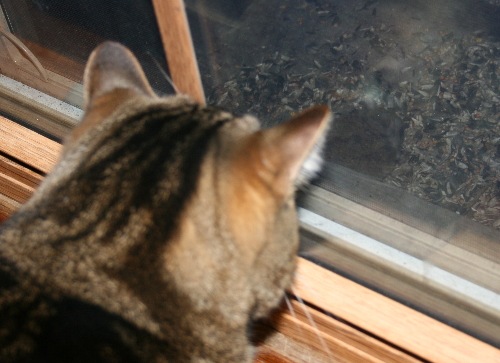
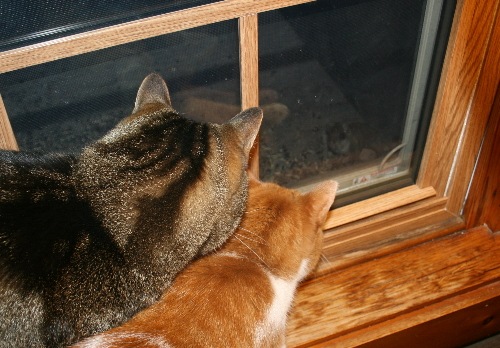
I missed last week’s post, busy preparing for a wedding, and yesterday, catching up from the wedding; apologies! But I’m super excited about today’s post. I was planning on another topic for this evening, actually – I’ll end up doing it this weekend, perhaps. But as I came down to check on the fire I noticed Oliver was hunched over, peering out the window at something at the window feeder. He does this regularly, and always when I go over to look there’s nothing there.

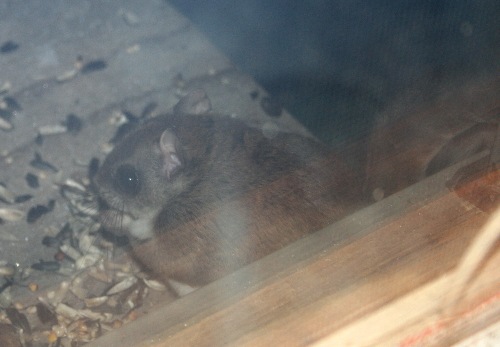
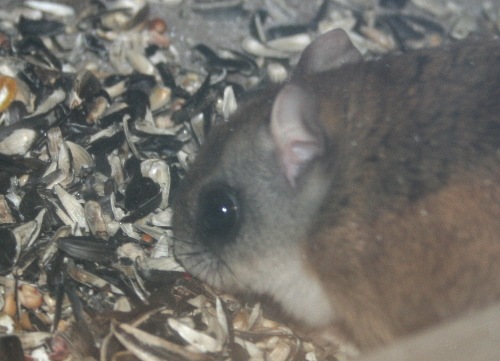
But this time there was! A small, furry brown body was curled up right at the window’s edge, its back to the house. I thought at first it was a rat or mouse, but then it stretched out to grab a seed and I got a good look at its eyes. They were huge! This was no rat – it was a flying squirrel!
squirrel4

I knew we had flying squirrels around here because I’d found shredded cedar bark in one of the nestboxes a couple of years ago. The box actually wasn’t that far from the house, but I’d never seen evidence of them visiting the feeders (on the other hand, I don’t know exactly what I’d be looking for). I have, however, on occasion heard little feet scampering up the side of our log house while I’ve been working in my study late at night. I know that sound from the daylight hours when the Red Squirrels run up and down to the feeder. I guessed that the nighttime scamperings must therefore belong to flying squirrels – but I’d never seen one till tonight. Here or otherwise.
squirrel3

There are only the two species of flying squirrel in North America (though there are a few subspecies). Ours are most likely Northern Flying Squirrels, though we’re near the northern edge for Southern Flying Squirrel, too. There are visual differences between the two species if you get a good look at one, including size, but they’re most readily distinguished by habitat preference, with the Northern preferring mixed or coniferous forests and the Southern largely mature hardwood forests, especially Carolinian. Our forests around here are pretty strongly mixed.
squirrel5

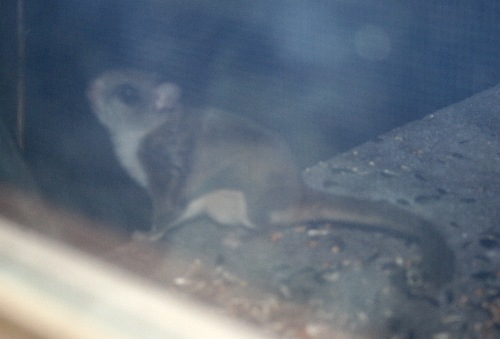
The flap of skin between the front and back legs can only be easily viewed when the squirrel is gliding, of course, though you can sometimes see the wrinkle there when they’re still. They’ve also got flattened tails that presumably help with steering when they’re in the air, and oversized eyes to help see in the dark. They’ve got a varied diet and are pretty opportunistic about what they eat, but Wikipedia suggests the bulk of their diet is truffles (various types of underground fungi), which they sniff out with their nose.
squirrel2

Obviously, they also eat birdseed. We have our feeder set up so one side of it is butted up against the house, below the living room window. The cats and Jack love this. Jack’s mostly interested in the Red Squirrels, while the cats prefer the birds. The critters at the feeder learn pretty quickly that what’s going on behind the glass has nothing to do with them and they’re free to keep eating. All of our animals will paw at the window or press their faces right up to it, but it doesn’t bother the critters at the feeder in the least.

Apparently the flying squirrel has learned this, too. It sat not four inches from Oliver’s nose, just a couple panes of glass between it and some sharp teeth. But it was very confident in those panes of glass. Charlie came and joined us after a bit (the two of them made it a little hard to get any pictures). I could put the camera right up to the window, the lens knocking against the glass and the flash going off at regular intervals, and the squirrel would be completely undisturbed. It’s too bad there’s a screen in the window; it makes it hard to get good shots. The smeary nose prints all over the glass doesn’t help, either. ;)

I hope he’s a regular visitor! I think it’s so cool we’ve got a flying squirrel coming to our feeders.

Waxwing droppings

poop1

When Dan came inside a couple of days ago he told me, “There’s a blog post for you over by the shed. All over the snow.” Figuring there’d been a predation out there and I’d had a murder scene to dissect, I grabbed my camera and went out to investigate.

But instead of finding fur or feathers, I found… purple stains?

poop2

It didn’t take much detective work to guess what these were from. We’ve had a flock of waxwings hanging about the last week or so. I’d thought they were Bohemians, the first time I noticed them, but I had no binoculars and the year since I’d last seen Bohemians had left my ear a little rusty. They turned out to be Cedar Waxwings the next time I saw them. (In my defense, Bohemians are much more common around here in the deep winter than Cedars are.)

The stains, of course, are the waxwings’ droppings, dyed purple by the berries they’d been eating. There aren’t a lot of purple berries available at this time of year; wild grapes and buckthorn would be the primary candidates. At the centre of most of the stains was either a bit of berry skin or some seeds, so I took a closer look to try to determine what they were eating.

poop3

It doesn’t help that wild grapes and buckthorn berries are both roughly the same size, especially after having passed through a digestive system. I took a photo of the bits, with my fingers for scale, figuring I’d try to look them up.

I first tried googling buckthorn berry seeds to see if I could find any images to confirm that’s what this was – I know what domesticated grape seeds look like, but don’t know if the wild type look the same, and I’ve never opened up a buckthorn berry. When that turned up nothing, I thought, you know, the easiest way to confirm this would be just to go get a buckthorn berry and see.

I write most of my blog posts in the evenings or, often, late at night. So this thought occurred to me at about 11:30 pm. After some minutes of weighing it in my mind, I finally decided that yes, in the interest of completeness, I’d venture out and find a buckthorn berry. Just to be sure.

I bundled up, grabbed a flashlight, and called to Raven. (Perhaps strangely for someone whose primary interest is a nocturnal taxon, I’m somewhat afraid of the dark. Fortunately, all the snow in the winter means it never gets really dark at night.) We ventured out to the one location on the property where I knew there were some buckthorn. The shrub was mostly empty, but a few lone berries remained.

Upon returning to the house with one, after stripping off all my winter garb again, I broke it apart on a kitchen plate. Inside the thin skin were four blunt-ended teardrop-shaped seeds that looked exactly like the ones in the droppings. Combined with the fact that the buckthorn shrub had been cleaned out, I’m pretty confident in saying that that’s what the birds have been eating.

Edit: Super-smart bird-poop expert Julie Craves comments that these are probably, in fact, wild grapes. D’oh! Check out her explanation in the comments for why.

I blogged about buckthorn a little over a year ago, and commented on its potential benefits to wildlife. It’s kind of nice to see our local wildlife making use of an invasive plant like this, especially since it’s one of those species that’s been so successful there’s probably little hope of eradicating it anymore.

Rough Stink Bug

stinkbug1

With the onset of winter it’s been a little while since Dan brought me any interesting nature discoveries, but a couple of days ago he walked into my study and set something down on my desk. It clicked as it landed lightly on the wooden surface. “Two of these have been flying around my lights all morning,” he said. Bugs seem to like Dan; I rarely have anything flying around my lights. The odd ladybug, perhaps.

In this case the pestering creature was a stink bug. Sometimes also called shield bugs for their medieval-shield shape, they have the distinctive (and memorable) ability to produce foul-smelling secretions when threatened or disturbed. The idea is that the smell will put off potential predators; since most birds have a very poor sense of smell, presumably the secretion also tastes bad. If you catch a stink bug in a bad mood, you’ll soon know it. Fortunately, this one seemed to be pretty calm.

stinkbug4

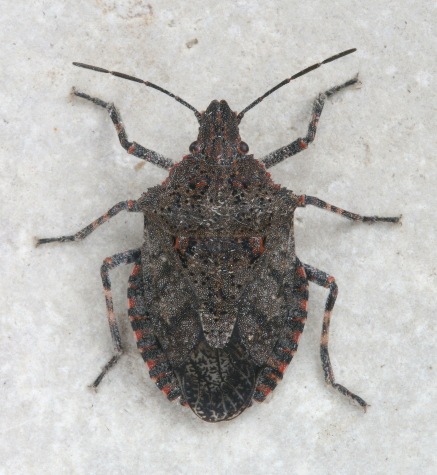
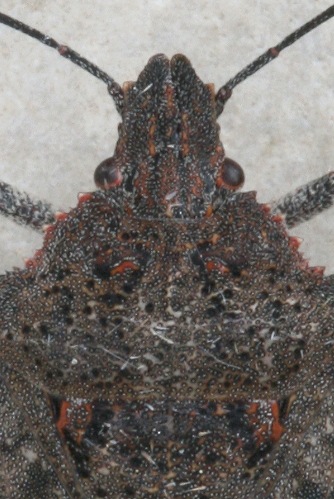
Using my Kaufman Field Guide to Insects I narrowed the genus of this individual down to Brochymena (rough stink bugs, I think so-called for the toothed edges to the pronotum, the section right behind the head), and then went onto BugGuide to figure out the species. I’m pretty sure this is a Four-humped Stink Bug, B. quadripustulata (“four pustules”?), which is one of the more common and widespread members of this genus. The KGI indicates that adults of some Brochymena species hibernate as adults beneath bark, so I’m wondering if these two came in with the firewood.

I found it interesting how much red the bug had on it, when I looked at the photos. To my naked eye it seemed fairly uniformly brown, with some darker Vs at the shoulders and around the bottom of the scutellum (the bit in the middle of the back that appears as a pale U in the first photo, and which didn’t stand out as pale to my eye). It amazes me how much detail cameras reveal in these smaller subjects, and it’s one of the reasons I enjoy photographing moths and other insects so much. (Incidentally, the random little pale dashes, such as the one on his head, are moth scales. I had him in one of my moth jars until I got my camera equipment set up.)

stinkbug2

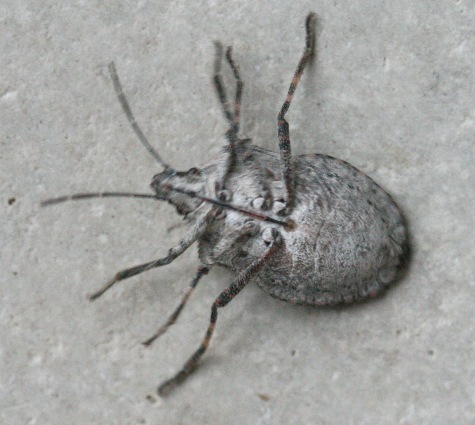
Although some of the 250 species in family Pentatomidae are hunters of other arthropods, most feed on the sap of plants. Some can be serious crop pests. They stab the plant with their long, thin proboscis and use it like a straw to suck the sap out. This doesn’t usually kill the plant (except in cases of bad infestations) but because a scar will form where the plant was pierced it can create deformities and blemishes – a problem for farmers trying to sell their produce for human consumption since we humans are so picky about the aesthetics of our produce. Sometimes it will destroy seeds, which can be problematic for grain crops or things like corn, where the seed needs to be whole to be useful. When not in use, the proboscis is tucked firmly against their underside. You can see it here as a thin line going from the head down between the legs.

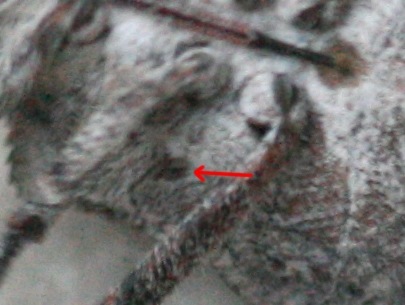
The other interesting thing you can see on its underside is the scent gland that produces the stink. It’s just a small divot in the side of the thorax, dorsal to the middle leg (ordinarily, when the bug is upright, it would be right above the leg, but in this photo it’s right below). A close-up of the gland is below, indicated with an arrow. Not the best quality, but he was squirming a lot, rowing his legs and pushing against the stone to try to flip himself upright. He wasn’t having a lot of success, and as soon as I got the photo I turned him over again. (For a better-quality photo, check out this one on BugGuide.)

stinkbug3

Biothon tiger (beetles)

biothon27

I’m a fan of tiger beetles. Pretty much any open dirt or rocky trail in the summer will have at least one or two of these gorgeous metallic-green beetles. I usually notice them first when they’re flushed; they fly up  from the ground with a bright glint of colour that catches the eye. Once they’re landed they can be a bit harder to pick out, but on a bare dirt path, and in the sun, they really stand out.

There are a number of tiger beetle species, found in every state and province, but by far the most common here in the east is the Six-spotted Tiger Beetle, Cicindela sexguttata. The only other species I’ve seen before was Green-margined Tiger Beetle, C. limbalis, along the road where we lived by the lake. I saw lots of Six-spotted on the biothon, hunting in sunny spots along open dirt trails. Tiger beetles, as their name implies, are predators. You can’t really see it in this photo, but they have huge, sharply-toothed mandibles that they use for catching their prey. Their large eyes are used for hunting visually, and their long legs make them swift.

biothon39

I was absolutely delighted when I turned up this second species of tiger beetle on the second day of biothoning. I didn’t recognize this one at the time, other than to know it wasn’t a Six-spotted; but it happens to be the same species I found along the road by the lake house, a Green-margined Tiger Beetle. This beauty caught my eye as it scurried across some open rock at the crest of a low roll (I’m not sure it was high enough to call it a hill) in a small treed meadow I checked out.

It was remarkably unflighty, which I found interesting, and even more so when I note that in my post from a few years ago, where I shared the lake house individual, I commented that that one was also pretty calm. Six-spotteds are so difficult to photograph because you really have to sneak up on them and even then they may take off before you get really close. But this one sat calmly for me (as did the lake house beetle); I was even able to lift off a twig that it had scuttled under and which was partially obstructing the photo. Species-specific temperaments in beetles?

Strangely, I wrote in that post:

In this case, Marshall notes, “The Green-margined Tiger Beetle lives on clay soils across Canada and the northeastern states.” BugGuide.net, my number one online reference for all things six-legged, adds that the habitat is “usually steep, moist bare clay soil, including… dirt roads”.

Except there really wasn’t any moist bare clay soil, dirt roads or otherwise, in the area where I found this one. It was on an open crown of granite amid quite a lot of grassy meadow. There were other patches of rock here and there, but I’m not sure there was even much open dirt along the trail, which was some distance away anyway. So that’s somewhat odd.

biothon18

I actually found this third species on the first day, not the second, so I’m presenting these a bit out of order. But this was the only one whose identity I needed to look up because I didn’t think I’d seen it before. Using this site of Ontario’s tiger beetles (created, interestingly, by a prof at my alma mater, University of Guelph, with whom I did an entomology course to Ecuador), I’ve tentatively ID’d this guy as a Twelve-spotted Tiger Beetle, C. duodecimguttata.

I found this one along the short dirt trail that led down to the gravelly beach. It paused to rest on a bit of rock, where I took this photo of it. It was much flightier than the Green-margined, more like the Six-spotted, and after snapping this photo (this is a tight crop from a much farther-away shot) I pressed my luck trying to get closer and it took off, not to be relocated.

On the Ontario page the habitat is given as gravel dams as well as areas with mixtures of moist sand and organic soil, tending to prefer sheltered spots rather than open beaches or dunes (the habitat favoured by most tiger beetles). BugGuide, meanwhile, says it’s found along the edges of streams and ponds. The lake we were camped at was hardly a pond, but it wasn’t huge, either.

When I found all these tiger beetles one of the first thoughts to cross my mind was “I’ll have to share these with Ted!” (Author of the wonderful entomology blog Beetles in the Bush, and an expert on beetles with a particular interest in tigers. He’s already corrected the ID of the fuzzy flower beetle of my last beetle post!) So Ted, hope you don’t mind confirming the identifications I’ve made here!