The moth guide has arrived!

book1

Guess what arrived today? My first copy of the new moth guide! Yaaaaaay!

The books are all printed overseas, and they’re all on a container ship somewhere on the Pacific at the moment, but the printer sends a few copies by air to the publisher so they can review them for quality (and start distributing them to the authors :), etc. This is one of the copies that came by air; the rest will arrive at the publisher’s about a month from now, then will be checked and inventoried and distributed and will be in bookstores maybe the week before release.

So you guys still have to wait. I’m sorry. But I can share with you some peeks at the book in advance! Complete with goofy faces. Because that’s just how excited I am. (Also, forgive the photo quality; these were taken with my webcam.)

book14

For example. My name! On a book!

Check out the width of that sucker. It’s 1.25 inches thick. That’s 611 pages of amazing mothy goodness.

book7

And between my fingers there is the species checklist at the back of the book. It’s 38 pages long. That’s a lot of moths, folks! I lost count along the way, but I think we were just a couple species shy of 1500 total in the book. Very close to 2000 images. (Which I clipped out from their backgrounds by hand. Every single one. Whew. Thank goodness they look so good in the book!)
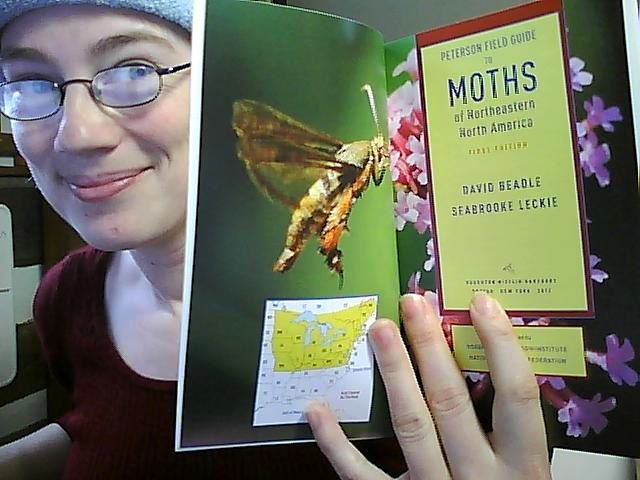
book2

The title page! I love this photo. It was taken by Dave, in his yard, and was a last-minute addition to the book.

Look! There’s my name again! Also, the map of area covered. Quite a number of the species in the book will be present in other parts of the continent, though, so the guide is potentially useful outside of the range depicted here. You just won’t have the benefit of range maps with the species accounts.
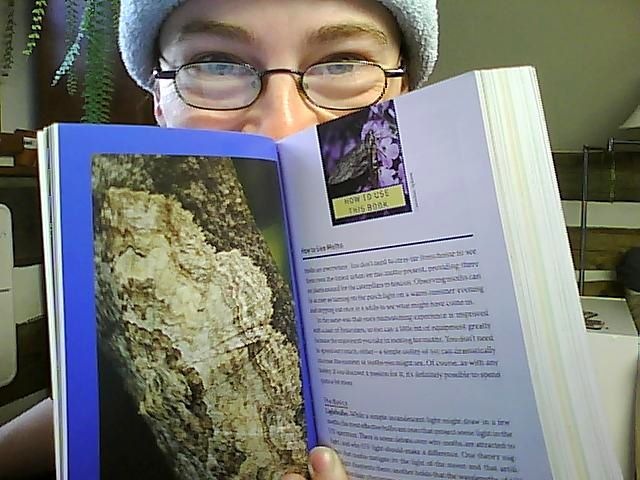
book3

Here’s the opening page of the How To Use This Book section. All of the sections have full-page images of different species of moths, like this. They’re nearly all Dave’s photos, moths he’s caught and placed on a natural-looking log or branch for photographing, and they look really great. The top of the sections also have those little square photos, also of moths in natural settings. All of them have the species name given, so you know which species the moth is. (This was my mom‘s suggestion. Thanks, Mom. :)

book9

That’s me! It’s the only photo of a person in the entire guide (no author photos). That’s my blacklight setup from… I think that was taken at my parents’ old house, actually, the place in Halton county where I grew up. I still run blacklight bulbs occasionally, but mostly now I use mercury vapour at home. They don’t make as interesting a photo, though. I’ll probably have both with me on the book tour.

The How To section has information on how to go about attracting and photographing moths as well as the necessary info on how to read and interpret the guide. Also tips on how to start learning to identify moths. It’s relatively short and quick to read, at 18 pages. So I hope you all read it, because I put a lot of time and careful consideration into writing it. :)

book8

These are the front endpapers. The diagrams are also in the How To section, but because it’s a pain to have to flip through the introduction in order to look up terminology, I requested these be put here at the front, where they’re easy to flip to. On the left are structural terminology, on the right are those for patterns. A number of these get referred to regularly in the text accounts.

book6

And these are the back endpapers. We don’t have every type of moth displayed here, but we do have many. The idea is a lot of moths can be quickly identified to group by shape/size alone. Some are very distinctive (scoopwings, for instance, or plume moths). So this provides a quick reference to give you a place (or places) to start browsing, if you’re not sure.

All of the measurements in the book are given in millimeters because so  many of the species are so small that inches don’t work well. On the inside of the back cover (barely visible in this photo) there’s a ruler printed with both centimeters/millimeters and inches, so you can quickly look up sizes.
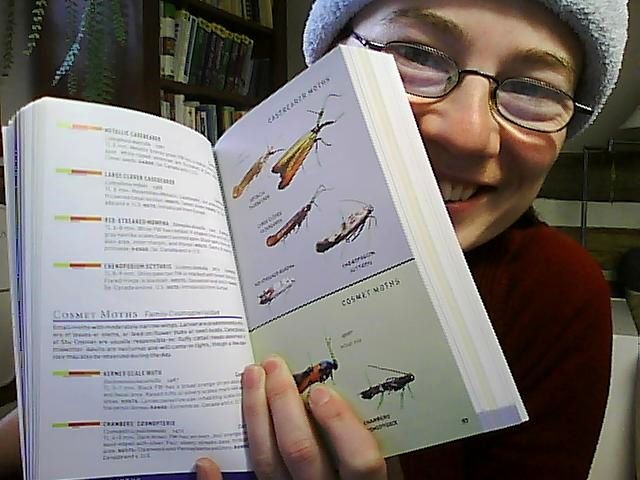
book4

On to the identification pages!

Each family is headed up with a paragraph describing general family characteristics and often mentions habits and/or host preferences, if there are some that are particular to the group. Where two families are on the same page, as here, the identification plate is separated into two panels.

Although it’s hard to see on this particular page, you’ll notice on the next few there’s a gray silhouette beside one of the images on the plate. This is showing the moth’s approximate size in real life, so you can get an idea how big these things really are.

book10

One of the things that makes this book unique over the few guides that have come before (besides that they’re all in natural resting poses here; most other guides show pinned/spread moths) is the number of micromoth species we’ve included. These are all the species that come in the first half of taxonomic lists, basically the moth equivalent of non-passerine birds (the first half of a bird field guide, all the birds that don’t sing songs). For the most part they’re small, hence the “micro”.

Not very much is known about most micromoth species, except for a few that are commercial pests (crops/forestry). So there are no range maps for these species. There are, however, flight period bars, those coloured bars beside each species’ name. Under each is a black line that corresponds to the time of year the moth can be found, and the three colours in the bar represent the three seasons of spring, summer and fall, roughly three months each.
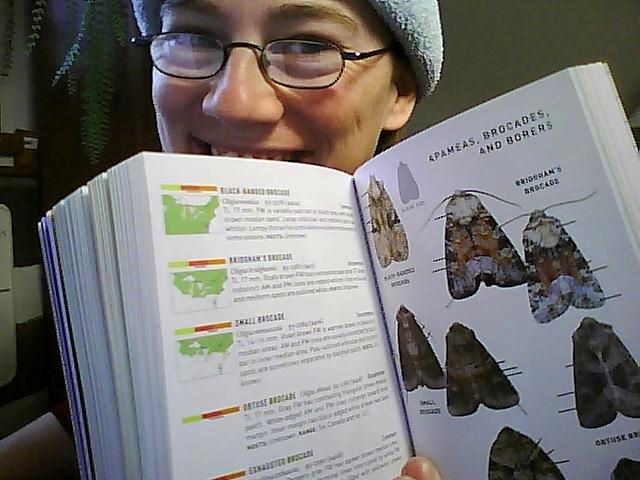
book5

Here’re macromoths – the second half of the taxonomic list, and, for the most part, larger than the micromoths. These ones mostly do all have range maps, information being much easier to come by for these. A large part of the reason for this has simply been the paucity of field guides that include micromoths – hobbyists actually contribute quite a lot of what we know about the distribution and other information for species. Some macromoths are still lacking in this department – for instance, the Obtuse Brocade, here, didn’t have enough information for me to be able to extrapolate a range map with any degree of confidence. Hopefully there will be future editions of the guide, and we’ll be able to create maps for these species then, as more people join the hobby.

book11

Not the greatest photo, though I blame that mostly on the limitations of the webcam. But trying to point out here the Peterson arrows. It was unfortunate timing, but Dave ended up being away for most of the period when the manuscript was at the stage where we insert the arrows (it wasn’t something that could be planned for, either, really), so I ended up doing this mostly all myself. And let me tell you, on 1500 species, there are a lot of arrows.

book12

Although there are plenty of species of moth that are so distinct they don’t really need the arrows, there are also lots that look so similar the arrows will be invaluable in helping you separate them out. For instance, the hydriomenas. That face I’m making here? I wore that for about two hours, seriously, as I sorted out specifically which features I should be pointing the arrows at. It involved several emails back and forth with moth expert Chris Schmidt of the Canadian National Collection (he was awesome with his time and expertise – you rock, Chris!), and lots of studying of images he sent me, ones I had, and ones online. As you can tell from this plate and the fact that each species has multiple images, there’s a fair bit of variation. But I finally got it figured out. You lucky souls don’t have to worry about it; the arrows are already there for you. :)

book13

The timing of the release could hardly be much better – right at the start of the new mothing season! It’s still winter here, but the first moths will be arriving soon – potentially just two weeks from now. That moth I’m pointing to, that’s my bet for first of the year for me – Morrison’s Sallow. All of the species on this page are contenders for first-of-season, though. (That’s my you-can-bet-on-it face, which actually works better when you can see me nodding knowingly.)

So there you go! A quick preview of the new field guide to moths. I honestly can’t wait till the release date (April 17! Two months!) so all of you can get your hands on a copy, too, because it looks great. Dave and I are both really happy with how it turned out, and I hope you will be, too.

You can currently preorder the guide from most retailers (online, though I think if you go into your local indie bookstore they’ll take orders, too…). If you want a signed copy, there are buttons on my sidebar or on this page where you can order one directly from me.

Otter trails

ottertracks2

A couple of weeks ago I noticed these trails out on the ice of the creek the rail trail crosses. It looked like the animals had traveled down the frozen stream on a mild day, or perhaps just after a rain, when the snow that had been sitting on top of the ice had softened just enough to create slushy conditions. The temperature must have dropped shortly after because the prints, while not detailed, were certainly well-defined.

When I first noticed them I’d naturally not brought my camera along, but the unusually dry winter we’re having did me a favour and didn’t snow at all before I was able to make it out. (It’s snowed since, but not very much, and you can still pick out the tracks frozen into the ice. I worry a bit for what this will mean for spring water levels, unless nature’s saving it all up for March. In which case, I worry for March.)

ottertracks3

The tracks belong to otters, of course. I say “of course”, but I actually wouldn’t have known this prior to moving to the lake house a few years ago. Then, we discovered a set of similar tracks out on the ice of the lake, and I’d hypothesized that it was a predator periodically dragging a heavy prey. Which still seems like a reasonable guess, but the real answer is obvious, now that I know it.

The long troughs are from the animals sliding on their bellies. They’ll bound for several strides and then flop down, letting their momentum and the slippery ice carry them forward. This helps conserve energy – and during winter, every little bit counts – but is also probably just darn fun. As animals go, otters must be among the most playful.

ottertracks1

I’ve actually seen otters in this creek before, so I’m not too surprised to see their tracks here, but I tend to forget they’re around. I encounter them much less frequently here than I do down in the Frontenacs where Dan and I do our summer bird programs.

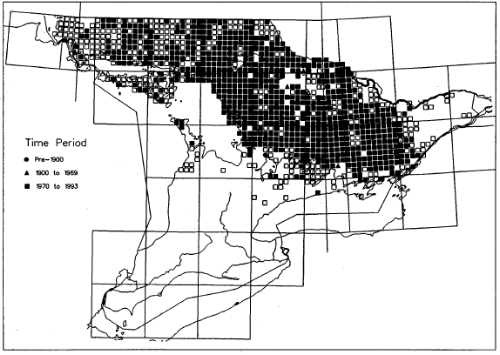
The Atlas of the Mammals of Ontario, a project undertaken by Ontario Nature and published in 1994 (back when they were still known as the Federation of Ontario Naturalists), provides range maps for all of Ontario’s mammals. The larger species are typically more well-documented than the smaller ones (rodents, bats) simply because they’re easier to find and identify. All of the maps are available at Ontario Nature’s website.

ottermap

I’ve included here the range map for River Otter, as documented up through the early 1990s. White squares indicate areas where the precise location the record is from (mostly historical and/or OMNR trapline data) can’t be pinpointed. Coloured squares are known. The data used was taken across most of the last century, when available, with date indicated by shape.

It’s pretty clear that the otter shows a close correlation to the Canadian Shield, rarely found in the limestone regions of most of southern Ontario. This is probably partly due to the fact that water bodies become scarcer in regions with the more porous limestone bedrock, but also likely has something to do with human land use. We’ve modified the vast majority of Ontario south of the Shield, to either urban or agricultural landscapes, with all the loss of habitat and pollution that comes with both. The Shield itself is too rocky, with too shallow a soil base, to make for good farming, so it’s largely been abandoned to nature in the last several decades. Where we live still sees a fair bit of agriculture, but it’s all mostly low-impact – small-scale livestock and hay farms. In the Frontenacs, even that scale of farming becomes scarce, and the primary use of land is simply residential and recreational – homes and cottages.

I was so delighted when I discovered, via a neighbour at the lake, that there were otters in the area. And then when I found the tracks – and later, saw the animals themselves – I was over the moon. Otters! How cool! I’d always thought it funny that I’d never seen them where I grew up, and had kind of figured it was just because where I lived there weren’t any decent-sized water bodies. But looking at the map, now, I guess they weren’t in the area at all. Even if all I’m seeing are the tracks, it’s nice to know they’re here.

A potato surprise

potato1

A few weeks ago I was preparing dinner and pulled out and peeled a few potatoes for whatever meal I was making. Three were just fine, but when I cut open the fourth it was dark and decayed all down the centre. I was surprised; there’d been a small blemish at one end, but there are often small blemishes and I just cut them off and use the rest of the potato as normal. But this one was hollowed out.

potato4

As I was contemplating whether it was worth cutting out the decayed bits and using whatever was left, or if the smell/taste of the decay might have permeated the whole potato, I saw what I thought was a bit of movement. Tiny, thin slivers of silvery-white, no wider than two or three hairs. I thought they were hairs at first, until they started crawling.

So I did what anyone who found their grocery-store potato infested with tiny silver worms would do: I put the potato slices in a bowl, covered the top with cling wrap, poked a couple of holes in it, and brought it up to my study for observation.

I wasn’t sure what to expect. I was kind of thinking they might be fruit flies, because that seemed the most logical choice for an insect that’s snuck home in fresh produce. But I figured if I just exercised a bit of patience, hopefully I would see. If they were in fact fruit flies, I’d have less than two weeks to wait – which is how long it takes a fruit fly to go from egg to adult stage.

I kept checking on it. After a couple of days I realized the potato was starting to dry out, so I started spritzing it once a day with water to try to keep it moist (not too much; I didn’t want them to drown). It would’ve been better if I hadn’t peeled the potato, but at the time I was peeling it I didn’t realize it held a secret inside.

potato2

Five days later, when I peered closely I noticed what seemed like a lot of tiny pearl-white seeds congregated in one spot within the decay. This was exciting! I figured they were nymphs, or the next life stage of whatever it was that the potato was growing. I got my camera and macro lens and got the closest shot I could of them.

potato3

This is the image, cropped to 100% – as close as I could get. I’ve been having some trouble with my camera card reader on my computer – it works, but takes some patient fiddling with – so I didn’t check them out closely right away. On the back of the camera, though, they kind of looked like tiny beetles, like maybe a nymph stage. I knew that beetles have a worm-like grub stage, and I’d already observed worm-like grubs, so that’s what I figured they were. Beetles. Just needed to wait till they grew into adults to find out what type.

I waited some more. Another few days went by. Finally, one afternoon I peered in to the bowl and there it was! The adult!

It wasn’t a beetle.

It was, in fact, a gnat of some sort. (Beetles, I learned upon further research, don’t have a nymph stage; their larval instars all look roughly the same. Ditto for gnats. More on this later.) Unfortunately, it accidentally got squished before I could get a photo, and only two adults ever emerged from the potato halves; I wondered if I hadn’t been keeping it damp enough in the decaying sections. So I don’t have a photo and can’t definitively say what it was. But it looked something like this:

fungusgnat

This happens to be a fungus gnat that drowned itself in my tea a couple of years ago.

My beloved Kaufman Guide to Insects doesn’t have much on gnats, so I turned to Google, which knows everything. Fungus gnats can be a real nuisance problem with indoor houseplants, and nearly everything Google turned up pertained to using a raw potato slice, placed on the soil surface, to draw the fungus gnats out of hiding so they can be removed. From this I deduced that they must actually use potatoes as hosts, at least occasionally.

I had to dig a little deeper but I did finally find a page in amongst the household remedy hits that confirmed this. This University of Florida information page said:

Most species of darkwinged fungus gnats (Sciaridae) feed on fungi and decaying organic matter and are not considered economic problems. A few species, however, attack healthy tissue of such economic plants as potatoes, wheat, red clover, alfalfa, cultivated mushrooms, pine seedlings, and various ornamentals, including tulip bulbs, ferns, begonias, coleus, geraniums, cacti, young orchids, areca palm, and dracaenas.

That’s quite the list! But heading it up is potatoes, which was the one I was interested in at the moment. Figure 2 on the page is actually of the worm-like larvae in a decaying potato.

Anyway, back to this photo:

potato3

I thought it was a larval stage of the beetle-no-actually-gnat. Until I double-checked the life cycles of beetles and gnats, and neither turned up any reference to a tiny, globular larval stage. That’s weird, I thought. But I image-googled “fungus gnat larva” to be sure. It was all photos of adults or the thin, silvery worms… except there were a couple that were round, slightly-haired critters.

Following the first image brought me to this bug-control page, which was a sales page for a live shipment of the invertebrate Hypoaspis miles. They’re predatory mites, and one of their primary prey items is – you guessed it – fungus gnat larvae. It says they are a soil mite, native, and fairly versatile in terms of habitat/substrate. Was that what I had? Predatory mites that ate all my fungus gnat larvae which was why I only got two adult gnats? Unfortunately, I don’t think the photos I took are of good enough quality to know for sure, but that’s the way I’m leaning.

So even though I only got two adults and ended up with more mysteries than answers, I’m considering the potato experiment a success.

Thaw

milkweedbug

I think most years about this time, give or take a week, we get a thaw where the weather is gorgeous and mild and the sun is shining and the snow melting and the insects poke their heads out for a breath of fresh air. Today was one of those days; a balmy 5.5°C (42°F), which had me returning from my walk with my jacket unzipped and my mittens stuffed in my pocket (in truth the mittens never came out). Even though I understand the groundhog saw his shadow last week and we’re in for six more weeks of winter, days like today give you hope that spring is not that far off.

(Potentially only three weeks, in fact; last year the first moth of the year came to our door on February 25. Of course, the evidence suggests he was not quite all there (or maybe just hopelessly optimistic), given that it was -3ºC (26ºF) at the time I found him. The first sensible moths showed up last year on March 17, which is – coincidence? – about six weeks from now.)

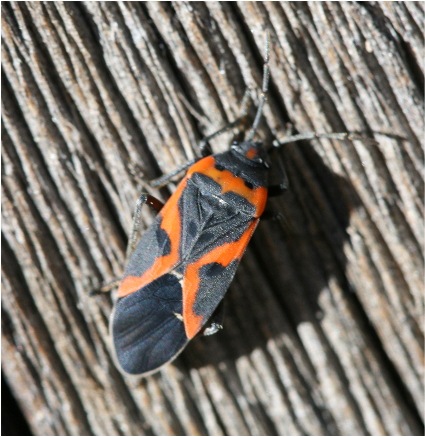
In any case, as I stepped out today I noticed some insects milling around on the sun-warmed cement and log beams of the house, which were, I believe, the first outdoor insects I’ve seen moving about this year (this doesn’t include springtails, which are probably not insects). Most of them are Small Milkweed Bugs (), which I’ve written about a couple of times before. They’re familiar faces, now, the first brave souls to venture forth at the hint of spring warmth. (In contrast to last year and the year before, I did actually ID them correctly this year; I’ve had a habit of calling them Box Elder Bugs when they first appear.) They’re a few weeks earlier this year; last year they didn’t come out to sunbathe until February 22.

(One of the most interesting things about keeping a blog has been being able to track the phenology of certain events like this, and compare it from one year to the next. I’ve always meant to keep a journal of sightings, first and otherwise, and some years I’ve even actually started, but I never remember to keep up with it. Perhaps it’s because, come April and definitely May, one starts to get flooded by all the “first” observations. I should probably select a few favourite and harbinger species – Red-winged Blackbird, American Woodcock, Dutchman’s Breeches, Coltsfoot, first moth, first butterfly, first Small Milkweed Bug – and just remember to record those every year. After all, they’re the ones that please me so when they first appear.)

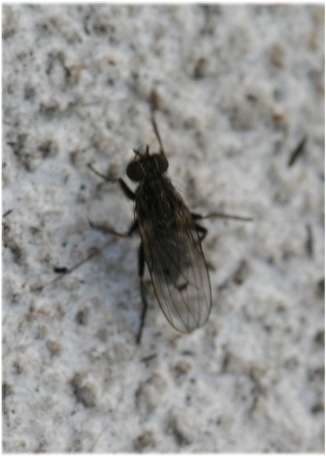
The milkweed bugs were joined by a few other critters – a couple of species of fly and a single spider, none of which I feel confident in ID’ing. I didn’t even bother trying for a photo of the spider as he was tucked into an awkward spot on the wall. Below is one of the flies. By the time I got back from my walk the sun had slipped farther down the sky and the patch of wall they’d all been hanging out in was now hidden in shadow; all but a few hardy (or hopeful?) milkweed bugs had retreated back to their cozy niches. We’re back to a forecasted high of -7°C (19.5°F) tomorrow, so that might be it for another few weeks, but it was a nice treat for early February.

fly