The book tour recap; nature break

cranberryglades

I took a day off following the New River Birding and Nature Festival; I’d been on the road a week, traveling and meeting people and talking, and though I’d been enjoying myself, I really needed a day to recharge my batteries. I’m an introvert by nature, and since I work from home my normal social exposure is a trip in to town for groceries and a new library book; so many people wears me down after a while.

My next stop was in northeastern West Virginia and I decided to aim for nearby Elkins, WV, as my destination for the night. Since I was in no rush to get there, not having an event that evening, I took the advice of Opossum Creek Retreat owner/manager and NRBNF organizer Geoff Heeter to stop at the Cranberry Glades Botanical Area along my way.
bog2

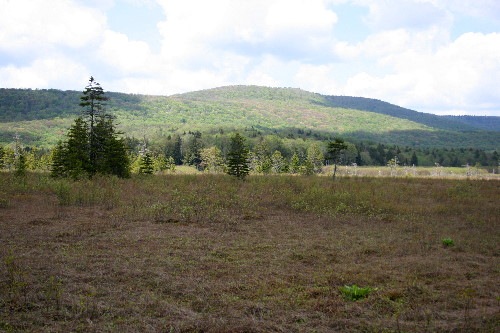
This is the location of one of the festival’s all-day trips. It’s a specialty destination, a rare habitat for the region. Bogs are typically a more northern phenomenon, where the ideal conditions occur (poor drainage, usually through non-porous bedrock; cooler temperatures; moderate precipitation) to form the acidic wet environments. This collection of bogs in West Virginia represents some of the most southernmost in North America, and is West Virginia’s largest.

In fact, it was probably the largest bog that I’ve personally had a chance to visit. The whole botanical area covers 750 acres, but the bogs themselves collectively measure 115 acres; the largest is 59 acres. The ones I’ve been to before have all been just a couple to perhaps a couple dozen acres. Up near Ottawa, ON, is the Alfred Bog which covers about 10,000 acres, but I’ve never been to it.

There are two hiking trails through the botanical area; one is 6 miles (9.7 km) long, which was a little more than I had time or interest for, but the other was a 1/2 mile (800 m) boardwalk that passed along the edges of two of the bogs as well as through some wooded sections. Given how much I dawdle over things, I figured that’d be plenty long enough and still allow me to see a lot.

bog1

The name of the place highlights one of the most common species there. The cranberries were pretty much everywhere, but the plants are so small and inconspicuous that you really had to look closely to see them. They’re more obvious once the berries form and ripen. Cranberries are mostly associated with boggy, acidic environments, though some cultivars have been developed that can do just fine in normal soils.

There were also the other expected bog plants there, including the two carnivorous species, pitcher plant and sundew. I only spotted a few pitcher plants, not blooming yet, and while I looked for sundew I didn’t see any. It could have been too early yet for them to be very large; like most non-woody plants they die back and grow anew each year. I only noticed the sundews in our little poor fen at the back of our property perhaps a couple of weeks ago.
skunkcabbage

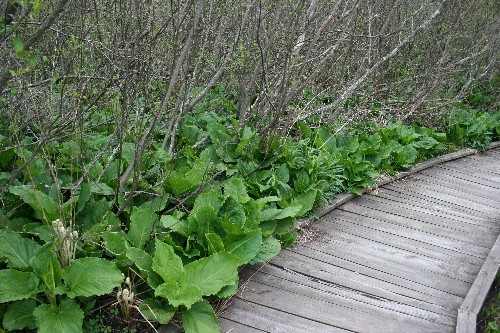
These plants were something of a highlight for me. Although by the time I visited they were well past their most identifiable stage, I was happy to see these Skunk Cabbage. It’s a species I’ve never yet encountered, as finding them in the spring when they’re just starting to peek through the snow requires a combination of luck and knowing where to look, and I’m not aware of any plants in our immediate vicinity. These don’t grow in the bog proper but rather at the bog’s edge, where there’s actual soil to grow in (rather than the peat covering that many bog specialists grow in/on). By this stage of their growth they’ve lost the distinctive odour that gives them their name (that’s used to draw insects in to their very early flowers).

PaintedTrillium

This was another plant I discovered there that I’d long been wanting to see. It’s a Painted Trillium, and the pink chevrons of the species are beautiful and distinctive. These weren’t in the actual bog either but rather in the drier forest habitat surrounding it. However, it’s perhaps no surprise they were there – they prefer more acidic soils, and away from bogs/fens are typically associated with trees such as evergreens and Red Maple that acidify the soil beneath them with their dropped needles/leaves. It is in fact found in Ontario, but I’ve never seen it here (never been in the right environments at the right time of year, I guess).

CAWA

There were lots of birds there, even by the time I arrived around lunchtime, so I can see why it was a popular destination for the NRBNF. There were many species I hadn’t seen since the previous summer. Blackburnian Warblers were extremely common, and I saw a few Canada Warblers as well. While the Blackburnians remained up higher in the evergreens the Canadas foraged at eye-level. This was the only wildlife photo I got (and a crappy one at that; while I have a long lens for my camera I’d naturally left it in the car, so this was taken through my binoculars), despite the abundance of birds; most were more readily heard than seen. Canada Warblers are a recent addition to the Canadian Species At Risk act, and are not surprisingly relatively uncommon. Nearly all of the individuals I’ve seen over the years have been through bird banding, when we’ve caught them in the net.

It wasn’t an especially long drive to Elkins from Fayetteville, but it was nice to stop and stretch the legs a bit and get out to do some nature-watching in an interesting place. Not to say that the New River area wasn’t interesting, but there was lots of it and I was there a few days. I’m sure you know what I mean.

Next up: Canaan Valley NWR, Ned Smith Center for Nature and Art, and the Ashland Nature Center.
Bear encounter

bear2

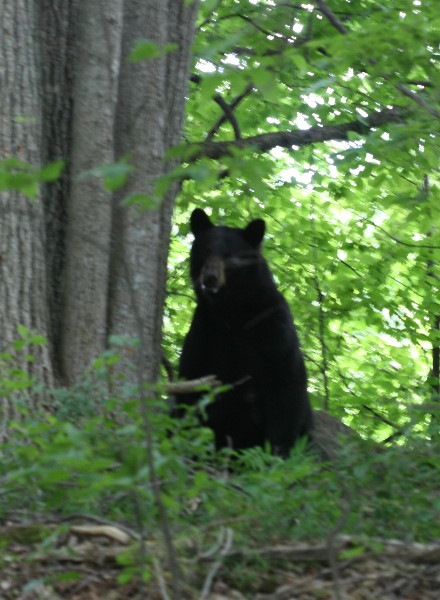
Yesterday afternoon while heading out with the dogs to see if I could relocate a Common Buckeye butterfly that Dan had seen in our back fields (they don’t typically occur up here, so this was a really rare sighting), we startled some wildlife in the tiny patch of trees that the trail passes, no more than a couple dozen feet across and a few dozen feet long but dense enough at the edges to make it hard to see into. The dogs were, of course, intensely interested and my focus was on preventing their pursuit of the thing; so it didn’t immediately register that the sound of departure was not the bounding ba-dump, ba-dump of alarmed deer but something more shuffling. Then when I seemed to hear something climbing a tree I thought it must be a porcupine, which I also did not want the dogs taking off after. But when I got Jack secured and Raven to heel and peered through the foliage, what was looking back at me was not a porcupine. Or a deer.

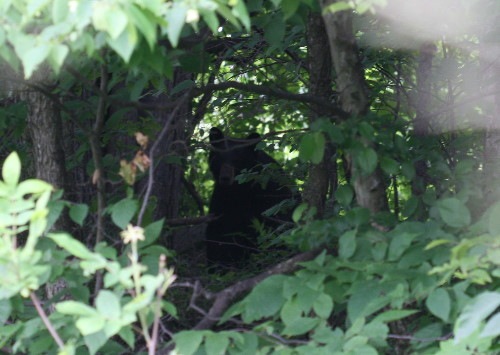
I was too surprised to move, at first. But the bear seemed more cautious than aggressive, and after a moment I relaxed, a little; enough to pull out my camera and try for a few shots. She was tucked in behind a wall of vegetation through which I had just a small window to see her, but I got a couple of photos that were recognizably of a bear and was content with that. Carrying Jack, and with a firm verbal leash on Raven, I turned and carried on down the trail so she could leave.

bear

I made my way slowly to the field where Dan had seen the butterfly and dawdled around there for a bit (didn’t find it). Then I started to mosey back, pausing a couple of times to take photos of things. By the time we returned to the woods patch the bear had had lots of time to clear out, but I still picked Jack up and approached slowly, just in case. Cautiously I peered through the trees to the spot she’d been, but the patch was empty and silent.

Relieved, I set Jack down. She’d made some marks on the trunk that I wanted to check out, so I started picking my way through the trees toward where she’d been. Halfway there, when I was about twenty-five feet from the target tree, there was a soft grunting growl and the bear sat up on her haunches beside it.

Panic! Panic! Call the dogs back! Jack, come! Raven, heel! Now! Thankfully, both dogs came quickly, and I turned my shoulder to her to show her I was not trying to threaten her (even while keeping her in my sight, just in case!) and started to casually leave the forest patch. She didn’t say another word as she sat back and watched me, alert and uncertain but staying her ground. I paused near the edge of the trees, since she wasn’t moving, and took a couple more (quick!) photos without the obstruction of leafy vegetation, then left.

bear3

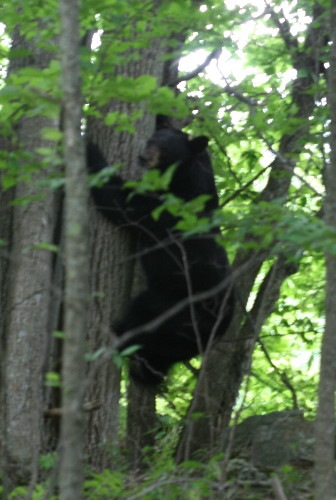
A couple of times while I was nearby she tried to climb the tree she was beside. This is about as high as she made it before slipping back down to the ground each time. When I’d first glimpsed her, through the small window in the vegetation, I’d thought I’d seen a second little head beside her. I’d definitely heard more than one animal in there, startled by our approach. And given the fact that fifteen minutes later she was still sitting beside the same tree, and inclined to climb it, even, I’m guessing she had at least one cub somewhere up that trunk. (I didn’t think to check, at the time; my focus was more on containing the dogs.)

It wouldn’t surprise me if that were the case. Last fall I found evidence that was very suggestive of a mother bear with a cub. Female bears mate every other year, and take two years to raise each cub. If the second animal of last year’s discovery was in fact a bear cub, it’s possible it was a second-year cub that was weaned before the winter, and this is the same mother bear with a new baby. Female bears tend to have home ranges of 1600 to 6400 acres (2.5 to 10 square miles; which is about 6.5 to 26 square kilometers); certainly not small, but not so large that the same animal wouldn’t pass through an area semi-regularly, especially if she had favourite haunts.

It was exciting to finally get a chance to glimpse our local bear, since in the three years we’ve been here we’ve seen lots of evidence of their presence but no actual bears. I kind of wish it had been at more of a distance… but hey. Luckily, she was calm. It makes me happy to know she’s out there, somewhere, and passing through from time to time.

Diurnal sphinx moths

HummingbirdClearwing

Our lilacs have been done blooming for a while now, but in the days following my return home from the book tour they saw a lot of activity from pollinators: bees and butterflies, flies and moths. Including these three, which happened to all show up at the bush by the house during the same afternoon; an extremely rare treat.

The above is a Hummingbird Clearwing (Hemaris thysbe), sometimes referred to as a “hummingbird hawkmoth”. It’s the most common diurnal sphinx moth around here, and nearly all of my sightings of sphingids at my garden flowers are this species. They’re reasonably abundant, with near-daily sightings once our phlox and bee-balm/bergamot start blooming. The name, of course, comes from their resemblance to mini hummingbirds, with which they share the same behaviour of hovering in front of flowers while feeding and darting quickly from one bloom to the next.

SnowberryClearwing

This one is the closely-related Snowberry Clearwing (H. diffinis). I’d never seen this species before, so I was pretty excited when Dan found the individual and called me over. He’d actually seen them once, earlier this spring, down in Frontenac Provincial Park near where we used to live at the lake house. I think they’re probably relatively widespread around here but simply not very abundant. They’re actually found across more of the continent than Hummingbird is.

While the Hummingbird has a fair bit of red to it and a solid green back, the Snowberry lacks much red and shows two pale stripes running down each side of its back, giving it a yellower look. There’s a third species, too, Slender Clearwing (H. gracilis), which is similar to Hummingbird but has a white border along the red and a red stripe going up the side to the eye; it’s the most uncommon of the three (I’ve never seen it) and restricted to the northeast. All of the members of genus Hemaris are called clearwings because of (duh) their clear wings, though they also share this common name with a group of wasp-mimic moths that also nearly all have clear wings.

NessusSphinx

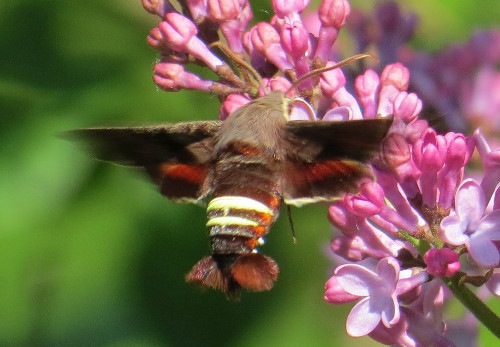
And the final species to show up at our lilacs was a Nessus Sphinx (Amphion floridensis). I had actually seen this once before, but not very well and not for very long, and hadn’t really gotten a good photo. So I was quite pleased about this one, too. Unlike the other two, this one belongs to a different genus and has solid-coloured wings. The distinctive identifying feature is the pair of yellow rings around the abdomen (though these can sometimes be single; this might be a regional variation, I’m not certain).

The three species fly most of the year, from mid-spring till the end of summer, so even though our lilacs are done blooming now there will still be the opportunity to encounter them again. Definitely the Hummingbirds will be back once the phlox starts to flower.

(All photos taken by Dan, whose camera was the one on hand and who knows how to work it a lot better than I do. Sadly, I’ve gotten so used to the manual-ness of my DSLR I can’t figure out a point-and-shoot anymore…)

The book tour recap, part 2

NRBNF1
Mothing at the New River Birding and Nature Festival. Yours truly demonstrating her expertise by looking something up in her own guide, on the right. Two fellow bloggers among those on the left, Sara Stratton (blue shirt, centre) and Nina Harfmann (blue shirt, left). Photo by Jim McCormac.

When I left Wheeling I headed south to join the New River Birding and Nature Festival, already in progress near Fayetteville, WV. I’d heard about the NRBNF from other bloggers who’d attended in past years and seemed to have a really great time, and I’d been keen to attend myself. However, West Virginia was a fair ways for me to travel. When I got the confirmation on the book tour I thought this would be the perfect excuse to finally make it down there, and I contacted the organizers. Lucky me, they were interested in having me come and do some events!

NRBNF2
Book exchange with fellow author (there were a few there!) Katie Fallon. Photo by Jim Rapp.

I arrived mid-afternoon on Wednesday and checked in to the cabin I was staying at with a few of the other festival guides: Katie Fallon (author of Cerulean Blues), Jim Rapp and Rachel Davis. They were there, relaxing in between the morning’s birding events and the evening’s dinner and entertainment; and they invited me in and made me feel immediately part of the group. They showed me to where dinner was being held (where I got to meet the wonderful Nina Harfmann, whose blog I discovered shortly after starting my own, and the inestimable Ohio naturalist Jim McCormac, who also keeps a blog that I highly encourage you to check out; go ahead, I’ll wait) and then later helped me with my event that evening. Honestly, half the reason I enjoyed the New River festival as much as I did was because of the people. Everyone was truly awesome.

The event that first evening went well, and the moths were extremely obliging. It was one of the better nights on the trip, with great weather and an excellent selection of species. Many people peeled out early (having been up at dawn to go birding, and planning to be up at dawn the next day to go birding), but a small group of enthusiastic people, including my cabinmates and Jim McCormac, stuck around and indulged in the mothiness. We were rewarded at the end of the evening with a caterpillar hunter, a giant beetle that, unsurprisingly, is a predator on caterpillars. Check out Jim’s excellent post on the creature.

NRBNF3

The next morning I was up far too early, to co-lead a birding trip with Connie Toops and Bill Hilton, Jr. While I’d never met either I knew of both of them prior to the festival – Connie is co-author of a number of bird books; while Bill operates the Hilton Pond Center for Piedmont Natural History in South Carolina, as well as Operation Ruby-throat studying hummingbirds on their wintering grounds. We did a great trip through the forested hills of the region, seeing many Carolinian bird species we don’t get, or have in small numbers, here at home. I also got to see my first Zebra Swallowtails, a flashy butterfly species that doesn’t make it to Ontario. In the photo above, Connie (in the white shirt on right) is talking about coal mining in the region, pointing out a small mine in the side of the slope.

NewRiver

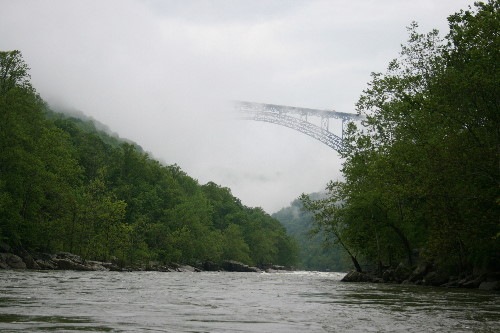
I did another talk that evening for a separate group participating in an Elderhostel program at a nearby state park. The following morning I returned to join the same group on another birding trip, along with Bill Hilton, Jr, again and nature columnist and radio show host Dr. Scott Shalaway. We got to take a jet boat out on the river, and while it was raining off and on most of the morning and therefore a little wet, it was also pretty amazing. The photo above is of the main bridge crossing the New River gorge. To give you a sense of scale, there’s an 18-wheeler tractor-trailer crossing the bridge in this photo (above the second strut from the right). Yeah. It was pretty spectacular. The whole New River region is, really.

Julie-me
Julie Zickefoose and celebrity Boston Terrier Chet Baker, and myself. Grinning from ear to ear at the opportunity to meet one of my idols.

Friday evening I didn’t do any mothing but instead enjoyed the post-dinner entertainment, a presentation by Julie Zickefoose. I have admired Julie pretty much since I discovered her blog in 2007; hers was one of the main inspirations for mine when I started it the following year. She’s the sort of passionate, dedicated person I would like to grow up to be, and I was super excited to have a chance to meet her. It was definitely one of the highlights of the trip for me – she’s every bit as friendly, generous and engaging as her blog makes her seem to be.

NRBNF4Enjoying lunch following a fun but very wet morning of birding the New River high country with Julie Zickefoose and Connie Toops. Photo by Julie Zickefoose.

Saturday morning was wet, wet, wet. I was on a trip with Connie Toops and Julie Zickefoose; it absolutely delighted me to be able to spend the morning in the company of these women I admire. So I could overlook the fact that it rained for pretty much the entire trip. We made a few stops for local specialties such as Golden-winged Warbler, and did end up getting a number of our target birds despite the damp weather. The birds I was most excited about weren’t actually the ones most other people were – I was keen to see the southern species, the ones we don’t get here in Ontario. I was happy that we did get a bunch of these, or at least heard them.

One of my favourite anecdotes from the tour was from this trip. We’d stopped someplace to check out some Golden-winged Warblers, and since the location was hilly and shrubby and it would be a while till we reached some washrooms, we thought it might be a good spot for a washroom break. While everyone else was checking out the warbler I carried on up the hill to see if it would be okay for the women to use. When I got up top it turned out there was a residence on the other side, some distance away but openly visible.
     I returned to the group and told my co-leaders, “I don’t think it’ll work for the women; there’s a house on the other side.”
     To which they gave me a funny look. “A what?”
     “A house.”
     The funny look remained. “A hearse?”
     They laughed when they understood (observing, “I know it’s West Virginia, but a hearse in the bush would be weird even for here.”).
     I found this greatly amusing, since I think it’s the first time my Canadian accent has ever caused a problem in communication. Honestly, I think I sound pretty much just like my American friends, but clearly there’s some difference , especially with the “ou” sounds. I got comments on my pronunciation both here and at other stops.

NRBNF5
Myself with Geoff Heeter (of Opossum Creek Retreat, and a coordinator of the festival), Mary Ann Barnett and Rachel Davis. Photo by Jim Rapp.

Saturday night I did my last event of the New River festival, running my moth sheets at Opossum Creek Retreat while The Rain Crows played inside. It was a cool night, threatening rain, so we didn’t get too many moths to the lights. Still, though, it was a decent evening – just enough diversity to interest people. It was also the last evening of the festival, so there was a lot of socializing. I signed a lot of books, and chatted with a number of people whom I hadn’t had a chance to at any point earlier in the week. Met a lot of new folks, such as Dave Fitzsimmons, author of the fabulously-done children’s book Curious Critters (seriously; check that link out). I also got a couple of my own books signed, which I had brought anticipating that I’d meet the authors. This included Bill Thompson III, Julie Zickefoose’s husband, whom I admire nearly as much as his wife for all the stuff he’s involved in and how much he puts himself out there for other people. What a couple!

nrbnf-guides
Many of the awesome people I met at the New River festival, most of us guides. Left to right – back row: Geoff Heeter, Paul whose surname I’ve forgotten, Ben Lizdas, Jim McCormac, Bill Thompson III, Jim Rapp, Heeter Jr whose first name I’ve forgotten, Liam Thompson; front row: myself, Julie Zickefoose (with Chet Baker), Wendy Eller, Rachel Davis; and Phoebe Thompson lounging out in front.

I was very sad to be leaving at the end of the week. I’d had such a good time there, met so many great people. Saw lots of interesting moths, including several lifers, species I’d never seen before. I’d definitely love to return, if I had the opportunity; unfortunately, West Virginia is no closer now than it was before, so we’ll have to see. Still, if you’ve got the chance to go yourself, I highly recommend it.

Onward I go, next to Canaan Valley NWR in northern West Virginia!

Baby bluebirds

EABL-boy

One of the nicest things about living at this property, I think, has been the bluebirds that have reliably nested in the box in the meadow a hundred meters back from the house. It’s probably the same pair returning each year; the birds can live up to 7 or 8 years or more and tend to be fairly loyal to their territories. Last week Dan and I went out to check on how the local family was doing. Although by the time I go out with the dogs in the afternoon things have mostly quieted down, Dan’s been watching them during his morning walks and he had a feeling they’d be getting close to fledging, which they do at this latitude at about 19 days old.

Sure enough, when we opened up the box the little guys were probably only a few days away from leaving the nest, if that. Fortunately, they weren’t quite ready to go yet, and just hunkered down when I reached in to count them and pull them out for a photo. Their feet, one of the first parts of a baby bird to mature so they can use them to cling to branches if they have to leave the nest early in an emergency, gripped at the nest as I picked them up, and then at my hand while I held them.

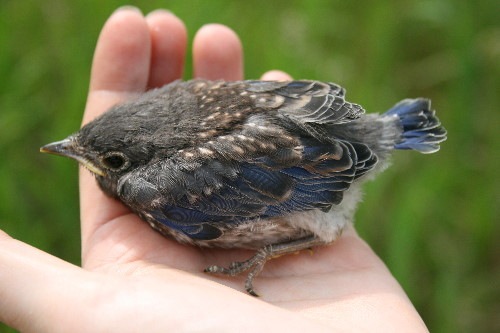
The photo above is of a baby boy. You can tell the sexes of the babies apart by the colour of the wing and tail feathers – blue in males, grayish in females (below). We had two of each in the box. While we had the box open the parents sat in a nearby tree and waited. They were pretty patient with us for most of it, having come to recognize Dan as no threat from his morning walks and occasional checks.

EABL-girl

For temperate migrants like these guys, who spend the winter not that far south of here, the breeding season starts early and many are already fledging young. Meanwhile, tropical migrants such as many of the warblers are only just starting to establish territories and build nests. We’ll be starting our MAPS visits this week and will get to see a lot more baby birds in the next little while. I do look forward to the fieldwork, for that and other reasons. It’s too bad it requires getting up so early!

EABL-girls