Mantids

Praying Mantis and underwing

There haven’t been many moths to my light the last few times I’ve set it out, even on the warmer, humid evenings. Something to do with the weather, maybe? The almost-drought from earlier this summer? I dunno. But what I did have a lot of one night were these guys. Praying mantises. At the point that I finally shut the light off and went to bed, well after midnight, I’d managed to attract 13 of them. Several clung to the sheet, others clambered up the log wall, one or two walked along the ground below the light. Equal numbers of both green and brown. I never saw any of them stalking (or holding) prey, though they did occasionally turn their heads to watch a moth walk by… like this one is doing. I love how mobile their heads are.

Praying Mantis

I did a post about praying mantises a couple of years ago, the first summer we moved here. They’re abundant in our fields, and late August through September seems to be when the adults start taking wing. Which is mostly when I notice them. Mantises go through a simple metamorphosis, meaning that the larval/nymph stages look very similar to the adults, but without wings. Grasshoppers, walking-sticks, and some others also do this. You might not immediately realize that what you have isn’t an adult if you found one. But in the autumn they moult into their last instar, the adult stage, and finally have wings.

I nearly always detect them by flushing them as I walk through the field, or by noticing them fly in to a spot near me. You can’t really tell the long, narrow body shape while they’re in flight, but they’ve got very distinctive wings: pale and sheer, like pieces of tissue paper. Even on overcast days, something about the nature of the wings makes them look permanently backlit. Once you know what to look for, it’s really easy to identify a mantis in flight. (I should see if I could get a photo of one flying when I’m out this week.)

Praying Mantises

I’d never had any come to my moth light before. So I was a little surprised to have 13 turn up. There are a number of species in North America, but the most common one, at least that I encounter, is the European Mantis, Mantis religiosa. It’s the one with the black-and-white spots on its inner “arms”. It’s been here over a century and has become pretty widespread in the northeast and the west (the prairies and the southeast don’t seem to have them yet).

Another introduced species, the Chinese Mantis, Tenodera aridifolia, is found through much of the east. Like the European Mantis, it has both a green and a brown form, but it lacks the spots on its arms. Beyond that one field mark I don’t actually know how to tell the two apart. Naturally, none of my photos show the inner arm well enough to tell if it’s got a spot on it or not. I think possibly the adult Chinese Mantises always have a bold spring-green stripe down the outer edge of the adult’s wing cover, even in the brown form, and maybe a slightly longer “torso”… but that’s just based on comparing photos on BugGuide. If that’s the case, these would all be European Mantises.

My Kaufman Guide to Insects notes, under Chinese Mantis, “Both sexes fly well and come to lights at night in search of prey”, but this seems also to apply to European Mantises (according to a quick Google search) and a few other native species.

Monday Snapshots: Les Chiens

This was supposed to be a Sunday Snapshots. And I had another post to go up today. But our internet connection went down and was out for all of yesterday and half of today… so I’m shuffling stuff around a bit. Dogs today; other post tomorrow. I’ve got enough to do catching up on all of that important internetting I missed while the connection was out. ;)

These are from a hike through the 100-acre woods a couple of days ago. I hadn’t been in a while, for one reason and another. It was quiet, but a pleasant walk, and a something different for the pups.

Jack and Raven

Jack and Raven

Jack and Raven

Jack and Raven

Jack and Raven

Jack and Raven

PFG to Moths contest winner

First off, thanks to everyone who sent in answers to the cover species and/or blogged and tweeted about the contest! I got a great response from folks, and I was pleased to see how well everyone did. Even considering the lack of a full printed field guide to live-image moths. ;) I went through everyone’s entries, put your names in a hat, and the winner of a signed copy of the new Peterson Field Guide to Moths of Northeastern North America is…

Jennifer Hansen!

Congratulations, Jennifer! I’m afraid you’ll still have to wait a little while before receiving your copy, but rest assured it’ll be coming. :)

For those of you who didn’t win but would still like a copy, don’t forget that you can now preorder the book from Amazon.com.

Here are the answers to the identifications:

3666 - Archips dissitana - Boldy-marked Archips
3666 – Archips dissitana – Boldy-marked Archips

9485 - Papaipema baptisiae - Indigo Stem Borer
93-2494 – 9485 – Papaipema baptisiae – Indigo Stem Borer

8641 - Drasteria grandirena - Figure-seven Moth
93-0915 – 8641 – Drasteria grandirena – Figure-seven Moth

5204 - Diaphanis hyalinata - Melonworm Moth
5204 – Diaphania hyalinata – Melonworm Moth

2401 - Atteva punctella - Ailanthus Webworm
2401 – Atteva aurea – Ailanthus Webworm

5058 - Pyrausta orphisalis - Orange-spotted Pyrausta
5058 – Pyrausta orphisalis – Orange-spotted Pyrausta

2589 - Podosesia syringae - Lilac Borer
2589 – Podosesia syringae – Lilac Borer

7033 - Nemoria lixaria - Red-bordered Emerald
7033 – Nemoria lixaria – Red-bordered Emerald

7859 - Eumorpha pandorus - Pandorus Sphinx
7859 – Eumorpha pandorus – Pandorus Sphinx

6105 - Cnaemidophorus rhododactyla - Rose Plume Moth
6105 – Cnaemidophorus rhododactyla – Rose Plume Moth

9314 - Alypia octomaculata - Eight-spotted Forester (side)
93-1979 – 9314 – Alypia octomaculata – Eight-spotted Forester

7922 - Pheosia rimosa - Black-rimmed Prominent
93-0012 – 7922 – Pheosia rimosa – Black-rimmed Prominent

1058 - Polix coloradella - The Skunk
1058 – Polix coloradella – The Skunk

10520 - Morrisonia evicta - Bicolored Woodgrain (light)
93-2802 – 10520 – Morrisonia evicta – Bicolored Woodgrain

7715 - Dryocampa rubicunda - Rosy Maple Moth (side)
7715 – Dryocampa rubicunda – Rosy Maple Moth

10670 - Feltia jaculifera - Dingy Cutworm Moth
93-3498 – 10670 – Feltia jaculifera – Dingy Cutworm

Giant Swallowtail

Giant Swallowtail

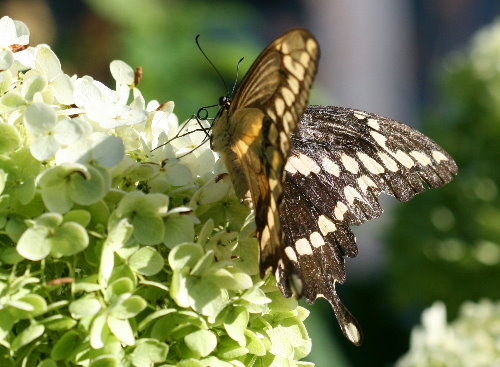
Dan really outdid himself with the gift he brought me this afternoon. He walked into my study holding a large black-and-yellow butterfly and asked, “Is this a Giant Swallowtail?”

It was indeed. He’d caught it while it fluttered lazily at the phlox in our garden. What makes this noteworthy is this:

Giant Swallowtail range from Kaufman Field Guide to Butterflies (highly recommended!)
From Kaufman Field Guide to Butterflies, definitely my favourite butterfly guide.

We’re at the tip of the red arrow, roughly.

The one and only time I’ve ever seen this species was a number of years ago, perhaps 2005. It was visiting my mom’s garden at my parents’ old house in the Greater Toronto Area. The species is very rare in Ontario; it occurs regularly in small numbers in southwestern Ontario, but the farther east you go the rarer it seems to become. Of course, it doesn’t breed out this way, so all occurrences of the butterfly here are immigrants that either traveled here under their own steam or were blown here in a weather system. The Canadian Biodiversity Information Facility has a species page for Giant Swallowtail, on which they note, “In 1992, a stray was recorded in the Ottawa area for the first time following high winds resulting from a hurricane in the southern U.S.” Could today’s visitor have ridden up ahead of Irene?

Giant Swallowtail

These are beautiful big butterflies. They fly as if their oversized wings are too big to flap properly, like floppy clowns’ shoes. They float lazily in the air, never traveling very high, cruising from one spot to another with what appears to be hardly any effort at all. Dan said when he first saw it above the garden he initially thought it was a falling leaf.

They also have the distinct habit of fluttering while they visit flowers. I took a couple of photos of it in Dan’s hand then had him release it. It stuck around the garden and I followed it about, camera in hand, trying to get a good photo as it resumed feeding on the phlox, but it wouldn’t stop fluttering. In fact, it seemed to use its wings to push its head deep into the throat of the flower. Judging by the blurred wings I see in many of the photos on Google Image search, this wasn’t unique to our butterfly.

Down south, in its breeding range, this species is considered a pest of citrus orchards, especially oranges which has earned its caterpillars the name of “Orange Dogs”. It’ll also feed on Hop Tree (Ptelea trifoliata) and Prickly-ash (Zanthoxylum americanum) where citrus trees aren’t common, such as up here (though both species actually in the same family as oranges and other citrus). I don’t think we’ve got Hop Trees here, but we certainly have lots of Prickly-ash about. I wonder if their range might expand, or if it’s not the availability of food plants that limits its northern distribution, but rather something like average winter temperatures or snowfall affecting overwintering survival.

My camera’s battery died after I’d run off a dozen shots, and since it seemed to be hanging about the garden and not going anywhere I hurried in to grab my spare. But when I returned, it’d disappeared, presumably off into the meadow somewhere. Safe travels, buddy, and thanks for visiting!

Brown Scoopwing and Reniform Helotropha

37-7653 - Calledapteryx dryopterata - Brown Scoopwing

First, thanks to everyone who’s sent me entries for the contest so far! It’s been great to see so many folks interested in moths (or at least interested in the book?). I’ve had a couple of people comment that they wanted to enter but didn’t have the time this week, so I thought I’d extend the deadline by a couple of days and give you guys the weekend to sort through the identifications. New deadline: midnight PST on Sunday, Aug 28. That’s 3am for EST readers. Winner will be announced on Monday. More details in the original post.

And on to other things. I had the guy above show up at my light a few nights ago. It’s a Brown Scoopwing, Calledapteryx dryopterata, Hodges #7653. The first time I saw one of these guys, the first year I was mothing, I was so excited to get it. Because, really, what a neat shape! I think even more than the bright colours, it was the weird shapes that I got really excited about early on (and still do, to an extent).

I’ve got this species at all of the houses I’ve lived since starting mothing, but for some reason I’ve always taken rather crappy photos. We actually had to solicit a photo for this species for the field guide because neither Dave nor I had one of sufficient quality. How could that have happened? It’s not even as though they’re particularly uncommon, either, such that we just never got the chance. They’re annual. In small numbers, yes, but still annual. So when I saw this guy at the light the other night I jarred him up so I could take a photo. Now I have one.

We’re pretty close to the north end of their range here. They’re not found up on the Shield, and we’re sort of at the edge of the Shield. Strangely, my annotated checklist for moths of Ontario says that the related species Gray Scoopwing is actually more common in the province. (Or perhaps “less uncommon” would be a better phrasing.) The Gray Scoopwing is found right up through the Boreal, too. And yet I’ve never seen a Gray Scoopwing, but I’ve seen Brown Scoopwing everywhere I’ve been. The Brown’s caterpillars feed on viburnam, while the Gray prefers honeysuckles. Lots of viburnum everywhere I’ve lived, so maybe I just haven’t had enough honeysuckle around.

93-2443 - 9453 - Helotropha reniformis - Reniform Helotropha

And this second moth was a new one for me; or at least, I don’t have a photo of the species labeled anywhere in my file folders, which are pretty complete, if not that well organized. (Thank goodness for file searches.) It’s a Reniform Helotropha, Helotropha reniformis, Hodges #9453, and #93-2443 under the new numbering scheme. It’s associated with sedges found in wet habitats, which is sort of funny because our current home has the least amount of wet habitat near the house of the three places I’ve done the most mothing. If I’d have expected this species to show up anywhere it would have been at the lake house, but even my parents’ old house had some large vernal ponds and a good-sized swamp within view of the house. But the moths, they do whatever they want to do. It’s not the first time I’ve been surprised, and won’t be the last.