Black Swallowtail

Black Swallowtail, Papilio polyxenes

Dan’s been showering me with gifts lately. The baby snake a couple of days ago, and then yesterday he caught me a swallowtail butterfly. I had him hold it for a couple of photos and then asked him to put it on our hydrangeas on the off-chance it might not fly away right away. It didn’t, and I was able to get some nice shots of it.

We have two black swallowtails that occur here: Black Swallowtails (Papilio polyxenes) and black-morph female Canadian Tiger Swallowtails (P. canadensis). From the top, the easiest way to tell the two apart is the orange spot at the corner of the hindwing – in Blacks it’s got a black dot in it, while in Tigers it’s just solid orange. Also, Blacks will show that faded yellow band partly up the wing, while Tigers don’t. The extensive blue in the hindwing makes this a female Black Swallowtail – males will have a bolder mid-wing yellow stripe and much reduced blue.

Black Swallowtail, Papilio polyxenes

Black Canadian Tigers are apparently rare, but at least up here in eastern Ontario Black Swallowtails are near the edge of their range and so not a whole lot more common. I would see Black Swallowtails from time to time back in the Toronto area, but I’m not sure if I’ve seen one since moving east. My mom had one at their place farther east from us this summer, though.

Black Swallowtail caterpillars feed on plants in the parsley family, Apiaceae. This includes, of course, parsley, but also a number of other cultivated and native species such as carrot, dill, fennel, parsnip, Queen Anne’s Lace and other plants that bear similar umbrella-shaped inflorescences. I haven’t seen caterpillars on any of my parsley plants, or on the wild parsnip or Queen Anne’s Lace in our area… but I haven’t looked too closely, either. The species overwinters in the pupa stage, which means they’ll be caterpillars through the fall, so I should keep an eye on our plants and see if anything turns up.

Red-bellied Snake

Red-bellied Snake, Storeria occipitomaculata

I was standing beside my raised garden beds yesterday, staking my indeterminate tomato plants for the third time this summer, when Dan paused in his lawn-mowing and a few moments later came up behind me and tapped me on the shoulder. He held out his hand as I turned around: in it he had lightly grasped a small, dark snake with pale neck markings. I exclaimed something like, “Oh, a Ring-necked Snake!” and dashed inside to grab my camera before he could say a word.

As it turns out, upon referencing my reptiles field guide, it’s not a Ring-necked Snake after all, despite its superficial similarities. Ring-necks (Diadophis punctatus; our subspecies is edwardsii) are the most well-known to bear this marking, but two other small snakes also do: Red-bellied Snakes (Storeria occipitomaculata; our subspp is occipitomaculata) and very young Northern Brown Snakes (Storeria dekayi dekayi; also known as Dekay’s Brown Snake). Although you can’t see it in these photos, this individual had a reddish belly, which rules out Northern Brown Snakes. The pale neck ring is solid in Ring-necks but broken into three large blotches in Red-bellies (occasionally not present at all, or only as a ghosted brown area, which has been the case with other individuals I’ve seen). So this is a Red-bellied Snake.

Red-bellied Snake, Storeria occipitomaculata

It’s also a baby. Look how absolutely tiny it is! Many snakes give birth to live young, and the Storeria are among these. Baby Red-bellies are born at 7-10 cm (3-4 inches) long; they’ll eventually grow to reach 20-25 cm (8-10 inches) as adults. Ring-necks are a little larger at birth, and grow to be longer adults. Litters (broods? clutches?) are usually around 7-8 snakelets, but can number as many as 20-30 (presumably from the very old, very large females).

Adults are largely predators on slugs, so are great snakes to have in one’s garden. They’re also usually nocturnal, spending their days hidden under logs or stones, so I’m not sure why this one happened to be out and about yesterday afternoon. I’ve read that Red-bellies are very docile snakes not typically given to self-defense, and indeed this little guy made no attempts to bite or threaten, wishing only to get away. Though perhaps that’s because he knew his itty-bitty teeth would have been unlikely to puncture my skin anyway.

I took a few photos then released him into the long grasses of the meadow, away from the mower. I’ve never seen a Ring-necked Snake so that would’ve been really cool, but it’s been a couple of years since I’ve seen a Red-bellied and I could count my total encounters with the species on one hand, plus this was such a little baby to boot, so it was still a great discovery.

Peterson moth guide update, and a contest!

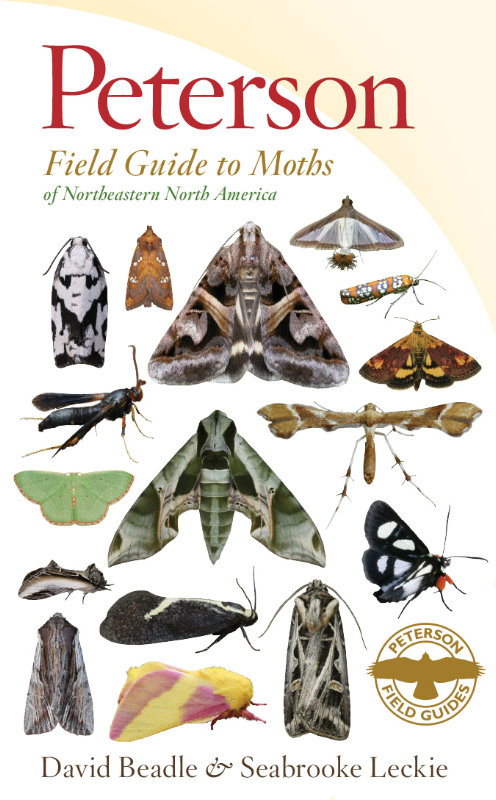
We have a cover! AND a publication date!

I’ve been away since last Friday, visiting my sister, and have been only minimally checking in with email. (Also the reason for the lack of posts; I did have my computer, but it’s harder to find the time to organize a post when away from home.) We received the official cover earlier this week, and I got the okay to share it with all of you – so here it is! The new cover of the Peterson Field Guide to Moths of Northeastern North America!

The Peterson field guide series is undergoing a small makeover, the most prominent difference being the covers of the guides. The bird guides have one of Roger Tory Peterson’s beautiful paintings on them, but the rest of the titles in the series will be a mosaic of an assortment of species from the guide plates. All of the images you see here are the actual images that will appear for those species on the identification pages of the guide.

Since I started this blog I’ve really wanted to run a contest – so here’s my very first one! Yay! Here’s what you have to do:

There are 16 species of moth on the cover. Tell me what they all are to be entered into a drawing – when the book comes out next spring, I’ll send the winner a free signed copy of the guide.

If you don’t know them all, you can send me a partial list. Common names are fine, but please include Hodges # and/or scientific name to make sure we’re both thinking of the same species. You’ll get one entry into the drawing for every 4 species you guess correctly. If you need an identification reference to look them up, this website can be very useful. If you need/want to see a larger version of the cover, click here.

If you share this contest on your own blog and/or Twitter and send me the link where I can see and verify it, I’ll put your name in the drawing once (or once more, if you also guessed the species). Send me your list of species (and/or blog/Twitter link, if applicable) by next Thursday, August 25, using my Contact Me form. I’ll contact and post the winner next Friday. The book won’t be mailed till next spring, of course. ;)

Which brings me to the second half of the announcement. The publication date for the moth guide has been officially set for April 3, 2012!

A few online retailers already have pages up for the guide. If you’re the sort to like to take care of these things early so you don’t forget, you can now pre-order your copy from Amazon.com (other sites have pages but no pre-order option).

Ambush bugs

jagged ambush bugs, Phymata americana

I discovered these guys on some yellow flowers in our garden yesterday afternoon. I think the flowers were a type of Rudbeckia, though I admit I’m drawing a blank now, at 9pm, and feel too lazy to go dig up a flashlight and wander out into the garden to check. ;) I can confirm, however, that I also discovered a single individual on a Black-eyed Susan out in our fields the same morning. They’re small – no more than a centimeter / half-inch – and strangely angular. The bright yellow of the lower individual blends in remarkably well with the flower.

These are ambush bugs, a type of assassin bug belonging to the subfamily Phymatinae. I think these are Jagged Ambush Bugs, genus Phymata, for which there are four species listed on BugGuide.net. Although the images for P. fasciata seemed to match these individuals more closely, the only BugGuide records for that species were from the southeastern US. So it may actually be P. americana, which appears to be a northeastern species.

Ambush bugs are predatory. They wait on plants, commonly on flowers, for another insect to stroll by. Flowers make good ambush spots because they’re frequently visited by pollinators. When the unsuspecting insect gets too close, the ambush bug leaps forward to snatch it using its mantis-like hooked forearms (which you can see quite well on the lower individual here). They’re capable of taking prey larger than themselves; like other assassin bugs, they rapidly move to stab captured prey with their sharp ‘beak’ and inject it with a mixture that paralyzes it and dissolves its insides so the predator can then use their straw-like beak to ingest the liquified tissue.

It looks like this is a mating pair, but this BugGuide photo had a comment on it suggesting that the upper individual, the male, is actually just hitching a ride on the lower individual, the female, because she’s larger and stronger and capable of taking down bigger prey than he himself is.

Primrose Moth

Primrose Moth, Schinia florida

I’ve taken up jogging recently, much to my surprise. I never pegged myself as a jogger. The primary reason, aside from a lack of desire to do anything that so obviously resembled exercise, was that I was unlikely to be able to stick to the pace: I’d be inclined to stop and check things out and I’d do a whole lot more peering than jogging. I like to run, like the feeling of my blood pumping and the wind rushing past my face, but I’m not in shape to run very far (not to mention that whole stopping to look at stuff thing) so I’d usually just do our first field, a couple hundred meters, and then resume my walk.

But then I discovered audiobooks and suddenly I’m yearning to go exercise, if only so I can find out what happens next in the story. (I’m also wishing dinner took longer to prepare and I had more dishes to wash…) It’s my trade-off – if I go do this boring thing I wouldn’t ordinarily like to do, I am rewarded with story. So I’ve started jogging, to try to get myself in slightly better shape than my leisurely hiking keeps me. We have the rail trail at the foot of the property, and I take the dogs down there, jog some distance down it and come back.

At the farthest point of my loop there are quite a number of Evening Primrose (Oenothera biennis) plants growing at the trailside. A few days ago I noticed as I passed one that there were a couple of pink moths with their heads tucked into the yellow blossoms. Primrose Moths! I’ve been checking primroses for the last few years, but have never turned up any of these pretty little moths (the only individual of the species I’d encountered had come to my blacklight). I’ve also never had such a large patch of primroses to check before. Naturally, I didn’t have a camera with me – I was jogging, after all, and the last thing I needed was a camera thumping against my side.

Primrose Moth, Schinia florida

I figured they’d be long gone the next day when I came back that way, so once again I didn’t bring my camera. The two I’d seen were gone, yes, but I discovered another on a flower in a different spot. So yesterday when I went out I grabbed my little point-and-shoot, which virtually never gets used except in unusual circumstances like this, shoved it in the back pocket of my shorts and hoped there’d be one there.

I wasn’t disappointed, though it was close to the end of my sweep and I was worried I might not turn any up, now that I had the camera with me. (Animals are typically quite camera-shy, you know. They usually only appear when they know you’re not carrying one, or you have the wrong lens.) I found a single individual, head deep in one of the yellow blooms. I still haven’t quite figured out macro mode on the point-and-shoot, but I ran off a bunch and a few of them turned out alright.

Primrose Moths (Schinia florida) seem to be widespread, occurring from the Rockies east, but uncommon or locally common. Their host plants are evening primrose, but rather than eat the leaves the caterpillars target the flower buds. The adults are usually found tucked into the flowers during the daytime, though they’ll sometimes come to light at night, too. I thought they just rested in the flower, but when I looked closely at this one I could see it had its proboscis extended down into the flower, so I assume it was actually sipping nectar.

Incidentally, the primroses are night-bloomers, with their flowers starting to close up by the heat of mid-day, something I hadn’t realized prior to now. This would explain why sometimes when I went out I didn’t see many fully-open flowers (and the moths were all on flowers that were fully-open). So note to self (and others): look for Primrose Moths mid-morning, when the day is warming up but the flowers aren’t yet closed.