Hologram Moth

93-1179 - 8897 - Diachrysia balluca - Hologram Moth

A few nights ago I got this fabulous moth to my mercury vapour light. This is the appropriately-named Hologram Moth, Diachrysia balluca. The large patch on its back is iridescent, shining green to bronze, depending on the angle of the light. Hints of this colour can be seen elsewhere on the wing as well, set into a lavender-gray base. And in case that wasn’t enough colour, it’s got this wonderful orange head.

This species ranks among my favourite moths, and yet this is only the second individual I’ve ever seen. The first was one I caught in 2008 at my parents’ old house in the Toronto area. It’s somewhat odd that I haven’t encountered it much, really. It has a fairly large range and is found throughout Ontario; and its foodplants aren’t particularly uncommon as it includes Trembling Aspen and Rubus spp. among its preferences. And yet in three summers of mothing here I hadn’t caught it till now. Where’s it been? Who knows. That’s one of the things I love about mothing: you never know what’ll turn up.

———

An aside. As anyone who keeps their own blog will know, blogging is a time-consuming activity. A single post can run from an hour to three, depending on its length and how much research you do; mine in the past have averaged on the longer side of that range. I’ve struggled to keep posting the last few months, though not for lack of content; simply for lack of time and energy. I keep meaning to improve, and keep failing. So I’ve had to seriously consider how I want to handle the future of the blog. One option would be to discontinue posting… but I don’t think I’m ready for that yet, even after three and a half years of blogging. I’m still taking photos, I still want to share them. The issue is I don’t want to spend two hours writing up a post (even though I want to share all that info! All those photos!). So the solution I’ve come to, after a serious heart-to-heart with myself, is simply to make the posts shorter. One or two photos, a couple hundred words. The blog won’t be quite the same as it was for the first few years, but it won’t be defunct, either. Life is all about compromises.

———

An additional note to thank whomever it was that nominated my blog for the Canadian Weblog Awards. I got an email the other day notifying me of my blog’s nomination in the categories of Best Written and Nature. I don’t expect to actually win, but it’s flattering to be nominated!

Nominations are open through October, so if you know a Canadian blog you think should be nominated (whether or not you’re Canadian yourself), you should pop over and do so.

European Skippers

meadow and horses

I’ve recently been hired to survey a piece of land out near Carleton Place. I’m there to inventory their birds, but I find my attention regularly wandering to the many other interesting things I encounter while hiking the site. About half of the land area there is open field, which has been leased to a nearby farm and is lightly grazed by a herd of perhaps 20 horses. The gentle land use has helped maintain the site as a lush meadow full of wildflowers and rambling growth. Beautiful, diverse meadows like this aren’t very common; certainly the fields on our property lack this sort of verdant vegetation.

My surveys are intended particularly to discover whether Species at Risk are present. The meadow type doesn’t contain enough grass to be especially appealing to Bobolink, and there are only a couple pairs of Eastern Meadowlark, and it’s far too grassy to interest Common Nighthawk; there aren’t enough shrubs to draw in Golden-winged Warblers, and not enough of what shrubs there are are hawthorn to make it appropriate for Loggerhead Shrike. I suspect the list of Species at Risk will end up being a little on the thin side, which is too bad, because it’s the presence of those species that results in protection for all the rest of the species that use the site. And this is a beautiful site.

European Skippers on milkweed

On previous visits I’ve been there on overcast mornings, but this weekend was clear and warm. I started with the forested bits first, and by the time I made it out to the meadows, about three hours after sunrise, the vegetation was all drying off and the insects were perched at the top of the plants, absorbing the sunshine and preparing for an active day. As I walked through the thigh-high growth my passage stirred up clouds of small orange skippers – dozens of them at a time, floating lightly just above the flowers. I felt like I was walking through a fairy tale.

In many spots they clustered on the flowers – especially the milkweed, but also the Viper’s Bugloss. They seemed to be actively sipping on the nectar of the milkweed, though others simply rested on the stems of grass they perched on.

European Skippers on Timothy grasses

Every single one of them, or at least every single one that I looked at, was a European Skipper, Thymelicus lineola. These little butterflies are, as the name says, not native. They were introduced to North America around 1910, in a shipment of contaminated Timothy grass seed. Adults lay their eggs on the leaf-sheath or the seed heads of Timothy and a few other grass species. The butterflies spend the winter as eggs, the only North American skipper species to do so. As you might expect, eggs built to overwinter are particularly hardy, and European Skipper eggs will even survive modern seed-cleaning methods.

The species has spread on its own, but it’s been helped along by the distribution of contaminated Timothy seed. This site relates that during the building of the James Bay Highway in the 70s roadsides were stablized using imported grass seed, including contaminated Timothy, thus bringing the skipper to northern Ontario. From its initial introduction a century ago in London, Ontario, the species now ranges over nearly all of northeastern North America.

European Skippers on Viper's Bugloss

In our area there are only two species of skipper whose wings are unmarked orange, bordered in brown: the European and the Least Skipper. The latter has much broader borders and a slightly different body shape (if you’re the sort to look that closely). I’ve seen a number of sources that describe the European as often ridiculously abundant in good habitat, sometimes outnumbering all the other skippers at the site combined. It’s also pretty widespread, since Timothy grass is found so commonly in both agriculture and other contexts.

European Skippers on milkweed

Interestingly, it’s apparently possible to sex male and female European Skippers by the forewing pattern. Males are supposed to have a narrow black stigma, which is a marking roughly in the center of the wing. In looper moths it’s a spot, often hooked in shape. In European Skippers, it’s more like a thin, short dash that runs from just beyond the shoulder to the middle of the wing. I searched through all the individuals I took photos of and only found one that was clearly a male:

European Skipper male

Scarlet Tanager

After-second-year male Scarlet Tanager

I’m halfway through a second post on the Frontenac Biothon, but kept letting myself get distracted by things and now it’s bedtime (well past, in fact!) so I’ll have to finish it up tomorrow. Instead, I’ll post this photo of a Scarlet Tanager. We caught this guy at our Maplewood Bog MAPS station last week. This gorgeous bird is, of course, a male. The females are always a greenish-yellow with brownish wings. In the fall males will also be greenish-yellow, but they’ll retain the black wing feathers of their summer plumage so it’s easy to tell them apart. This handsome fellow is an after-second-year individual (that is, he was hatched at least two years ago [2009 or earlier]; birds’ ages are labeled by calendar year, so birds hatched this summer are called “hatch-year”, those from last summer are “second-year”). You can tell second-year males from after-second-years by the blackness of the wings and the redness of the body – second-year birds will have browner wings and oranger body plumage. The after-second-years practically glow.

Sunday Snapshots – Showy Lady’s Slipper

Showy Lady's Slipper (Cypripedium reginae) at Purdon Conservation Area

This afternoon, as part of our Father’s Day weekend family get-together, my parents, youngest sister and I visited Purdon Conservation Area to see the display of Showy Lady’s Slipper (Cypripedium reginae). I’ve seen other lady’s slipper orchids before in the wild, but had never encountered this species, sometimes felt to be the prettiest of the Cypripediums. While I’ll reserve judgement on this latter statement, they were very beautiful, and seeing so many in one relatively small area was incredible.

My mom wrote about Showy Lady’s Slippers when she visited Purdon two years ago – you can read more about the orchids at her blog.

Showy Lady's Slipper (Cypripedium reginae) at Purdon Conservation Area

Showy Lady's Slipper (Cypripedium reginae) at Purdon Conservation Area

Showy Lady's Slipper (Cypripedium reginae) at Purdon Conservation Area

Maple Eyespot Gall

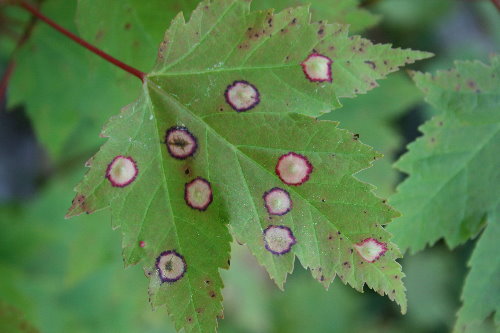
Maple Eyespot Gall Midge, Acericecis ocellaris

I’m disappearing for the weekend to visit my parents for Father’s Day, but as my sister, whom I’m carpooling with, is late, I have time to share a quick photo.

I found this leaf at Maplewood Bog, one of our three MAPS stations. It was near the edge of a poor fen that curls around the northeastern corner of our site, and I spotted it as I walked the water’s edge looking for dragonflies. Leaf galls aren’t that unusual themselves, but this one was pretty interesting for the pattern – perfectly round, pale spots bordered in dark, vibrant pinks and purples. The leaf itself is a Red Maple, an not uncommon species at the site.

Looking it up in my marvelous Tracks & Sign of Insects by Eiseman and Charney, I learned that these are the work of a Maple Eyespot Gall Midge, Acericecis ocellaris. These tiny midges lay their eggs on the underside of new leaves in May; the larvae form these distinctive circular galls while they feed through June. The galls themselves can be variable in colour, from greenish-yellow to bright cherry red, and may or may not have the colour repeated in a central spot to create the “eyespot” of the common name. Eventually the larvae drop from the leaf to pupate in the soil; once they’re gone, the galls turn a uniform brown as the leaf material dies. The species uses Red Maple almost exclusively as its host plant, with just occasional occurrences of galls on other maples and rare instances on other trees.