
So as I said in my last post, this weekend I was in Frontenac Provincial Park participating in the Frontenac Biothon. Dan started the biothon last year with the intention of it being an annual fundraiser for his bird research and monitoring project, Frontenac Bird Studies. Dan is the only employee of FBS; I’m it’s only regular volunteer (he’s had a couple other people come to help out on a few occasions, but he doesn’t have a full established core of volunteers). It’s a small project with a correspondingly small budget, which makes fundraisers like this useful and valuable. The amount that we’ll raise through the biothon may not be much for a larger organization, but it goes a long way here.

Frontenac Provincial Park covers a huge area, more than 5200 hectares (nearly 13,000 acres), and there is only one official road going into it, at the south. There is camping in the park, but it’s all backcountry, and some of the sites are a pretty good hike in (a few are accessible by boat, if you have one, but even some of those require a fair amount of paddling to reach). This provides for some fabulously beautiful scenery at the camp site and a whole lot of privacy – no camp site contains more than four reservable units. The Park has been extremely generous and supportive of FBS and Dan’s research efforts, including the biothon, and we were able to reserve an entire camp site for the weekend of our biothon. We selected camp site 6, which is set at the north end of Little Salmon Lake. Aside from the park ranger who dropped by shortly after I arrived to service the outhouse, and a few people back at the parking lot as we were leaving on Sunday, I didn’t see a single other person all weekend, only our group of biothoners. Just another reason Frontenac is such a glorious park.
There was Dan and I, of course, but we also had two friends of ours up from the Toronto area to help out. They’d joined us last year, too, and now that Dan and I live some distance away this is the only time of year we usually get to see them, so it was great to have them out. We were missing one additional teammate this year who stayed at home with a newborn. Unfortunately, she was our designated Plant Expert, but the rest of us were determined to do our best in her absence.

Dan and the two guys all headed out to another part of the park early Saturday morning while I hiked in to the campsite to get started there. I arrived at the site mid-morning after an hour and a half hike from the parking lot. The park ranger who stopped by said I was welcome to let the dogs off leash while at the campsite to swim, since there was no one else they might bother, as long as they didn’t run off and leave the campsite. Raven was delighted by this. She spent a good chunk of the day paddling in the shallows, chasing minnows, or maybe just the shadows of ripples, I couldn’t really tell. As long as there’s water to paddle in, you can take Raven anywhere and she’ll be happy.

Jack, meanwhile, is not yet so enamoured with water. He went down and checked it out, decided it wasn’t all that interesting, and retired to a patch of poison ivy to watch. The camp site opened up into a weedy, open bank that sloped down to the water’s edge. Unsurprisingly, almost half of it was covered in poison ivy, a plant that likes sunny, exposed forest edges. It’s a good thing that neither Dan nor I react to poison ivy. I sure hope the same is true for our friends; they weren’t complaining of extensive rashes on Sunday morning, at least.

All four of us have the most expertise in birds, but I have a fair bit of experience with insects and plants and was nominated as the biothoner in charge of those groups. While the park checklist does include plants, it doesn’t have insects, so I kept track of everything I saw in a notebook that I carried around with me all weekend. I marked taxonomic headers at the top of each page – “Birds”, “Butterflies”, “Dragonflies”, “Other Insects”, “Mammals”, “Plants”, etc – and then slowly started walking along the path from the campsite, writing down the names of each species I encountered in the appropriate spot. That first hour is a bit overwhelming, where you have to pause every step or two to write down six new names. But once you get all the common stuff listed, it gets easier, and you can start watching for new species. Your eye slides over all the poison ivy and raspberry cane and past the bumblebees and corporals to pick out the less common things. I carried my camera with me and took photos of stuff I didn’t know and needed to look up in my field guides later in the evening, or of things I found interesting.
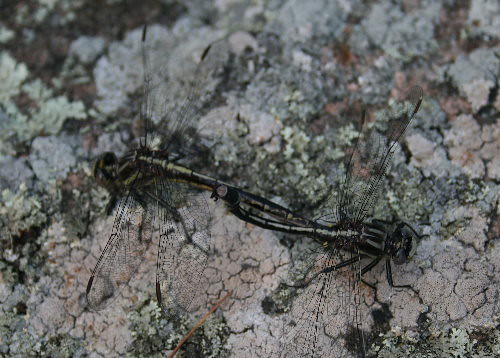
Such as these mating caddisflies, one of the first photos I took Saturday morning. I don’t really know much about caddisfly ID other than to say that there are a lot more species of them than you’d think there were. At my moth sheets in the evening I’m always surprised at the variety. Some are quite tiny, while others are rather large. This pair fall into that latter group. Each was more than an inch long in body (obviously nearly double that when you include the antennae). I always find observing behaviours interesting, so this mating pair caught my eye more than a single individual might have.

A common viney plant that I think was Hedge Bindweed was riddled with holes. The holes were all in the middles of the leaves, rather than cut from the edges, which usually points to adult leaf beetles rather than caterpillars, in my experience. Sure enough, after turning over half a dozen leaves I discovered this guy. I believe it’s a Mottled Tortoise Beetle, Deloyala guttata, which is a relatively common and widespread tortoise beetle. Tortoise beetles typically feed on members of the morning glory family, of which Hedge Bindweed is a part.

In the shaded area around the camping pads I found this guy, the first moth of the biothon for me (if you don’t include all the pale flutterers disturbed from the ground but not positively ID’d while I hiked in). Perched in plain site on the upper side of a leaf, it was doing its best to mimic a bird dropping. It is, in fact, named the Pale Gray Bird-dropping Moth (Antaeotricha leucillana), which is appropriate. I’ve got these from time to time at my sheets, but it’s always interesting to encounter moths in their natural habitat. They seem different somehow, as if out of context, although really it’s the blacklight and sheet that are out of the moth’s natural context.

In the grasses along the sloping banks of the lake there were many dragonflies. Most of them were Chalk-fronted Corporals or Common Whitetails, but I paused to check each one I saw just in case. In doing so I turned up this individual, which I believe is an immature male Calico Pennant. I tend to forget about the pennants, I don’t know why. Every time I find one I’m excited all over again. A pennant! Wow! As it turned out, when I visited some meadow habitat on Sunday I found lots of pennants cruising over the grass there, but this first one got me excited.

Also down along the shore were a number of these plants. They were growing in patches, at the base of the rocks that I imagine would be near the high-water mark. The water was well below that now, but I figured they were water species of some sort. The flowers seemed pretty distinctive and I thought it would be easy to find a match in my wildflower guide, but no luck. Polling my knowledgable Facebook friends later, upon our return, this turns out to be Tufted Loosestrife, Lysimachia thyrsiflora. I did think the leaves had a loosestrifey look to them, but the flowers were completely throwing me off.

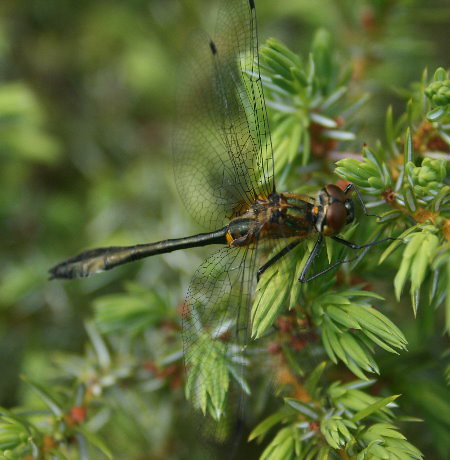
Continuing along the shore a bit farther, I was stopped by a sudden rattling of insect wings. A pair of dragonflies fell from the air to the ground just in front of me. At first I thought it was two trying to mate, but peering closer it seemed to be two different species: what I took to be a clubtail and a whiteface. They wrestled on the ground for a few moments and once I decided that they weren’t a male and female of the same species I thought that it must be the larger one was trying to kill and eat the smaller one. I don’t know if he found the smaller one too much to handle, or if I was misinterpreting what was going on, but after some struggle the smaller one managed to get away and fly off. The only dragonfly that I know will attack other dragonflies nearly its own size is the Dragonhunter, but I don’t think that’s what this one is. I need to invest in a better odonate guide.
All that before lunchtime! I have quite a few photos that I’d really like to share, so I think I’ll wrap up there for today. This will probably need to be at least four installments to fit them all in – more tomorrow!
If you’re interested in supporting FBS through our biothon, we’d be extremely grateful for your donation! All donations over $10 are tax-creditable and will receive a receipt for this purpose. More info at the Frontenac Biothon page, or donate through Paypal below. Thank you!
Frontenac Biothon

.






 seabrookeleckie.com