Sunday Snapshots: Work and play

I’ve been struggling with some particularly debilitating computer malware I unfortunately caught on Thursday – it ultimately required a full reformat of my C drive. Just when I was getting back into the swing of things! More words tomorrow. (I know, I keep promising that. But I mean it this time.)

Family portrait

Work: loosely defined as anything to do with obeying a command. In this case, “stay”. Because I want to pose a self-portrait …

Jack and Raven

… or because I need a scale reference or a point of interest. (Jack’s opinion of work is clearly the same as mine.)

Jack and Raven

But once the work’s done, there’s plenty of time for play.

Jack and Raven

Jack and Raven

Jack and Raven

Jack

Bee fly behaviour

beefly1

I discovered this bee fly hovering along the side board of my raised garden bed a couple of days ago. It’s a Greater Bee Fly, Bombylius major, as told from the plump, furry golden body and the wings with dark fore-halves. I found the observation interesting for two reasons. First was simply the timing. The BugGuide page for B. major notes that the species can be found “from March to May (most common in April)”. Well, here we are at the end of May; it seems a little late for these guys to still be about. In fact, in thinking back on it I’m pretty sure that all of my previous encounters had been early spring. This is probably the latest I’ve seen the species by a few weeks.

beefly2

The second was what the fly was doing. While the adults use that long proboscis to sip at nectar, the larvae are parasitic on the larvae of mining bees. I knew this, so I found it puzzling to watch the fly doing what appeared to my unaided eye to be laying eggs. It would hover in front of the board for just a moment and then land for a few seconds, pressing its abdomen against the board repeatedly while it hung there; can you see that yellow bit at the end of its abdomen, against the board? As I leaned over, peering at it while it did its thing, that little bit of light colour caught my eye so I could observe how the abdomen was being moved. Then it would pop up again, move over an inch or two, land and press its abdomen to the board again.

If it wasn’t laying eggs, I don’t know what it was doing. But why would it have been laying eggs on the boards of my raised bed? I don’t know if the flies lay their eggs directly on the host, or if they lay them in the ground or on a surface and let their maggots find the hosts; perhaps if the latter, it was doing that?

I find behaviour one of the most fascinating aspects of nature (alongside web-of-life level ecological connections), but it’s also one of the hardest to get answers for, especially since you can’t just ask the organism, “why are you doing that?” Anybody want to offer a hypothesis on this guy (gal)?

Signs of age

CHSP2

During the process of bird banding, several bits of data are collected on each bird captured and banded. Species is recorded, of course, and measurements are taken on how much fat it’s carrying and the length of the wing. Sex is noted, if possible. And the age. Ageing birds has always been my favourite part of the banding process; I find it fascinating that it’s possible at all to determine how old a bird is. Not only is it possible, it’s actually not all that hard.

The theory of ageing birds is based on molt patterns. Many birders are familiar with the concept of graduated plumage from gulls and eagles, but passerines (songbirds) can and do show a type of graduated plumage, too. For most species of birds, the end-of-summer molt undertaken by a young-of-the-year bird will be different than that for an adult, an individual that was a parent that summer. Young birds grew a full set of feathers while in the nest, of course. Feathers are very energetically costly to grow, so if the bird can avoid having to grow a whole nother set of feathers so soon after the first set, it will. As a result, hatch-year birds will only replace a subset of their feathers during their end-of-summer molt. How many and which ones varies from species to species, but very few species will replace all of their feathers as a hatch-year bird.

The adults, on the other hand, are wearing the same feathers they’ve had since the last year’s end-of-summer molt (some might have replaced their body feathers back in the spring, but very few will also replace wing feathers in the spring). After a year of use, of being subjected to wind and sun and thick vegetation, they’re a little worse for wear. At that end-of-summer molt, the adults will replace all of their feathers. And while they replace them sequentially, the timing is close enough together that they appear to be relatively the same age.

Compare that to the feathers of the hatch-year bird. Feathers grown as a nestling tend to be poor-quality: they’re grown all at once, and very rapidly – you can guess just how energetically costly this would be. To try to minimize the costs, the feathers grown are usually slightly narrower and shorter than those grown by an adult bird, more tapered at the tips, are less richly coloured, have fewer barbs, and are weaker such that they fade and wear faster than adult feathers. The feathers replaced in the end-of-summer molt, because the bird has more time to grow them, typically look like those of adults. Even though it may only have been two to three months between when the nest feathers are grown and when the end-of-summer molt is completed, there is often a noticeable difference between feathers of the two ages. This becomes even more pronounced by spring.

The bird in the top photo replaced the topmost tertial (the tertials being the three layered feathers that line up all in a row when the wings are folded) during its end-of-summer molt last year, but not either of the two lower tertials. The difference is subtle, but visible if you know what you’re looking for. The feathers are a richer, darker brown, with richer, wider edging. There’s a little bit of wear at their edges, but that’s to be expected with feathers that are exposed all of the time, and the wear along the outer edge isn’t as great on the upper tertial as it is on the lower two. This visible difference in age, called a molt limit, tells us this bird was hatched last summer.

The bird below is the same age; it was also hatched last summer. But the reason we know this is different. For some reason, this bird has had to replace all of the tertials and some of the inner greater coverts (those shorter feathers at the top of the tertials) on its left side. This might have been a run-in with a predator, maybe a fight with another bird, perhaps feather mites or some disease like that; I don’t know. Whatever the reason, it’s had to replace these feathers independently of its usual molt – we know this because all molts, whether hatch-year or adult, occur symmetrically on both wings. These feathers are relatively fresh. Dark, broad, richly-edged, these are adult-type feathers and it’s pretty easy to see the contrast between them and the hatch-year feathers on the right wing. Having them side-by-side like this makes the differences especially apparent. You can even see how the hatch-year feathers are shorter than those of the adult.

It’s obviously a lot harder to see molt limits on live birds in the field than it is while they’re in your hand, but in a few species it might be possible to spot them on birds at your feeders, for instance. The second bird here would undoubtedly stand out. It’s kind of neat to be able to look at a bird and know its age.

CHSP1

PFG to Moths, status update

And, I suppose, an update on me. I’m still here! And just fine, though I’ve been really busy the last few weeks. I’ve been working five days a week at Innis Point Bird Observatory since the end of April, which amounts to the same number of hours as if I were working a typical 9-to-5, except I’m getting up before 3:30am every morning to do it and then I spend seven hours largely on my feet. Needless to say, by the time I get home I don’t have a lot of energy for things, and what energy I do have has to be judiciously distributed among my main priorities. Lately one of said priorities has been the moth guide; since I know all of you are eagerly looking forward to getting your hands on a copy the moment it’s available, David and I have been working the last couple of weeks for its prompt return to the publisher to ensure no delays in its publication.

I’ve found being involved behind-the-scenes on this project incredibly enlightening as to what goes on in the production of all those volumes resting on my bookshelves. I’m not sure I’d ever really given much thought to how they came to be, or if I did it was simply along the lines of author writes book, publisher publishes book. But there many more steps, and a lot more people involved, than that. The author(s) writes the book, sure, and submits it to their editor. But their involvement doesn’t end with the manuscript’s submission. The editor goes over the whole thing and sends it back for correction/revision. Then a copyeditor goes over the entire book again. That’s the stage we’re currently at.

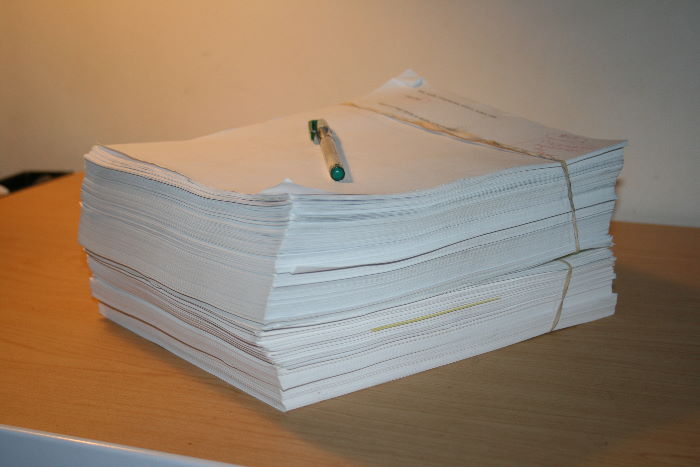
The copyeditor is a godsend. Their job is to make sure the author doesn’t look like an idiot. They go through the manuscript with a metaphorical fine-toothed comb, cross-checking the details to make sure no mistakes or dumb goofs have slipped in. And believe me, when you’re working with something of this complexity, mistakes will slip in. It may be something as simple as forgetting to write in the host plants for one species. It may be misspelling the name in one spot. Realizing you left out an oft-used technical term from the glossary. Omitting the male/female plate labels for a species. Inconsistencies in vocabulary, calling the tree a tamarack in this account but eastern larch in this other; or calling a species a leafroller here but a leaffolder there. (Works of fiction also have copyeditors, incidentally; they’re looking for inconsistencies in plot or scene or other loose threads.) I must admit, I had gone through the manuscript before submitting it last fall, so I was a little dismayed be the red pencil all over it when the 4.5 inch stack of paper was returned to me. Dismayed, but very grateful.
I thought it might take me six or eight hours to work through all the corrections, and figured I could get it done in one full Saturday of work. But, as it seems I do at every stage so far, I severely underestimated how long it would take. (I honestly have a whole new respect for the authors of the field guides on my shelves. It might not be complicated, but it’s a helluva lot of work.) Some 30 hours later I finally bundled up the last of the papers into the box they were sent in and took them back to the post office. Needless to say, this has taken up most of my spare waking hours for the last couple of weeks, and I didn’t have many to spare to begin with.

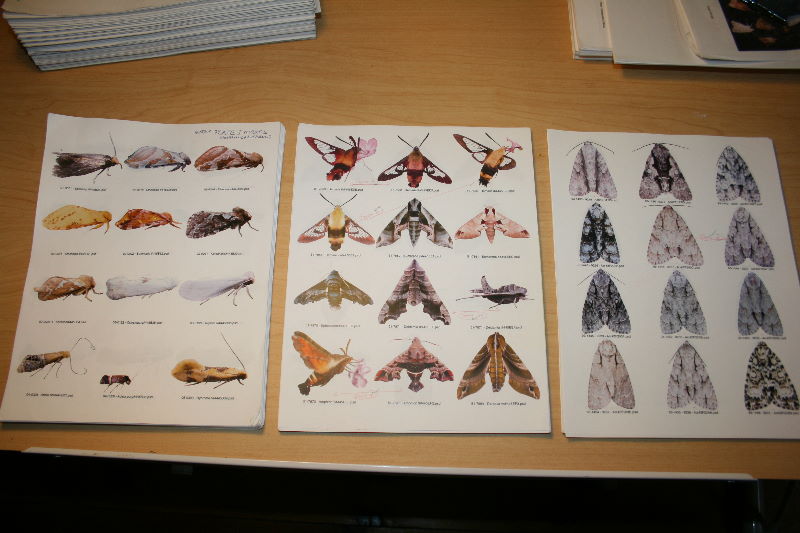
Still, it was pretty neat to see the book moving forward. The part that really made it seem real to me, like it was actually going to become a bunch of pages bound inside a cover, were the images for the plates. All laid out together in rows, the moths clipped out and on a white background, it was already starting to feel like a guide. Once the publisher receives my box next week the materials go on to composition. Some poor person will spend the next several weeks taking all of our bits and pieces from their many sources and bringing them together in one spot, for species after species. We’ll have an opportunity to look over the first couple that get done, to ensure that it all looks correct before the compositor does four hundred of them. Then once the compositor is done, we’ll have another round of proofing, this time going over the laid-out plates. It’ll really be starting to look like a book then.
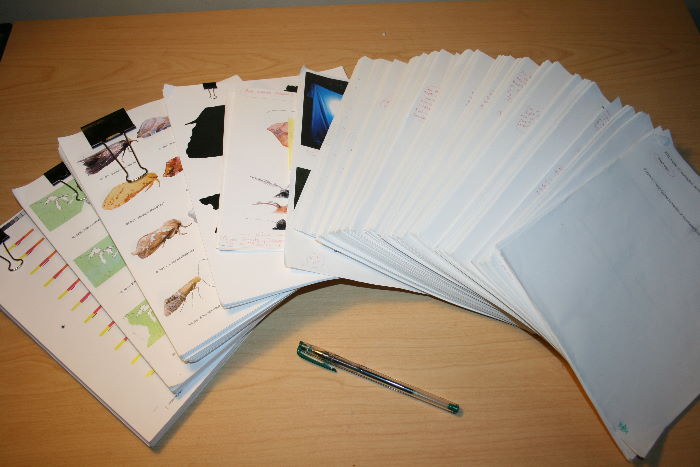
Here are all the different components of the book, sent to us for our review of the copyeditor’s mark-up. From left to right: the graphics illustrating the flight period for each species, the range maps for each species, the plate images, the endplate (inside-cover) silhouettes, the terminology diagrams for the introduction and the endplates, the photos for the introduction, and then the full manuscript, including the intro and end materials and the species accounts themselves. Each species has components in five spots (flight period, map, image, species account, checklist entry) and trying to keep track of everything can get a little confusing!

Now that that’s been mailed back, I’m hoping to get myself back into the habit of posting every two or three days here. I’ve got a huge backlog of photos that need clearing out, and now that summer’s arrived there’ll be more coming in every time I go out hiking. The posts might be a little shorter, but shorter is better than not at all. ;)
