Sunday Snapshots: Squirrel update

Red Squirrel baby girl

I had grand plans for productivity this weekend. And while I was, in fact, extremely productive, it was on none of the things I had really wanted to be productive on. I spent some 15 hours this weekend working on the moth guide manuscript edits… but more on that tomorrow (hopefully). At some point, I keep telling myself, life is going to calm down a little again and I can resume my normal routine. In the meantime, some photos.

On Friday I returned to the nestbox in our garden to check up on the baby Red Squirrels. They’ve grown a lot since my last check and are now covered in recognizable fur. You can even see the dark stripes along their flanks. Their eyes aren’t open yet, though, and their noses are still very underdeveloped (or overdeveloped, depending on your point of view). They’ve still got a bit of growing to do before they’re going anywhere.

Red Squirrel babies

This time I pulled them all out of the nest to see how many there were, and of what sexes. There were five: three females and two males. The individual I took the single photos of is a little girl.

Red Squirrel baby girl

Gifts

Blue Jay feathers, Giant Water Beetle elytra, Mourning Dove egg

Like any thoughtful Significant Other would, Dan brings me gifts regularly. But unlike the usual bouquet of flowers or similar traditional items that most women probably get, my gifts are from nature, and perhaps the more thoughtful for it. I’ve had a little collection of such items on the shelf in my study, and when Dan brought me another the other day I decided I’d put them all together for a blog post.

The Blue Jay feathers have been on my shelf for a little while. I didn’t actually ask where specifically he picked these up from, but a jay was partially de-feathered along the trail back in our fields a few months ago, so perhaps it was from there. Blue Jay feathers are so pretty, such a surreal cerulean blue, a shade not well-captured in photos on a monitor. He just gave me the two feathers, shown here; can you tell from which part of the bird they came? The one on the left is a tail feather, while the one on the right, the one with the white tip, is a wing feather. The easiest way to determine this is by the placement of the feather shaft. On the tail feather it’s almost directly down the center of the feather, while on the wing feather, it’s offset slightly to one side. This offsetting actually tells you from which wing it came from, too; the shaft is closer to the outside of the wing than the inside. So this is a feather from the left wing. Blue Jays only have white on the tips of their secondaries, not the primaries, so we can narrow it down even further to a secondary on the left wing of a Blue Jay. Most passerines have 9 primaries and 9 secondaries, three of the latter group being shortened and modified to form the tertials, leaving only six full-length secondaries. We can tell within six feathers where this one came from on the bird.

The beetle bits are pretty neat. Dan found the single elytra, on the left, first and brought it back for me. I knew what it was from the size and pattern: it’s from a Giant Water Beetle, one of which I’d found at about this time last year. A few days later he found another, this one nearly intact except for missing its abdomen. Even the legs were still there, curled underneath. The interesting thing about the second, nearly whole one is the obvious puncture in the middle of the back. Was that made by a sharp bird beak? Or by the canine of a hungry raccoon? I asked Dan’s opinion, and he thinks it’s definitely a bird predation; I’m inclined to agree. We mused over what would be small enough to make a hole that size, that would be feeding along the water’s edge; his suggestion was grackle. All of the blackbirds have narrow, pointy beaks that would fit that size, and would forage at the edge of the pond, so this seems like as good a guess as any to me.

And the third item he brought to me Raven actually found. It was an egg that she’d picked up from under the cedar bushes near our house. Dan retrieved it before she’d damaged it too much; we’re not sure if she’d found it on the ground or where it came from, but couldn’t see a nest in the cedars. Dan’s guess is that it was from a Mourning Dove, which seems about right in terms of size and colour. He suggested I open it up to see if anything was inside.

Mourning Dove embryo

So I did. And there was. At first it looked like it was just a lumpy blob of yolk, but then I noticed a darker bit at one side, partly concealed.

Mourning Dove embryo

Finding a twig to use, I gently cleared away the yolk sac to expose the dark area. It turned out to be an embryo, still small, only about a centimeter (< 1/2″) long. The dark spots are its eyes, and its body curls beneath its head. Look at the network of arteries that has developed, running through the yolk to absorb the nourishment the chick needs to grow; the bird’s equivalent of our mammalian umbilical.

Mourning Dove embryo

I stretched it out away from the yolk for a better look. Check out the tiny, translucent beak, the developing wings. You can see the rudimentary thumb on the wing, near the bend. Notice the pale spot in the eye. Birds have a ring of bone inside their eyeball, inherited from their reptilian ancestors, called the sclerotic ring. It serves to strengthen the eye and is often found in animals that lack spherical eyeballs. The pale spot is the hole in the center of the sclerotic ring.

Mourning Doves have an incubation period of about 14 days. Diagrams on this page (which is for chickens and therefore an incubation period of about 21 days) suggests the embryo is about halfway through its development; perhaps 7 days old for this Mourning Dove chick.

Check out this list of developmental events in the growth of a chicken embryo (taken from that same page). Look at how fast those first stages happen! And now think of it sped up by a third again for a Mourning Dove chick. Pretty amazing.

First day
16 hours – first sign of resemblance to a chick embryo
18 hours – appearance of alimentary tract
20 hours – appearance of vertebral column
21 hours – beginning of nervous system
22 hours – beginning of head
24 hours – beginning of eye

Second day
25 hours – beginning of heart
35 hours – beginning of ear
42 hours – heart beats

Third day
60 hours – beginning of nose
62 hours – beginning of legs
64 hours – beginning of wings

The first spring babies

(American) Red Squirrel mother

A few weeks ago, Dan commented to me that he’d seen a (American) Red Squirrel sitting atop the nestbox we have in the garden by the house. It had been chewing at the entrance hole, and when he’d peeked in there was a fair amount of soft strips of cedar bark. I kept meaning to go back out to investigate, and Dan kept meaning to look into ousting the critter in the interest of saving the box for the birds, but neither of us ever got around to it.

This afternoon, before heading out for a walk with the two dogs, I did a loop about the garden to see how things were growing. As I approached the nestbox I could see a small, fuzzy nose sticking out of it, enjoying the sunshine. She didn’t move as I approached, and only withdrew slightly when I reached the base of the box. I could see her dark eye peering cautiously out at me from the darkness.

(American) Red Squirrel mother

Curiosity piqued by the fact that she didn’t leave, I climbed onto the milk can still sitting below the box from last year. I lifted the lid slowly, not sure if she might turn around and jump out at me now that I was so close. But she didn’t move. I lowered the lid, turned my camera on and adjusted the settings, then lifted it again. Still she sat motionless, head turned slightly to glance over her shoulder at me. I snapped a photo, the camera held in the air in front of me since the nest box is just a shade too high for me to look through the viewfinder while aiming. Finally, as I opened the lid the rest of the way, she dashed out through the entrance hole, down the box to the pole, then jumped to the ground where she scurried to the nearby spruce to hide.

Baby (American) Red Squirrels

With her gone I felt safer leaning over to peer inside. All I could see was a mass of cedar, so I held the camera up directly over the open top to shoot straight down at what I couldn’t see. It wasn’t much help. Still, just a mass of cedar strips.

I was about to shrug and close the lid, figuring she was just using it as a sleeping chamber or perhaps was still building it, when I heard a few soft peeps coming from inside the box. Babies! Or I sure hoped it was babies, anyway.

We don’t seem to have a stepladder, so instead I retrieved the bar stool from the kitchen and set it up in the garden below the box. Standing on it I was just tall enough to peer over the side of the box to see the contents. I wasn’t sure whether squirrels, being mammals, would be put off by human scent (birds aren’t, but that’s because they have a lousy sense of smell), so I used a twig to manipulate the nesting material, opening up the narrow tunnel by pushing the cedar to the sides of the box (an effort that was only moderately successful as the bark strips seemed especially springy).

Down at the bottom I could see pink things wriggling. Again I heard a few peeps. Then one rolled over and there was the cutest, tiniest, most delicate little paw.

I tried taking a couple of photos from above the box, but getting the focus was difficult since I couldn’t look through the viewfinder. I tried half a dozen, putting the camera on a manual focus and moving it up and down above the box, but this was the clearest one I got. And you still couldn’t see much. It could simply be a pile of beach stones in there, for all you can tell.

Dan came around the corner then and asked what I was looking at, to which I enthusiastically replied, “She has babies!” I asked whether he thought she’d desert if I touched them. He offered his opinion, but suggested I ask Google, who always seems to know the answer. So I did. And was assured that a mother squirrel will not be put off by people-smell. (This probably makes sense, since the nestbox probably also smells a bit like people.)

Baby (American) Red Squirrel

Which meant that I could carefully lift one out for a photo without fear of repercussions. And, I’m sorry, after seeing that little pink foot, I just had to.

When I place the small, squirming body on my palm I just about melted from the cute factor. It was so tiny! With little bitty ears and little bitty toes and a little bitty tail. Its eyes were still firmly closed, and if it had teeth it didn’t recognize the need to use them. It paddled a bit with its paws (awwww!), pulling itself across my hand, but that was all.

Baby squirrels open their eyes at age 4 weeks, which makes this guy younger than that – not that that’s a surprise. One chart I found suggested that at the point where their pink skin starts to darken on the head and back they’re between 2 to 3 weeks. That might be about right, if it took the mother a few days to a week to build the nest.

Baby (American) Red Squirrel

Look at that face, those tiny ears! The wrinkles of skin at his neck! You can see the down starting to cover his head. He’s even starting to get whiskers, at his muzzle and below his eyes.

Baby Red Squirrels grow at a rate of nearly 2 grams (1/14 oz) per day (from a starting birth weight of 10 grams / 1/3 oz); at just past 40 days old, about six weeks, they’ll leave the nest with their mother. They stay with her for some time yet after that, even continuing to nurse for up to another month. They don’t reach adult size till four months; we’ll have baby squirrels to look forward to seeing.

Dan joked that we’ve been doing a great service for the local Red Squirrel population, helping them to increase their numbers. When we moved in, we were lucky if we even saw one on the property, and they never hung out by the house. Then we put out birdfeeders. Then the squirrels discovered the feeders.

Good thing they’re cute.

Moth-hunting

Canoe Lake

!!!!! I prepared this last Friday (the 22nd), and thought I had posted it then. I just now noticed that WordPress didn’t publish it (or I forgot to hit the button?). Ordinarily I double-check to make sure it appears okay, too.

In the meantime, I’ve recently started a short-term job working as the bander-in-charge at Innis Point Bird Observatory – a post I also held last spring. I’m up at 3:45am (and getting earlier each week) so despite that I’m home by early afternoon I’m actually shorter on time. I’ll try to post regularly, as I can. Now, if only spring would hurry up and start happening instead of this dreary trickle we’ve been subjected to this year.

My image-editing program broke this week. If there’s one thing that inconveniences a photographer more than a broken camera, it’s broken editing software. I’m not quite sure what went wrong, but it required a full re-install, which meant digging out the installation files, uninstalling the previous copy, re-installing the program again, and then organizing all my internal settings again (I like my software to be just so). I’ve been putting it off because it’s a pain, but I finally got around to it this evening because I have some photos, taken today, that I’m looking forward to sharing.

I’ve been planning for a little while to make a trip back to the area where we used to live, near the lake house, to look for Infants, those early-spring day-flying moths. Although I could, in theory, find the species just about anywhere where the host species grows, they were just so abundant along the road near the lake house. But not only that; there was also that rare one that I found there, and I was keen to see if I could locate it again. I had intended to make a trip down last spring, but between one thing and another I never made it. I resolved I would definitely go this year.

Birches along Canoe Lake Road

And then this spring turned out to be cold. Cold and rainy, and slow, slow, slow in coming. We’re lagging about two weeks behind where we’ve been at this date the last couple of years. Our wildflowers are only just beginning to bloom. Insects have yet to emerge in any numbers. Migrant birds are running behind schedule. And we’ve only had a couple of those absolutely gorgeous days that one looks forward to at the start of spring. I’d been waiting to make my trip down to Frontenac, first for nature to get a move on, and then for a good day weather-wise to go. I was looking for something in the high teens Celcius (sixties Fahrenheit), sunny, and preferably not too windy. I waited… and waited, and waited.

Finally, today, I bit the bullet. It was a mild day, if not really warm, it was sunny, and the wind was light enough that in the shelter of the forest it wouldn’t be a problem. Given that on Sunday I’m beginning work running the bird banding (migration monitoring) program up in Ottawa, I was out of chances to get this trip in. So today it was.
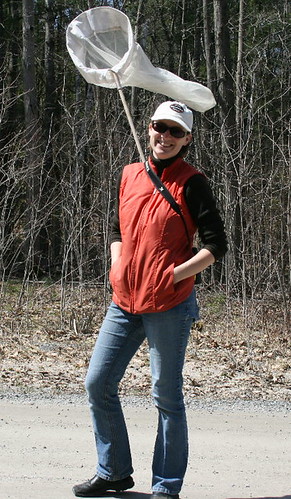
Moth-hunter

Since I had a particular goal in mind I wanted to be prepared in case I should actually find my target species. I brought my camera, of course, but two lenses: the wide-angle for landscape shots and my macro for insects and flowers (I also had the telephoto, but after a bit of debate decided to leave it in the car). I brought my binoculars, for (hopefully) checking out any fluttery insects from a distance to decide if they needed to be snuck up upon. Also for looking at birds. I brought my bug net, just on the off chance that the moth wasn’t being cooperative and settling on the road for a photo; I could scoop it out of the air if it came down to it. I brought moth jars, and stuffed three of them in my back pocket to have close on hand. And I brought a cooler containing ice packs (which I left in the car), so that when I snagged the uncooperative moth and put it in a jar I could then put it in with the ice packs to cool down (hopefully) for a photo.

I walked about 5 km (3 mi) along the roads from where I parked my car, checking out the spots where the moths had been most frequently encountered a couple of springs ago. I saw quite a few other things, but lepidoptera were not in great abundance, and I didn’t find any of the moths at all. I’d gone with the expectation that I probably wouldn’t find the rare species, but I didn’t even see a single individual of the common one. Was I too late in the season? Was it too cool out? Too windy? Too much road traffic? (Being Good Friday, I had probably fifteen cars pass me in the two hours I was out there, which is pretty busy for that area, at least compared to what it was when we lived there.) Maybe it was simply that I jinxed myself by being over-prepared.

Round-lobed Hepatica

I was a little disappointed to not find any at all, but it was still a really nice outing. I spent two hours outdoors enjoying the sunshine and checking out flora and fauna. One of the first things I noticed was that the hepaticas were all out in full bloom. We don’t have hepatica up at our current house, but none of our other wildflowers are blooming yet, so this was a pretty nice surprise. Various shades of purples and pinks and whites, little patches of colour dotting the forest floor.

Coltsfoot

Also blooming was coltsfoot. Some patches of it can be quite large. It seems to like damp or poorly-drained areas (but not wet), and also favours disturbed habitats; I find it most often in the ditches along road edges where the ground gets a bit soggy. It’s an interesting plant in that the flowers come up before the leaves do.

Bloodroot

I saw two individual blooms of bloodroot. The landlord has some planted in our garden, right near the foundation of the house, and they’ve been up and blooming for about a week now, but I haven’t seen any yet growing wild in our woods. These are one of my favourite wildflowers, so I was pleased to discover a couple.

Male Wood Duck

As I was heading back to the car, having turned up nothing, I paused to listen to a funny bird call. I didn’t immediately place it, but it was easy to spot the caller, perched up in a tree: a Wood Duck! I can never quite get used to seeing a duck perched in a tree, despite knowing that Wood Ducks come by their name honestly. Both the male and female were perched there, though I didn’t immediately see the female and she wasn’t visible in the photo I took. Presumably they were scouting for a nest cavity. Wood Ducks will nest up to 2 km (1.2 mi) from water if cavities are hard to find; these guys weren’t nearly that far, only a few hundred meters.

Morrison's Sallow

While I was standing still, watching the ducks, I noticed (and was noticed by) a moth. It flew back and forth and up and down the section of road a few times, but when it came close to me it seemed to be attracted to something. I thought at first it was maybe the white bug net, or my white hat, or perhaps the orange vest. It landed on me a few times (once even on my sunglasses!) but when I went to peer at it, or even when I flipped the on switch of my camera, it took off again. It seemed disinclined to settle on the road for some reason, but I stayed patient with it, hoping it might put down somewhere. Well, it did – on my camera lens! It started dabbing with its proboscis, obviously picking up the salts from my palm (I wasn’t sweating, so there couldn’t have been much). I was able to coax it off the lens and onto my palm, where it started walking about and then up my arm. It finally stopped at the edge of my shirt (which was pushed up to my elbow; not the most convenient for photos, macro lens notwithstanding).

Check out the little hairs on its proboscis; I presume these are used to trap nectar when it’s drinking.

Morrison's Sallow

After taking a few shots, I touched it gently to try to get it to move back to another position, but instead it let go of my arm, folded its wings and dropped to the ground. This is a defense mechanism used by many species when disturbed: a fast and inconspicuous way to escape from a potential predator.

Once it was on the ground I could finally get a good look at it to identify it: it’s a Morrison’s Sallow, a relatively common species at this time of year. But since the Infants were a no-show, I’d take what I could get. :)

Pseudexentera sp. or related

This was the only other moth I found. There were a couple of these, and I haven’t bothered identifying it to species, as moths in this group can be tricky. However, it looks like a Pseudexentera sp., or something closely related. Little micromoths often encountered out during the day.

Spring Azure

I saw only two butterflies; one was what looked to be a Compton’s Tortoiseshell, fluttering in the tree canopy, and the other was this little guy, a species of blue. I always have to double-check my blues when I get home to be sure, but it turned out I correctly guessed on the ID of this one: a Spring Azure (Celastrina ladon), one of the first blues to be seen. Or, it could be the very closely related Lucia Azure (C. lucia), which the Kaufman butterfly guide notes, “The ‘spring azure’ in the northeast may actually be C. lucia“, though beyond this no notes are offered for specificity or overlap in range.

So all in all, a good outing, even without the Infants. Perhaps next year!

House Sparrow

Young male House Sparrow

About a week ago we had an unusual visitor to our feeders. The visitor himself wasn’t all that unusual, but his presence at our feeders was. It was a House Sparrow, what seemed to be a young male, all by his lonesome.

House Sparrows, like starlings, are among our most well-known and widespread of North American species (somewhat ironic that they’re both introduced), and yet neither occur with much regularity in the rural landscapes where I live or have lived. This is the first House Sparrow I’ve ever had visit one of my feeders (with the exception of the couple of years spent in town, of course). In the country, they’re almost exclusively associated with farms where they pick through spilled grain and the grass seeds from hay.

I love House Sparrows. If I had to draw up a list of my top five favourite species, House Sparrows would be in there somewhere. There’s just something about their ever-cheerful chirps that can warm my heart even on the coldest or wettest days. If I hadn’t had House Sparrows or starlings about during the years that I lived in town I think I would have had a much harder time dealing with living in an urban environment.

Young male House Sparrow with American Tree Sparrow

And yet, when I saw this guy at our feeder, I had very mixed feelings about it. On the one hand, it was pretty cool to see a new bird for our yard, and one of my favourites, at that. But on the other, I worried for our Tree Swallows and bluebirds.

House Sparrows are notoriously vicious birds, when it comes to disputing property rights. If they want a box, by the phoenix’s last feather, they’re going to have that box. Even if it means murdering the previous tenants. They can not only oust your native residents, they can really damage your local population, because the youngsters from a successfully fledged brood will return to their natal territories and set up shop themselves and before long you’re supporting a small colony of them. Then it becomes a lot of work to try to cull your colony (like Julie Zickefoose was forced to do a few years ago; what happens to the sparrows after they’re caught is up to you, but since they’re non-native and not part of the Migratory Species Act you could choose to keep them as pets instead of euthanizing them) in order to let the native birds come back.

Still, one sparrow does not an infestation make, and I figured we’d just let him be unless I saw him eyeballing any of the boxes, or hanging out with a girlfriend. In fact, he seems to have moved on since then; we haven’t seen him in a few days.

Young male House Sparrow

You might be surprised to learn that the House Sparrow is actually declining in Ontario. Between the first Ontario Breeding Bird Atlas and the second (a span of 20 years), the probability of observation* for the species declined by a statistically significant 20%. Most of this decline took place in the Lake Simcoe-Rideau and Southern Shield regions. The border defining the separation between these two adjoining regions is the southern edge of the Canadian Shield, and helps to explain why these are the regions most affected. These areas represent marginal farmland at best, and as agriculture became more industrialized, especially in the prime farming locations in the east and southwest of the province, these low-quality farms were abandoned or allowed to grow in such that they’re no longer suitable for House Sparrows. That said, similar declines have also been noted in Breeding Bird Surveys across Canada as well as in Christmas Bird Count data.

*The probability of observation is one of those annoyingly specific, technically-correct terms that had to be implemented for the atlas to convey what it was the statistics were actually calculating. Because of the way the data was collected, there was no way to compare absolute numbers of the populations of species. Even the absolute number of atlassing squares the species was found in can’t be compared perfectly because of an increase in effort during the second atlas. So what they’re comparing is the probability that the species will be detected in any given square within the first 20 hours of fieldwork.

Young male House Sparrow

The black bibs of House Sparrows are a social signal. Many studies have shown that the most dominant males (often, but not always, the oldest) have broad, solid black bibs while young and/or subordinate males have smaller, mottled bibs. (Wikipedia suggests, however, that other studies have not concluded this.) This guy is clearly ranked somewhere at the bottom end of the pecking order. I can only presume that he’s scouting the landscape, looking for a place to set up his own territory. Since House Sparrows are largely sedentary, rarely moving more than a few kilometers/miles, I suspect he came from the sheep farm at the end of the rail trail that I often walk to with the dogs, where I often hear them chirruping. I hope he found a nice place to call home – preferably somewhere away from bluebirds and other native cavity nesters.