
Doe, a deer

deer3

A few days ago we had a deer wander through our front yard. Dan noticed her while she was browsing along the side of our driveway and called me down. I took a number of photos as she wandered slowly through, not far from the house, before finally heading off to the forest across the meadow.

I don’t see a lot of deer, but they’re definitely around: I see tracks regularly once the snow falls, and the dogs have made an art out of sniffing out piles of deer droppings to roll in. We’ve startled one or two while out on walks, but for the most part rarely encounter them during the day. The last time I recall seeing a lot of a daytime White-tail on our property was when Joe Buck came to visit a couple of Thanksgivings ago.

deer2

Joe Buck was, of course, a buck; this one’s obviously a doe. Around this time of fall deer are starting to enter the annual rut, when the females go into estrus. Males will get so caught up in their pursuit of females that they’ll stop spending much time eating; besides the size of his antlers, Joe Buck was always foraging when we saw him so I knew he was a youngster. The females, however, go about business as usual. I’m not sure, therefore, if this female is old enough to mate. Does don’t reach sexual maturity until their second fall, but I don’t know if their behaviour changes much between their first and second year, the way it does with males.

deer1

About 30 subspecies of White-tailed Deer are currently recognized. Ours is Odocoileus virginianus borealis, which ranges from western Ontario to eastern Canada and neighbouring states south to southern Ohio and New Jersey. Like most animals, the subspecies of the north are larger-bodied with smaller extremities. Deer in southern parts of the continent can be noticeably smaller, with larger ears and longer legs. Beyond that, there are some differences in the tone of body colouration or antler size… but for the most part they seem to be subtle and sometimes gradual and indistinctly defined to populations. The only really distinct populations seem to be fairly isolated, such as those on islands. The smallest are the White-tails of the Florida Keys, which only reach a height of 24 to 30 inches at the shoulder (compare to 4 feet for our northern deer).

I find that white throat patch interesting. I wonder if it serves a purpose? I started out checking the subspecies descriptions to see if it was perhaps present in some but not others, but doesn’t seem to be mentioned, as far as I can tell.
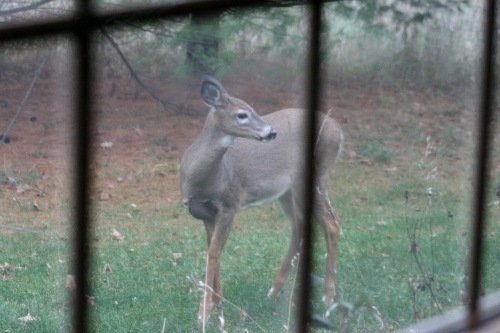
deer4

She came right up to the garden and nosed around a bit but didn’t seem to find anything to her liking. When Joe Buck was coming around, he’d nibble on my hostas and some of the other plants there. Deer can often be a problem in gardens, but we haven’t had trouble with them here. Maybe I’m just not growing appealing plants.

The very last moths

38-7437 - Operophtera bruceata - Bruce Spanworm

Last night as Dan was going to bed he told me there were a couple of moths at the front door. It had been a lovely afternoon, very spring-like in its mildness, but it was still quite chilly by the time the sun set. When I went down to check out the moths, the thermometer read 2°C (35°F), which is hardly a temperature that a moth should be out and about at.

But some of my surprise disappeared when I saw which species the two moths were. Both at the front light, and three more individuals at the back light, were Bruce Spanworms (Operophtera bruceata). Up here where I live, these are usually the last species of moth I see flying each fall. They’re particularly cold-hardy and I often see them active at temperatures that would keep most other species from flying (such as last night). They’re frequently seen out and about during the day, too, pale fluttery insects that catch the low autumn sun on mild afternoons.

The appearance of the Bruce Spanworms heralds the end to the mothing season for this year. Now that it’s November (how did that happen?) there may only be a couple more nights where the temperatures are warm enough for stuff to be flying, and like last night, they’ll likely be mostly these spanworms. Time to pack up the lights and the sheet and the jars for another year. They’ll be tucked away in the basement for the next four months, awaiting the first moth of spring on a mild evening in March.

Moth Surprises

93-1998 - 9699 - Condica sutor - The Cobbler2

It’s starting to get late in the season for moths. I’ll still see the odd one through mid-November, probably, but the numbers and diversity are rapidly decreasing. Most nights are single-digits Celsius and the warmer nights tend to be rainy, so I don’t put my light out often – the return isn’t usually worth the energy expended (mine or the electricity). That said, though, every now and then I’m happily surprised at what turns up.

Last week, for instance, I put my light out one warmish evening. I only got a dozen moths or so, but one of them was the above. I didn’t immediately recognize it – itself a sign that it’s probably something unusual, or at least a new species for me (still being a relative youngster in the mothing world, at just four and a half seasons’ experience, this still happens with some regularity). So I jarred it up and put it in the fridge to get a photo and ID the following day.

I had my suspicions about the ID – my gut instinct was a type of groundling. I opened my folder of guidebook jpgs in Windows Explorer and searched the images for ‘groundling’… but neither seemed right. So I tried a few other possibilities that were my second guesses, and when they proved unsuccessful I went back to the start of the noctuids and began scanning one by one. It turned out I’d been right – it was a type of groundling, but its common name didn’t contain the word groundling so it didn’t come up in my search. This is The Cobbler, Condica sutor, indeed a species I hadn’t seen yet. Happy with the ID, I labeled it and filed it away.

The following day I was working some more on the moth guide proofs and happened to notice the species account for The Cobbler. Its map, I noted, seemed to indicate that the species was Carolinian and south in distribution. It only snuck into Ontario in the southwest. My Ontario annotated checklist confirmed this. I’m quite some distance from southwestern Ontario… did I have the ID wrong?

Chris Schmidt at the Canadian National Collection in Ottawa (with whom I’d been corresponding about some stuff for the guide proofs) confirmed it for me: yes, it was The Cobbler. The species is migratory and prone to wandering in the fall, with records occasionally outside of its usual range. And while my house is quite a long way out of its range, it’s not impossible. Still, the Ontario checklist gives Guelph as the closest Ontario record; the guide to Québec moths has no records at all. The records from BugGuide are all mostly southern, with the exception of one in Illinois. So that’s pretty cool.

42-6570 - Aethalura intertexta - Four-Barred Gray2

Then a couple of nights ago I noticed a moth hanging on the screen of one of our ground floor windows, attracted to the light from the floor lamp there. It was clearly a geometer by the spread wings, but it wasn’t the shape of any of the geos that are familiarly flying right now, so I went around to check it out. This one was easier to ID, since it’s a common enough moth: it’s a Four-barred Gray, Aethalura intertexta.

What’s unusual about it is the timing. I haven’t seen a gray in weeks, going on months. Curious, I checked the flight period indicated in our guide: April through August, it said. BugGuide has images from April through July. All but one of my personal records are from April and May; that one exception is from August. Sooo…. mid-October? What was it thinking?

05-0367 - Acrolophus morus - Dark Grass-tubeworm

This one was unusual only in that I’d never seen the species before. This is a Dark Grass-Tubeworm, Acrolophus morus. It had been sitting on the outside of the back door at Dan’s mom’s house when we were there at Thanksgiving. We were preparing to head back home after an enjoyable weekend of visiting, so there was some activity as we went in and out of the house, but the moth didn’t seem to mind. Dan was the one to point it out to me. I had a feeling what it was but had to wait till I got home to confirm.

38-7217 - Thera juniperata - Juniper Carpet

And finally… this one is a Juniper Carpet, Thera juniperata. It was hanging out on the front door of Dan’s mom’s house (seems to be a mothy place there). It’s uncommon, but not unusual, seen annually in small numbers. I mostly include it because this was the first individual I’d seen this season; I’ve since seen one additional here at home, but that’s been all. And they’re nice-looking moths, don’t you think?

Leopard Frog

Northern Leopard Frog, Rana pipiens

It’s mid-October and most of our summer wildlife has disappeared for the winter: birds south, insects dead or tucked away, herpetiles and cold-sensitive mammals holed up. We still get the occasional warm day, though; Thanksgiving weekend, for instance, was beautiful with highs in the mid-20s C (mid-70s F). Some hibernators, snakes in particular, will take advantage of these lovely afternoons to soak up a last few rays.

It was on one such day that I came across this Northern Leopard Frog (Rana pipiens). I nearly stepped on him, in fact. He was in a hollow of moss, back in our little bog-fen. I must admit, I was rather surprised to see him so late; aside from one or two lonely Spring Peepers peeping in the nearby swamps, it’s been weeks since I saw a frog. I’d sort of forgotten about them, assumed they were all snugged away for the winter. It was a nice day, but it still wasn’t exceptionally warm, particularly in the shaded dampness of the bog-fen. The frog, being an exotherm, wasn’t feeling his most chipper self as a result. He flinched a bit as I reached down, but didn’t make any effort to leap away. When I gently picked him up he sat calmly, his throat puffing as he breathed, hunched close to my hand.

Northern Leopard Frog, Rana pipiens

According to this site, Northern Leopard Frogs will start to head for hibernation sites at the bottom of ponds or lake edges once air temperatures fall below 2°C (36°F)… though it doesn’t specify daytime or nighttime temps, or whether those temps need to be sustained. Definitely we’ve already had quite a number of nights that have gotten that low, at the end of September. Our daytime highs have for the most part remained in the double-digits Celsius, though.

That website happens to be one for the Canadian Species At Risk registry; I was a little surprised to see that the Northern Leopard Frog had a page there. The species is certainly no less abundant than any of our other frogs, either here or where I grew up, in the Toronto area. It turned out the SAR registry listing was for the western boreal and prairie populations, which have suffered noticeable and serious declines since the 1970s. Although the reasons for the decline are not clear and probably include several different contributing factors, one of the key players is thought to be the acid rain of the 70s, 80s and 90s, the effects of which were especially pronounced in boreal regions where the granite bedrock was unable to neutralize the acidity of the rain (compared to the limestone bedrock south of the Canadian Shield, which is basic and therefore could to some extent). In the prairies, it’s more likely that habitat loss has been the largest factor in their decline.

Giant Leopard Caterpillar

8146 - Hypercompe scribonia - Giant Leopard Moth caterpillar

A little while ago Dan brought a caterpillar up to my study where I was working at my computer. It was a big guy, the size of my thumb, fuzzy black with bright red bands between the body segments. It was a Giant Leopard Moth (Hypercompe scribonia), perhaps my favourite caterpillar species. The first time I encountered this species was at the lake house a few years ago. I got the adults to my moth light, first, and later found a caterpillar in our yard. For whatever reason the species was high on my must-see list, so I was pretty stoked when I found the first one.

When we moved I was a little disappointed to be leaving them behind. The lake house was in a unique area where the habitat has many Carolinian characteristics and a number of typically more southern species are present, but our new house, about 35 km north, was outside of that pocket. We don’t have Cerulean Warblers or Black Rat Snakes here, no Yellow-throated Vireos or Five-lined Skinks. Or Giant Leopard Moths, I thought.

8146 - Hypercompe scribonia - Giant Leopard Moth caterpillar

But then, a couple months after we’d moved, Dan brought me a fuzzy black caterpillar with red bands. I was surprised and delighted, but also puzzled. At the time I was just getting started on the range maps for the moth field guide. To draw them I’d comb the printed and online data I had available for each species and compile the data points into an understanding of the ecoregions each moth was associated with. All of the data I had indicated that Giant Leopard Moth was a species of Carolinian forests and those southward. In Ontario, the Carolinian region is restricted to the southwest, with some species also present in the Kingston region (the area of our lake house) at the east end of Lake Ontario. Our new house is most definitely not in the Carolinian zone; it straddles the St. Lawrence/Great Lakes and Southern Shield ecoregions, with a little bit of both habitats. So what was the Giant Leopard Moth doing all the way up here?

I still don’t have an answer to that. But I’m happy they’re here.

8146 - Hypercompe scribonia - Giant Leopard Moth caterpillar

When Dan brought it to me, the caterpillar was curled into itself in the typical defensive position of most tiger moth (fuzzy) caterpillars. The spines can irritate soft skin and mucus membranes, so the posture is a defense mechanism, dissuading potential predators from picking them up. Wanting to get photos, I let the caterpillar sit on my desk while I continued working, and after about five minutes it decided the threat had passed and uncurled itself. It crawled up on my hand when I placed it in its path, and I grabbed my camera to head outside.

And then the caterpillar did a funny thing: it paused in its crawling and started pinching my skin with its mandibles as if I were a leaf it wanted to chew a piece off of. Though great for ripping through leaves, the little mandibles weren’t large or strong enough to do anything; it felt as though someone was trying to lightly pinch my skin with a pair of tweezers. It tried briefly at one spot then crawled to another and tried there… I’m not sure what it was trying to accomplish. Was it really trying to feed? Or was it trying to persuade me to put it down? I didn’t keep it long, in any case. I took a few photos, then let it go at the base of a tree. It was probably on its way to find a secure nook to curl up for the winter; it’ll awake in the spring, finish feeding and pupate, and then emerge as an adult in June.

8146 - Hypercompe scribonia - Giant Leopard Moth2