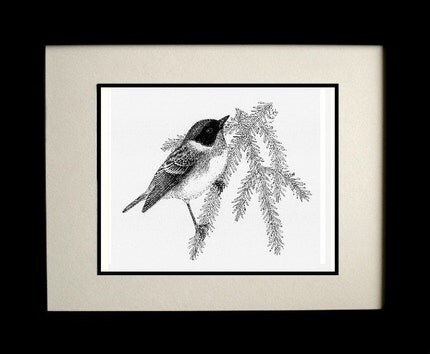
Some shameless self-promotion


Northern Hawk-owl – pencil

I think I’ve mentioned in passing once or twice that aside from maintaining a blog about nature stuff I’m seeing, I do have other pursuits as well. One of these was a post I made way back in March, where I included a sketch I did from the field, of a snow-covered trail. I’d made a semi-resolution to try to do more field sketching this year. Well, I haven’t, just so many other things to do, to look at, to photograph.


Northern Waterthrush – ink

That doesn’t mean I’ve abstained from drawing, however. In fact, I’ve done considerably more this year than I do in an ordinary year. Most of it has been on commission. The primary project that’s been keeping me occupied lately is illustrations for a book on the birds of Niagara County, Ontario, edited by noted Ontario birders Kayo Roy and John Black. The book is currently in process (good thing, or my drawings would be a tad late), and I believe will be published sometime early next year.


Hooded Warbler – ink

I’ve been asked to do the warblers for the book. I’ll be the first to admit that I’m no Julie Zickefoose, or Debby Kaspari, at least not yet. Hopefully with a bit more practice, and some more years under my belt, I’ll be drawing like they do. But I still feel that I draw well, and am happy with the works I do. It was an honour to be included in the Niagara Birds project. There’s no up-front compensation for the drawings I do for it, but it will be great exposure for me, and practice, plus I do have the opportunity to sell the originals once they’ve been scanned in by the layout designer.


Black-throated Green Warbler – ink

To this end I’ve set up a storefront at Etsy.com through which my pieces will be available for purchase. I’ve tried to price them fairly – both for myself, in terms of receiving reasonable compensation for the time put into them – but also for the buyer, since I’m still a relative nobody in the art world (perhaps I always will be, or perhaps in twenty years I’ll be the next Robert Bateman – okay, I’ll probably never be a Bateman, but it’s nice to fantasize).


Bay-breasted Warbler – ink

My shopkeeper name there is simply Seabrooke, and the store address is Seabrooke.etsy.com. In addition to the Niagara warblers, I also have a pencil drawing there that I did for the Ontario Field Ornithologists’ October issue of OFO News, and a few gouache paintings that I did last year for my own enjoyment. I’ll be putting up the rest of the warblers as they get done and scanned in for the book, as well as other works where I have the original to sell. I invite my readers to swing by and check them out if interested.


Yellow-rumped Warbler – ink

Today at Kingsford

Moonrise over Kingsford

Blackburnian came up from fishing this evening, and prodded me to get up from the couch, where I was dozily watching tv with the puppy, to look out the window at the lake. The moon was nearly full again, and was reflecting off the water in a glittering ribbon. After a few days of clouds, and some stormy, windy weather last night, the calm and brightness of tonight’s full moon was beautiful. The temperature has dropped with the passing of the storm, as well, from a sweltering humid evening trying to wear as few items of clothing as possible yesterday, to contemplating putting the fire on for the first time this fall this evening. I bundled myself up in my winter jacket, put my camera on my tripod, and trundled down to the dock to take a few photos on what little juice remained in my camera’s rechargable battery. I don’t go down to the dock after dark nearly as often as I’d like to, mostly because the trail down is so dark, and is steep and littered with stones, not a good combination. If we were to buy this place, one of the things I would like to do is put in stairs down to the water, so I could enjoy the moonrises and starry skies.

Moonrise through the cattails

A scar on the face of the earth

Quarry1

Of course, when I was back in Toronto this week I couldn’t very well pass up the opportunity to visit my parents – it was still an hour from Toronto, but a heck of a lot closer than from Kingston. It was necessarily a short visit, by the time I got there after my doctor’s appointment, and I had to leave mid-day the next day. However, Mom and I did have time to run out to a few places in the morning.

One of our destinations took us past the quarry northeast of their house. I don’t go that way much anymore, though at one point, back in high school, it was a semi-regular route to school. If it’s a nice day I like to stop and look out over the quarry from one of two lookouts along the road. At least from this point in the operations, I find the vista beautiful. The northwest corner of the quarry is old, and for as long as I can remember the bottom has been filled with water. The water there is a cool crystal green-blue, and on a sunny day sparkles like it’s scattered with diamonds.

The above photo is taken from the broad-side (rather than the end) viewpoint, which looks out over the midpoint of the quarry pit. To the right is the old sections, filled with water. To the left is still active, with the quarry offices and a few roads. You’ll need to really click on the image, and then click on “All Sizes” on the subsequent page, to get the full effect (or you could just click here).

Quarry6

Quarries fall into the NIMBY (Not In My Back Yard) category. The sort of thing that most folks recognize is necessary, and/or have no particular problem with – they just don’t want it in their neighbourhood. I’m sort of on the fence about them. They are a bit of a scar on the landscape, creating a permanent destruction to habitat. The area will never be the same again, it’s not like logging where the forest has the potential to regrow, if given sufficient time and resources. The landscape is not going to refill itself, in the case of a quarry.

Quarry13

This is taken to the extreme in the case of mountaintop removal mining, itself a type of quarrying. This affront to the landscape was blogged about by many people, the first that I was aware of being Julie Zickefoose. It’s a bit shocking that whole mountains can be removed by people. If you think a hole in the ground changes the landscape, try the removal of the undulating peaks of the Appalachians. This satellite view (taken from Google Earth) is of a mountaintop quarry near Fayetteville, West Virginia, one of the areas Julie talks about. You can see the corrugations of the feeder streams running into the valley creeks surrounding the mountains, and then there’s the scar left by the mining operations. It’s more shocking from ground level – some of the photos on Julie’s blog are very alarming.

Quarry8

The largest limestone quarry mine is at Rogers City, Michigan. It’s shown above, with the town just to the left. The quarry is expansive – about 5.6 km (3.5 miles) across. It’s three or four times the size of the neighbouring town, whose population is about 3,300. I have to assume that much of the town is populated by the quarry’s workers, or employees of the associated cement or limestone processing plants.

Quarry9

There are two quarries near my parents’, and neither are mountaintop removal mines, or as big as the Rogers City mine, so their visible impact on the landscape, at least at ground level, is less obvious, though still present. Both quarries are limestone quarries. The Niagara Escarpment, which runs from Niagara Falls all the way north to Georgian Bay, is a ridge of limestone that protrudes in cliffs and outcroppings. It supports a unique collection of habitats, in part because its rocky nature has made it less suitable for farming and therefore more landscape has been spared or allowed to re-naturalize, but also because of the structure of the rock below.

Quarry12

(I also want to mention an observation on limestone, though don’t have a good spot in the flow of the post, so I’m tagging it here. Limestone is very basic – the opposite of acidic – and so tends to neutralize acid rain when it falls on landscapes with limestone bases. In the north, on the Canadian Shield, the base is granite, which doesn’t neutralize acid rain. As a result, lakes and groundwater on the shield has more acidity problems that affect the insects, fish and other wildlife there than those south of the sheild. Also, limestone is a very soft rock, and is prone to easy erosion, which can and does shape landscape formations such as the “flowerpot” stacks of Flowerpot Island.)

Quarry11

I recall while growing up the occasional rattle of the windows in their panes when the quarry detonated some explosives, but the quarry had little influence on my life otherwise, except as a curiosity. However, I had friends who lived along a road that backed on to the quarry. As the quarry aged, and by necessity expanded its borders, it began to encroach upon these residences. At some point after we’d all graduated from high school and I’d lost touch with many of these friends, the quarry bought out the residents, and had the homes demolished. I haven’t been down there since, but the satellite shows a stark picture. This is probably the most direct negative influence quarries have on people and communities. A more indirect effect, not only on human but also on natural communities, is the pollution of local streams and groundwater with tailings or silt runoff, particularly true of mountaintop mining.

Quarry7

However, this rock is also ideal for many beneficial human purposes. For most of the 19th and 20th centuries, but even as far back as the Middle Ages, limestone was a popular building material. In fact, so much of Canada’s original capital, Kingston, Ontario (the city nearest me now), was built out of limestone that it’s sometimes nicknamed the “Limestone City”. Limestone is still used in building, but is more often used as siding, in the form of thin slabs, than large building blocks.

Beyond this, it’s also used in cement and mortar, in aggregate (the crushed rock used as the base for roads), in toothpaste, in paper, paint, tiles and other materials as a white pigment and inexpensive filler, in bread and cereals as a source of calcium, and in many other processes and products. It’s hard to think of what our society would be like without this versatile and widely-used material. And it has to come from somewhere. Thus the NIMBY dilemma.

Quarry10

One of the issues is that the distribution of limestone often coincides with the distribution of people. In the more northern parts of Ontario, the more sparsely populated, the rock is granite. In the south, the rock is limestone, but there are also more people using the landscape. It would be easy to solve the NIMBY problem if we could simply shift operations to the north – the environmental issues would still exist, but it would be out of sight, and therefore out of mind, for most people. But you have to mine where the resources are, so that’s not really an option. It doesn’t seem as though there’s a satisfactory solution, unfortunately, and I anticipate quarries to remain a source of conflict for as long as we consume the material they produce.

Quarry2

There are some monster machines in quarries. As we were trying to get a peek in to another part of the quarry, this giant boulder-mover (I’m sure it has a more official name among the quarry industry) rolled up the quarry road and stopped at the stop sign before crossing the sideroad. It’s monsterous. I didn’t get a good shot of the driver, looking puny behind the steering wheel, but imagine me coming only 2/3rds of the way up the wheel. Yeah. Monsterous. But then, to be efficient in its operations, the quarry really does need to move this rock in bulk.

Quarry5

There isn’t much wildlife there, though, even in the older, abandoned parts. I imagine there are problems with dissolved minerals in the water that makes it unable to support much. And yet, down there on a little spit of dirt, was a pair of Canada Geese. I doubt they bred there, they’re probably either post-breeding dispersals or migrants, but in either case they seemed content to use it as a pit-stop. Certainly lots of water to paddle in, and couldn’t ask for much more privacy.

Quarry3

As we were looking down on the vista from the overlook of the first photo, a vehicle caught my eye. It was parked off to the right, near the water. It looked like a police van. I couldn’t think of a good reason a police van would be in the middle of a quarry except for an investigation (did someone dump a body down the hill?). But they appeared to be putting up signs.

Quarry4

Pulling out my telephoto lens revealed the answer: they were setting up for target practice! If you want a remote, unpopulated area within the densely-populated Toronto region where you don’t run any risk of someone wandering through, it’s hard to do much better than an old quarry.

Five worthy blogs

Morning at Kingsford

First, I should start off by announcing that the latest I and the Bird is up at Wrennaissance Reflections. Wren has categorized the various posts into all the different aspects that make up “the joy of birds.” Definitely worth a read, pop over and check it out!

Beth of Beth’s Stories did me the great honour of choosing my blog of the 100-odd she follows to include in a blog-recognition meme. At the very least I’d like to thank her and return the linkage (worth checking out, if you don’t know her already – she’s one of my daily reads). But further to that, it’s a good opportunity to recognize some other worthy blogs.

The rules of the meme are thus:

1. Choose a max of 5 blogs (we could all probably list our entire blogroll, but then you might as well just point people at your blogroll).
2. Four of the 5 have to be dedicated followers of your blog.
3. One has to be someone new or recently new to your blog and live in another part of the world (the definition of “another part of the world” is left to your discretion).
4. You must link back to whoever gave you the award (fair’s fair! If they’re sending traffic your way, the least you can do is thank them by sending traffic back theirs. Hopefully you also like their blog, too).

Field in morning

Since I discovered the amazing convenience of Bloglines.com, a blog feed reader that keeps track of all your blogs for you and lets you know when new posts go up, so that you don’t have to check dozens of pages every day, since I discovered that the list of blogs I follow has inched up to 50. I could easily follow more, and will probably end up adding additional blogs to the reader because there’s so much good writing out there. And that’s just for nature blogs. If you have any doubt about the prolificity of nature blogs, simply check out the Nature Blog Network. When I signed up to it, when the network was just a couple weeks old, back in February, I was right at the bottom, #68 I think. Now, there are 440 blogs in the network, and more being added every day. My blog bobs up and down on the list, sometimes in the 50s, sometimes in the 60s, once as high as #48, at its lowest about #105. It uses the average of the last 10 days to calculate your average number of visits, so it can vary a fair bit from one day to the next. I think a fair number of my visitors are people who Google for information on various species, but I like to think that many (most?) are dedicated readers of my blog.

Some of the blogs on my reader are very well read by others, and some have a much more limited following. The latter are generally because they’re relatively new, rather than due to lack of content (I wouldn’t invest the time in following a blog that didn’t have interesting content – and on dial-up, it is something of a time investment!). The ones at the bottom of the Nature Blog Network list are there either because they don’t post often or don’t post good content, or they have good content but few views simply because they haven’t been around long enough to be discovered and develop a readership.

The five I’m choosing, therefore, are all younger or less frequently followed blogs that I think are worthy of a stronger readership (currently they all rank on the 4th page of the Nature Blog Network, or lower – they deserve to be higher than that!). They have all, at one time or another, commented on my blog so I know they do or have read it periodically. I encourage all my readers to check them out, and leave a comment if you like what you read.

Morning spiderweb

In no particular order:

Huckleberry Days – If you like my blog, you’ll enjoy reading this one. Styled in the same vein, profiling different species and phenomenon of interest, this blog fulfills the #3 rule as well – Huckleberry found me within the last month (or at least started commenting then), and lives on the far side of the continent, out in British Columbia.

Beetles in the Bush – Ted is a regular reader, but also maintains an excellent blog of his own. He posts less frequently than some, but this is where the convenience of the reader comes in – you’ll never miss a post because you forgot to check in. As the name implies, the blog is all about the wonderful world of beetles. And there’s no shortage of them to talk about!

From the Faraway, Nearby – One of my favourite things about this blog is the address – a nod to a favourite cartoon of mine when I was young, the Adventures of Tintin. Indeed, T.R. (as noted in his profile, but is it so hard to guess his name?) travels for a living, and his exploits are chronicled here. Most recently, he had the good fortune to be able to visit China to attend the Olympic Games. Lots of good photos and interesting stories.

Roundtop Ruminations – Carolyn lives out in the forested mountains of Pennsylvania. Her observations of life in the Pennsylvanian forests are interesting and enjoyable to read, and offer a different perspective on rural life than most people get.

Voice of the Turtle – And finally, after long deliberation on who the last blog should be, I settled on this one. Although not a nature blog, Turtle is a gifted writer, and her entries are sprinkled with frequent stories and limericks. Her corgis and family figure prominently in her posts, she runs occasional contests (prize: a 500-word story on the subject of your choice), and generally offers an upbeat view on life. She’s also one of my most dedicated readers.

All worthy recipients; I hope you go check them out!

Anatomy of a sunset

sunset13

When I was involved in bird research projects, I would usually be up and arriving at the research site in the pre-dawn twilight to set up our equipment. One of the best things about having to get up so early – okay, the only thing – is that you would get to enjoy the sunrise every day (on those days where the sky wasn’t clouded over, anyway). I have some beautiful sunrise photos from that period. Pinks seem to predominate, though I have a number of striking oranges and reds, as well.

sunset8

I was mildly disappointed that our new house faced east, such that we wouldn’t see the sunsets across the water, because I did really enjoy watching the colours of the sky. I knew that I was unlikely to be up often enough, at least in the summer and fall, to catch the morning sunrise that we would be able to see from our deck, but I am always up for sunset. I used to admire some that we would see from the apartment in Toronto, but would never take a photo. It just wasn’t an ideal setting, with all the buildings and power lines and everything else in the way.

Sunset3

I guess I hadn’t expected to be out in the boat so often here, or out so late. But some of the best fishing can be had at dusk, so we’ve frequently gone out just after dinner and stayed out till after the sun has gone down, navigating our return by the silhouettes of the trees and the reflection of the water, and tracking our location by the illuminated houses of our neighbours.

Sunset2

I think the best sunrise and sunset photos are those taken across water. It has the dual advantage of a large open space to give you a better view of the sky, as well as the reflective properties of the water that replicate the colours below. Since I’ve been fishing for the smaller guys, using jigs instead of cast-out lures, I really prefer to fish during the daylight hours; early morning is my favourite, when the lake is still and quiet, though it unfortunately requires setting the alarm to be sure I’m up. It’s easier to go out in the evening, you’re up anyway. My favourite part of being out late, after I can’t see my lure in the water anymore, is watching the sun go down and the sky light up.

sunset6

The reason that the sky isn’t just the usual blue during sunrise and set is because of the angle the sun’s rays are traveling through the atmosphere at. If you move six hours east (in the case of sunrise) or west (for sunset), the sky will be blue under the sun there. It’s the same sun, just the angle has changed. At all angles, the light waves are encountering particles in the atmosphere, and are breaking up into their different components and scattering. The ones that head down to the ground are in the blue spectrum, which is why the sky looks blue. The reds and oranges get scattered sideways. At the very acute angles that the sun’s rays are viewed when the sun is near the horizon, it’s these reds and oranges that reach our eyes.

sunset5

Almost inevitably, sunsets are more dramatic and more brightly coloured than sunrises. Since the sun is entering and leaving the horizon at the same angles, it’s the amount of dust and other particulates (like pollution) that affect the colours. The more particles in the atmosphere intercepting light waves, the more light that gets broken up and scattered, the brighter the sunrise and sunset.

sunset7

The reason sunrises tend to be paler, then, is because there’s less in the air. During the course of the day, activity by people puts dust, dirt and pollution into the air; it settles out, to some extent, at night. Also compounding this effect is that as the sun warms the earth it creates convection currents – winds – that stir things up into the atmosphere as well. Clouds and moisture can contribute to bright displays, which is likely the meaning behind “Red sky at morning, sailors take warning; red sky at night, sailor’s delight.” A red sky at night is just a reflection of the day’s dust, but a red sky in the morning is probably reflecting off the particles associated with a storm system.

sunset10

Of course, the sky’s colours can also be affected by natural events such as volcanic eruptions, large wildfires, or dust storms, which throw immense amounts of dust and particulates into the atmosphere, too much to settle out quickly. Some events are so large in scale, such as the eruption of Krakatoa in 1883, as to affect the atmosphere of the entire globe. Not surprisingly, though, and perhaps rather thankfully, these events are rare.

sunset9

What we think of as a typical sunset doesn’t occur on planets other than our own. Differences in atmosphere composition and distance to the sun mean that the light refracts differently than it does in our own atmosphere. This is also why a blue sky is a novelty to our planet, and why the moon has no daytime sky at all (it lacks an atmosphere). High winds on Mars kick up sufficient dust high enough into the atmosphere to sometimes create a lingering red sunset that can last as long as two hours after the sun sinks below the horizon. However, without this dust in the air, the sunset there isn’t much to look at.

sunset14

Another interesting sunset phenomenon is called the green flash. I’ve never seen it, and I’m unlikely to here. It happens just as the sun dips over the horizon, right at the cusp. The light waves break and scatter in just such a way, and the atmosphere is just dense enough at that angle, that for a brief period the sun’s rays glow green. They’re usually only seen on an unobstructed horizon, such as over a large lake or the ocean, or in the great plains. This is because the light needs to be traveling through the densest part of the atmosphere to create the effect, and this usually occurs close to the ground. Given all the forest surrounding us here I probably won’t be seeing one any time soon.

sunset11

The problem with taking photos of things like sunsets is that you can amass a huge collection of them, since you’re tempted to photograph each and every one, because they’re all different. But then what do you do with them all? Well, I can share a few of my favourites from the last few weeks here, in any case.

sunset15

sunset12

Sunset1