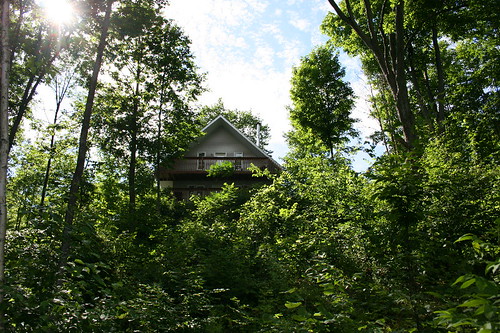
At home with the birds

Dusk

Well, here I am, finally! I didn’t intend to be gone quite this long, but through various mix-ups, miscommunications and snags, we only just got our internet hooked up today. We opted to go for a bundle deal with one of the primary companies around here, and have been rather unimpressed with how things have gone. Our phone was hooked up two days late, and our satellite television still isn’t working quite right (we have a service person out today to have it looked at). Hopefully the last of all this will be sorted out today.

But, we made it, without incident, and we’ve otherwise settled in. We unpacked the last of our boxes yesterday, and there’s just a few last tidying-up details to take care of. It’s certainly feeling like home already. We’re just loving the location. Although it’s a bit further from town than we’d probably originally have considered, it’s still an easy, reasonable drive for once- or twice-a-week trips for supplies. If we were the commuting sort, it would be an average commute in to the “big” city (big being a relative term; compared to Toronto, virtually all of Ontario’s cities, with the possible exception of Ottawa, are moderate in size).

Dawn

The scenery and wildlife make it all worthwhile, however. Right across the lake is a provincial park, and the non-park shore has a pretty low population density itself. It’s not a small lake, at about 3.5 km long, but there’s only a couple dozen buildings along its outer shore. There’s hardly ever anyone out on the lake, at least that we’ve noticed. This weekend was a holiday long weekend for most people, and even then, while there was an increase in boaters, it still wasn’t busy, by any means. During our housing search we checked out a couple of other places that were located on lakes, but they were very busy, and noisy. Not our speed, really.

The birdlife here has been amazing, and we’ve only been here a week. We’ve tallied 63 species so far at our home, on the lake, or within a short walking distance along the road. To put that in perspective, our yard/neighbourhood list back in Toronto was less than 30 after five years of living there. August is perhaps the quietest time of the bird-season (April through October), when all the breeders have stopped singing, but the migrants haven’t really started to arrive yet. And in winter, while the diversity is lower, they’re coming to your feeders and are easy to observe. We anticipate some great birding through the rest of the year. The park has a checklist of 170 species to date, so we still have lots yet to see!

REVI2

Red-eyed Vireos are abundant, in any flock of birds there will be at least two or three of them. For the first few days after we arrived, there were Red-eyed Vireos hanging around in the trees just off our deck. At first we just saw the adults, but shortly a fledgling showed up with them. This photo was taken from the deck, looking down into a little shrub the family was sitting in. Also in the trees around the house has been a regular family of chickadees. Young chickadees are very vocal, loudly begging for food from their parents, so we can always tell when they’re outside.

CERW

A few mornings ago, Blackburnian was on his way down to the dock with his morning coffee when he heard some commotion along the road, a mixed flock of birds moving along the trees of the road edge. He grabbed his binoculars and went out to check them out. Among the flock was a family of Cerulean Warblers, and, knowing that I’d like to see them, he came back in to get me. Ceruleans are an endangered species in Ontario, sparsely distributed through the southern part of the province and only found in certain local patches. However, in these areas they can be locally common. One of the spots recognized as being among the best places to find breeding Ceruleans is not too far east from us, and we’re at the western edge of their eastern Ontario stronghold. It’s a great place for them; around here there is extensive forest cover, because of the low population density and the rocky landscape, which makes farming impractical.

YTVI

Although this isn’t a great photo of it, this was one of the birds I was most pleased to catch a glimpse of. It actually sat rather obligingly for a little while in this open spot on the branch, catching the morning light nicely to illuminate his bright colours. It’s a Yellow-throated Vireo, and it’s a bird that’s been on my jinx-bird list (those birds that seem to elude you no matter how hard you try to find them) for quite a while. I had heard a few singing before, but try as I might I’d never been able to see one. I hadn’t actually expected them to be breeding this far north and east, I tend to think of them as a Carolinian species, but consulting my recently-published copy of the Atlas of the Breeding Birds of Ontario, I see that they actually occur in a strong band along the southern edge of the Canadian Shield, as well, and their largest pocket of high abundance in the province is actually the Frontenac Axis.

Black-and-white Warbler

Black-and-white Warblers are also abundant in the area, if not quite so much as the Red-eyed Vireos. I haven’t seen any adult males, with their bold black throats, but I’m not certain whether that means the birds I have seen are females and immatures, or if the adult males have already moulted into their winter plumages. There’s a surprising diversity of warblers in our area. Back in Toronto and area we had a small handful of species that might breed commonly. So far here we’ve tallied 10 species of warblers, all of which would be local breeders, with the potential of another 10 or 11 that we haven’t encountered yet.

RTHU2

The first birds we observed at the house were a pair of Ruby-throated Hummingbirds on our first viewing of the place. One of the first things we did outside once we moved in was to fill up the hummingbird feeder. The previous residents had a feeder in place, but it didn’t look like they’d been keeping it filled. It didn’t take long for the hummers to find it. Since they did they’ve been regular visitors. They decided quickly that we weren’t any serious threat, and will often feed while we’re only half a dozen feet away.

COLO

And finally, the quintessential cottage-country birds, Common Loons. We didn’t notice any when we were viewing the house, but we were only here for an hour or so each time. Once we moved in they became quite apparent – but more by their calls than by spotting them. They call regularly every evening and periodically through the rest of the day. They seem to be done breeding, and move often from our lake to any of the many others in the area. On the same morning that we were out looking at the Cerulean family, a family of five Common Loons flew overhead, calling to each other, as they moved to the lake on the other side of the road.

We also noticed a phoebe had built a nest on the security light above the deck stairs, and occasionally hear one singing in the area. I was worried that we wouldn’t have scrub and meadow birds around here and that I’d miss birds from my parents’ like the Eastern Phoebe, Eastern Kingbird or Indigo Bunting, but they’re all here. There are Osprey and Red-shouldered Hawks frequently seen along the lake edge. We also have some more northern birds that I was hoping to get in the area, such as White-throated Sparrow, Common Raven, or several of the warblers. We’ve heard Red Crossbills on a few mornings, though it’s hard to say if they’re post-breeding dispersals or early “winter” irruptives.

And that’s just a small sampling of things! The rest of the local wildlife is just as varied and abundant… but that’ll be another post.

See you on the flip side

Moving boxes

Tomorrow’s moving day! We started packing yesterday and have nearly finished everything today. There are a couple dozen boxes and a dozen garbage bags of soft stuff all piled up near the door, ready to be moved out into the truck. We pick the truck up this evening, load everything from the storage locker and what we can move out from here, and then finish the last of it tomorrow morning before hitting the road.

We’ll be leaving this view:

Apartment view

For this one:

Lake

I’m pretty happy with that trade-off! Although, as city views go, ours isn’t too bad. I’m looking forward to taking my tea down to the dock our first morning there and sitting and watching the lake, a relaxing experience you just can’t get in the city.

Our internet and tv get set up on Thursday, so hopefully I’ll be back online at the end of the week. I’m sure I’ll have lots to share!

See you at the other end!

We’re moving!

House as seen from the lake

After some five years here in Toronto, Blackburnian and I decided it was time for a change, time to move on. Neither of us are city people, and when circumstances allowed that we could move back out to the country, we jumped on it. We’ve spent the last three weeks or so driving around a good portion of southern Ontario checking out house listings, which, it turns out, are few and far between when you’re looking for a rental (we want to both save up a bit and also make sure that we really want to be in the area before we commit to investing in a home). Yesterday we spent a long day on the road, checked out four listings, two of which we absolutely loved. The view from the one of them finally won us over, and we went back today to take care of paperwork. While we were out that way (it’s nearly three hours from where we currently live, so not exactly around the corner!) we revisited the house to take some measurements and also some photographs to share with people.

View from the upper balcony

It was the view that really drew us to the place, and the general setting. It’s right on a shallow lake, with the house at the top of a small rise, looking through the trees at the water. It’s surrounded by forest, with small open patches here and there. Unfortunately, both days we visited it was later in the day, past the hour when birds would be active and singing, but it’s starting to get late in the summer to hear much anyway. The timing of the move isn’t great for experiencing the local bird life (we may have to wait till next spring for most of the residents), but we’ll get to see all the migrants through the fall and feeder birds in the winter, and in the meantime there’s still lots of other wildlife to be seen.

Lake

A view looking up the lake from the dock. It’s a relatively small lake, and quiet. Apparently most of the water traffic is human-powered, with just the odd motor boat going by. The other shore is only about 200 meters/yards away, an easy paddle, or even an easy swim if one was so inclined. The other shore is part of Frontenac Provincial Park, another reason why boat traffic is quiet. A short canoe paddle will take you to miles of hiking trails through relatively untouched wilderness.

Looking back from point

Part of the 2 acre property swings out into a little point. This is looking back toward the dock and shoreline from the point. The water in this area is fairly shallow, only a couple feet deep through most of it. The water is pristine and clear, and you can see right down to the gravelly bottom. There are plenty of fish in the water, and what I would consider to be larger stuff (fisherpeople would scoff at that description, I know), bass and sunfish and others that are easily six or eight inches long. There are even bass spawning beds in the gravel just offshore (Blackburnian had to point them out to me; he used to fish and knows all this stuff much better than I do).

Muskrat

To make up for the lack of birds while we were there, other stuff put in appearances. Here’s a muskrat that was paddling around in the lilypads just off the dock, while we were standing there.

Black Rat Snake

And a Black Rat Snake that we startled from the shrubs at the edge of the lawn (I’m actually not sure who was more startled, the snake or us). It’s the first one either Blackburnian or I have seen in Ontario, where their range is extremely limited, and the species is declining and listed as threatened. They’re only found in a few patchy locations in the southwest, and in the Frontenac axis in the east. Unfortunately, I only had my wide-angle lens on the camera, not anticipating to be taking photos of wildlife. It seems that there will be lots of good fodder for future blog posts from there!

Main deck

Not sure if you can tell, but I’m excited to move! We officially take possession August 1, but are hoping to arrange to be in a few days earlier, if possible, both so we could overlap the move with our last day at this apartment, but also simply because we’re really looking forward to moving in!

Pine, torn asunder

Tree hit by lightning

A couple weeks ago, when I was visiting my parents, my mom took me back into the woods behind their house and showed me this tree. It had been an old, massive White Pine, mature but still in good health. I love the pines on the property, the White Pines towering above the rest of the forest canopy, still catching the last rays of the setting sun even after it’s left the rest of the forest, the first to catch the early morning sun as it slides up over the horizon. They’re favourite perches for crows, who like to sit up in the highest tree and scan the landscape. They’re majestic in their strength, enduring, almost powerful.

So to find one of these giants torn asunder, lying on the forest floor, is a bit of a shock. It takes a powerful force of nature to topple such a massive tree: this one was hit by lightning.

Tree hit by lightning

We’re now experiencing an extended period of sunshine and nice weather, but for a while there we had thunderstorms virtually every afternoon. I remember talking to my dad on the phone one evening, and he’d commented that that afternoon they’d heard a crack of thunder so startlingly loud they knew it had to have hit nearby. It may have been this tree. They project so high over the canopy that they would be the forest’s inevitable lightning rods.

Lightning with many step leaders and a single massive discharge strike. Borrowed from the Wikimedia Commons.

I did a bit of research on how lightning works, though, and although lightning does generally target the tallest objects, they don’t necessarily always do so. Lightning works by the air particles beginning to ionize, or form directional charges, like the way a magnet has been ionized so that all of its molecules line up in the same direction creating a positive end and a negative end. The ionization spreads along the path of least resistance, but may spread out in multiple directions at once. These paths are called “step leaders” (note it’s leaders, not ladders, which is how I keep reading it). The direction is often, but not always, down towards the earth.

Lightning hitting the Eiffel Tower in 1902. Note the streamers coming up from the bottom. Borrowed from the Wikimedia Commons.

As these step leaders start to get close to the ground, the air near the ground begins to form strong charges and the equivalent of reverse step leaders, called “streamers”, form from objects on the ground, reaching up into the sky. When one of the step leaders contacts one of the streamers it forms an unbroken path of ionization that the cloud’s electrical charge discharges through. The streamer to be contacted is often the one that reaches the highest, but it doesn’t have to be, depending on the path the step leaders take. All objects, including people, send out streamers, which is why you can still be hit even if you’re near taller objects. Both streamers and step leaders glow, but are not as blindingly bright as the discharge.

Tree hit by lightning

The whole process, from the start of ionization to the connection of the step leaders and streamers, to the discharge of electricity, takes a fraction of a second. Prolonged lightning is actually multiple pulses of discharge flowing along the ionized path, but so quickly that it just looks like a long strike to our eye. The length of a roll of thunder represents the relative number of pulses (or “re-strikes”). The discharge is incredibly hot – hotter even than the surface of the sun. Anything it touches will be immediately burned, or, if liquid, vapourized, and if the medium doesn’t conduct electricity well, the excess heat created by the electrical resistance will cause the effect to be pronounced. This is what happens when lightning hits a tree. The sap within a tree is not very conductive, so rather than funneling the electricity through the roots into the ground, the sap vapourizes. Gas takes up more space than liquid, and so the result of this instantaneous vaporization is an explosion – tearing the tree to splinters. They’re a bit hidden in the ground vegetation in this photo, but there were splinters and chunks of wood everywhere.

Tree hit by lightning

Oak and elm are the most commonly hit types of trees, but pine ranks third. They have deep tap roots that reach the water table, and typically stand higher than other trees in a forest. The high resin content and needles also contribute to higher electrical discharge, though Wikipedia fails to elaborate on why. Trees are actually a good way of protecting a building from lightning strikes. Some species are more capable of dealing with strikes – trees that have massive root systems, which spread out in the soil and have a higher biomass than the above-ground portion of the tree, have the ability to dissipate lightning very efficiently. In most trees the lightning takes the path of least resistance, which is generally the wettest part of the tree, often outer layers where the sapwood is. This results in a burning of the bark, and possibly the stripping off of a small section of the trunk, but is generally easy for the tree to heal over from. Deeper wounds are more difficult to heal and usually result in the decay and death of the tree.

In the case of my parent’s pine, the strike went right down through the heartwood and tore the tree in two. One side has a trunk and crown that is still standing and intact, but it’s hard to say whether the damage to the lower part of the trunk will be enough to kill the remaining part of the tree. If it does die, it won’t be a terrible thing – the Pileated Woodpeckers will love it.

Some announcements

Willow Flycatcher

This is a post for news-y bits that I’ve been collecting over the last week or so. I thought I’d just hold on to them all and put them into a single non-nature post. Well, still nature-related, just not directly so.

First, I’ve participated in a few blog carnivals that all came out recently. Carnivals are a great way to sample the writings of many different people, as well as learn about many different, varied things. I invite everyone to browse over to It’s Just Me (aka The Egret’s Nest) for I and the Bird #78. Lots of great bird-related stories, from close to home to far abroad (no matter where home is for you!). Once you’re done there, check out Gossamer Tapestry for the latest Circus of the Spineless (a carnival dedicated to – you guessed it – invertebrates of all shapes and sizes), edition number 34. And finally, wrap it up with a visit to Earth, Wind and Water to read all about our arboreal neighbours in the Festival of the Trees #25.

Northern Pine Looper - Caripeta piniata

Some exciting news of a more personal nature, the field guide to moths that myself and The Moth Man will be co-authoring has been bought by Houghton Mifflin and will find a home in their Peterson field guide series. We have yet to sign the official documents, but the deal has been done, and I’m very excited to get started on the project! During negotiations it also came up that they’re planning a re-design of the Peterson series in the next few years, of which ours will be one of the first. It will be in the style of most bird books, with the images opposite the text and maps. We’re pretty stoked. Our deadline is 2010, so expect to see the book hit shelves in a couple years (if not before!).

[ACTUAL BLOG AWARD IMAGE REMOVED]

And finally, a few days ago Voice of the Turtle passed on a Tree of Happiness to me. The “award” or recognition includes the above image, which is written in Portuguese. Not speaking Portuguese myself, I had to run it through a web translator. Actually, I ran it through several, since none of them are perfect. Roughly, the words mean this:

You have just received the Tree of Happiness.

It is still just a little seedling, but depends on you to grow steady and strong.

Plant it in your heart, water it with smiles and kindness, feel the fragrance of its flowers, the sweet taste of its fruits and share its shadow with whom you want!

The good things are better still if we can share them with people dear to us; then be a generous person and share this tree with your friends.

So plant happiness where you go!

You’ll see how many people come closer.

Will you?

This would be better if I had an actual little seedling to nurture and grow and share, but in the absence of that, a recipient is supposed to list six things that make them happy, and pick six other bloggers who deserve such an award (presumably because their writing makes you happy, rather than that you think they need an infusion of happiness).

Things that make me happy (in no particular order):

1. Breathing the fresh air, feeling the breeze in my hair and the sun on my face, listening to birds sing, out in the quiet of the countryside on a warm day.
2. Sharing my knowledge with someone and watching them grow, or seeing their enthusiasm or amazement in the subject. Blogging falls into this category.
3. Doing good by someone. Anyone, friend, family or stranger.
4. Sitting in a puddle of sun with a book in my hands, a tea at my side, and a purring cat in my lap.
5. Spending time with Blackburnian. Catching up with my best friend or family.
6. Art supplies. I like playing with them, too, but really art supplies are my version of the woman’s shoe collection. Don’t send me into an art store unsupervised.

I started to list six blogs that I felt were worthy recepients. I got up to six, then realized there was no way I could pick just six blogs who exemplified the qualities set out in the Portuguese above. So instead, I point you to the blogroll in my sidebar. All of these bloggers show some or all of the qualities listed, or I wouldn’t have included them in my blogroll. If you haven’t visited these sites, I highly recommend you do.