Scotch Pine wasps

Scotch Pine

This Thanksgiving weekend Dan and I returned to the Toronto area for dinner with his family. The weather was gorgeous, and while there we took the dogs for a walk to a bit of natural habitat just down the road. The house is in a suburban area but backs onto a nice patch of woodland habitat, one of the largest such patches in the immediate vicinity, so there’s often some interesting goings-on there. I heard Carolina Wrens, which don’t really occur out here (they’re rare and very local), and Red-bellied Woodpecker which is also rare this far east but relatively common there. We have Northern Cardinals here but they’re sparse and in low numbers; down there, you hear them nearly every time you step out.

Despite that, there wasn’t a lot of time for naturalizing, but I did pause to ponder this tree when I came across it in a small meadow. It wasn’t the tree that caught my interest so much as what was going on with it: it was crawling with wasps. (The tree itself is a Scotch Pine, a non-native species that’s often planted in plantations or urban areas because it’s hardy and fast-growing. This one seems to have planted itself naturally.)

Yellowjackets on Scotch Pine

It’s a shame my camera doesn’t do video, because only video could have captured the numbers of wasps really well: the branches were alive with them, crawling between the needles and flying from one spot to another. There are seven wasps in this photo alone – multiply that by so many branches. I presumed that they were all converging on this tree because it was exuding sap for some reason, perhaps the way new buds are sticky to the touch. I wasn’t keen to stick my hand into the branches to find out if the twigs were sticky, however, so I just took a number of photos and then hurried to catch up with Dan, who by that time had made it halfway across the meadow.

Yellowjacket with scale insects

But when I got home and started looking more closely at the photos, I noticed small brown bumps on the twigs. On some of the twigs, but not all of them. And the twigs with the most wasps seemed also to have the most bumps. Coincidence?

Some poking about Google and a quick reference of my Tracks and Sign of Insects, and I think I have an answer. I suspect these bumps to actually be scale insects, which are usually small, featureless domes scattered along twigs. They could be Pine Tortoise Scale, Toumeyella parvicornis, which is small and reddish and includes Scotch Pine among its targets. Like aphids, as they feed scale insects will produce honeydew, a sweet secretion resulting from their diet of sap. This honeydew, in turn, is very attractive to nectar-feeding insects such as bees and wasps.

Spider wasp sp.

The most common species of wasp on the tree was Eastern Yellowjacket, but I noticed at least one other yellow-and-black species, one mostly black species with a single yellow band, possibly two species of metallic green sweat bee, and the above, which I think is a species of spider wasp (family Pompilidae), though none of the ones shown in my Kaufman Guide to Insects or in the group’s photos on BugGuide seem to match. The Kaufman Guide does note about the family, though, that “Many visit aphid colonies for honeydew secreted by those insects.” Also present on the tree were quite a number of ladybugs. Ladybugs may be interested in the honeydew, but are probably there to feed on the scale insects themselves.

Mantids

Praying Mantis and underwing

There haven’t been many moths to my light the last few times I’ve set it out, even on the warmer, humid evenings. Something to do with the weather, maybe? The almost-drought from earlier this summer? I dunno. But what I did have a lot of one night were these guys. Praying mantises. At the point that I finally shut the light off and went to bed, well after midnight, I’d managed to attract 13 of them. Several clung to the sheet, others clambered up the log wall, one or two walked along the ground below the light. Equal numbers of both green and brown. I never saw any of them stalking (or holding) prey, though they did occasionally turn their heads to watch a moth walk by… like this one is doing. I love how mobile their heads are.

Praying Mantis

I did a post about praying mantises a couple of years ago, the first summer we moved here. They’re abundant in our fields, and late August through September seems to be when the adults start taking wing. Which is mostly when I notice them. Mantises go through a simple metamorphosis, meaning that the larval/nymph stages look very similar to the adults, but without wings. Grasshoppers, walking-sticks, and some others also do this. You might not immediately realize that what you have isn’t an adult if you found one. But in the autumn they moult into their last instar, the adult stage, and finally have wings.

I nearly always detect them by flushing them as I walk through the field, or by noticing them fly in to a spot near me. You can’t really tell the long, narrow body shape while they’re in flight, but they’ve got very distinctive wings: pale and sheer, like pieces of tissue paper. Even on overcast days, something about the nature of the wings makes them look permanently backlit. Once you know what to look for, it’s really easy to identify a mantis in flight. (I should see if I could get a photo of one flying when I’m out this week.)

Praying Mantises

I’d never had any come to my moth light before. So I was a little surprised to have 13 turn up. There are a number of species in North America, but the most common one, at least that I encounter, is the European Mantis, Mantis religiosa. It’s the one with the black-and-white spots on its inner “arms”. It’s been here over a century and has become pretty widespread in the northeast and the west (the prairies and the southeast don’t seem to have them yet).

Another introduced species, the Chinese Mantis, Tenodera aridifolia, is found through much of the east. Like the European Mantis, it has both a green and a brown form, but it lacks the spots on its arms. Beyond that one field mark I don’t actually know how to tell the two apart. Naturally, none of my photos show the inner arm well enough to tell if it’s got a spot on it or not. I think possibly the adult Chinese Mantises always have a bold spring-green stripe down the outer edge of the adult’s wing cover, even in the brown form, and maybe a slightly longer “torso”… but that’s just based on comparing photos on BugGuide. If that’s the case, these would all be European Mantises.

My Kaufman Guide to Insects notes, under Chinese Mantis, “Both sexes fly well and come to lights at night in search of prey”, but this seems also to apply to European Mantises (according to a quick Google search) and a few other native species.

Giant Swallowtail

Giant Swallowtail

Dan really outdid himself with the gift he brought me this afternoon. He walked into my study holding a large black-and-yellow butterfly and asked, “Is this a Giant Swallowtail?”

It was indeed. He’d caught it while it fluttered lazily at the phlox in our garden. What makes this noteworthy is this:

Giant Swallowtail range from Kaufman Field Guide to Butterflies (highly recommended!)
From Kaufman Field Guide to Butterflies, definitely my favourite butterfly guide.

We’re at the tip of the red arrow, roughly.

The one and only time I’ve ever seen this species was a number of years ago, perhaps 2005. It was visiting my mom’s garden at my parents’ old house in the Greater Toronto Area. The species is very rare in Ontario; it occurs regularly in small numbers in southwestern Ontario, but the farther east you go the rarer it seems to become. Of course, it doesn’t breed out this way, so all occurrences of the butterfly here are immigrants that either traveled here under their own steam or were blown here in a weather system. The Canadian Biodiversity Information Facility has a species page for Giant Swallowtail, on which they note, “In 1992, a stray was recorded in the Ottawa area for the first time following high winds resulting from a hurricane in the southern U.S.” Could today’s visitor have ridden up ahead of Irene?

Giant Swallowtail

These are beautiful big butterflies. They fly as if their oversized wings are too big to flap properly, like floppy clowns’ shoes. They float lazily in the air, never traveling very high, cruising from one spot to another with what appears to be hardly any effort at all. Dan said when he first saw it above the garden he initially thought it was a falling leaf.

They also have the distinct habit of fluttering while they visit flowers. I took a couple of photos of it in Dan’s hand then had him release it. It stuck around the garden and I followed it about, camera in hand, trying to get a good photo as it resumed feeding on the phlox, but it wouldn’t stop fluttering. In fact, it seemed to use its wings to push its head deep into the throat of the flower. Judging by the blurred wings I see in many of the photos on Google Image search, this wasn’t unique to our butterfly.

Down south, in its breeding range, this species is considered a pest of citrus orchards, especially oranges which has earned its caterpillars the name of “Orange Dogs”. It’ll also feed on Hop Tree (Ptelea trifoliata) and Prickly-ash (Zanthoxylum americanum) where citrus trees aren’t common, such as up here (though both species actually in the same family as oranges and other citrus). I don’t think we’ve got Hop Trees here, but we certainly have lots of Prickly-ash about. I wonder if their range might expand, or if it’s not the availability of food plants that limits its northern distribution, but rather something like average winter temperatures or snowfall affecting overwintering survival.

My camera’s battery died after I’d run off a dozen shots, and since it seemed to be hanging about the garden and not going anywhere I hurried in to grab my spare. But when I returned, it’d disappeared, presumably off into the meadow somewhere. Safe travels, buddy, and thanks for visiting!

Black Swallowtail

Black Swallowtail, Papilio polyxenes

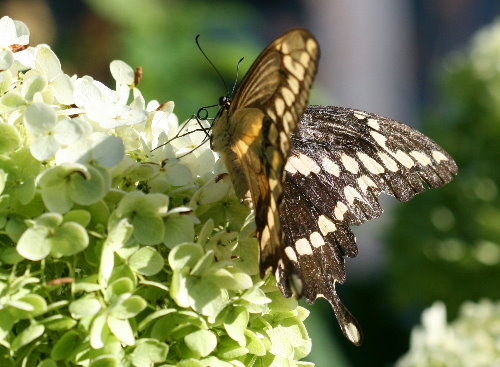
Dan’s been showering me with gifts lately. The baby snake a couple of days ago, and then yesterday he caught me a swallowtail butterfly. I had him hold it for a couple of photos and then asked him to put it on our hydrangeas on the off-chance it might not fly away right away. It didn’t, and I was able to get some nice shots of it.

We have two black swallowtails that occur here: Black Swallowtails (Papilio polyxenes) and black-morph female Canadian Tiger Swallowtails (P. canadensis). From the top, the easiest way to tell the two apart is the orange spot at the corner of the hindwing – in Blacks it’s got a black dot in it, while in Tigers it’s just solid orange. Also, Blacks will show that faded yellow band partly up the wing, while Tigers don’t. The extensive blue in the hindwing makes this a female Black Swallowtail – males will have a bolder mid-wing yellow stripe and much reduced blue.

Black Swallowtail, Papilio polyxenes

Black Canadian Tigers are apparently rare, but at least up here in eastern Ontario Black Swallowtails are near the edge of their range and so not a whole lot more common. I would see Black Swallowtails from time to time back in the Toronto area, but I’m not sure if I’ve seen one since moving east. My mom had one at their place farther east from us this summer, though.

Black Swallowtail caterpillars feed on plants in the parsley family, Apiaceae. This includes, of course, parsley, but also a number of other cultivated and native species such as carrot, dill, fennel, parsnip, Queen Anne’s Lace and other plants that bear similar umbrella-shaped inflorescences. I haven’t seen caterpillars on any of my parsley plants, or on the wild parsnip or Queen Anne’s Lace in our area… but I haven’t looked too closely, either. The species overwinters in the pupa stage, which means they’ll be caterpillars through the fall, so I should keep an eye on our plants and see if anything turns up.

Ambush bugs

jagged ambush bugs, Phymata americana

I discovered these guys on some yellow flowers in our garden yesterday afternoon. I think the flowers were a type of Rudbeckia, though I admit I’m drawing a blank now, at 9pm, and feel too lazy to go dig up a flashlight and wander out into the garden to check. ;) I can confirm, however, that I also discovered a single individual on a Black-eyed Susan out in our fields the same morning. They’re small – no more than a centimeter / half-inch – and strangely angular. The bright yellow of the lower individual blends in remarkably well with the flower.

These are ambush bugs, a type of assassin bug belonging to the subfamily Phymatinae. I think these are Jagged Ambush Bugs, genus Phymata, for which there are four species listed on BugGuide.net. Although the images for P. fasciata seemed to match these individuals more closely, the only BugGuide records for that species were from the southeastern US. So it may actually be P. americana, which appears to be a northeastern species.

Ambush bugs are predatory. They wait on plants, commonly on flowers, for another insect to stroll by. Flowers make good ambush spots because they’re frequently visited by pollinators. When the unsuspecting insect gets too close, the ambush bug leaps forward to snatch it using its mantis-like hooked forearms (which you can see quite well on the lower individual here). They’re capable of taking prey larger than themselves; like other assassin bugs, they rapidly move to stab captured prey with their sharp ‘beak’ and inject it with a mixture that paralyzes it and dissolves its insides so the predator can then use their straw-like beak to ingest the liquified tissue.

It looks like this is a mating pair, but this BugGuide photo had a comment on it suggesting that the upper individual, the male, is actually just hitching a ride on the lower individual, the female, because she’s larger and stronger and capable of taking down bigger prey than he himself is.