
Water bugs

Water beetle

The purpose of the visit to the pond last week was primarily to check out the creatures in the water, not the forest paths, as much as I enjoyed that. We didn’t see any of the salamanders on this trip; as plentiful as the newts had been a couple weeks ago, they were now conspicuous in their absence. In fact, there didn’t appear to be any macro-life in the pond, at least that was visible from the water’s edge. However, there was still lots of micro-life.

We scooped up a number of samples of pond water and bottom-muck, and let it settle out in a basin. Then we poked through it to see what we could find. Copepods were abundant, as well as a number of other little, microscopic creatures that were best observed with magnification. There were also quite a number of large critters, which could be observed easily (and photographed).

The above is a predaceous diving beetle, probably of the genus Neoporus. The group is also sometimes known as water tigers in their larval stages, for their predatory habit, but it also well suits this black-and-orange adult individual. Adults propel themselves with their broadly flattened hind legs, which they use as oars (but don’t confuse them with oarmen or boatmen!). I noticed while trying to get a photograph of this guy that whenever he stopped moving he’d go bottoms-up, with his head tipping forward to point toward the bottom of the tub. It was not especially helpful in getting a good photo, but this is how they collect air to breathe – in tipping forward like this they trap an air bubble underneath their wing covers which they carry with them while swimming. They’re not strictly aquatic; they can fly and will travel in order to exploit temporary water bodies.

Skimmer larvae

This is the larvae of a skimmer dragonfly. Dragonfly larvae, or nymphs, are entirely aquatic during this first phase of their life. Adult dragonflies lay their eggs in the water, usually attached to vegetation, where they develop and hatch. A dragonfly spends most of its life in a larval form. Some species can remain in the water as a nymph for up to five years, depending on the species and the local environmental conditions. During this period they’ll go through more than 20 instars, or larval stages, where they moult their skin to grow. The different types of dragonflies have differently shaped larvae; the skimmers are short and squat, like this guy. Nymphs are predaceous, feeding on other invertebrates, or even sometimes small fish or tadpoles. When they’re ready to metamorphose into adults, they’ll climb up a stem out of the water, where they’ll split their skin and crawl out as an adult form. The newly emerged adult will take a few hours to strengthen up and gain its adult colours.

Blackfly larvae

This is a blackfly larvae. I didn’t know what it was when I first spotted it in the water. It moves along much like an inchworm, securing one end, then moving the other, rather than crawling like a caterpillar, or wiggling like mosquito larvae. It uses suckers on its bulbous end in order to firmly attach to its substrate. If they happen to become dislodged, they remain secured to the substrate by a thin silken strand, much the way a spider that gets knocked or blown off will catch itself on a string of silk before it reaches the floor. This prevents it from getting swept away in the currents, but can also be used as a controlled way to move from one point to another within their habitat. They tend to prefer the faster-flowing segments of streams or creeks, but can be found in ponds as well. A small, leg-like appendage under the head can create a small current where none otherwise exists. They’re mostly filter-feeders, using “gills” near their head to sieve food from the water as it flows past, which is where moving water would be advantageous.

Water strider

I expect that most people will recognize this bug. It’s a water strider (also known by a dozen other names of a similar theme), usually found skittering across the surface of still water such as ponds or lake edges. However, they’ll also inhabit faster moving streams, and in fact this particular one came from the creek where we caught the crayfish, although there were also some on the pond surface as well. Predatory insects, feeding on other insects and invertebrates found on or near the water surface, they can scoot across the water as fast as 1.5 m/s (nearly 5 ft/s) – per second! They need this speed to be able to catch their prey before it takes off. They’re able to stand on the water through a combination of structural and chemical water-resisting features. They have a wax covering on their legs, but the more important factor is a series of tiny hairs with grooves that line each foot and spread out the pressure of their foot on the water surface, while simultaneously trapping air between the hairs, acting a little like snowshoes combined with waterwings. At certain times of year adult striders of some species can develop with wings, which allows them to disperse from one area to the other; in other species they always have wings.
Springtail

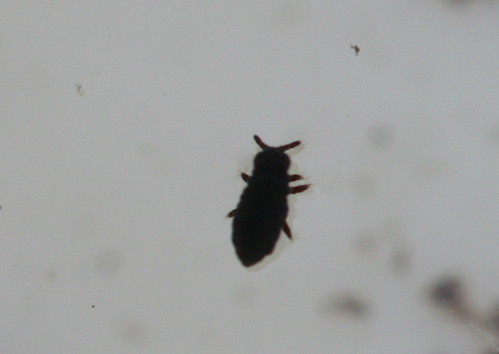
This was my favourite of all the little critters we swept up in our container. We got several of these, little tiny guys just a couple millimeters long. They sit on the water surface, much like the water striders. However, to move around, they jump like fleas. In fact, I think the name “water flea” would be much more appropriately labeled to these guys than to the microscopic Daphnia. They jump by using a mechanism similar to the click beetle in yesterday’s post. They have a long spike on their abdomen, resembling a “tail”, which is generally kept locked into place. When they want to jump, they release the clasp and the spike rapidly springs away from the body, pushing against the substrate (in this case, the water), and propelling the insect forward. It’s this jumping mechanism that gives the group its name. They can be found in nearly every habitat, even on the snow surface in winter – these ones are appropriately called “snow fleas”. Interestingly, unlike with the water striders, this speed isn’t for capturing prey, but rather for general locomotion and avoiding predators, as they’re primarily savengers, feeding on decaying plant and animal debris.

Look carefully

Ant on dandelion

On Tuesday I bought myself an early birthday present. I’ve been wanting a good macro lens for a while. In the winter I got a Canon close-up lens, basically the equivalent of a magnifying glass that you screw on to your existing lens like a filter. It worked fairly well, but unfortunately the lens that I had wasn’t top quality, it was the entry-level telephoto lens that came with the camera kit bundle. Sure does me fine for a beginner DSLR-er, and the price was definitely right (next step up is megabucks, relatively speaking), but because it’s low-end the optics are soft and the photos are never crisp. Generally this can be corrected with digital sharpening in Photoshop, but with the addition of the close-up lens, which softens the image a tad more, it was really hard to get good sharp shots without a tripod and ample light.

So I’d been eyeballing a dedicated macro lens. I find macro photography fascinating, because, unlike most wildlife photography, it’s a world that we don’t ordinarily see with our unaided eye. We also tend to overlook a lot of the small stuff, and I wanted to be able to capture these things to share with others. I wanted a lens that wasn’t afraid to get in there, and that would produce good sharp photos while doing so. The answer was the Canon EF 100mm f/2.8 USM Macro (quite a mouthful of a name!). I did a lot of research, and the general consensus was that the Canon 100 was the best bang for the buck at that price level. I couldn’t find a bad review. So I bought it.

fly

I took it out to test-drive it that afternoon, swinging by the Leslie Street Spit, which wasn’t too far out of my way. It was unfortunately quite windy, and a little cool, and I had other errands to run after, so I didn’t stay out too long. I focused on the dandelions that were growing along the edge of the parking lot and nearby path, pretty much the only wildflowers growing yet in these disturbed areas. There didn’t seem to be anything visiting them, no bees, no butterflies, no insects of any sort. Until I looked closely. There, crawling around at the base of the petals, deep within the flower head, was a teeny-tiny ant. It had a slight purple sheen to it, and its antennae were tipped with pollen. I don’t really know what it is (aside from colour and general size, ants are so similar to each other…), but it does resemble the Odorous House Ant in the Kaufman guide to insects. I gather it’s not limited to houses, despite its name, and the “Odorous” comes from its habit of emitting butyric acid, which smells of rotting coconut (presumably someone who lives where coconuts grow, and subsequently rot, would know better what this smells like).

The above fly, although also on a dandelion, was from a couple days later, when I was back at my parents’ place. It was also the only insect I found on the flowers. Like the ant, flies are difficult to identify, but this might be Cheilosia sp., a type of flower fly from the family Syrphidae.

Click beetle

Later that day my mom and I returned to the same pond site where we found the salamanders for another check-up visit on the status of things for a program she’s doing next week. We decided to walk down the trail through the woods a little ways, looking at the wildflowers and seeing what was blooming. We were mostly focused on the flowers, so nearly overlooked this beetle, even though it was sitting out in the open on a leaf.

It’s a click beetle, though species is uncertain. Click beetles are named after a characteristic noise they make. They have a spine on the underside of their thorax that snaps into a groove a short ways further back. It’s the snapping of this spine that produces the distinct clicking noise. The noise is primarily used to distract predators, but the spine can also be useful for flipping the beetle back right-side-up if it gets turned over. The action can be quite violent sometimes, jumping the beetle some distance into the air.

Asclera ruficollis

Further down the trail I stopped to photograph some trilliums and found this brightly-coloured beetle perched on the edge of a flower. I discovered, when I went to look it up in the field guide, that there are quite a number of long, narrow black beetles with red collars. This particular one had the unique characteristic of two bumps on the red thorax that made it easier to distinguish from the others, but I still had to submit the image to BugGuide.net to get an ID for it. It’s Asclera ruficollis, a beetle of the northeastern woodlands. Adults are found feeding on the pollen of wildflowers during the spring period, from March to May.

Pseudexentera sepia?

The last bug of this post was a little moth that flitted across the trail as we were walking. I tracked it a short distance off the path, where it came to rest on a dead log. If I hadn’t watched it land, though, I may have been hard-pressed to locate it again. It’s just a small moth, maybe a centimeter (half an inch), and cryptically coloured so it blends in with the wood (it looks fairly obvious here because I’ve isolated it with the camera, but believe me, it wasn’t). I think it’s a species of Pseudexentera, though I don’t really know which one. I could even be wrong on the genus. All those micros can be so tricky to ID! There just aren’t a lot of field marks on their tiny wings to reference.

Going out with my new lens in hand, I was looking for little things to photograph, but I was somewhat focused on the flowers. The lesson here: look carefully and pay attention, there’s lots out there that you can just walk right by without even noticing!

Monster bug

Giant Water Bug

Yesterday I returned to my parents’ for a couple of days, and took advantage of the warm weather last night to try for some moths. There’s a great diversity of habitat here, with a mature mixed forest on one side, open scrubby areas to another, of course the wet swamp in the corner of the property. So I was hopeful for some good stuff, and I wasn’t disappointed. That all will be the subject of another post. I’ll be setting up again tonight (I head back home tomorrow), to hopefully add to the list.

I ran my new trap overnight, but I also put out a sheet and blacklight. I got a number of species at the blacklight that didn’t show up in the trap, and some nice ones among them. However, the most interesting thing to come to the sheet last night wasn’t a moth at all. Most of the time I just glance over the beetles and wasps and midges (I can only focus on one taxon at a time, and currently it’s the moths). But I couldn’t ignore this guy. I was leaning forward investigating some moth on the sheet when a very loud buzzing whirr whizzed by my head and flopped on the ground in front of the sheet. Out of the corner of my eye I thought it was a sphinx moth or something big like that, but when I stooped to investigate, it most definitely was not. My second impression was of a cockroach, since it had the same dorso-ventrally flattened body.

Giant Water Bug

But it’s neither. In fact, this is a Giant Water Bug, also called Giant Electric Light Bug, after its habit of coming to artificial lights. It was rather alarming in its size and apparent ferocity. Fortunately, the same features made it very easy to identify. I got a clear plastic container and brought it inside to show my mom. She joked that she wasn’t going outside at night again.

Giant Water Bug

It’s about 6cm (or 2.5″) in length, with these giant broad modified front legs that it uses to secure its food. As its name indicates, it’s an aquatic insect, primarily, associated with swamps and wetlands. Normally it lives in or near the water, preying on aquatic insects, but supplementing this diet with opportunistically-caught vertebrates such as frogs or small fish. It uses a tubular rostrum to suck out the body fluids of its victims. It can inflict a painful bite, and so also has the name “Giant Toebiter”, which I would assume dates back to the days when kids were more likely to wade into mucky water barefoot (I used to do that as a kid, carefree about the creatures inhabiting it; I’m more cautious now, but it’s more because of concerns over submerged or buried sharp things, especially glass or metal garbage).

Giant Water Bug

Check out the giant eyes, which it obviously uses in stalking its prey. Plus the giant single claws at the end of each leg. I’m not sure what the white goop on its one eye is. The bugs are found across North America; there’s actually three species that are similar in appearance (I’m not sure which one I have here), and which overlap in range. Young look similar, but are obviously much smaller and take smaller prey. It takes them five moults to reach adulthood, which they do in a season; they overwinter buried in the mud as an adult. This site suggests that adults are edible, but I’m not sure I’d find them much of a delicacy.

Mites on a Giant Water Bug

When I copied the photos to my computer and looked at them closely, I discovered that the bug had been carrying what I took to be mites. You can also see a couple of large ones in the second photo, where it has its wings spread. I have no idea what species they are, or even if they are really mites, and not fleas or some other parasite like that. It seemed to have a good infestation going.

It’s amazing how it’s possible to overlook something that you would think would be quite obvious. If it comes to lights, why have we never seen it at the porch light? And being so large, you’d think we would have noticed it one of these times when down poking around the ponds. But it somehow escaped our notice to now.

Cocoons, big and small

Argyresthia thuiella? cocoon

I’ve had this cocoon sitting around since mid-March, a loose end without a blog companion to parade the web with. I also didn’t know what it was, although I imagined a Google search would turn something up quickly enough. However, recently I had two things happen. The first was I finally received my copy of Stephen Marshall’s book Insects (the first copy that was sent was lost by Canada Post, something I’ve never personally had happen before; the seller was kind enough to courier the second parcel overnight – I didn’t specifically need it overnight, but I thought it was a nice gesture). In flipping through it recently I came across practically the exact photo of the little cocoon I’d taken. The second was that I got some partnering photos to post it with. They’ll come next.

This first one, above, is the itsy-bitsy cocoon of a cedar leaf miner. It’s one or the other of a couple moth species from the genus Argyresthia that occur around here, but likely Argyresthia thuiella. This little moth is tiny. You can tell just by looking at its cocoon that it’s going to turn into a small moth. It has a wingspan (not length) of about 8mm as an adult. I happened across it while looking for bagworm moth cases (I didn’t find any), and just by chance spotted a little dash of white on the underside of a cedar branch.

You can notice the dead brown sections of cedar “leaf” nearby. These are areas that have been mined by the larva of the moth. On a deciduous leaf you’d see little trails, but the structure of the evergreen leaf hides it. Larvae overwinter inside the mined tunnels, then come out to pupate in late March or April, with adults emerging in May to June and hanging around for a couple months. They lay eggs mid-summer, and the larvae, once they hatch, spend the rest of the fall munching on cedar leaves. They overwinter in the tunnel and the cycle begins again. I gather that at the peak of their flight season, approaching a cedar where they’re gathering and laying eggs can result in momentary clouds of moths as they take off at the disturbance and swirl before landing again.

Polyphemus moth cocoon

This second photo I encountered while tracking the Yellow-bellied Sapsucker at TTPBRS last week. It’s the cocoon of a silk moth, I’m pretty sure a Polyphemus Moth. I know that the Polyphemus occurs down there because several years ago, in the first fall season I was volunteering there, we found one of the caterpillars dangling in a mist net, either having fallen off a branch above, or dropped by a bird when the bird that was carrying it flew into the net (there was no bird in the net, so if that was the case, the bird had escaped by the time we checked it). We took the caterpillar home with us, curious about what it was. Shortly after bringing it home it spun itself a cocoon, which sat for some time on the top of a dresser. When it finally emerged, it had turned into a beautiful, big, rich brown moth with gorgeous big eyespots on its hindwings. In sharp contrast to the previous moth, this one has a wingspan of nearly 6 inches.

The name Polyphemus comes from the mythical cyclops with the same name, mentioned in The Odyssey by Homer, and presumably refers to the moth’s giant eyespots. It’s the most common and widespread of the silk moths found pretty much across the continent north into southern Canada. There’s a neat series of photos of a newly-emerged adult moth at BugGuide.net. When a moth or butterfly first leaves its cocoon its wings are small and crumpled. The moth then has to pump haemolymph (the same blood-substitute body fluid that the jumping spider uses to jump) into its wings to extend them before they dry. If they dry before they’re fully filled out, or if the moth is in cramped quarters without room to extend them, the wings will be deformed and the moth most likely unable to fly.

Mystery cocoon

This last one… I don’t know what it is. When poking around the sides of the building at TTPBRS (the same building where I found the jumping spider), I found dozens of these little coils of sand grains stuck to the walls. They weren’t especially clustered, although they did seem to mostly be on the south and west sides of the building (the sunny sides). They’re only 7-8mm in diameter. I thought they were the neatest little things, and whatever made them had to be fairly common. The closest thing I could find was the cocoons of antlions, which make spherical balls of sand, but they’re found actually in the sand, not stuck to a wall, and they’re round, not coiled. I posted an ID request to BugGuide.net, and will add an edit if I figure it out.

Edit: I have an answer! The folks at BugGuide.net have come through: it’s the cocoon of the Snailcase Bagworm, Apterona helix. It belongs to the same family, Psychidae, as the bagworm moth I posted about previously. It was accidentally introduced to North America from Europe in the 1940s, and is now found in many states and provinces on both sides of the continent. The coolest thing about this species is there’re no males – the females reproduce parthenogenically (unfertilized eggs). Also cool, the adults are wingless, and the moths spend their entire lives within their case, only crawling out once they’ve laid their eggs, at which point they die.

Along came a spider

Zebra spider

When I was down at TTPBRS on Thursday, it was a pretty quiet day. Not too many birds around, so I spent some time examining the walls of one of the buildings for bugs or other interesting things. One of the creatures I came across was this jumping spider. Jumping spiders are tiny, less than a centimetre long, and fairly stocky. This particular one is a Zebra Spider (Salticus scenicus), so called for the striping on its abdomen. It’s a species with a holarctic distribution, found nearly throughout the northern hemisphere. There are more than 5000 species in this family of spiders, which represents nearly 13% of all spider species, the largest taxonomic family of the arachnids.

Zebra spider

Jumping spiders have excellent vision, aided by two giant eyes placed on the front of their head, which gives them strong binocular vision, but in a narrow field of view. They have eight eyes total; two others are also located on the front of the head, but the other four are on their back. These remaining six provide the spider’s peripheral vision. They are also amazing jumpers (hence the name of the group). They don’t have the large leg muscles of some jumping insects (such as grasshoppers). Instead, their spring power comes from a hydraulic-like system that uses their interior body fluid (insects and spiders have their “blood” loose in their body cavity, rather than contained in a vascular system) to rapidly extend their legs.

Some jumping spider species can grow quite large; one African species can reach 14 inches in length. These massive spiders have been recorded to jump as far as 7 feet in a single leap. In the larger spiders, where you can clearly see their eyes, you can watch which way they’re looking. This is because the retina of the spider’s eye sits loose at the centre of the back of the “eyeball”, and the spider moves it around, rather than moving the eye itslef, in order to see. This causes the visible colour of the eye to change, depending on where the retina is. When the eye is blackest, the spider is looking right at you.

Zebra spider - the approach

All spiders are predators, there are no herbivorous spiders. Zebra spiders feed on other insects and spiders that are their own size or smaller. As I stood there and watched this individual, snapping photos, I noticed a small brown spider crawling up the wall towards the Zebra, apparently oblivious.

Zebra spider - patience

The Zebra honed in on it right away. It patiently waited for the brown spider to pass it, actually moving out of its way, to one side, to allow it to do so.

Zebra spider - preparing to jump

Then, once the brown spider’s back was turned, the Zebra lined itself up, gathered its legs under itself…

Zebra spider - the pounce!

…and pounced!

Brown spider

The brown spider made it out alive by rapidly letting go of the wall and dropping down on a thread. A happy ending for the brown spider, not so happy for the Zebra.