Early spring moths

The Infant

I hadn’t intended for yesterday’s post to ramble on quite so much as it did. When I sat down to start to write, I had only planned for a single introductory paragraph explaining the background of my interest in moths. Somehow, when I place my fingers on a keyboard, they get carried away, and words just start to flow out.

Speckled Green Fruitworm Moth

So the initial purpose of yesterday’s post was to talk about the start of the mothing season. On Monday evening the weather was reasonably warm and clear, so I visited TTPBRS for an hour or so and hung up my sheet and blacklight to see if I could draw anything in. I just got a single moth, but I was pleased to get anything at all given that it was still so early in the season. The first moth of spring was the above individual, a Speckled Green Fruitworm moth. It’s a widespread and abundant species, and one of the first to come out in the spring, even though they overwinter as pupae, not adults. They’re extremely variable, with individuals ranging from the buffy-brown of this one, to grayish, to whiteish.

This variability can really throw me off with some of these species ’cause you think you’ve got something different or special and it turns out to be just another fill-in-the-blank-here. And then you’ve got other species that look so similar to each other they can be hard to tell apart. I guess that’s not all that unlike birds. You’ve got the variable Dark-eyed Junco with all its different-coloured subspecies, which can all occur together in some parts of the country, and then you’ve got the Willow/Alder Flycatcher complex, where the two species are only really distinguishable by song.

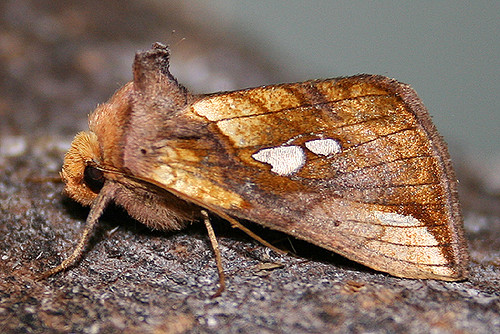
Moth number two was the top introductory photo, a day-flier called The Infant, found at my parents’ the following day. Being out in mid-day, basking with its wings spread in the sun in the lee of the barn, being brightly coloured, and then also the way it fluttered, it all reminded me of a butterfly, but it wasn’t any butterfly I was familiar with. Of course, the shape and position of the wings, and the lack of club tips to the antennae, all gave it away as a moth in the end. It’s a common and widespread early moth of the north, usually found near birch, its foodplant, and could be seen (along with a few other day-flying early-spring species) on a hike in the woods on a warm afternoon.

Spring Cankerworm

That evening I set out a couple of sheets hoping to perhaps catch a few moths. Well, was I ever surprised to eventually get not just a handful, but 50 moths to the sheets in four hours after dusk. Of this 50, 24 were the above species, by far the most common of the evening. This may be because their larval food is maple, birch, cherry, and a few other deciduous species, all quite common in the forests around my parents’ (in fact, the one sheet was actually hanging from the branches of a maple). They overwinter in the soil and pupate to emerge in early spring. The females are flightless, lacking wings altogether, and resemble something like a cross between a spider and a beetle.

The Half-wing The Half-wing (dark morph)

The above two moths are of the same species, The Half-wing, so named because females of this species are also flightless, but sport cute half-sized wings to at least resemble a moth. Yet another species whose flight period is restricted to early spring, these were caught in moderate numbers at the sheets, as well, the second-most common with 18 individuals. The species has two colour morphs, the white individual at left, and a dark melanistic morph, at right. I caught two of the dark guys, and originally thought they were a separate species before I looked it up. They’re closely related to the Spring Cankerworms, though separate in genera.

Morrison's Sallow

I caught a few other less common species, as well, including the above Morrison’s Sallow, which overwinters as an adult (this is a particularly ratty individual), and a few “micromoths”, little guys less than an inch long, which are more challenging to identify (so I haven’t yet).

The weather has cooled down, and we may not have another good evening for moths for a little while, though the long-range forecast suggests next weekend may be fairly warm. In the meantime, I’ll be looking for some of the day-fliers on the sunny afternoons.
Going beyond birds

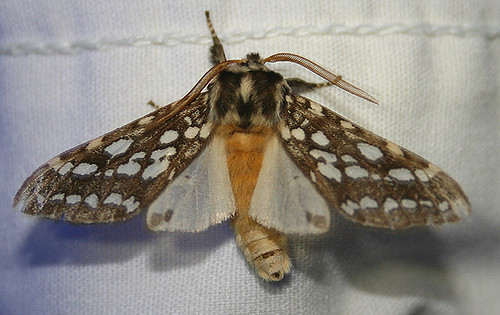
Silver-spotted Tiger Moth

Silver-spotted Tiger Moth

I’ve been birding since 2000, when, as a first year student in university, I decided I wanted a job in my field rather than a boring office job, and was offered an opportunity to work for the Toronto Zoo doing an “inventory” of their breeding bird community. This is not a long time, compared to many birders, particularly given my age. I came into birds late in life; most serious birders I’ve met have started either in their early-teens (13-14 seems to be the age something twigs for a lot of people), or as a young child. Myself, with the rural setting for my childhood, I was certainly aware of the birds, and knew all the common backyard stuff, but the birds that you have to go out to look for in order to see I didn’t get to know till that job at the zoo.

I have had the advantage of having spent a very large portion of the last five years out in the field, nearly every day. When you’re out there seven or eight hours every day you hone your identification skills rather quickly. Just about anything likely to be encountered on an average day at any time of year here in southern Ontario I would feel pretty comfortable identifying now, by sight or even just sound. Some of the less common birds of our region I could identify by sight but perhaps not sound, and I will be the first to admit that some groups (gulls, for example) I generally stink at – though mostly for lack of interest in learning (nothing against gulls, but they just don’t hold my attention for very long).

Lunate Zale

Lunate Zale

So what do you do when you’ve reached your desired level of proficiency with something? Well, you could try to hone it further (suppose I could buckle down and learn those gulls). You could try investigating deeper (learning to identify the different subspecies). You could travel to new areas (works best if you have money and time to travel). Or you could branch out into something different.

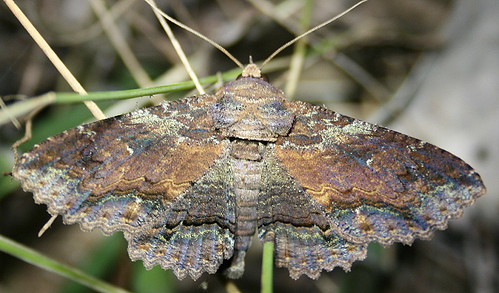
White Underwing, Catocala relicta

White Underwing

Lacking money and any real desire to get nit-picky with bird identification, I’ve opted for the latter. Even early I started learning butterfly identification (the obvious second choice to a birder – you’re standing there watching the birds with butterflies dancing about your feet anyway), as well as odonates (the dragonflies and damselflies). I got familiar enough with these groups to be able to identify all the common things. But for whatever reason, I never really got caught up in them the way I am with birds.

Pale Beauty Moth

Pale Beauty

Then, last summer, I traveled west, to British Columbia, for a job. The job didn’t work out quite as planned, and I spent three weeks staying with the organization’s gracious president, twiddling my thumbs and waiting for word on the situation. While there, I discovered he had a blacklight. And I thought, what the heck, let’s throw a sheet up and see what I get.

Violet Brocade Moth

Violet Brocade

Well, that hooked me. I don’t know what it was, specifically. Perhaps the amazing diversity and beauty of the moths that came in. Perhaps the mystery of these nocturnal creatures that makes them so hard to observe. Perhaps the fact that they’ll come to you, wherever you are, and you never know what you’re going to get. TheMothMan has well over 500 species of moths recorded for his little (and I do mean little) urban Toronto backyard. Perhaps it’s that moths are everywhere.

Ailanthus Webworm, Atteva punctella

Ailanthus Webworm

While I don’t think they’ll ever trump birds on my priority list, they may eventually run a close second… we shall see (I dislike making such bold predictions). So far, with the exception of those nights in British Columbia and one hosted by TTPBRS in early September, all my “mothing” has been done in the off-peak (for moths) late fall and, now, early spring periods. The moths are just starting to come out now, on the warmer nights, but these cool-weather moths are generally more drab. The flashy species are mostly found in the warmer months, and I’m rather looking forward to looking for them in the next few months.

Unidentified moth

Unidentified Eucosma sp.

Doesn’t matter where you live, attracting moths is pretty easy, and I almost guarantee productive (unlike trying to bird from your suburban backyard, where House Sparrows and starlings are your most likely guests). Any night where the temperature is warm (>10C/50F), hang a white sheet from a clothesline or against the side of your building, and set up a light in front of it. Although a regular white bulb will work okay, bulbs that emit rays in the UV spectrum, such as blacklights (cheap, less than $5 at Home Depot) or mercury vapour bulbs (considerably more expensive but brighter so will draw more in) will give you the best success, since the moths are attracted to the UV wavelengths. Make sure your white sheet is the sort that glows in the dark – some types of fabric don’t phosphoresce, which decreases its effectiveness.

Lempke's Gold Spot Moth

Lempke’s Gold Spot

The above photos are all ones I took either in British Columbia, or at the TTPBRS moth night. They’re only a few of what I have, primarily of some of the brighter species. If you’re interested in seeing some of the rest of my extremely modest collection of moth photos (mostly from BC at the moment, and taken with flash; I’m refining my technique), visit my moth set on Flickr.

Homes for the winter

Cecropia moth cocoon

Here’s some of those photos I’ve had sitting around for a while, waiting for an opportunity to post about them. This first one I’ve had since January! I came across this interesting structure while out with Blackburnian during the Colour-coding Chickadees walk. I had no idea what it was at the time. It was already open when I came across it, and there was nothing in it. It resembled a cocoon, but I didn’t really know. Lots else to post about, so I never got around to looking it up.

Then in mid-February, Jennifer over at A Passion for Nature posted a cocoon she’d been seeing on some of her walks, and a couple days later she posted a follow-up about the cocoon’s occupant. Turns out, it’s the cocoon of a Cecropia Moth, one of the North American silk moths, a group of beautiful, giant moths whose caterpillars spin “silk” which they use to create their cocoons. Jennifer directs her readers to a rather amazing site that documents the life cycle of the moth from egg to adult (and now I’ll direct you there, too!). The site indicates that the moths overwinter as pupae, so the fact that this cocoon is split open likely suggests that it’s either last year’s case, or somebody/thing got to it before I did this winter.

Bagworm moth case, Psyche casta

This second one is also a moth, and I’ve also had it on hand since January. I knew right away what this one was when I saw it, from having browsed through the Moth Photographers Group website while identifying a few moths last fall. Of course, I couldn’t remember exactly which it was, just that I’d seen it on the pages, so I had to go back and scan through their many (very useful) pages all over again.

The case, which superficially reminds me of those made by caddisfly larvae, is made by a moth belonging to the group of “bagworm moths”. This one’s probably Psyche casta; the different species have different case styles, but I would assume some of them to be subtle. Like the caddisfly, the moth larvae tote this bundle of sticks around with them until it’s time to pupate, at which time they affix it to a solid surface for the winter. I found three of these all sitting in the window frames of my parents’ house. Two were between the panes of glass, but this third one was on the interior frame, which made it easier to photograph, but also meant it was exposed to spiderwebs, dust, pet hair, etc.

Wikipedia indicates that many bagworm moth females have vestigial wings, and sometimes never leave their cases, mating with males even while still inside. They die after mating, either having laid the eggs inside the case, or without having laid the eggs (so the larvae mature and emerge from the female’s body). The eggs are very hardy, and a bird that finds the case and eats it will pass the eggs through its digestive system intact, aiding in the spread of “new blood” from one area to another.

Praying mantis egg case

And this final case isn’t a moth or butterfly cocoon, but instead was created by a Praying Mantis. They started appearing late last fall, and I think I found five in total, four of them laid on the research station’s exterior walls. I didn’t know what this was at first, either, but I think one of the volunteers at the station pointed it out and identified it for me. They were still there, all of them, when I was back for the start of the spring season. When they were first laid they were a little gooey to touch; now they’re all quite hard.

I read somewhere that they’re always laid on the south side of the object they’re affixed to, which is actually true of the four on the station building. The one pictured here, however, found at the base of a metal signpost, was on the north side. I guess that one didn’t get the memo. Mantids are fairly common at the spit, which is pretty neat, since I never saw many growing up. Despite their slightly startling, ferocious appearance, they’re pretty tame to pick up and handle, not inclined to bite, which makes them great for showing to kids. Just like hatching a cocoon, you can bring these cases inside and set them up in a terrarium to hatch – or, if you don’t want to risk damaging the wild ones, you could order your own Praying Mantis Encounter from Discovery Channel’s store, and treat the kids (or yourself) to a neat experience watching them grow. Only available to the US, unfortunately, or I’d order one! :)

A beetle from summer

Grapevine Beetle

When I returned to my parents’ this week my mom had brought out a beetle she had found while shopping downtown in the local town back in the summer, following a conversation we’d had earlier this week on a subject I can’t recall now. The beetle was dead when she found it, so she picked it up and brought it home with her. It was a warm reddish-tan, with large black spots down each side of the carapace, and one in the middle of the back. It’s obviously a member of the scarab beetles family, and further research revealed it to be a Grapevine Beetle, Pelidnota punctata.

Ordinarily a dead beetle on the sidewalk would probably have been passed by unnoticed, but the size of this particular beetle was what caught her eye. Below is an image of the beetle posed with a (live) ladybug for comparison. The scarab family contains 1300 species, some of them the largest beetles in North America. Grapevine Beetles can grow up to an inch long, which is not quite up to the six inches of the southern Hercules Beetle, but is still a pretty impressive beetle for this part of the country.

Grapevine Beetle and ladybug

I’ve never seen this beetle alive myself; in fact, this is the first time I’ve seen it ever, which seems somewhat unusual for what looks like it should be a rather conspicuous bug. It seems fairly common, occuring through most of the east from Ontario south to northern Florida and west to Nebraska. The adults can be found from May to August through much of its range, and will regularly come to lights in the summer.

Grapevine Beetle head

It inhabits deciduous forests. Adults feed on the foliage and fruit of grapevines (hence the species’ common name), but appear to do little serious damage. It lays its eggs in the summer on decaying logs, which the larva feed on during their development. Larva overwinter in the logs, pupating and emerging as adults in the spring. I found one site that offered care information for the species, but aside from a couple comments on the web, couldn’t see any evidence that it was frequently kept in captivity.

Grapevine Beetle head

One of the features of scarabs is their club-like antennae. You can sort of see here that the club is actually many-parted. These plates are called lamellae, and the beetle can fan them out when sensing odours. When it’s not testing the air, it folds them up out of the way. This individual’s a little dusty from sitting on a shelf since the summer, but in this and the previous photo you can also see the mouthparts it uses to cut bits of vegetation. In the previous photo you can get a better view of the upper cutting mandibles, and the lower manipulating ones.

Grapevine Beetle legs

Beetles, like many insects, have hairy legs and bodies, under their smooth carapaces. These hairs are called setae, and are used for sensing the environment. Generally they sense small changes in air pressure.

Take a look at the claws at the end of this guy’s feet. The claws are primarily used to help the beetle secure itself to whatever it’s walking on. However, in scarabs the front claws are modified for digging. You can see how much more curved they are on this individual. Grapevine Beetles aren’t really diggers the way some scarabs are (such as dung beetles), but they retain the characteristics of the group.

In looking up information on beetle feet, I discovered this site that is doing research on the applications of beetle-foot design to modern technology. One of the main things they’ve developed from it is an adhesive that’s twice as sticky as glue-based tapes, and is reusable simply by washing with soap and water. I wasn’t quite clear on the specifics of the technology from their description, but it uses the principle of a beetle’s hairy feet (I gather this is a characteristic of a different family of beetles), which act like a thousand little suction cups on long threads. The suction cups adhere to the surface, while the long threads allow dust motes and other debris to slip between the affixing surfaces, so it can attach to dusty and dirty surfaces as well. The lab’s site has videos of their Mini-Whegs robots scaling vertical glass walls using the adhesive. I’m on dial-up while here at my parents’, so wasn’t able to watch them, but even just the idea is pretty cool.

Tunnels from top to bottom

Insect mines under bark surface

When I sat down to enjoy the sunshine and do a bit of sketching in the Don Valley trails on Sunday, I chose a young sapling to sit in front of. Not for any particular characteristic of the tree, but just that I like to have something at my back. I didn’t pay much attention to the tree initially, and I hung my camera bag on a broken-off branch before sitting down. When I got up and reached for my bag, I happened to notice these lines on the bark.

They’re obviously made by some sort of insect. Curious to what it may have been, I started poking around the ‘net. The answer to this question was not nearly as easy to find as I had expected it to be. Between yesterday and then again today I’ve spent several hours typing in search terms into Google and checking out promising links. This is easily the longest I’ve spent on researching a post to this point, and I didn’t even come up with anything conclusive for all that effort.

Insect mines under bark surface

Research for my posts usually starts with a single, rather vague, descriptive term. For instance, when I was researching the Black Knot information, my first term was “black crusty growth on twig”. You usually get a few misses at first before hitting on to what’s obviously the correct identification. In this case I started off with “bark miner”. I’m familiar with leaf miners, which create tunnels between the two surfaces of a leaf, and this looked very similar. It seemed like a pretty obvious connection, but the search produced no viable hits. I changed my approach. “mines under bark lines on surface insect branch”.

This turned up a lot of not very useful stuff, but did contain one page that had something. It was a fact sheet on the Allegheny Serviceberry. What does that have to do with insect mines? It had a section on pests. The first paragraph read, “Cambium miners cause concern when noticed but are not very damaging to the tree. The mines can extend from a twig all the way down to the roots. The mines form light-colored lines in the bark.” Aha! A lead!

So the next search term was “cambium miners”. The cambium is the layer of reproducing cells in a tree located between the outer bark and the inner hardwood which is the source of the tree’s outward growth. It’s just a narrow layer, and in a young thin-barked tree like ash, maple, birch, and other deciduous species, it’s pretty close to the surface. This seemed promising.

Insect mines under bark surface

Most hits I found just simply called them cambium miners, without identifying the species or even the order of insects they belonged to. I didn’t find this especially useful. However, after poking through a number of hits I came across a page from an online resource called Tree Dictionary. The page seemed to be focused on pests of trees as well, and included a lot of information on various fungi. Also paragraphs on sapsuckers, squirrels, frost, beetles, and, the object of my search, cambium miners.

The page indicates that cambium miners are flies belonging to the genus Phytobia. The flies lay their eggs on branches near the top of the tree, and the young larvae mine their way through the cambium down toward the roots, where they stay till they pupate. There isn’t actually a lot of information on the life history of this genus on the web, at least that I turned up in my initial searches. I was able to determine that there are a number of different species that have different host preferences, and some are cambium miners while others are leaf miners.

Insect mines under bark surface

Knowing the species of my tree would help. I’m not certain, as it’s a small sapling in the middle of winter with no leaves. I can rule out birch fairly safely, I would think, and cherry, because there aren’t any horizontal lines. Beech and maple would be grey. Hawthorn would have spines. But that still leaves me with an assortment of options, including common species like ash, and less common ones such as alder, hickory, etc. I’m leaning toward ash, given the location and its commonness.

On the website ForestPests.org I found an informative factsheet on the Ash Cambium Miner. The page indicates that the larvae of this fly mine in straight or serpentine tunnels near the top of the tree, but the further down they get (and presumably, the older they get), the more their tunnels take on a zig-zagging appearance until they’re distinctly so by the time they reach the roots, where they’ll spend about 10 months. They overwinter there, then exit the roots in late spring and pupate in the soil.

I continued to poke around, pressing on and changing the search terms to see if I could turn anything else up. I had a few other potential culprits, including flat-headed borers (metallic wood boring beetles, the group that includes Emerald Ash Borer), and small moths of the genus Cydia, but none of the online resources seemed to match as well. I’m still not positive on calling them Phytobia sp, either, given that I couldn’t find any resource showing their mines to be able to compare to the ones I photographed, but the information all seems to match pretty well.

Laminate floor

Today I spent the day laying laminate floor in the family room at my parents’ house. I’m pretty sure that laminate wood flooring is a little like vinyl tile in that they make the wooden planks out of pressed particleboard (or something resembling it) and then print a design on top, rather than laying an actual wood veneer over it. However, I assume they use an actual image of woodgrain to create the print image, so the laminate planks represent actual woodgrain patterns.

What does this have to do with cambium miners? Well, on both of the sites mentioned above, they indicate that the mines left by the larvae get grown over as the tree continues to grow and result in small discolourations in the wood. These show up as small dark marks on stumps when the tree is cut or, as in the case here, in wooden planking, where they’re called “pith flecks”, among other names. They apparently don’t show up in ash wood very well, but are fairly noticeable in most other types of wood. I’m not sure what type of wood this laminate is supposed to be an imitation of, but it’s got a distinctly reddish tinge.

Pith flecks

Here’s a close-up of the pith flecks in the woodgrain of the laminate print. You can see nearly all of them are associated with the tree-ring growth mark, where the larva would have been tunneling close to the surface of the bark (the dark growth line). A couple of the marks are further in; apparently there are some species that will occasionally feed in the xylem (the layer under the cambium) for short periods, and that could be what these are.

Despite that these marks are due to insect damage, they’re not generally considered defects of the wood by most lumber manufacturers, but they are recognized as such by the Fine Hardwood Veneer Association (who knew there was such a thing?). I suppose that, over the course of a tree’s life, there’s a good chance it will be infested at least once so it would be hard to completely eliminate the marks from wood products.

Insects. They’re everywhere.