Anti-sunblock

Giant Hogweed (Heracleum mantegazzianum)

On Friday this week my mom and I spent the morning painting the outbuildings on their property to match the new house colour. There wasn’t a lot of stain left, and we used up the last of it without finishing the first coat. Since we were going to need another can, and we had a few other errands to run in town, the two of us made a trip out in the afternoon. We took the backroads home from town, a route I don’t often have occasion to travel anymore, since ordinarily I’m taking the major highways between my home and my parents’. It was nice to see some of this countryside that I haven’t been through in a while.

Along that road there’s a number of wet spots where these giant plants grow. The stuff is called Giant Hogweed (Heracleum mantegazzianum) and is – you guessed it – an invasive species. It’s related to our native Cow Parsnip (H. maximumin), and is in the same family (Apiaceae) as the also-introduced but much more frequently encountered Queen Anne’s Lace, among others. It bears some resemblance to the wild carrot of roadsides and pastures, with broad, spreading flower heads and deeply incised leaves. However, it grows to be three to four times larger, reaching on average 2-5 meters (6-16 feet) high, with some extraordinary individual plants as tall as 7 m (23 ft). The flower stalks are all a reddish-purple colour that helps distinguish the species from other similar-looking plants such as Cow Parsley or Water Hemlock (neither of which grow as tall as the hogweed).

Giant Hogweed (Heracleum mantegazzianum)

The plants were all mostly finished blooming by this time of year, but can be quite a roadside spectacle when they’re all in bloom, the many clustered plants, with their giant white umbrellas, looking like congregations of oversized Queen Anne’s Lace. Later in the summer, once they’re done blooming, they develop large seed pods, each the size of a pumpkin seed. A single, large plant can produce as many as 100,000 of the things. This was the stage most of the plants were in when we stopped to check them out. My mom, who has more opportunity to travel that way, living in the area as she does, watched as they grew, bloomed, and started growing seeds. I just caught the end of the show. The plants only flower in their second or third year, so these have been present for a while.

Giant Hogweed (Heracleum mantegazzianum)

The patch had started out some years ago not that large, but has spread out into the surrounding wet areas. This particular area of hogweed now lined both sides of the road and extended into the wet forest a short distance, as well as lining the edges of the cattail stand. You can see some distance patches on the far side of the cattails in this photo. It is an aggressive weed, choking out the native vegetation without much difficulty, aided in large part by its size. The individually biennial plants also grow from a perennial tuberous root system, such that once it’s expanded into an area it’s not likely to relinquish it again without intervention.

The species is native to central Asia, but was introduced to Britain and France in the 19th century, primarily as a garden ornamental, and is now found through many European countries. It was probably brought to North America not long after for the same reason. Since then it’s escaped the gardens it was planted in and is now found throughout wet areas in much of the northeastern and northwestern regions of North America. In Ontario it’s found through many localities in the south of the province, now occurring as far north as Haliburton county.

Giant Hogweed (Heracleum mantegazzianum)

Giant Hogweed prefers wet areas such as riverbanks and marsh edges, but ditches are also a perfectly acceptable habitat. Given the disturbed nature of roadside ditches, sturdy plants such as this are a natural to settle in, and it doesn’t take them long to spread out into other areas from there. Along this stretch, the giant leaves of the huge plants nearly envelop the guardrails from view.

You can easily see how such a species could begin to crowd riverside walking trails or boardwalks, if given a chance. With most plants this wouldn’t be a problem. However, Giant Hogweed (and in fact all members of the genus Heracleum, including Cow Parsnip) contains a chemical that is as dangerous to encounter as that of Poison Ivy. The sap, and all of the oils that coat the surfaces of leaves and stem, contains a type of compound called furanocoumarin. Whether or not you can pronounce the stuff, it will still create an extremely adverse reaction with your skin.

Giant Hogweed (Heracleum mantegazzianum)

Brushing up against the leaves or stem of the plant will result in the oils being spread across your skin, much like touching Poison Ivy does. The reaction it produces is different, however; the oil of Giant Hogweed doesn’t create an allergic reaction the way Poison Ivy does, but is rather a phototoxic plant. This means that getting the oil on your skin will make your skin extremely susceptible to burning upon exposure to UV rays such as sunlight. It’s sort of the opposite of sunblock, enhancing the effects of the UV rays instead of reducing them.

It takes 10 minutes for the oils of the plant to set in to your skin, but after that any exposure to UV light will cause the skin to redden and itch, and subsequently blister like a bad sunburn (which is effectively what it is). The burns will usually become purple or blackish scars, persisting for potentially several years. If you can remain inside, or completely covered up and protected from any UV rays, you’ll be fine, no reaction will occur. Wash the area with soap and water and try to remain protected for several days before going back out in the sun. Getting the oil or smoke from the plant in one’s eyes, however, can cause temporary or permanent blindness.

Giant Hogweed (Heracleum mantegazzianum)

Like with Poison Ivy, the effects of the oils seem to be contained to just a small group of animals. The insects appeared to be unaffected. We found a small plant at the edge of the road that was still blooming, and being visited by small wasps. As with the common Queen Anne’s Lace of the meadows, the flowers of the Giant Hogweed will attract local native pollinators. Wikipedia notes that its introduction to France was “much appreciated by beekeepers.” The flower heads can often be heavily infested with aphids, but I didn’t happen to notice any while we were there (though I admit I wasn’t specifically looking).

Giant Hogweed (Heracleum mantegazzianum)

There are control programs in place in some areas to try to manage this invasive plant, but methods are complicated by the danger of touching or inhaling its oils. If well-protected with full skin and eye coverage, it is possible to physically cut down the flower stems and broad leaves. This weakens the tubers (which can be as deep as 60 cm, or 2 ft), making them easier to pull up and destroy successfully. However, probably more effective, and certainly more efficient, if a bit less environmentally friendly, is the application of herbicides to the plants. Even once the plants themselves are removed, however, the seeds that the plant has dropped can persist and germinate for up to 15 years later.

Giant Hogweed (Heracleum mantegazzianum)

The Apiaceae family contains quite a number of unpleasant plants. Besides the invasive hogweed, there’s also Water Hemlock, native to North America, and Poison Hemlock, native to Europe, that are extremely poisonous, with ingestion of the plant in even a small amount causing death within as little as 15 minutes. The latter was the hemlock that was given to Socrates (not related to the hemlock tree, which is what most people likely associate with the name hemlock). On the other hand, quite a lot of the family’s members are also commonly eaten – including carrot, parsley, celery and parsnip, just to name a few. I wonder how many people it took to figure out which was which?

Daylilies and dragonflies

Meadowhawk sp.

This is the time of year when my mom’s garden really reaches its peak. It’s a perennial garden, with many different types of flowers, shrubs and plants, but with a focus on daylilies. There are hundreds of cultivars of daylilies, you could fill up acres collecting every one. Mom doesn’t have that many; her collection is somewhere around a hundred cultivars, and was mostly limited by the space in the garden. Most daylilies flower from mid-July through August, and during this time the garden is a riot of colour. The only natural flower colour that seems to be missing is blue, which they haven’t managed to create in the species, perhaps because blue is a structural pigment and isn’t formed through the same processes that produce reds, oranges and yellows. Each bloom on a daylily only lasts one day (hence the name), and a walk around the garden each morning will be just a little different from the previous day, with some cultivars blooming, others not, multiple flowers on some, and first blooms of the summer.

Meadowhawk sp.

For the last couple weeks, we’ve noticed that the garden is full of these guys, little dragonflies, short and small by dragonfly standards, in red and orange. Dozens of them, all hanging around the garden. They’re meadowhawks, a type of skimmer. About the same length as the damselflies, they can be easily distinguished by their chunky bodies and wings, and oversized eyes. They’re fairly common dragonflies, but there are several species and telling some of them apart can be tricky. A number of species have orangey wing markings, but for those that don’t (and this includes the ones that occur here), the best characteristic is the face. Around here we’re likely to get White-faced, Cherry-faced and Ruby Meadowhawks. There is some overlap in face colour, just to make things confusing, but generally the White-faced have a pure white face, the Ruby has a straw-coloured face, and the Cherry a reddish face (although eastern individuals can be olive-yellow). The book Dragonflies Through Binoculars states that Ruby and Cherry-faced cannot be separated by face colour in the east. The Stokes Beginners Guide to Dragonflies also warns, “A meadowhawk with a dull yellowish or ivory face cannot be identified with certainty in the field.” Rather, definitive identification requires examination of the genitalia under a microscope. And, to throw a wrench in the works, Through Binoculars indicates that all three species hybridize in the northeast, such that intermediate individuals may not belong to one species or another but are instead hybrids.

Meadowhawk sp.

The brown individuals are all females, or possibly immature males. Male meadowhawks remain this brownish colour for about two weeks before obtaining the bright red of maturity. During this time they’re separable from the females by examining their genital structures, but I didn’t look that closely. It’s interesting how much of dragonfly and damselfly identification comes down to the genitalia. How do the insects know which species another individual is when courting? Are there little visual clues that we haven’t seen, or are too small for our naked eyes? Or do they use behavioural cues? It would be embarrassing to try to hook up with a female just to find your lock and key don’t fit; good thing dragonflies don’t get embarrassed.

Meadowhawk sp.

More than most other dragonflies I observe, meadowhawks like to perch at the tips of tall pointy things that stick out from the surrounding foliage. It was tough to get a photo of one actually on a daylily bloom because they would favour the long grasses, tall thistle stalks, and even the unopened daylily buds over the flowers themselves. Like all dragonflies, meadowhawks are predaceous, feeding on other insects, using their speed and agility to catch them. I imagine that perching in an exposed location like that offers them the best view of their surroundings, and potential prey, and also allows them to dart out after something without having to navigate around plants. If you watch a meadowhawk closely you can see it turning its head to focus on different things.

Meadowhawk sp.

I’ve noticed the occasional individual will adopt this pose while resting. It’s called the “obelisk position”, and its purpose is to minimize the surface area of the dragonfly’s body that is exposed to the sun. Since insects have no physiological ability to thermoregulate, they must change their behaviour to prevent overheating. Whereas we would simply sweat and cool down through evaporation, a dragonfly must either seek shade or, where shade isn’t available, or is impractical (such as in hunting in open areas), minimize their exposure to the sun. While most dragonflies are associated with water edges, meadowhawks, as their name implies, are often found in meadows or other open areas that may have minimal shade. Notice how small the dragonfly’s shadow is on the fern frond.

Also interesting to note, the above individual appears to be a male changing from its immature brown into its mature red colouration. You can see the red starting on the top of the abdomen in a couple spots.

Meadowhawk sp.

In taking close-up photos of a few individuals, I noticed that the pattern of colours and spots on their large compound eyes varied from one individual to the next. For instance, the above individual looks like it has pupils and is smiling at the camera, while the one below has more diffuse spots on its eyes. I wonder if this is a difference in species, in sex (since immature males are the same colour as females), or simply individual variation?

Meadowhawk sp.

A flower by any other name

Orange Hawkweed

Summer wildflowers are beginning to come out. I’m seeing many that I tend to associate with the hot, still, “dog days” of summer. Flowers such as chicory, daisies, vetches, bladderwort, Viper’s Bugloss, and others. One that I spotted recently was the above. I’ve always known this as Indian Paintbrush, so I was a little surprised to find, when I Googled “Indian Paintbrush”, that the actual wildflower of that name is not this plant and has nothing to do with it. (When Blackburnian asked what today’s blog topic was, I showed him a photo of the plant, and he said, “Oh, Indian Paintbrush?” So I’m not the only one to have thought that was its name! They do look very paintbrush-shaped.) So now what? I thought I’d try the wildflower ID tool that Winterwoman at A Passion For Nature posted about a little while ago, but it turns out it’s down while the site manager switches ISPs and gets everything up and going again.

So I did a search for Ontario Wildflowers, found a site that listed names alongside pictures, and located my flower. It’s Orange Hawkweed, Hieracium aurantiacum, and like virtually every other wildflower I’ve posted about lately, it’s not native to North America. (Incidentally, the true Indian Paintbrush is native.) It goes by several other names, including Devil’s Paintbrush and, in Europe, where it’s from, Fox-and-cubs. One website indicated that the name Hawkweed originated from ancient Greece, where they believed that hawks would eat the flowers to improve their eyesight (although it was actually used as an herbal remedy for sight problems, this not likely true, but a delightful image nonetheless). It’s a member of the aster family, Asteraceae, like daisies, dandelions, asters, and others, with many rayed “petals” around a central cluster of tiny individual flowers.

Orange Hawkweed

It was introduced to North America, possibly Vermont in 1875, as a cultivated garden plant. At some point it escaped from cultivation (this brings up images of plants growing legs and sneaking away) and quickly settled into disturbed habitats around human development. Among its favourite spots are roadsides, abandoned and regenerating fields, and waste places such as empty lots – the sorts of places where nothing’s established and it’s easy to gain a foothold over native plants, or where the conditions are harsh enough that few native plants would prosper. However, it’s also found in natural areas where conditions are suitable. It’s now found coast-to-coast, though it has a much stronger presence in the east, near its original “release” site. The species is on the noxious weeds list of many states and provinces, and is prohibited from distribution or cultivation in most of these. It has also been introduced to Australia, Tasmania and New Zealand, where it is also problematic.

Orange Hawkweed with skipper

Despite its non-native status, the flowers still attract many native insects. I’ve seen butterflies, such as this skipper, visiting them, as well as bees, flies and ants. The plants tend to be passed over by herbivores, however, and heavily grazed areas may end up with large populations of the flower, as the grazing down of native, palatable vegetation allows for the hawkweed to take root.

When the plants go to seed they’ll produce little tufts, like the seeds of dandelions. Each flower stem can have up to 30 flowers, each of which can produce as many as 30 seeds. They generally rely on wind for dispersion, however the invasive spread of the species is aided by hitching rides on passing animals and people (who can carry the seeds much greater distances). Once a seed and plant is established, it spreads locally through rhizomes (underground roots that can produce whole new plants some distance from the parent) and stolons (sideways stems that lie flat along the ground, putting down roots at intervals and starting new plants). Because of this vegetative reproductive strategy, pulling up individual plants may not necessarily remove the whole patch, as remaining bits of rhizomes or stolons have the potential to regenerate.

Orange Hawkweed with ant

Although it can be very widespread and abundant in some areas, at my parents’ there are only a few small patches. I seem to remember there being more, when I was younger. There also seemed to be more dandelions on the lawn, too, though, and daisies and Queen Anne’s Lace and New England Asters in the fall… Pollinator populations are falling, but I highly doubt that it’s enough (yet) that the wildflower community is being taken over by grasses, so perhaps it was just the slightly distorted memory of a child, when everything seemed bigger and grander.

Yellow Hawkweed

There are actually hawkweed species native to North America. Wikipedia lists 51 species of Hieracium in the United States. Flora Ontario gives 19 unique results for the genus Hieracium. All of the other 18 species are yellow. Identifying Orange Hawkweed is a breeze, but identifying the rest requires a bit more deliberation. I think the one above is Yellow Hawkweed (among many other common names), Hieracium caespitosum, because it appears to be the only one of Ontario’s species that tends to clump all of its flowers at the top of the stem, rather than branching them more spread out, in a more open pattern. It’s also a fairly common species, relative to the others. Unfortunately, like the Orange, it’s also an introduced species. I’m sure if I keep looking I’m bound to come across a native meadow wildflower eventually… (It really says something about the state of our ecosystems, doesn’t it?)

By the hundreds

Moth jars in fridge

Hundreds of moths

This is my 100th post. It arrived rather quickly, it’s hard to believe I’ve written that many entries already, on subjects as varied as fungus and flora, birds and bugs, earth hour and green parties (the events, not the political groups). I thought the hundredth post deserved special attention, to mark a milestone, but I wasn’t sure how by. I spent some time thinking about it, and finally decided upon a post of hundreds – recent observations of multitudes of whatever it is I’m observing.

I happen to be at my parents’ this week, taking care of the horses while my mom’s away at a conference. Unfortunately, they’re not as easy as goldfish where you sprinkle them some food and they’re good to go for a while. I don’t mind coming out to care for them, though, as it gives me an excuse to visit the countryside. One of the things I use that excuse to do is catch moths, of course. I had a few sheets up last evening, and this. It was on the cooler side overnight last night, about 15 C (60 F), but there was still a good selection of things coming in to the sheets and trap; this evening is warmer and there’s much more activity. Since I need to photograph everything in order to later identify it, I jar the moths I don’t know and tuck them in the fridge. It doesn’t take long for the fridge to fill up. The above photo is the state of things after last night.

Insects on Goatsbeard

Hundreds of bugs

In my mom’s garden there are a couple clumps of goatsbeard (Aruncus dioicus), a perennial native to North America and western Europe. It produces sprays of white flowers, which insects absolutely love. I highly recommend that any budding entomologist buy themselves a goatsbeard for their garden. It gets everything: butterflies, of course, but also day-flying moths, wasps, bees, flies, beetles. You can even find mosquitoes nectaring on the flowers. During the plant’s peak blooming period, which lasts a couple of weeks and is about this time of year, the blooms will be alive with activity, covered in bugs. Hundreds is not an exaggeration here. The longer you stand there, the more you see. It attracts some pretty interesting things.

Beetles

Hundreds of beetles

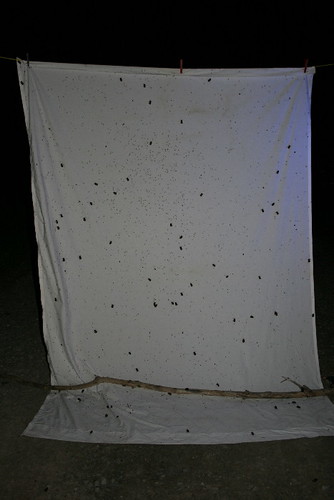
Earlier in the month I did some mothing down at the research station. Or tried to, anyway. I didn’t actually end up catching very many moths, though I’m not sure why; it was fairly warm that evening. However, what I did end up getting lots of were beetles. In many shapes and sizes, but the most apparent were the June Bugs. These guys aren’t a lot of fun to have come buzzing in to a sheet at the best of times, since they’re clumsy and just as liable to run into you as the sheet. Having about 100 come in to the light was almost creepy. In this photo, those large dark spots are the June Bugs; there are 67 visible on the sheet, and there were easily a few dozen more on the other side, on the ground, and in the nearby vegetation.

Colewort

Hundreds of flowers

The colewort in the garden is also still going strong. Because the plant is ginormous, there are easily hundreds upon hundreds of flowers blooming on it. The colewort attracts a lot of insects, too, and has a fairly strong and pretty scent. Yesterday I watched a few interesting beetles, flies, and a tiger swallowtail dropped by to sample things. This wouldn’t be a bad plant for the garden of an entomologist, either, but it does take up a lot of room.

Chokecherries

Hundreds of berries

I noticed while making the rounds of the garden that the chokecherry tree is beginning to put out its berries. They’re still far from ripe, being a green the same shade as the leaves, but they’re nearly full-size now. The tree is covered in them, and staring up into the canopy creates an interesting effect, almost abstract in appearance.

Hail

Hundreds of hailstones (and raindrops)

The last couple of weeks we’ve had regular, near-daily afternoon thunderstorms. Many of the thunderstorms have included hail, often rather large hail. I tried to take a photo of some of the rather large hail, but couldn’t really capture it any better than this. It’s been strange just how much rain we’ve got this year. I heard something about this June being the wettest on record (so far), but can’t seem to corroborate that. All this rain is especially strange compared to last summer, which was the polar opposite – days upon days of nothing but clear skies and sunshine, not a drop of rain in sight. My parents actually had concerns over their well running low and had to implement a strict water conservation plan. Won’t be an issue this year.

I actually started this post last night (Tuesday), but have been quite busy filling my mom’s shoes while she’s gone. In addition to the dentist appointment, which was quick and went well, but still took a chunk out of my day. I have new respect for the amount of work my mom (or my sister, when she’s here and takes over) puts in around here, especially with the horses. I don’t think I fully appreciated just how much time was involved in caring for them.

In any case. Here’s to another happy hundred.

Lion’s teeth

Dandelion

Is there anything as cheerful as a lawn blanketed with dandelions? Dandelions are one of my favourite so-called weeds. The bane of gardeners and lawn purists, and the backbone behind an entire herbicide industry, this sturdy plant pops up just about anywhere. But it’s hard to feel antagonistic towards something so cheery.

I was shocked to discover that the incredibly common dandelion is in fact not native to North America. It’s originally a plant of Eurasia, but has been spread throughout virtually all temperate areas around the globe, in both northern and southern hemispheres. The species group evolved about 30 million years ago on its home continent; its presence here in the Americas is just a tiny blip in evolutionary time.

The name dandelion refers to members of the genus Taraxacum. There is some debate among scientists about just how many species are included in the group, with estimates for just the British Isles ranging from 60 to 250 species. I don’t know a whole lot about the taxonomy of plants, so I can’t comment on what they use to define a species. The definition we learned in school is that a species can’t mate with other species to produce fertile offspring (it either can’t mate in the first place, or the egg won’t fertilize, or the embryos abort, or the living offspring is infertile, like in mules). Of course, we know this isn’t always strictly true, but it seems like a pretty good rule of thumb, so I’m surprised at all the confusion. Perhaps the new genetic barcoding projects will help clear things up.

Dandelion

The name dandelion is a corruption of the French name “dent de lion”, or Lion’s Tooth, a reference to the jaggedly toothed leaves. This seems to have been a historical French name, as they no longer call them that. Instead, the modern French name for the plant is “pissenlit” – separated, “piss en lit”, which means, of course, “piss in bed”. I thought this was hilarious. Can you imagine a plant with a name like that here? It apparently comes from the plant’s diuretic properties when consumed. The Italians and Spanish have something similar, and an English folk name is “pissabed”.

Going a different route, locally in Veneto, Italy, they’re known as “pisacan”, meaning “dog piss”, referring to their common occurrence in such favoured places of dogs. Novara, Italy, and the Polish are much more refined, with their words both meaning “to blow”, a reference to the plant’s seed heads. In Hungary it’s known as “dog milk”, commenting on the pale sap that comes out when the stem is broken, or “child chain grass”, an observation on how children can make chains by removing the flower heads and inserting the narrow top part of the stem into the hollow bottom part.

Dandelion

Dandelions are members of the family Asteraceae, characterized by family members bearing flower heads that have many individual flowers. In the case of the dandelion the individual flowers are difficult to separate from each other. I’m unclear about whether each yellow “petal” represents a separate flower on these plants or not.

The leaves themselves grow in a rosette, from which one or multiple flower stems may grow. In low-growing, open areas such as lawns, the leaves can spread out and kill surrounding plants by preventing light from reaching them, however where they grow with vigorous competition the leaves are usually more vertical, and the plant can grow fairly tall. Dandelions have a monsterous taproot, which can make them a real challenge to pull out of the ground successfully. If you break off the taproot, the plant has the ability to regenerate from what remains in the soil.

Dandelion

You can see the pollen-producing organs here, the older of which seem to have split open. I’m not sure exactly what’s going on, whether this split releases more pollen, or what the situation is. I’m also not sure where the female organs are. I’m sure I could easily have turned up some webpages on dandelion reproduction, but to me that’s not the most interesting thing about these plants.

Dandelion pollen is collected by many insects, and many others come to the flowers for the nectar. When watching the flowers on my parents’ lawn I saw bees, wasps, flies and ants all visiting the plants. Once the seeds mature, they are eaten by seed-eaters such as goldfinches. There are quite a number of caterpillars that feed on the foliage.

Dandelion seed head

Each fertilized ovary develops into a single seed, which is attached to the flower head. A small parachute of fine hairs grows from the seed, and carries it away on the wind. The seed head is called either a “clock” or a “wishie” – the latter, of course, being from the children’s game of making a wish as you blow the seeds off the seed head. The seeds can be carried some distance on the wind, but eventually will either settle to the ground when the wind dies, or be blown into an object, where the parachute breaks off and the seed drops to the ground. This is why you often see so many dandelions growing along the edges of walls or around the base of trees.

A single seed head can produce anywhere from about 50 to 175 seeds, depending on its size, and a plant can grow multiple seed heads. It has been estimated that some very dense stands of dandelions may produce up to 97 million seeds per hectare, or about 39 million per acre!

Dandelion

Dandelions are eaten in many places as a culinary dish. The dandelion greens can be served cooked or raw, much the way one would use spinach. Raw leaves have a slightly bitter taste, and usually only the young leaves and unopened buds are used in salads. Older leaves are generally cooked. They’re high in vitamins A and C, and contain more calcium and iron than spinach. Dandelion flowers can be made into a sort of wine, and the roasted taproot can be a coffee substitute. In the UK, a soft drink exists that is made from dandelion and burdock and is called, appropriately, “Dandelion and Burdock”.

Interestingly, Wikipedia also claims that the milky sap from the flower stem can be used as a mosquito repellant, though you’d have to clip a lot of dandelions to get enough to work, I’d think. It can apparently also be applied to warts as a wart remover, and other parts of the plant have historically been used for treatment of other ailments.