Gold in the creek

Marsh Marigolds

Just a short ways down the road from my parents’ house is this little creek. I don’t know its name, or even if it has a name. It meanders through the woods to either side of the road, backing or crossing through various properties. I’ve always wanted to wander down its length, but never plucked up the courage to brave the potential encounter with a displeased property owner.

But I admire it from the road’s edge whenever I drive through. My sisters and I would come down here sometimes when we were young. We liked to drop sticks into the flowing water and see whose came out from the other side of the bridge first. I recall occasionally pushing through the vegetation, either to look at the little chub that swam in it, or to pursue the damselflies that danced along the water’s edge. In the summer it’s lined with grasses that will slice your skin like a papercut, so I either had to be especially keen or otherwise well-covered to want to approach the water.

Marsh Marigolds

Every spring I watch it for the first signs of the Marsh Marigolds. They’re such a cheery spring flower, and the first ones out in the creek corridor. There were some blooming last week when I visited, and I thought that was the show, but this week they abound. I’ve noticed they’ve been featured on a couple of other blogs that I read, in particular A Passion for Nature; they’re just that eyecatching.

Marsh Marigold

They’re part of the buttercup family, Ranunculaceae. There’s about 2500 species in this group of plants, found across all continents, but most prominently in the palearctic. Most species have flowers that are radially symmetrical (meaning it will look the same from any direction), though a few are bilaterally symmetrical (have a definite up/down/left/right). In their centres they have a small forest of pistils (the female organ) surrounded by stamens (the male organ). Insects come to collect pollen and also to sip at the nectar that is produced at the base of the pistils. In doing so, the pollen sticks to their bodies and they spread it from one flower to the next, easily done when the parts are all so close together.

All members of the family contain a compound called protoanemonin, which is toxic to people and animals. Many species also contain additional compounds, especially concentrated in the sap and in new shoots; buttercups and clematis contain glycosides, which are potent skin irritants, while Marsh Marigold, delphinium, monkshood and larkspur, among others, contain highly toxic alkaloids. One site recommends only handling these plants while using gloves. Some particularly sensitive-skinned people may find that necessary, but I’ve never had any reactions to handling any of these plants (for instance, buttercups – kids pick them and hold them under their chin to see if their chin glows yellow… which means something. Probably to do with love, since that’s a popular theme among kids games. But I’ve never heard of kids getting rashes from doing so).

Apparently these properties make it useful for a number of medicinal purposes, however, including removing warts (I guess the sap effectively burns the tissue). A tea made from the leaves can be a diuretic and laxative (that would be the poison aspect of it kicking in there), and other aspects of the plant can be used to treat fits, anemia, and even the common cold.

Marsh Marigolds

They tend to grow in discrete clumps, rather than as broad swaths of the flower. This patch was in the ditch right next to the road and I didn’t even need to get my feet wet to photograph it. They aren’t limited to streamsides, though that’s often the place they’re most easily seen since road bridges allow unobstructed views of the water’s edge. They can also be found in the soggy ground around wetland and marsh edges, and in bogs, fens, and swamps. Partial shade is their favourite, they’re unlikely to do well in heavily canopied forest swamps or wide-open marshes.

In some areas they’re a common garden flower, planted in water gardens or soggy areas. They grow well, and their showy, early flowers make them very appealing. They can be easily bought from many nurseries, and there are a number of different cultivars now available.

Marsh Marigolds

According to Wikipedia, the common name, Marigold, apparently refers to the flower’s use in medieval churches at Easter in celebration of the Virgin Mary. However, I know there’s more than one plant called marigold, so it may be that, like the North American robin, one was the species truly used and the others were just flowers that reminded the namer of the first species.

The species is also sometimes called Kingcups, though I’ve never heard them called that myself. They’ve got many local or little-used, but colourful names as well: Mayflower, May Blobs, Mollyblobs, Water Blobs, Water Bubbles, and the Publican, among others. I have no idea where they get “blobs” from, or even Water Bubbles, since they look like neither to me. I would suggest that these names were inserted into Wikipedia by someone as a lark, but I have actually seen them mentioned elsewhere, as well. Wikipedia suggests that these other names for the species reflect the plant’s persevering nature, especially through the often inclement weather of spring. I don’t get that either, really…
Going beyond birds

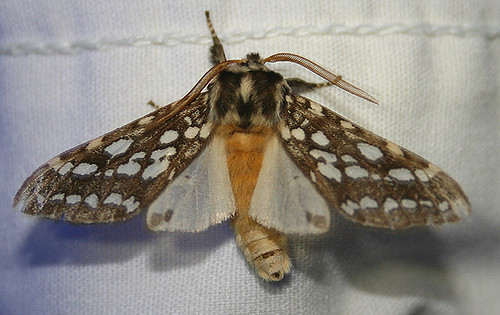
Silver-spotted Tiger Moth

Silver-spotted Tiger Moth

I’ve been birding since 2000, when, as a first year student in university, I decided I wanted a job in my field rather than a boring office job, and was offered an opportunity to work for the Toronto Zoo doing an “inventory” of their breeding bird community. This is not a long time, compared to many birders, particularly given my age. I came into birds late in life; most serious birders I’ve met have started either in their early-teens (13-14 seems to be the age something twigs for a lot of people), or as a young child. Myself, with the rural setting for my childhood, I was certainly aware of the birds, and knew all the common backyard stuff, but the birds that you have to go out to look for in order to see I didn’t get to know till that job at the zoo.

I have had the advantage of having spent a very large portion of the last five years out in the field, nearly every day. When you’re out there seven or eight hours every day you hone your identification skills rather quickly. Just about anything likely to be encountered on an average day at any time of year here in southern Ontario I would feel pretty comfortable identifying now, by sight or even just sound. Some of the less common birds of our region I could identify by sight but perhaps not sound, and I will be the first to admit that some groups (gulls, for example) I generally stink at – though mostly for lack of interest in learning (nothing against gulls, but they just don’t hold my attention for very long).

Lunate Zale

Lunate Zale

So what do you do when you’ve reached your desired level of proficiency with something? Well, you could try to hone it further (suppose I could buckle down and learn those gulls). You could try investigating deeper (learning to identify the different subspecies). You could travel to new areas (works best if you have money and time to travel). Or you could branch out into something different.

White Underwing, Catocala relicta

White Underwing

Lacking money and any real desire to get nit-picky with bird identification, I’ve opted for the latter. Even early I started learning butterfly identification (the obvious second choice to a birder – you’re standing there watching the birds with butterflies dancing about your feet anyway), as well as odonates (the dragonflies and damselflies). I got familiar enough with these groups to be able to identify all the common things. But for whatever reason, I never really got caught up in them the way I am with birds.

Pale Beauty Moth

Pale Beauty

Then, last summer, I traveled west, to British Columbia, for a job. The job didn’t work out quite as planned, and I spent three weeks staying with the organization’s gracious president, twiddling my thumbs and waiting for word on the situation. While there, I discovered he had a blacklight. And I thought, what the heck, let’s throw a sheet up and see what I get.

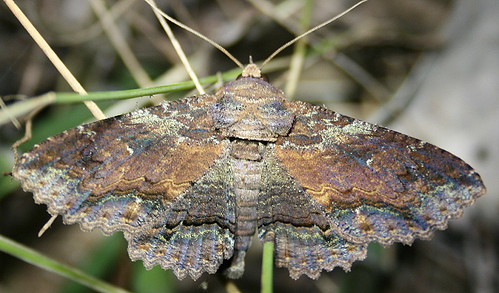
Violet Brocade Moth

Violet Brocade

Well, that hooked me. I don’t know what it was, specifically. Perhaps the amazing diversity and beauty of the moths that came in. Perhaps the mystery of these nocturnal creatures that makes them so hard to observe. Perhaps the fact that they’ll come to you, wherever you are, and you never know what you’re going to get. TheMothMan has well over 500 species of moths recorded for his little (and I do mean little) urban Toronto backyard. Perhaps it’s that moths are everywhere.

Ailanthus Webworm, Atteva punctella

Ailanthus Webworm

While I don’t think they’ll ever trump birds on my priority list, they may eventually run a close second… we shall see (I dislike making such bold predictions). So far, with the exception of those nights in British Columbia and one hosted by TTPBRS in early September, all my “mothing” has been done in the off-peak (for moths) late fall and, now, early spring periods. The moths are just starting to come out now, on the warmer nights, but these cool-weather moths are generally more drab. The flashy species are mostly found in the warmer months, and I’m rather looking forward to looking for them in the next few months.

Unidentified moth

Unidentified Eucosma sp.

Doesn’t matter where you live, attracting moths is pretty easy, and I almost guarantee productive (unlike trying to bird from your suburban backyard, where House Sparrows and starlings are your most likely guests). Any night where the temperature is warm (>10C/50F), hang a white sheet from a clothesline or against the side of your building, and set up a light in front of it. Although a regular white bulb will work okay, bulbs that emit rays in the UV spectrum, such as blacklights (cheap, less than $5 at Home Depot) or mercury vapour bulbs (considerably more expensive but brighter so will draw more in) will give you the best success, since the moths are attracted to the UV wavelengths. Make sure your white sheet is the sort that glows in the dark – some types of fabric don’t phosphoresce, which decreases its effectiveness.

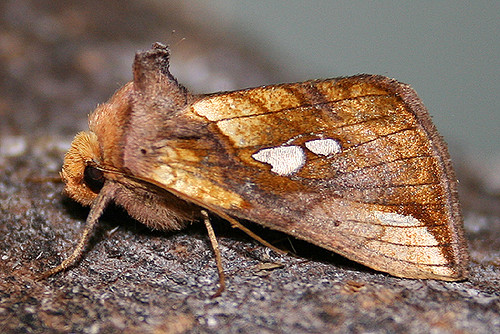
Lempke's Gold Spot Moth

Lempke’s Gold Spot

The above photos are all ones I took either in British Columbia, or at the TTPBRS moth night. They’re only a few of what I have, primarily of some of the brighter species. If you’re interested in seeing some of the rest of my extremely modest collection of moth photos (mostly from BC at the moment, and taken with flash; I’m refining my technique), visit my moth set on Flickr.

Fuzzy fungus

Schizophyllum commune, split gill fungus

I discovered this neat little fungus growing on some beaver-downed logs at the research station earlier this week. It was unusual in that it was fuzzy, and it caught my eye because of the attractive lobing of the growths into neat leafy shapes. I went back once the sun was high enough to peek over the trees and took a few photos.

Unfortunately, the field guide I had used to identify the fungi back in January had been a library book, so I didn’t have it on hand. And trying to find the identity of something is much aided by a field guide like that. There aren’t any good, complete references online (or at least, if there is one I didn’t stumble across it in my searching). However, I finally discovered something that closely resembled my fungi while browsing search results from ForestryImages.org.

Sure enough, further investigation reveals it to be Schizophyllum commune, or the split gill fungus. The genus name literally means “split leaf”. And naturally, the key identifying feature of this fungus, the split gills, I had no photo of. I had peeked under the cap to check out whether it was gilled or pored, determined that it was gilled, and left it at that. Who knew it was that important?

Schizophyllum commune, split gill fungus

I actually do have an image of the split gills, above. This is a crop-down from one of the larger photos, which just happened to have one individual curling up enough to expose its underside to the camera, which was nearly overhead. It actually looks more like paired gills, rather than split, with the ridges radiating in twos out from the centre. Schizophyllum is the only genus with this characteristic, and is in fact so unique it has its own family, Schizophyllaceae.

Schizophyllum commune, split gill fungus

There’s a handful of species in this genus, but Schizophyllum commune is by far the most common. It’s found across North America, and in fact occurs on every continent except Antarctica, where there’s no wood for it to grow on. It superficially resembles the commonly-found bracket fungi that grow on trunks and logs, but has these “gills” instead of pores. The gills aren’t actually spore producing the way they are in true gilled mushrooms, but are instead simply folds of tissue.

Similar to the Mycena corticola I posted about in January, these fungi are marcescent: they can dry out over the winter months or during periods of low moisture, and then come back to life at the next rains. This adaptation is part of what makes this fungus so successful around the world. Rather than growing new fruiting bodies each year, the fungus’ “roots” (the mycelium) only have to produce one growth which will last throughout the year, even during dry spells.

Schizophyllum commune, split gill fungus

Fungus reproduction is a complex thing, where compatibility of external mating structures is less important than compatibility of genomes. In order to reduce the likelihood of inbreeding, a fungus can only “mate” with other fungi that have a different DNA sequence (allele) at a gene location (locus) from their own. To compare to humans, it’s like blue-eyed people only being able to mate with brown-, green-, or hazel-eyed people, but not other blue-eyed people. In fungi, there’s usually two loci used in mating compatibility, and each locus has multiple alleles. In the case of Schizophyllum commune, there’s more than 300 alleles at the first locus, and over 90 at the second – resulting in more than 28,000 allele combinations. So instead of the two sexes found in vertebrates (male and female), there’s 28,000 sexes in this species of fungus! This enormous number means any given individual will be compatible with over 99% of the rest of the population (vertebrates are only compatible with 50%).

Schizophyllum commune, split gill fungus

One other wild thing about this fungus – it doesn’t just stick to rotten logs. There have been a number of reports (though very rare) of the spores of this fungus (presumably inhaled) infecting the respiratory tract of humans. For instance, this poor woman had the fungus actually growing in her sinus cavity! Of course, it probably didn’t have these lovely fan shapes inside her nose, and it was identified using DNA sequencing. In another, the fungus had grown through the soft palate of a child and was forming fruiting bodies in her sinus. I can’t find the actual paper on that one to determine whether they were actual mushroom-shapes, though all the sites that mention it sure make it sound that way (this site is where I read it first). Others document lung, airway, and even brain infections.

So be careful not to inhale too deeply when you bend over to check this neat little fungus out…

Time seals all wounds

Carving on live birch

This is a familiar sight on public-use trails. Something in the human nature cries out to leave a mark, something to indicate that yes, I was here. Perhaps it’s our subconscious recognition that our life is fleeting, ephemeral? Perhaps it’s lovebirds applying superstition to an emblem of their love: as long as this shall remain, so shall we. Or perhaps it’s a declaration of possession, this bit of tree belongs to the carver. Whatever the motivation, the poor trees that find themselves suddenly trail-side usually also find themselves dealing with regular wounds.

Animals, when wounded, regenerate the cells that were killed or destroyed by nearby cells of the same tissue type splitting and multiplying to take their space. If tissue has died but was not removed, the dead tissue is sloughed off or metabolized, then replaced. Trees, on the other hand, simply seal off the wound site and dead or decaying wood, and don’t have the ability to regenerate dead tissue.

Birch tree wound

Trees wounds can be caused by being scraped, eaten by animals, broken branches, fire or insect attacks. The outer layer of the tree, the bark, is effectively dead and damage to this layer doesn’t result in injury to the tree. For a tree to suffer a wound, the injury must occur to the live wood containing the tree’s food and water transport systems (called the phloem and xylem, respectively). For some species of trees, like beech or maple, the bark is often thin and easy to penetrate (which makes them great for carving your initials into), while for others, such as many pines, the bark can be much thicker.

Trees use two methods to seal a wound. The first is compartmentalization. New wood growing around the edges of the wound creates a sort of “callus”, which effectively walls off the wounded wood from the rest of the plant. This prevents decay and infection from spreading to other parts of the tree. In the above, and below, a branch was broken off at some point in the tree’s life. The large rolls at the sides of the hole is the result of the tree sealing over the wound site with “callus” wood.

Old decaying tree

In addition to sealing off the wound site, a tree will also try to prevent the spread of infection by using certain chemical and physical responses to pathogens at the wound edge (the way our immune system sends out white blood cells to attack intruders). The exact mechanisms by which a tree does this are not well understood, but often the long-term health and survival of the tree depends on how well it accomplishes this. If pathogens are able to slip past, the whole tree may become sick. As with animals, usually vigorous, healthy trees are able to ward off infection successfully.

It used to be that the use of special tars or paints were recommended to dress tree wounds, such as those from pruning, to protect them from infection and to speed “healing”. In fact, research has suggested that these dressings did little to help, and may actually hinder a tree’s ability to seal a wound, as they may prevent drying and encourage fungal growth, and may interfere with callus growth. Similarly, filling a hollow tree cavity with the intention of increasing the strength of the trunk used to be fairly common practice, but isn’t often done anymore. It’s generally accepted that a tree’s own mechanisms are more successful than ours.

Carvings on live arbutus

This is the trunk of an arbutus, observed when I was out on Vancouver Island last summer. They’re beautiful trees, with their deep red bark and bright evergreen (but broadleaf, not needle) leaves. Their trunk is cool and silky-smooth to the touch, like a giant piece of hand-worn worrywood, it’s incredibly soothing to run your hand across. I wish we had them here. Just looking at these images and remembering makes me feel calm.

I was so intrigued by this tree, because it seemed to have an unusual method of “healing” wounds. Rather than growing in from the sides to leave a noticeable, sharp scar, like in the first photo, the arbutus almost seems to be lacking bark altogether and just keeps building up layers of wood, filling in wounds, more like how an animal would regenerate cells. Perhaps they fill in their wounds using the same method as the deciduous trees I’m used to seeing, but form smooth, uniform wood where the wound edges meet, due to the lack of rough bark. (Note, Kim, Bert and Ken were here.)

Broken limb on arbutus

This is the end of a broken branch, after the tree has healed over the wound site. It resembles an amputated limb to me, an even more uncanny resemblance to animal healing. I tried doing a bit of research on how arbutus trees deal with wounds, but I couldn’t find anything very helpful. I will admit that I didn’t spend hours hunting for an answer, so there may be something out there I didn’t get to.

Old fencing

Out in the woods behind my parents’ house there’s an old fence that used to bound part of a field, a long time ago. It predates my parents’ ownership of the place, so it’s several decades old. The tree it was secured to has grown over and around the wires so now it looks like they were drilled straight through the trunk. The scarring created by the wound-sealing process as the tree grew is visible only as a thin line, so the whole thing sort of now resembles a bit in a horse’s mouth.

Funny bark pattern on beech

Blackburnian and I encountered this weird beech tree while out at the Rouge. I have no idea what has happened to its trunk, since it doesn’t seem like the usual pattern of wounding from any sort of animal or insect attack I’m familiar with. It makes me think of parched, cracked soil, but I doubt that dehydration is the cause here. Maybe a beetle or fungus infestation?

Tree Gall

This last one is usually referred to as a “burl”, a large growth affixed to the trunk, or sometimes large branches or roots, of a tree. The cause of burls isn’t clearly understood, although it may be due to physical trauma, or insect or fungus infestation. Burls are prized as carving wood, as they have interesting grain patterns that create beautiful finished wood pieces. Check out the size of this one spotted in the Missouri Ozarks!

Make a list, check it twice

Making a list

For Christmas, I got a number of books, one of which was Julie Zickefoose‘s new book, Letters From Eden. I read it in just a couple of sittings, and enjoyed every page (some day I wanna be just like Julie!). Another one I got was Good Birders Don’t Wear White. It’s a collection of “essays” by some of the country’s best-known and leading birders and naturalists. There are some good stories and advice in it, but one of them that I thought was a particularly good suggestion was submitted by Julie as well. It’s titled, “Write it down: making a calendar”.

Spring bunny
A bunny in my mom’s garden – photo credit my mom

Many naturalists, and birders especially, are great at keeping track of what they see. Usually, however, it’s in the form of lists. Here I have my backyard list. There is my year list. This one’s my life list. Lists are great because it’s a record of what’s been seen. The more specific the list, the more useful it can be later (for instance, a list for your backyard is more useful than a list for a state or province because it’s more specific to a certain spot; not everything on your state list will be encountered in a given spot in the state). The best lists are those that are accompanied by extra information. Rather than simply being a list of names, more details are attached to each name. For instance, recording the date you first saw a particular species in your backyard, or the location that you saw a certain species in your state.

Green and Leopard frogs

This is the basis to Julie’s suggestion. Keep a calendar of your observations. When you see the first robin of spring, write it down. When the first green frog starts to trill in the swamp, make a note. Record notable observations you have, such as a bluebird feeding babies, or a fox trotting across your backyard. If you do this over the course of a few years you start to get a very precise picture of the timing of nature. You have a great reference to refer to when you want to know when something happens, or where, or even if. There are some great online tools for tracking bird observations, the best perhaps being eBird.com (or eBird.ca for Canadians).

The Tommy Thompson Park Bird Research Station, which I currently volunteer for, has essentially created such a calendar through careful records of observations every day for five years. It’s really interesting to compare arrival dates for species to previous earliest (or latest) dates, or to look at frequency (you actually have numbers to back yourself up when you make the statement, “this is the most bluebirds I’ve ever seen in a spring!”)

Red-winged Blackbird

My mom has lamented recently that she wishes she’d kept a journal or record of her observations. My parents have lived at the same home in the southern Ontario countryside for nearly 30 years. By now my mom has a pretty good idea of when the Red-winged Blackbirds arrive, or when the spring peepers start to sing. But it’s still a general idea when, and there’s no record of whether it’s the same as it was 30 years ago. My parents are planning on moving and were thinking to leave some nature notes, including a species list, for the new owners. Such a calendar would have been a great introduction to the home.

AMWO
Look at that great bill! And those out-of-this-world eyes!

I myself have kept a very casual personal journal on some of my birding observations over recent years, going back to 2004. It’s been helpful to refer to for some things, when I saw a certain bird, or took a particular trip. This week, I looked back through it for the date the American Woodcock arrive here. I had been thinking that they should be showing up soon. I had the notion in my head that they start their dusk display flights at the end of February.

Well, I browsed through all my late-February entries, and saw no mention of it. I tried early March in case I’d written it down late. Still nothing. Finally, it twigged that I was a month early, they won’t return till late March. Sure enough, there were the entries, at the end of March.

How disappointing. But at least it saves me from trudging out through the snow at dusk this week looking for birds that aren’t there yet.

(For those who were curious, that leading photo is from a point count survey I did one spring for the bird research station. I had forgotten my pen and notepad, but handily found a bit of charred wood to make notes with; the list washed away in the next rain. Hopefully you’ll have paper available when making your lists.)