Alder tongue gall

Alder cones and catkins

If I go east on the rail trail I’ll eventually pass through a wetland, through which a tributary of the Tay River meanders. On either side of the rail trail, where the banks are high enough to allow growth of trees who like to dip their toes without getting their whole feet wet, are Speckled Alders (and cedars, but it’s the alders that caught my interest last time I was out that way).

Alders are interesting trees in that they produce both male and female flowers on the same tree, and quite often the same branch. The female flowers develop into cone-like structures that house the seeds. In the winter the cones open and dry out, not unlike conifer cones. The alder shrubs are easily identifiable even from a distance by the clusters of dark cones intermixed with long, thin catkins (the male flower bits), garnishing the bare branches like ornaments.

Apparently the catkins are edible and high in protein, but taste bitter (so not for snacling, but useful for next time you find yourself lost in the woods and starving). Another useful bit of survival knowledge: tea brewed from alder bark is useful for treating skin irritations, not to mention lymphatic disorders and tuberculosis (important to know for woodland emergencies). Also useful should you need to barter something is the knowledge that Fender Stratocasters and other electric guitars are made from alder wood. Which supposedly has a nice, bright sound.

Alder cones with Alder Tongue Gall, Taphrina alni

Anyway, enough with the trivia. I’d been planning just to do a post on alders in general when I noticed that a number of the cones had long curly things coming out of them. Suspecting galls, I took a photo. The tongues are, in fact, galls – the result of a fungal infection by the fungus Taphrina alni or one of the others in the genus. The fungus triggers the production of the long tongues, the purpose of which is to increase the surface area from which the fungus will release its spores. For all intents and purposes, though, the fungus is harmless; there’s no measurable cost to the tree besides some lost seed production.

Incidentally, I remembered my mom doing a post on alder cones last winter and returned to her blog to look it up; turned out she’d been blogging about the galls, too, rather than the shrub. They’re just that curious, I guess. Her post can be found here.

Evergreen grass rosettes

Hairy Panic Grass, Dichanthelium acuminatum

While out walking Raven this afternoon, I noticed a few clumps of grass in our rearmost field where the tall stems had collapsed sideways to reveal a small, dense basal rosette of leaves – still green. They looked much more like early spring shoots than late fall die-back, which I found curious. Were they simply holding on to life for as long as the lack of snow would permit them to? Or would they really remain green all winter long?

There were two means to answer the question: the easy, but longer, way would be to stuff a stick in the ground at one of them and return mid-winter to check. The harder way would be to come home and try to identify the species of grass to find out what its overwintering habits are.

Identifying grass is a little like identifying sparrows or warblers – once you know what to look for and what the differences are, everything can be figured out relatively easily, but when you first start learning it’s all a giant hodge-podge of lookalikes. Right now I just look at a grass and say: grass. And leave it at that.

I started with a handy website called Ontario Grasses, which has helped me before, but I didn’t see anything there that looked like my species. Not all of Ontario’s grass species are yet up on the website (it’s a hobby project done by the guy in his spare time, I gather), so thinking it probably hadn’t been posted yet, I then turned to my checklist of the plants of Lanark County and started Googling each species with a “common” distribution.

When I got to Dichanthelium acuminatum, this Flickr photo turned up in the results, and I leapt out of my chair and danced about the room crying, “That’s it! That’s it!”

Hairy Panic Grass, Dichanthelium acuminatum

Okay, so no dancing was involved, but I did have that Aha! moment at seeing the image. I’m still not 100% that it’s Dichanthelium acuminatum, but I am positive that it’s at least a Dichanthelium sp. And D. acuminatum is a pretty good bet.

Dichanthelium acuminatum is more commonly known as Hairy Panic Grass, or sometimes Tapered Rosette Grass or Woolly Panic Grass. It’s a common and widespread native species, found pretty much throughout southern Canada and the US. After noticing it at the back field, I watched for it on my return walk, but didn’t see it anywhere else. Our three fields have different, distinct grass communities, I think perhaps partly due to differing grazing pressure from the sheep the previous owners kept, though possibly also the result of underlying soil substrate. It’s been interesting to note how species are distributed between the three areas. The part of the field where I found it is, I think, has slightly richer soil and better moisture than the more open, drier fields.

It might have been easier to identify in the fall, when it still had its seedheads, but the little tufts of leaves along the stem are a helpful identifier. There are a number of different panic grass species, but the clumpiness of the stem tufts seems fairly unique. Also, the leaves are hairy, so logically it should be Hairy Panic Grass. Though I’ve found that such observations are not necessarily a guarantee of correct connections. What was left of the seedhead did, at least, help to narrow down the possibilities.

Hairy Panic Grass, Dichanthelium acuminatum

But back to the basal rosette, which was what had first caught my interest. Now that I knew what the species was, the next thing to look up was its wintering habit. Sure enough, it turns out that Dichanthelium (and the closely related Panicum, from which panic grasses take their common name) species maintain an evergreen rosette of short leaves – what I observed is actually many separate plants all clustered tightly together, which is, I gather, how they grow. The evergreen leaves would give them a leg up on some of their other meadow competition through the ability to photosynthesize late into the season, and to start again first thing following snow melt in the spring.

A couple of websites noted that because they remain green, they provide a source of forage for certain herbivores during the winter months (primarily when the snow isn’t too deep, I suppose). One source said White-tailed Deer and Wild Turkey were the main foragers, though noting that it’s felt to be a poor forage for the deer.

So, I was pleased with that discovery, and that I found an answer without too much pain. I’ll be keeping a watch on our fields now to see if I can find it anywhere else.

Buckthorn berries and Bohemians

Common Buckthorn (Rhamnus cathartica) berries

While out walking the other day I came across a single, lonely buckthorn shrub-tree along one of our fencelines. It stood out from the other woody vegetation because it was the only one in the row that bore any berries. We have so few berry-bearing bushes on our property, I went up for a closer look and some photos.

Buckthorn isn’t native to North America; it’s originally from western Eurasia, and was introduced to North America early in the 1800s. Given the right conditions (which includes disturbed land), buckthorn can be very invasive. It leafs out earlier than many of our native plants, giving it a longer growing season, and plants are very hard to kill – like willows, they’ll resprout from roots and stumps. One site I’ve read also suggests that the shallow, spreading root system outcompetes those of other understory plants. I’ve been to a few places where the shrub has spread and established itself over a wide area. Not a lot of fun when you have to walk through it! The name does actually refer to little hawthorn-like thorns that grow at the ends of the stems.

Common Buckthorn (Rhamnus cathartica) berries

When freshly ripe, those berries look like they ought to be tasty, but they’re actually poisonous. A handful of berries will give you abdominal pain and diarrhea; a bowlful can cause serious problems. The amount of poisonous chemical contained within the berries decreases once they’re ripe – probably a strategy the plant evolved to keep animals from eating the berries before they were ready to be dispersed.

This can cause some problems for wildlife in areas where the plant has been introduced. In its native range, berry-eating birds know not to eat the berries before they’re ripe, but birds not familiar with the plant don’t have that knowledge. They may eat the berries while they’re still toxic, and suffer the consequences.** (Edit: Reader Julie of the Rouge River Bird Observatory in Michigan comments that the author may have jumped to conclusions with the article I linked to at the **. Julie’s own research on avian use of non-native fruits has shown no such toxicity of buckthorn berries to birds. Julie knows a thing or two about a thing or two, so I’m inclined to believe her.) However, if the berries make it past ripening and into the fall, they’re an excellent source of winter nutrition for our birds. Clumps of buckthorn are great places to check out when you’re birding in the winter, because more often than not there will be waxwings or robins or bluebirds or other berry-eaters flitting about the shrubs.

Bohemian Waxwings

Many species will feed on buckthorn, but of particular interest to me are Bohemian Waxwings. The winter specialty of Bohemians is mountain-ash, also called rowan (Sorbus americana), which bears bright orange berries. In years that mountain-ash crops in the north are poor, Bohemians will move farther south looking for food. Once they reach southern Ontario the mountain-ash crops might have improved, but their diet can also be supplemented with the berries of the widespread buckthorn (by the time they make it down here, of course, the berries are well past ripe and entering shriveled).

I saw a flock of Bohemians, 40 of them, while I was out this afternoon. I spotted them before I heard them; they were being unusually quiet for waxwings. I had neither my binoculars nor my long lens, but the way they were all clustered at the top of a couple of trees is, from my small amount of experience, typical of the species, as was their completely unconcerned attitude as Raven and I approached to stand a short distance away. A few birds were calling, which confirmed the ID even if I couldn’t see them well. I stood and watched for several minutes before they all began to call and then abruptly departed.

One buckthorn bush isn’t enough to keep them occupied for the winter, nor is our neighbour’s single crabapple tree. Still, I hope they might linger, that I might meet them again.

Bohemian Waxwings

**As per this article. Some websites are very anti-buckthorn, others are pro-buckthorn, at least in terms of its benefit to wildlife.

Thimbleweed

Thimbleweed, Anemone virginiana

For the most part, we (or at least I) most often take notice of wildflowers while they’re blooming. The colourful blossoms are at their showiest, catching our attention. When I try to bring to mind exceptions, one that stands out is Common Milkweed, as the drifting seeds from the dried, split pods are difficult to miss, especially when illuminated by the low autumn sun. Common Mullein might be another, the stiff, woody stalks lasting long into the winter and often the following spring, eventually one of the few bits of meadow life still poking out above the deep beds of snow.

To that category I’ll have to add Thimbleweed, Anemone virginiana. These plants bloom during the summer months, June through August. We have, it turns out, quite a few of them scattered randomly through our fields, and a number of them grow not too far from the trail that cuts through the grass. And yet, during the summer I don’t recall even once making a note of the plants. It’s only been since the flowers have died and the seed heads developed that they drew my eye.

Thimbleweed, Anemone virginiana

The deeply sharp-lobed leaves at the base of the plant, and the evidence of similar (though now dead) leaves partway up the stems, told me this was an anemone, and a bit of poking around reveals it to be Thimbleweed (sometimes clarified as Tall Thimbleweed to distinguish it from the similar Long-fruited Thimbleweed). The name, of course, comes from the seedheads which do look an awful lot like thimbles, and are about the right size as well. When flowering they have typical anemone blossoms, five-petaled and white, pretty but unassuming, which is perhaps how I missed them all summer.

Anemones are generally woodland plants, but some, including Thimbleweed, can be found growing out in the open, though usually within sight of the woods. It seems to have a preference for dry habitats, but is adaptable and will also grow in moist soil. As the fall progresses, those thimble-like seedheads will open up, releasing puffs of cottony seeds, not dissimilar to those of milkweed and dispersed by the same means.

Interestingly, the plant isn’t often eaten by mammalian herbivores because the leaves contain a compound that can blister the inner membranes of the mouth and stomach. Perhaps the same chemicals that cause this made it useful to Native Americans as a medicinal plant, used as an expectorant (thins mucus so it can be more easily coughed up), an emetic (triggers vomiting), and an astringent (shrinks body tissues to reduce swelling or irritation). Smoke from burning the seed pods was also used like smelling salts, to revive the unconscious.

Ladies’-tresses

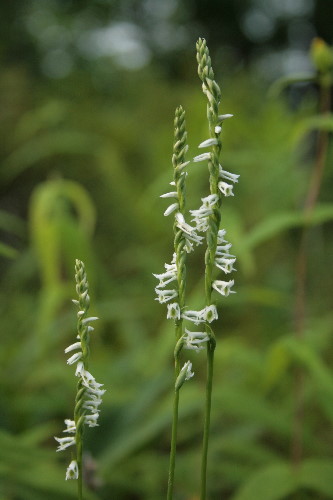
Slender Ladies'-tresses, Spiranthes lacera

We were at our Maplewood Bog MAPS station today. This is our second year running it, so we’ve already got one season under our belts. Although the exact dates that we’re visiting this year differ from last, the protocol for operations states that we must make seven visits approximately evenly spaced between last week of May and first week of August, so we do still get to see the site across the season. So it was with a bit of surprise that I noticed on this visit some wildflowers that I hadn’t seen there before, either this year or last. The discovery of new-to-me species wouldn’t be too noteworthy in and of itself, except for the fact that these were right beside the path. I mean right beside, like I could have stepped on them right beside. How had I missed them? Could they possibly have been present last summer and I’d just overlooked them?

Slender Ladies'-tresses, Spiranthes lacera

Perhaps part of the reason I might not have noticed is that they’re pretty small. Each flower is tiny, just a few millimeters wide. The stem itself is a little taller, but few were more than a foot/30 cm.

I thought I recognized that spiraling pattern of the flowers, either from browsing field guides or from some online research I’d done at some point. I had a suspicion that the plant was an orchid, but it was only confirmed when I returned with my camera and was able to get a photo of the flowers I could zoom in on (being close to the ground as they were and not wanting to cut any, it was tricky to see closely otherwise). They have that full lower lip and the two thin side petals that I tend to associate with orchids.

Slender Ladies'-tresses, Spiranthes lacera

The exact identity remained a mystery until I got home; I couldn’t even remember the common name of the group of orchids it belonged to. However, the answer was easily found: these are Slender Ladies’-tresses, Spiranthes lacera. This is one of the more common of the five species of Spiranthes that have been recorded in Lanark county (where our home is; Maplewood Bog is actually in Frontenac county, but they’re close enough that much of the flora is shared, and I only have a detailed checklist for Lanark). The Frontenac Provincial Park species checklist only lists four ladies’-tresses. They are much smaller than I thought ladies’-tresses were, and if they didn’t have that spiraling pattern I might not have clued in.

Slender Ladies’-tresses are the easiest to identify because, as their name implies, they have a very slender flower stem compared to the others. The “ladies’ tresses” part supposedly comes from the fact that the flower formations resemble the braids of long-haired women (particularly in some other species where there are double-spirals, instead of the single spiral as seen here). The Lanark checklist specifies that the species is found in dry, rocky meadows, and the spot at Maplewood sure fits the bill. The flower in July and August, and the leaves, present in the spring as a basal rosette, wither before the flowers open. Apparently they have a sweet scent, but I didn’t try sniffing them.

It is interesting to note that in that first photo, at the top, two of the stems spiral clockwise while the third spirals counterclockwise. I gather that this is a genetic difference akin to the right- or left-handedness of people. The flowers themselves grow with the thick lower lip at the top, and perform a 180-degree twist prior to opening so that the lip will be presented at the bottom of the flower (this is a characteristic true of most orchids; if you own potted indoor orchids, try watching the flower buds as they open).