Emeralds in the garden

Emerald Spreadwing - male

When I went out to photograph the wrens, I also poked about the garden a bit. It had rained all afternoon, so all the foliage was damp, but also vibrant. Not much was flying, as far as insect life, and I was mostly looking at the flowers (many of which, after a week of daily rainstorms, were looking a little bedraggled with their heads on the ground). But when I leaned in to the garden edge to peer more closely at something, a cloud of metallic-green damselflies rose from the vegetation, disturbed by my approach.

These may be the first damsels I’ve seen this summer in any numbers. I think I’ve seen the odd one here or there, but not many. Damselflies are the smaller, slimmer cousins of dragonflies, and can be told apart by the general size and chunkiness of their heads and bodies. Also, most damselflies will rest with their wings folded behind their backs, while dragonflies usually rest with their wings spread. These damselflies are the exception, however, and tend to rest with their wings open, though rarely as broad and flat as dragonflies. There are many species that do this, all classified in the group spreadwings.

Emerald Spreadwing - male

Dragonflies and damselflies together are part of the order Odonata. There are about 300 species of dragonflies, and 130 species of damselflies in North America north of Mexico. All but two of the 19 North American spreadwings are classified in the genus Lestes. In general they’re associated with the edges of ponds or slow-moving streams. There’s certainly ample water at my parents’, but the garden is some distance from it, so it was interesting to find so many of them there. Many of the spreadwings can be difficult to tell apart from one another, some requiring examination of the genitalia to do so, but I believe these were all Emerald Spreadwings, Lestes dryas.

Emerald Spreadwing - female

The females are browner than the males. There are very few species of Odonates where the two sexes are the same or very similar in appearance; generally you can tell them apart fairly readily. However, the surefire way of doing so is to look at the end of the abdomen. Although I didn’t get it in focus in this (or any, as it turned out) photo, you can still get the idea. In males, the abdomen ends in appendages that look like a pair of pincers. These are used to grasp the female gently but firmly around the neck during mating, and two damsels found like this are called “in tandem”. The female has a thicker tip to the abdomen, with a special structure that includes an ovipositor to lay the eggs. The female curves her abdomen around underneath her and touches the tip to a swelling on the underside of the abdomen just behind the male’s thorax (can sort of be seen in the second photo), where she receives the sperm. This is usually called the wheel position, and one can sometimes observe a pair flying together like that.

Emerald Spreadwing - female

Spreadwings, like all odonates, are carnivorous predators. Adults have strong mandibles and some of the larger dragonfly species may bite if handled, although it is little more than a strong pinch and doesn’t deliver any venom. They kill their prey by biting it, and “chew” it to ingest it, rather than eating it whole. They eat mainly small flying insects, such as mosquitoes, small flies, and others. The larvae are aquatic, with adults laying their eggs on vegetation, rocks or other substrates at the water’s surface. They look only vaguely like the adults, being not as thin and lacking wings. The larvae eat other aquatic insects, but may even take (very) small fish. Odonates undergo incomplete metamorphosis, meaning they lack the pupa stage that most insects have. Instead, the last larval stage crawls up onto some vegetation, where the skin on the back splits open and the adult climbs out.

Emerald Spreadwing - male

Because they’re predatory, both damselflies and dragonflies have excellent eyesight. They have a pair of large compound eyes that are their primary means of detecting prey, but also several occelli across their “forehead” that they use for sensing small changes in light and dark, which helps them to orient upwards. The eyes are another useful feature to separate damsels from dragons – the compound eyes of the latter meet at the top of the head, while those of damselflies are usually widely separated. The eyes are also very important for avoiding predators. Damselflies can be eaten by just about anything larger than themselves. They’re not as strong fliers as dragonflies are, and as a result are often meals for their larger relatives. Adults are also eaten by birds, frogs, and spiders (getting caught in their webs). The nymphs are eaten by larger aquatic insects, amphibians and fish.

Emerald Spreadwing - male and female

Here a male rests on a leaf just above a female. I’m not sure what happened to the male’s abdomen. It’s possible he had a close call with a predator, or when he emerged from his last larval stage his yet-to-harden abdomen was in a funny position. Most insects have very soft exoskeletons when they emerge from metamorphosis. It’s a little like a human baby’s skull – because it has to fit through a very narrow passageway, much of the skull is soft and doesn’t become fully firmed up until the baby is anywhere from nine months to about two years old. In insects the process is necessarily a little quicker – the adult itself may only live a week or two. Insects “wear” their skeletons on the outside, with their muscles attaching to the inner surface, rather than the other way around in vertebrates. The exoskeleton needs to be flexible enough to fit in the cramped space of the pupa or final larval stage, but when the insect emerges, it straightens, wings are expanded by pumping with fluid, and they harden through exposure to air. The air also helps to develop their full colouration, as they are often quite pale when they first emerge.

Unfortunately, there aren’t any really good printed references to the damselflies of North America, which is a funny oversight since there aren’t an overwhelming number of species. Part of the problem is that many can’t be conclusively identified by colouration alone. There are a few good regional field guides, however. In the east, one of the best is A Field Guide to the Dragonflies and Damselflies of Massachusetts, and in the west Introducing the Dragonflies of British Columbia and the Yukon (I’m pretty sure this has damselflies as well, as I recall referencing it while working out there a few years ago – it was part of my employer’s library, but I really liked it).

A few colourful moths

Sphinx_drupiferarum

I’m at my parents’ this evening, and it is chilly, unseasonably cool (it seems to me) for a mid-June night, nearly summer. I would ordinarily be outside, checking for moths on the blacklighted sheets I’d have set up, but it’s too cool for that tonight; approaching 10 C (50 F), the moths are, for the most part, tucked into sheltered spots waiting for a warmer night to fly.  Since it’s June, there ought to be many nights of 20 C (68 F) temperatures that would be much more ideal. I’ve got my trap running anyway, since it involves very little effort and hey, you never know. But I’m not expecting much when I check it in the morning; the couple times I’ve peeked out the window at it I haven’t seen anything at the sheet I set up behind the light.

In contrast, earlier this month I had some excellent, warm nights. I have yet to see any nights with a sheet covered in moths, but that’s probably just as well – my identification isn’t good enough yet for me to be able to pick through the common stuff to locate the more unusual species, and I would probably feel a little overwhelmed. Even just the couple of busy-ish nights I’ve had, with 50-80 species, have been enough to keep me busy for many hours the next day. Another disadvantage to not knowing anything is that I have to photograph every moth I encounter if I want to identify it, whereas if I already know 40 of those 50 species there’s not much photographing that needs to be done the next day.

The other problem with getting so many moths is trying to choose a select few to post to the blog. With such variety, how do you narrow it down? For the non-moth’er, the large or colourful species are the obvious choices, but even among that group there is quite a selection. I eventually settled on half a dozen that I thought were the most interesting from the last few weeks. Narrowing it down to just the species I had identified helped considerably as well.

The above moth is a Wild Cherry Sphinx (Sphinx drupiferarum), which came to the blacklight at my parents’ last week. I happened to be checking the sheet as it flew in, and I knew something that large had to be a sphinx, so I really wanted to catch it. Unfortunately, I didn’t have my large-moth containers there at the sheet with me. I didn’t trust it to remain (it still hadn’t settled on the sheet, but was buzzing across its surface), so I ended up catching it in one hand, creating a loose cage with my fingers. Good thing I did, too, as it’s a somewhat uncommon species, and one that The Moth Man hadn’t seen before, so we needed photos.

Silver-spottedGhostMoth

On a similar note, another uncommon species that he hadn’t seen so we needed photos of was this one, the Silver-spotted Ghost Moth. The reason this species isn’t often seen is less due to its abundance, however, and more because of its habits. Most moth’ers attract their moths to some sort of lure, either a UV light or sugary syrup concoctions. This moth rarely comes to lights, so it’s infrequently caught. It has a sort of lekking behaviour, where giant swarms of males form in the evening near the species’ host trees, alders, and female moths will come to check them all out. The moths are most often encountered in these swarms. In the case of my moth, it was the rare individual that did come to check out the light, and I found it sitting in the trap. This species is also unusual in that, taxonomically, it is more closely related to the wee bitty moths than the larger moths, but it itself is about two inches long.

Isabella Moth (Wooly Bear Caterpillar) - Pyrrharctia isabella

The caterpillar of this moth will be more familiar to most people than the moth itself. This is the adult form of the Wooly Bear caterpillar, that fuzzy, brown and black caterpillar frequently seen in the fall and perceived as a predictor of the nature of the impending winter. For such a distinct-looking caterpillar, the adult is rather bland, although its abdomen has an orange wash to it. The adults are known as Isabella Moths (Pyrrharctia isabella).

Pink-legged Tiger Moth - Spilosoma latipennis

There are a number of different species of tiger moths, which are generally characterized by being about an inch in size and fuzzy, with a fuzzy caterpillar stage. The Isabella Moth is part of this group, as is the above, appropriately named the Pink-legged Tiger Moth (Spilosoma latipennis). There are two tiger moths that are nearly entirely snow white, this one and the very similar Agreeable Tiger Moth. The primary difference is in the legs – the Agreeable’s are a yellow-orange instead of pink. I’ve seen a few Agreeables so far this spring, but this was the first Pink-legged I’d caught.

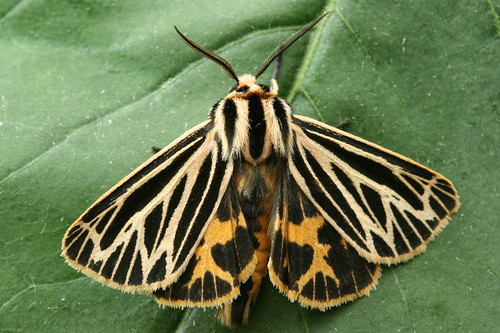
Harnessed Tiger Moth

Yet another bunch of tiger moths have black and tan-striped wings. This one is a Harnessed Tiger Moth. There are half a dozen or more species with this sort of pattern, and telling them apart relies on the size of the stripes, the presence of cross-bars, and the colour and pattern of the hindwings. Last week I also caught a Little Virgin Tiger Moth, very similar but for the orangeish rather than pinkish hindwings, and thinner and more numerous stripes.

Stone-winged Owlet - Chytolita petrealis

When Blackburnian and I were at his mom’s place, we went for a walk through the bit of forest that backs onto her property. As we walked we kicked up many moths, about an inch in size and a bland tan colour. They were these guys, Stone-winged Owlets (Chytolita petrealis), so named for the stone colour of their wings (apparently; I think of stones as gray, not beige, personally). The long up-curved “snout” is actually a pair of palps, and are used as sensory organs. Many moths have palps, but they’re more exaggerated in some species than others.

Unicorn Prominent - Schizura unicornis

This last one is the subtle but beautiful Unicorn Prominent (Schizura unicornis). I’m not sure why it’s been called unicorn since it has no obvious horn (unlike the previous moth). I love the shades of mocha, peach, olive and teal in the wings of this moth. I couldn’t get him to do it again for the photo, but while he was sitting in the little jar I had him in he had his hind end and wings tightly furled together and raised up in the air, like a bit of peeling bark. The prominents are a varied bunch, with some mottled like this one, others smooth and sleek, and still others rather fuzzy like the tiger moths.

As usual, if you’re interested in browsing some of the other species I’ve caught, check out my moths photoset on Flickr.

Wrigglers, tumblers and skeeters

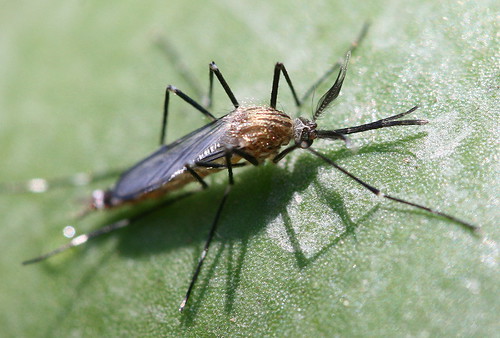
Mosquito

It’s that time of year – the time when any foray out to the country or conservation area necessitates packing a can of deet-filled bug spray, when bug jackets and bug traps and bug lights and bug incense all start flying off the shelves. When many people lose many hours of sleep listening to a whine in the corner of the room. When a new dance move, more widespread and familiar than the twist or macarena, begins to be seen at outdoor gatherings. When the mosquito starts to fly.

Mosquitoes are ubiquitous and cosmopolitan, occuring on every continent except for Antarctica. We tend to think of the insects as simply “the mosquito”, but in fact there are 3000 species around the world. Most of these occur in the tropics, however North America has somewhere between 150 and 170 described species north of Mexico. In Canada, where the climate is, for the most part, much harsher and habitats less varied than through the US, that number is just over 70 species, and in Ontario it’s somewhere around 50. But still. Fifty species of mosquitoes just in my home province. Identifying the various species usually requires an expert and a microscope. The Roger Tory Peterson of mosquitoes, Richard F. Darsie Jr., has dedicated most of his career to learning and studying them all and their life stages, and is still going strong at age 90. He lives in Florida, still frequents the University of Florida’s entomology department, and continues to update his 380+-page identification and range guide to North American mosquitoes. I sure hope I’m that active and together when I’m that age!

Mosquito

For the rest of us, the 150 species all just get lumped into the same broad category of “the mosquito”. Mosquitoes are members of the order Diptera, which contains the flies. Like all flies, mosquitoes have just one pair of wings, a pair of vestigal wings called halteres, used for stabilizing the insect in flight, and a pair of relatively large compound eyes. Unlike most flies, mosquitoes have a specialized mouthpart, a tubed proboscis that they insert into the skin of their target to suck out blood. The proboscis is not a smooth tube, as one might expect, but is serrated, which minimizes the points of contact that the proboscis has with the host’s tissue. Unlike a smooth needle which most people can feel being (painfully) inserted, the tiny serrations ensure that very few, if any, nerves are contacted while the mosquito is feeding, and it’s possible for the host to never feel the bite or know the mosquito is there. Of course, it’s not foolproof, and often the proboscis will hit a nerve on the way in – resulting in a quick reflex that the mosquito may or may not survive.

Only female mosquitoes take blood. Mosquitoes don’t actually need blood to survive – males will never ingest any, and a female could live out its whole life without ever having a “blood meal”. Adult mosquitoes actually feed on nectar, like most flies. An adult can live for 2-3 weeks, or as much as 6 months, depending on the species. The longer-lived species are generally ones that overwinter as an adult rather than as an egg, and can sometimes be found buzzing around your house in the dead of winter when there’s a warm spell.

The blood is necessary for the development of eggs, as the female needs the protein available in the blood to produce them. Female mosquitoes generally find their targets at a distance of tens of metres/yards by detecting exhaled carbon dioxide and various body secretions such as sweat, and hone in once they get closer through sensing infrared heat given off by the target’s body. Some people will attract more mosquitoes than other people based on these things (for instance, men, because they’re generally warmer and sweatier, are likely to attract more bugs than women). Mosquito repellents work not by poisoning the mosquitoes or creating a distasteful barrier, but rather by disorienting the mosquito’s infrared honing system. Because of this repellents are not 100% effective, as the insect can still by chance, luck, or a missed area, land on and bite its target, but they’re pretty good.

Mosquito close-up

Because they are blood-suckers, and inject saliva into their targets, mosquitoes are problematic vectors of many diseases. These primarily occur in the tropics, but some, such as West Nile which was introduced to North America in 1999, have made it into temperate areas. Mosquitoes are estimated to transmit diseases to 700 million people around the world annually, many of which are fatal. The mosquito-borne parasite malaria causes the death of 5.3 million people, mostly young children, every year.

The reaction to mosquito bites varies by individual. The very first bite any person gets will not swell or itch, but antibodies are created from that bite that result in subsequent reactions. The itchy bumps are essentially an allergic reaction by your body to the mosquito’s saliva, which contains more than 15 different proteins, including one to prevent clotting, one to disable platelets, one to dilate blood vessels, and others that aid in sugar digestion and nectar feeding. With continued bites some people can become desensitized to the saliva, while others can become hyper-sensitized, with mosquito bites causing severe allergic reactions with rashes, blisters and bruising.

The specific saliva composition varies from species to species, so immunity to one species does not necessarily guarantee immunity to another. My mom recounts that us girls could go outside and play for hours when we were younger and hardly be bothered by the mosquitoes or show any reactions, but when we went on a camping trip a few hours away we all found the mosquitoes horrendous – presumably a different species that we had no immunity to. These days I find I react to the mosquitoes around my parents’, but they don’t bother me too much and providing I don’t scratch them the bumps don’t itch and subside within an hour or two.

Mosquito larva

A mosquito has four life stages. Females will lay eggs on the surface of water. For this they need still bodies of water – eggs laid on a river’s surface would just get swept away. Any body of still water will do, regardless of size, and standing water in birdbaths, old pots or tires, eavestroughs, etc, can be a breeding ground for baby mosquitoes. Public awareness programs advocate dumping standing water and clearing your eavestroughs to eliminate potential breeding locations, and providing that you don’t live near a pond or a lot of puddles, it will probably work. This is more practical in town, however, where mosquitoes aren’t as much of a problem to begin with. Out in the country the accepted approach to dealing with mosquitoes is just that – just deal with them. There are many products that advertise repellents or control, but they’re hard to avoid altogether.

Mosquito larvae

The above life stage, the larvae, are known in many places as “wrigglers” or “wigglers” for their habit of moving through the water by rapidly whipping their tail end back and forth. When they’re not moving, they tend to sink into the water with their tail tip at the surface and their head pointed downward. Most species of mosquito have a tube, called a spiracle, on the tip of their tail which they poke out of the water and use for breathing. One method of large-scale mosquito control involves laying a substance over the surface of the water that blocks the larvae from breathing.

Mosquito larvae eat micro-organisms and organic matter in the water, and are themselves food for many other creatures, including fish, amphibians, reptiles and other invertebrates. The latter includes the larvae of other mosquito species, specifically those in the genus Toxorhynchites which are sometimes known as “mosquito hawks” (this genus also happens to be one of the few where the females do not take blood). They have been used in some areas as a natural form of mosquito control, but are found in tropical and subtropical forests, so aren’t an option for most of North America.

Mosquito pupae

A couple weeks ago my mom and I started noticing these round, dark invertebrates in the water in my parents’ water garden. We had no idea what they were, but they seemed to have just suddenly appeared. We brought one in and looked at it under the microscope, where it appeared to have a giant thorax with a couple of short antennae, and a long abdomen that folded underneath it. It wasn’t shown in my mom’s aquatic invertebrate guide, and we were stumped, so my mom sent the photo off to an invert expert at the University of Guelph.

It turned out to be the pupal form of the mosquito. Known by many as “tumblers” for their somersaulting movement through the water. The pupal form of many invertebrates is often stationary, but mosquitoes are very active. The two little antennae on its head are its breathing spiracles. The pupal form has no mouth, so its movement through the water is primarily a predator avoidance response, or to move to better conditions (such as out of the sun).

Empty mosquito pupa

When I went back with my camera I found this empty pupal case stuck to the water hyacinth, just above the water line. Nearby were two newly-emerged adult mosquitoes, resting quietly on the water hyacinth bulb, waiting to dry out. Another reason that mosquitoes need still water is this emergence process – in areas with large expanses of open water it’s not possible to affix to vegetation or rocks, and the mosquito emerges at the water surface, where it rests until its wings and body are dried out and hardened and it can then fly off.

Adult mosquitoes are not strong fliers, and a slight breeze (or a fan) is enough to keep the bugs from bothering you. They fly at about 1-2 km/h (0.62-1.24 mph), for up to 4 hours at a time, and on a still night can fly as much as 10km (6.2 mi). I presume this is not usually actually in a straight line, but rather is the distance covered if the mosquito’s looping movements were unwound into a straight line (like measuring a long-distance runner’s laps of an oval track), but it wasn’t actually stated. Mosquitoes are mostly crepuscular or nocturnal, but they can be very active in the deep shade of the woods, as well. Or just about anywhere, for that matter. But they tend to avoid direct sunlight. In the day they’re usually found resting on vegetation, and walking through long grass in the shade of a forest edge can often throw up clouds of the insects.

The whine associated with mosquitoes is produced by the high-frequency whirring of their wings. This high-pitched noise isn’t heard by many adults, but is heard by nearly all younger people. As I was browsing the net for info, I discovered that this concept has been applied to a product called a “mosquito alarm” – not actually anything to do with mosquitoes at all except in its similar sound frequency. Rather, it’s a high-pitched noise that most adults can’t hear, but most young folks can, and is placed in areas where teens tend to gather and socialize, which can be very offputting for adults, especially if they have to wade through the groups to a store entrance or such. Many towns and stores in western Canada have started installing these and claim to have a great success rate in that they no longer have loiterers in the areas where the “alarms” have been installed. Teens can take it the other way with a “mosquito ringtone” for their cell phones, a high-pitched tone that just the younger folk can hear, allowing them to receive messages in class, or other forums where they aren’t supposed to have or use their phone.

I have several other things I could mention, but I think I’ll stop there today. I’m sure knowing all this won’t make you any happier to be out in the swarms, but at least you’ll have something to tell your friends as you’re swatting!

Shoo fly, don’t bother me

Greenbottle Fly, Lucilia sericata

While at my parents’ recently, taking photos of dandelions for a previous post, I happened to notice a fly on one of the flowers. It was diving in and burying its head among the petals, I assume collecting nectar. It was a metallic green, small and hairy. I had seen many of these before; I believe they’re greenbottle flies, quite possibly Lucilia sericata, and are a very common species found across the continent.

I decided to see how many different types of flies I could turn up in a quick tour of the property. I’ll add a disclaimer here that these IDs are all tentative, and I may have them incorrect – flies, like many groups of insects, are a notoriously difficult bunch to ID well. They’re easy to tell apart from other insect groups because they only have one pair of wings (unlike bees, wasps, mantids, butterflies, dragonflies, etc, etc, which have two pairs). Flies evolved from a four-winged insect, but their second pair of wings is reduced to vestigial knobs that serve the purpose of stabilizing the insect while in flight (I’m not quite sure how this is accomplished, beyond that it’s a sort of gyroscope effect).

Flesh Fly, Sarcophaga sp.

The greenbottles were common. Another common fly was this one, which I think is a flesh fly, perhaps Sarcophaga sp. The group name suggests a connection to animal flesh, and many species do lay their eggs in open wounds or in carrion. However, there are also many that will parasitize invertebrates of many sorts, or will lay their eggs in dung or manure. In the case of this genus, the females lay their eggs mostly in carrion. Blow flies are the first maggots to appear in a roadkill, with the Sarcophaga arriving later. However, the latter will lay live larvae, rather than eggs, to make up for that time difference.

There are 250 species of Sarcophaga in North America, which even though it sounds like a lot, is just a drop in the bucket compared to the total number of dipteran flies on the continent – about 17,000 species, more than the moths I’m attempting to learn, and utilizing a broader set of ecosystem resources – moths generally don’t have much to do with animals, while many flies, as we know, are common nuisances.

One of the things I love about this photo is you can see the sucker pads on the fly’s feet. These are what allow flies to walk along a wall or the ceiling, seeming to defy gravity.

fly10

This particular individual was grooming itself, and had its mouthparts exposed for cleaning. Most flies have some sort of sucker-like mouthpart that they use either for sponging up food (such as nectar), sort of in the manner a cat will lick up a bowl of milk, but some have a piercing mouthpart that they use to pierce and suck up their food, such as with biting flies like black flies. Mosquitoes, even though they don’t look it, are actually a type of fly as well.

Despite their reputation for spreading disease, most flies are fastidious groomers. There are some groups that inhabit unsanitary conditions and are attracted to manure, sweat, dead animals, and other things we tend to think of as dirty. However, the majority of flies don’t have much to do with such things, instead frequenting flowers or other food sources. If you watch a resting fly, chances are it will groom itself while it’s sitting there, running its legs over its wings, eyes, and other legs.

Bee Fly, Bombylius major

One of those flower-visiting flies is this bee fly, probably Bombylius major. They’re named bee flies not for their resemblence to bees (which they superficially do, particularly the bumblebees), but rather for their habit of parasitizing ground-nesting bees. This species is very widespread and relatively common. I watched it for some time visiting the forget-me-nots. It never strayed far from this patch, which was handy, because when I first spotted it I didn’t have my camera on me (I forget what I was doing now, but it was not related to photographing things), and it allowed me to run inside to grab it. It would hover in front of the flowers it was visiting, rather than landing on them to feed.

Flower (Syrphid) Fly, Helophilus fasciatus

Many of the “true” flower flies, belonging to the group Syrphidae, are mimics of bees and wasps. This presumably affords them some measure of protection against creatures who would ordinarily view non-stinging flies as a food item. They’re also known in some regions as hover flies for their habit of hovering in front of flowers, but not all hovering flies are Syrphids, and not all Syrphids hover. The group are valuable pollinators of flowers, and the larvae of many species prey on aphids. This one, probably Helophilus fasciatus, I think is likely a male – the females have longer abdomens with an extra black band than the male, and a long black stripe between the eyes that the male lacks.

Myzid Fly, Suillia sp.

This fly looks albino, with its overall pink colouration and orangey-pink eyes, but I believe its actually a normally-pigmented member of the myzid fly group, in the genus Suillia. There are 100 species in this family in North America, eight in this genus, but the life cycles of most aren’t well-known. In those where they have been studied, larvae are found in a variety of habitats where animal droppings can be found, such as in burrows, bird nests, or bat caves, or on carrion, dung piles, or rotting fungi.

Crane Fly

Crane flies, those long, gangly insects that look like oversized-mosquitoes, are actually members of the Diptera group as well. They’re kind of creepy in their long-leggedness, but are harmless. They are an extremely difficult group to identify beyond family, and even family is tricky, so I won’t try. Like skinks that will lose their tail if threatened, crane flies easily drop legs, so many individuals have fewer than six. Interestingly, there is a group of wingless crane flies that can be found on the snow surface in northern North America in the middle of winter. Larvae are, for the most part, herbivores or detritivores, and can be a major food source for many sandpipers and other shorebirds, especially in the arctic.

Black Fly

And finally, one of our favourites – the black fly. The have the other common name of “buffalo gnats” for their somewhat humpbacked appearance (presumably they would also bother buffalo, along with everything else). They bite people and other animals for the protein in the blood they take, which allows them to develop their eggs more successfully, although most species can produce viable eggs without taking blood. Larvae are aquatic filter-feeders, securing themselves on a rock or piece of vegetation by a sucker-like bit on their abdomen, and using a string of silk to tether themselves should get get swept off (much the way a spider that gets knocked off doesn’t usually fall all the way to the ground). There are 165 species of black flly just north of Mexico, primarily in the north, which amazes me. This particular individual was dead. Partly because it made it easier to photograph, but also partly because it’s hard not to swat at the things when they bite you. They’re the subject of a popular Ontario folk song:

The black flies, the little black flies
Always the black fly no matter where I go
I’ll die with the black fly a-pickin’ my bones
In north Ontario-io
In north Ontario

Nothing to do with fish

Spring Fishfly - male

The weather was so warm while I was at my parents’, I couldn’t resist setting up to try to catch a few moths, even though it was a bit breezy and they were calling for rain in the early morning. Since I’m not living there, I have to take advantage of whatever opportunity I have during visits, and can’t be as choosy about the weather. I set up two sheets with blacklights, one near the house and one along the driveway about 100 metres/yards away. I also ran the trap overnight, just putting a glass bowl over the bulb to protect it from the rain that was supposed to arrive. I was hopeful for a few moths flying despite the breeze, and wasn’t disappointed. I ended up with somewhere between 80 and 90 species that evening – double the highest count I’d had there before, and more than enough to keep me occupied for hours photographing all the species new to me (which was most of them) the next day, even if it wasn’t quite up to par with TheMothMan’s 130 species he picked up at Rondeau earlier that week.

As observed in my post about the Giant Water Bug, the lights don’t attract just moths. You can get a good variety of insects, including many species of beetle, flies, midges, ichnumonid wasps, and others. Among the “others” I discovered a number of these guys. This is a fishfly, from the genus Chauliodes. I spent some time puzzling over the two different species on BugGuide.net, and finally decided that this was the Spring Fishfly, C. rastricornis. The most obvious difference I noted from the photos is that at the back of the head there’s two short dashes side-by-side, and in the Spring Fishfly they are dark-on-light, while in the Summer Fishfly (C. pectinicornis), they are light-on-dark. Time of year can also help, but we’re at the time where they start overlapping a bit so it wasn’t of much use to me. Both species are found through most of eastern North America.

Spring Fishfly - female

Males and females are dimorphic. The females are larger, and have straight, thin antennae, while the smaller males have feathery (pectinate) antennae. Like with moths, the males use these feathery antennae for detecting the pheromones of the females. I got both males and females in to the sheets and in the moth trap, perhaps half a dozen individuals total, though unfortunately the female I caught for a photo didn’t want to cooperate for me, so this was the best photo I got of her. Both sexes are quite large, easily a couple inches long. The first one I got in to the sheet quite startled me, because of its size and ferocious look.

Spring Fishfly - male

They spend most of their life cycle in the water or associated with it. Eggs are laid on vegetation near the water’s edge, and when the larvae hatch they crawl to the water where they can spend as much as two to three years. During that time they’re omnivorous – they’ll eat a lot of detritus, but also graze on the vegetation or opportunistically predate other invertebrates. Because of these feeding habits they prefer still water bodies with a good layer of detritus on the bottom. When they’re ready to pupate, the larvae leave the water again, finding a rotting log or dead tree where they pupate under the bark. The adults emerge after about 10 days, and will live for about a week to mate and lay eggs.

Spring Fishfly - male

Supposedly the fishflies don’t eat while adults, so I’m not sure what these things that look like mandibles are, or are for. Fishflies resemble the related dobsonflies, except that the dobsonflies have huge mandibles. I also don’t know what the purpose of the dobsonfly’s mandibles are, as they don’t eat as adults, either. In fact, there’s very little detailed information on fishflies, and it’s compounded by the fact that mayflies, those ephemeral insects that line the screen door and exterior walls of the cottage by the hundreds in the summer, are also known as “fishflies” in some areas. There’s also another genus of fishfly, Nigronia, which are more darkly patterened than the Chauliodes. I don’t know where the name “fishfly” comes from, as I don’t think any life stage of any of the species actually has anything to do with fish. However, the larvae of fishflies and dobsonflies are often used as bait for fly fishing…

Spring Fishfly - male

Although none of the references I looked at mention it, the adult fishflies have large compound eyes and therefore, I presume, excellent sight. Given that they don’t eat as adults, I assume it’s primarily used in locating mates and avoiding predators. There’s also three shiny bumps on its head between its antennae, which are ocelli, light-detecting organs that sense light and dark, but not detail the way the compound eye can. Ocelli are usually unable to perceive form, but are much more sensitive to light, and process information more quickly, than compound eyes. Ocelli are divided into two main types: dorsal (such as these) and lateral (on the sides). Dorsal ocelli are found especially on flying insects, where they use the light sensors to help orient themselves vertically while flying.