
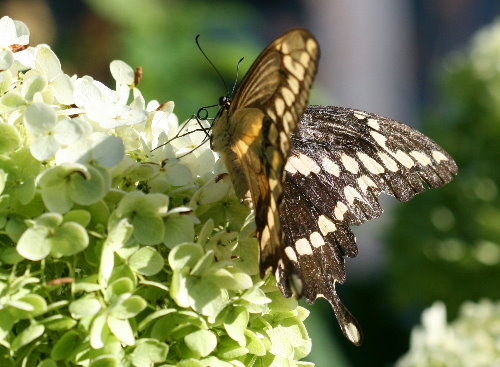
Dan really outdid himself with the gift he brought me this afternoon. He walked into my study holding a large black-and-yellow butterfly and asked, “Is this a Giant Swallowtail?”
It was indeed. He’d caught it while it fluttered lazily at the phlox in our garden. What makes this noteworthy is this:

We’re at the tip of the red arrow, roughly.
The one and only time I’ve ever seen this species was a number of years ago, perhaps 2005. It was visiting my mom’s garden at my parents’ old house in the Greater Toronto Area. The species is very rare in Ontario; it occurs regularly in small numbers in southwestern Ontario, but the farther east you go the rarer it seems to become. Of course, it doesn’t breed out this way, so all occurrences of the butterfly here are immigrants that either traveled here under their own steam or were blown here in a weather system. The Canadian Biodiversity Information Facility has a species page for Giant Swallowtail, on which they note, “In 1992, a stray was recorded in the Ottawa area for the first time following high winds resulting from a hurricane in the southern U.S.” Could today’s visitor have ridden up ahead of Irene?

These are beautiful big butterflies. They fly as if their oversized wings are too big to flap properly, like floppy clowns’ shoes. They float lazily in the air, never traveling very high, cruising from one spot to another with what appears to be hardly any effort at all. Dan said when he first saw it above the garden he initially thought it was a falling leaf.
They also have the distinct habit of fluttering while they visit flowers. I took a couple of photos of it in Dan’s hand then had him release it. It stuck around the garden and I followed it about, camera in hand, trying to get a good photo as it resumed feeding on the phlox, but it wouldn’t stop fluttering. In fact, it seemed to use its wings to push its head deep into the throat of the flower. Judging by the blurred wings I see in many of the photos on Google Image search, this wasn’t unique to our butterfly.
Down south, in its breeding range, this species is considered a pest of citrus orchards, especially oranges which has earned its caterpillars the name of “Orange Dogs”. It’ll also feed on Hop Tree (Ptelea trifoliata) and Prickly-ash (Zanthoxylum americanum) where citrus trees aren’t common, such as up here (though both species actually in the same family as oranges and other citrus). I don’t think we’ve got Hop Trees here, but we certainly have lots of Prickly-ash about. I wonder if their range might expand, or if it’s not the availability of food plants that limits its northern distribution, but rather something like average winter temperatures or snowfall affecting overwintering survival.
My camera’s battery died after I’d run off a dozen shots, and since it seemed to be hanging about the garden and not going anywhere I hurried in to grab my spare. But when I returned, it’d disappeared, presumably off into the meadow somewhere. Safe travels, buddy, and thanks for visiting!


 seabrookeleckie.com