Star-nosed Mole

Star-nosed Mole

The second-most interesting thing of the seed-exchange weekend was the rather unfortunate encounter with this creature. My mom and I had spent a half hour or so at the mudpuppy event, then, because the night was still young and we weren’t too far, decided to drop by my sister’s place to meet her new puppy, which she’d brought home only the day before.

She lives on a horse farm on a rural sideroad, surrounded by many acres of both natural and cultivated habitats. As we were pulling up her long driveway, I noticed a dark shape waddling in circles in one of the tire tracks. Unfortunately, the driveway was icy and slippery, and while we might have stopped the car in time in dry conditions, on the ice the wheels locked and it slid. I hopped out to check on the animal, but we hadn’t been able to avoid him.

Making the best of sad circumstances, however, I grabbed my camera from the car and took a couple dozen shots of the creature. The dark bundle of fur turned out to be a Star-nosed Mole, Condylura cristata. Despite the poor thing’s untimely demise, I was pretty excited to actually see one up close and be able to get a good look at it. I’d only ever seen a mole once before, and it was a fleeting glimpse insufficient to identify the animal to species. I’d never been able to check it out in detail.

Star-nosed Mole

The mole is, of course, named for the wildly unique appendage found at the end of its snout. There are 22 fleshy “fingers”, 11 on each side of the nose. The mole is effectively blind, visually, and the star acts as the mole’s eyes. Over its surface are spread some 25,000 mechanoreceptors that are exceptionally sensitive to touch (consider that in our entire hand we have about 17,000 similar receptors).

These receptors are linked directly to the brain, and signals from the star are received and interpreted at lightning speed. It takes the mole only about 25 milliseconds (1/40th of a second) to detect a potential food item and decide if it’s good to eat. Consider that it takes us about 600 milliseconds (3/5ths of a second) to detect something jumping out on the road in front of our car and stomp on the brake. Nearly half of the mole’s brain is dedicated to interpreting the signals from its sensory star. Some scientists have also hypothesized that these receptors might also be able to detect the natural electrical impulses that living creatures produce, though there is currently little data to back this up.

(These facts primarily taken from, and more info on the mole’s fascinating nervous system arrangement available at, this excellent ScienceBlogs post.)

Star-nosed Mole

Star-nosed Moles are active all year. They’re excellent swimmers and spend a lot of time in or near water, especially during the winter months when the ground’s too hard to do any foraging in the soil. Because of their amazing nose, they’re the only known creature able to smell underwater. They accomplish this by blowing out tiny bubbles then re-inhaling them, detecting the scents that the bubbles pick up from the water. They have long, relatively thick tails that they use to store fat during the leaner winter months.

They’re also pretty darn good diggers, too, as expected with paws like that. The oversized forelimbs are broader than long and angled sideways, equipped with massive claws for tearing through dirt. They function as big scoops, allowing the mole to move large quantities of earth quickly. They can and do make molehills, though these are more typically the product of its land-dwelling cousin species, the Eastern Mole, Scalopus aquaticus (the scientific name is clearly a misnomer; the original specimen from which the species was named had been found dead in water).

I spent much longer than intended reading up on the Star-nosed Mole – what a fascinating species! A shame about this unfortunate individual, but at least you and I got to benefit from it.

Hare fare

Snowshoe hare feeding sign in brambles

Earlier this week we had a one-day warm front come through. The day before had been around -14°C (7°F), and the day following was only a degree or two warmer. But that day it was 2°C (36°F) – balmy! It seemed like a perfect opportunity to take a jaunt over to the 100-acre woods and mosey about. I didn’t need my long johns, or my second toque, or my inside vest, and my mittens remained stuffed in my pocket most of the time. It should’ve been a really pleasant outing.

The problem was, I hadn’t accounted for the above-freezing temperatures making the snow heavy and wet. I wore my snowshoes, because the snow was just deep enough that I’d be disinclined to hike off-trail without them (and the 100-acre woods is all, pretty much, off-trail). And found their first (and to-date only) flaw: the built-in crampons on the underside of the snowshoe were spaced just perfectly to pack in and hold the wet snow. In half a dozen steps I had large snowballs underneath each foot. It was nearly impossible to walk on the packed trail, and even in the loose snow my feet would plant at funny angles.

I thought this simply annoying at first, but soon felt otherwise. It’s roughly 1 km (0.6 mi) from our house to the entrance to the 100-acre woods. By the time I reached there, I had blisters forming on the backs of my heels from rubbing unusual spots in the boots. I discovered that our neighbour, who maintains the trails in the woods, had been through recently on his ATV; I took my snowshoes off, limping the 2 km through the woods and back to our house along the packed snow of his tracks. I didn’t do much nature observation.

But the weather was nice.

The one thing I did notice was at the foot of our 30 acres, before the blisters had gotten too bad. It was the above scene. In a patch of brambles, there were several long, narrow depressions in the snow, most of them filled with bunny droppings. (The contrast in the photo is increased to emphasize the tracks). Snowshoe hares, by default; I have yet to notice any evidence of cottontails around here. The long depressions suggested they’d paused in the one spot for a while; the droppings that they’d perhaps hopped forward slowly as they left the depression. I bent down to investigate more closely.

Snowshoe hare feeding sign on brambles

And that’s when I noticed that many of the twigs had been snipped off at the end, sheared cleanly by sharp teeth. Obviously the hare(s – I couldn’t really tell if there’d been only one or if there were more, though hares are usually independent) had dallied here browsing. I was rather surprised by this. While I know that in the winter, when tender greens are scarce, hares will turn to twigs and evergreen needles for food, I thought there surely must be easier plants to target than the prickly stems of brambles.

Snowshoe hare feeding sign on brambles

Quite a few of the stems were nibbled, so the hares must have found them tasty. I wonder how they keep from getting poked in the mouth as they eat?

Snowshoe hare feeding sign on juniper

A short distance away I found a couple more depressions alongside a juniper bush. The tips of many of the juniper twigs were also trimmed off. This didn’t surprise me nearly as much as the brambles; although the junipers are pretty prickly, as evergreen needles go, they’re not the same sort of sharp as the needle-points of the bramble thorns.

It was interesting to see this evidence of the hares feeding. Ordinarily I see many tracks, criss-crossing back and forth through the forests, forming well-trod highways, but they’re always going from somewhere to somewhere. This was only the second time I’d noticed them spend any time in a spot, and the first time hadn’t looked to be for feeding.

Snowshoe hare feeding sign on juniper

Signs of porcupine

Porcupine den

A couple of weeks ago, Dan returned from a walk with Raven and said that they’d discovered a den. It was on the neighbour’s property about a third of the way back along our fence, visible from the fenceline. It was too dark by that point for photos, and the following day was raining, but I did manage to get out with Raven the day after that. He hadn’t been sure what it was, and given Raven’s curiosity in such things, hadn’t spent much time investigating. When I returned with Raven I made sure to have her sit and wait at a safe distance, just in case.

The den was larger than I was expecting, located halfway up a sandy bank, under the overhanging branches of a large fir. The slope had been worn down with the repeated passing of little feet, though there weren’t any obvious tracks in the soft substrate when I got closer. I’d have to look for some other clue to the identity of the owner.

Porcupine den

Fortunately, that clue wasn’t hard to find. Outside the front door, and just inside the entrance, were many dried droppings of a shape and size that I recognized immediately: the round pellet-like winter scat of a porcupine. Nearly all of them were quite old, suggesting that the den site had probably been used last winter. Whether it was being used this winter or not I wasn’t sure. As soon as the snows settle in porcupines start relieving themselves just outside the den (can you blame them? if you were all alone in your cabin in the woods, wouldn’t you just pee off the back porch instead of hiking through the snow to the outhouse, too?), but during the snow-free months, while the animal has more freedom to wander around, it’s more fastidious in its housekeeping. Normally you’re likely to encounter the pale macaroni-shaped summer scat underneath the feeding trees or in the middle of the forest floor, instead.

On occasion, when I’ve found a porcupine den before, I’ve noticed a few shed quills outside the entrance, but I didn’t see any this time. I’m not actually sure if the den is in use yet; I gather that porcupines have separate summer and winter den sites, with the latter often being at ground level and the former being in a hollow in a tree. If he hasn’t yet moved in, that would explain both the lack of fresh droppings and the absence of shed quills.

Porcupine feeding sign - snipped-off balsam fir twigs

I snapped a few photos then carried on along the fenceline, looking for a good place to hop it to cross back to our property. Along the way I passed through a grove of Balsam Fir, which we seem to have more of in the immediate vicinity of our house than any other naturally-occurring conifer (the owners had at some point planted a fair bit of spruce and pine between the house and the road as a privacy screen, but there isn’t much of it in the neighbouring woods). Eyes to the ground as I picked my way across some fallen branches, I noticed small bits of balsam twigs scattered over the forest floor beneath the trees.

Although I scanned the trees themselves and saw nothing, these are pretty clear evidence of porcupine foraging – in all likelihood, the same individual who will be using that den, come winter. I found this interesting, because it was my understanding that northern porcupines feed nearly exclusively on hemlock during the winter months, with a bit of White Pine thrown in for occasional variety. On the other hand, I noticed feeding sign on one of the tamaracks in the bog last winter, and with not too many hemlock in the immediate area, perhaps the animal was just eating what was available.

I’ll have to come back once we have some snow on the ground and see whether the den is occupied and, if so, where he’s feeding. After finding the trails of a porcupine last winter, I’ll be curious to know what this one’s home range is like.

Sunday Snapshots: The neighbours

horse

I’m just returned from a few days back in the GTA visiting my best friend (who lives too far away); today I’m catching up on a few things, so I’ll simply share a few photos from a week ago, of the horses down the rail trail a little ways. Big, beautiful animals, with sweet temperaments. The farmer has about ten of them, all appearing to be drafts or draft-crosses, and I’m not sure what their story is. I’ve occasionally seen him out on his tractor doing work about the farm, and he doesn’t work his land, so they may not be put to any practical purpose… perhaps he just like draft horses. Sometimes, that’s all the reason you need.

horses

horses

Look at the neck on this one! Three of the horses are huge, with hooves literally the diameter of dinner plates. The pinto and the black horse are both regular-sized horses (perhaps 15hh/5ft at the withers), for comparison. Gentle giants.

horses

The stray kitten, a year later

Charlie

It was a year ago today that Dan discovered a small orange-and-white kitten huddled in the field at the back of our 30 acres and brought him back to the house. He settled right in from the start, friendly with both us and Raven, and very quickly won us over, despite some initial reservation regarding adding another animal to the household. Since I posted about him the day he was found, I thought I’d do a follow-up on how he’s doing now.

Stray cat
Nov 10, 2009

When he first arrived, he was starving. He was nothing but skin and bones, so thin you could feel his backbone through his stomach. He had joint problems, his back legs walked stiffly. At the vet’s office, he weighed in at a tiny 3.8 lbs (1.7 kg). He was so small, I’d initially thought he was a three- or four-month-old kitten, but the vet examined his mouth and said he had all of his adult teeth, some of which were even starting to show a bit of tartar build-up, and so was most likely at least a year old. There’s no way to know how long he was wandering around out there, but it was long enough that the poor nutrition stunted his growth severely.

Stray cat
Nov 10, 2009

Despite his obvious hardships, he was still extremely friendly, not the least bit skittish. We got him on antibiotics, bought some high-cal kitten food to try to put some weight back on his frame, and quarantined him in my study for a couple of weeks until we were sure he had nothing bad that the other cats might catch. His runs cleared up, his wet nose improved a bit, and he started to round out a bit. We finally decided to keep him by default – while we waffled over what to do, we’d grown too attached to this charismatic cat.

Charlie

We named him Charlie. Now he weighs about 7 lbs (3.2 kg), and he’s convex instead of concave. It took a couple of months, and a neutering, but the social dynamics have all smoothed themselves out among the other members of the family. Despite being half their size, Charlie holds rank over the other two cats, although Ollie still struggles to come to terms with this fact. He could even cause Raven to vacate a space for a while, the result of a few good swats in response to Raven’s misinterpreted friendliness (they’ve come to an understanding, most of the time). He had a very short fuse when he first arrived, but with lots of love and food security he’s mellowed out considerably.

Charlie

I’ve never met a cat with so much personality. Charlie has two cats’ worth of character packed into half a cat of body. He’s so much a part of the family now, it’s funny to think we ever considered giving him away.

Animals at fireside
His favourite spot during the winter. He spends most of the day there.
Charlie
It took me a while to figure out what was happening when I'd come back from my walk with Raven to find strings of characters and strange windows opened on my computer. He likes the warmth under his belly.
catTV
His new second-favourite spot. Dan just put this up last week. The first day it was there, Charlie didn't move from the window until the birds stopped coming at dark. The birds quickly learned that the cats were trapped behind the glass and no threat.
Charlie and Ollie
He had zero interest in sitting on the screen porch last winter and spring, but once the weather turned nice he started investigating more. He'd spend hours out there in the sun. Now that the weather's cold again, he's back to staying close to the fire.
Charlie and puppy
No fear. This friendly puppy came wandering (had escaped the neighbour's yard) and cheerfully followed us into the house. The other cats disappeared. Charlie barely gave it a second look.
Charlie and Ollie
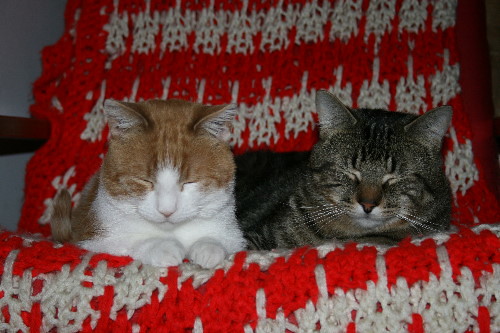
A rare sight. Usually only when everyone's feeling very dozy. Or chilly.
Charlie and Raven
Ditto. Charlie would like to be friends now. Raven hasn't forgotten those paws have claws, but maintains an uneasy truce.
Charlie
Helping us stack firewood. Or maybe investigating the open basement window hoping to get out, it was hard to tell.

Charlie