The last little while I’ve been hard at work making a push to wrap up the last of the maps for the moth field guide. This is partly because I’ve been itching for spring and the return of moths and wanted to focus on something moth-y, but mostly so that we will still have lots of time to review them before our deadline this summer. It’s been a bit of an undertaking – we plan to cover some 1300 species in the guide, and hope that some 800 of those will have range maps accompanying them. This will be the first guide to comprehensively provide maps for the majority of macro-moths, for the entire northeast region. Guides that have gone before have simply offered text descriptions of range (a few have maps, but of just the state and/or a subset of moths) but these can be so hard to interpret, especially when you’re not one of the corner states/provinces given in the text. We wanted to include something that would be faster and easier to interpret than text, more “user-friendly”.
The downside to this decision is that there just isn’t the data out there for moths that there is for other organisms, such as trees or birds. The data that does exist is in a highly scattered form. It includes records that may be extralimital occurrences (ie., vagrants), but with so few data points it’s hard to know for certain which ones are and which ones aren’t. I have a number of resources I’m referencing, both printed and web, as well as checklists and collection data from private moth’ers. I wish I had the sort of information at my disposal that birders have, but I’m making do.
There are a couple of approaches to presenting the data on a map. We could just plot points for locations we had data for. While this is easy to do and is guaranteed not to lie, it also doesn’t tell the whole truth as the species may occur in other areas where it just didn’t happen to be collected. We toyed with filling in states and provinces in a presence/absence presentation based on the data we had, but once again, while it was easy to do, this approach would also be misleading – even if a species only entered a state along one side or corner, it would still be displayed as though it occurred throughout. We really wanted to do smoothed range maps, because they look the nicest, but they require that you have a strong body of data in order to accurately define the boundaries.
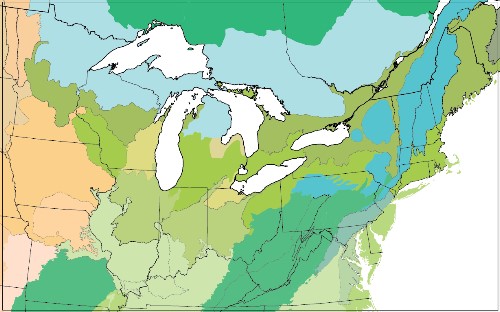
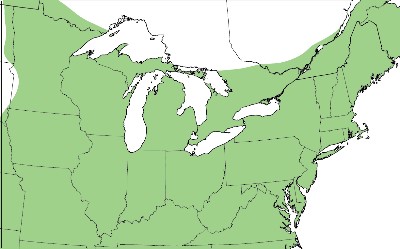
After considerable thought and discussion, we decided to combine the latter two approaches. However, rather than using political boundaries to define our areas, we took an ecological approach. The map above shows ecoregional boundaries as defined by the North American Atlas project, a partnership between the Commission for Environmental Cooperation, and the governments of all three North American countries (you can download their maps for free here). The data I had for each species of moth was matched to the ecoregions on the map, and a range drawn encompassing all ecoregions that the species was known or believed to occur in based on collection data as well as information on habitat or food plants. Fortunately, because moths are so tied to their host species, ecoregions works better for them than it might for some other organisms.
Some assumptions are necessarily made in mapping ranges this way, and the depicted ranges may over- or under-estimate occurrence, but in a group of organisms for which data is sparse, this is almost inevitable. One of the hopes we have with the publication of this guide is that there will be an increase in interest in moths as a result of an easy-to-use ID guide, which will in turn create a bigger database of observations as people go out to look. Hopefully the second edition, down the road, would be able to refine the maps. In the meantime, I’m happy with how they’re turning out. Here are a few for a bunch of species that I’ve mentioned in the past here on the blog. I’ve also included the text range description from the original Peterson guide to moths by Charles V Covell, so you can see how they compare. The moth images below are the ones that accompanied the post, not the ones that will be in the guide.
*****
The Infant, Archiearis infans
These are early spring fliers, sometimes out even before the snow has completely melted from the ground. I typically see them in open areas near patches of birch. I wrote about them last spring, in a post I did about birch trees.
Text range description: N.S. to N.J. and Pa., west through Canada south to Minn.
*****
Morrison’s Sallow, Eupsilia morrisoni
This was my very first moth last spring. They’re encountered late in the fall and early in the spring, and occasionally in mid-winter on very warm days/evenings. They overwinter as adults, so they’re able to emerge from hiding to fly as soon as temperatures are warm enough.
Text range description: N.S. to Wash., D.C. and e. Ky., west to Ont., Minn., and Mo. [after carefully studying ecoregion boundaries compared to the rest of the described range, my other data points, and the species’ hosts/habitat, I decided not to include Missouri. I had no other data points for Missouri besides Covell’s.]
*****
Eastern Tent Caterpillar Moth, Malacosoma americanum
I’ve posted about tent caterpillars on a few occasions, but the first was on encountering a number of tents early in the spring during my first year of writing this blog. The adults fly in late June and July, after the caterpillars from the tents have pupated.
Text range description: Common throughout our area. [True; doesn’t occur in the northern Boreal, however.]
*****
Maple Spanworm, Ennomos magnaria
Back in September I participated in National Moth Night, a UK initiative that I was encouraging North Americans (and other countries) to adopt, too. Our two nights were cold here, and I got very little to my lights. The species that turned up in highest numbers was Maple Spanworm.
Incidentally, National Moth Night 2010 will take place on May 15. The date gets moved from year to year to sample different seasons. Don’t worry, I’ll remind you again before then.
Text range description: Nfld. to n. Fla., west across Canada, south to S.D., Mo., and Miss. [Actually found in a broader range within the east than the tent caterpillar, because it also occurs in the Boreal, however note that this species’ range was defined, while the tent caterpillar’s was not. My suspicion is that Covell started out trying to detail the ranges for everything, than then halfway through decided nuts to it, the common stuff he’d just save himself some time and put “Common throughout”.]
Yesterday I highlighted what my favourite posts of the last year were, choosing one per month (and leaving out many that were probably just as worthy as a result). As a related idea, last year I also summarized what the most popular posts of the year were, and I thought I’d also do that again this year. WordPress keeps tabs not only on how many visitors your site gets, but also which pages they’re visiting. By far and away the page that gets the most visits is my home page, with the blog stats returning 33,333 hits in the last 365 days, as of this evening. My “About Me” page also gets quite a few. But what about the others? What are people looking for?
Well, most people are looking to find more about milk snakes. Although I don’t typically rank very high on the Google web searches, my photos can often be found on the first handful of pages of results for relevant search terms. I think this is how most people searching for milk snakes, or even just “snake”, arrive here. In a search for “eastern milk snake”, the above photo even makes the first page, and I suppose is different enough to catch people’s interest. A grand total of 7,861 people dropped by to check out the milk snake post.
Compared to the milk snake, all of the rest of my posts have a rather paltry visit count. The next closest, if you can still even call it close, is my grapevine beetle post. The above photo comes up on the first page of image results for “grapevine beetle”, and probably accounts for much of the traffic. There aren’t very many images on that first page that offer a sense of scale, so perhaps that’s why this one is interesting. Over the last year, this post got 2,139 people visiting.
Ranked number three, with just 1,509 hits, is my post on poison ivy. Given just how many pages there are out there about the subject, it’s surprising that it gets even that much regular traffic. It doesn’t come up on the first few pages of Google results.
Coming in fourth is my post on White Pines, the Tree of Great Peace. It collected 1,298 page views over the last year. It’s likewise a commonly discussed subject, so visitors must be coming by way of more detailed searches.
I’m a little surprised that my fifth-ranked post, about house centipedes, isn’t higher on the list considering how creepy most people find them. On the other hand, so many people find them creepy, there’s lots of web content about them. It had 1,292 hits.
Number six is about water bugs – a handful of species of invertebrates that I found in some pond water samples. Although the post mentions a number of species, I suspect many, if not most, of the 1,264 visitors were searching for info on blackfly larvae, the corresponding photo of which, above, comes up on the first page of Google image search results for the subject.
The seventh post, I’m delighted to say, is about a few colourful moths. Yay moths! I would hazard a guess that the particular moth most of the visitors were interested in was the Isabella Tiger Moth, above, which is the adult form of our very familiar Woolly Bear caterpillar. The above photo is the very first image returned for the Google image search “Wooly bear caterpillar moth” (number two if you spell woolly with two L’s). It’s had 1,235 visitors over the last year.
Some 1,185 people have come by to check out my post on flamingos. The post was titled “pink flamingos for the yard” and I’ve noticed a number of search terms on my stats pages indicating people looking for plastic lawn flamingos. These ones probably weren’t what they were looking for; they were captive birds kept by a neighbour down the road from my parents’ old house who bred them and sold them to zoological institutions.
I noticed that as soon as my post on snapping turtle eggs went up last June that it started getting a lot of hits. In just half a year it’s accumulated 1,149 page views. It’s a shame that the eggs I found had been depredated already, but hopefully the post at least offered some useful information.
And rounding out my top ten, the only other one with more than a thousand hits (1,007 total), was my post on giant water bugs. This one got picked up on a web forum – for video game animation or something weird like that – which still brings me periodic hits. The popularity, I think, is partly due to the post’s title, “monster bug”. One of the photos comes up on the second page of Google image results for that term.
It’s interesting to note that only two of these ten posts are actually from 2009: the white pine and the snapping turtle. All the rest are from 2008.
There’s something about the turn of the calendar, the rolling over of a digit (or in this year’s case, two), that inspires people to make lists and set goals. It’s at this time of year that we’re all at our most introspective and reminiscent as we look back on the year that was and make resolutions on how we’re going to better the year ahead. It’s an arbitrary date to have picked – why not choose our birthdays, when we officially mark the passage of another year from the anniversary of our birth? Or, why are we inclined to do so on only one day? Perhaps it’s too weighty to look back, or ahead, on a regular basis, it’s easier to coast along in the present. Likewise, we need some prompting to make resolutions. “They” recommend, to smokers and others trying to kick a bad habit, to pick a quit date that becomes the start of your new life plan. I guess January 1 is our quit date. Or, in my case, January 2.
In the spirit of things, I thought I would do ten lists of ten things, both looking at the year that’s passed and the year to come, and share them here. The first list is a common one for birders, and is shared here pictorially: the first 10 species of birds observed in 2010, in order of appearance (with two camera-shy individuals). For many people, this list is heavily biased toward feeder birds, and mine is no exception.
Another common birder list is to select your 10 best/favourite species seen in the preceding year. In 2009, my favourite species and/or encounters (in no particular order) are:
1. Broad-winged Hawk – we captured and banded one this summer at our Rock Ridge MAPS site, it’s the first individual I’ve seen of this species at any angle that wasn’t directly underneath.
2. Red-eyed Vireo – the week before we left the lake house, a female started building a nest in the maple tree less than ten feet from the living room window.
3. Whip-poor-will – I didn’t blog about this one; while leaving Rock Ridge after a set-up day at the start of the season we encountered a female with two adorable downy chicks.
4. Hoary Redpoll – in February we had a couple of lovely pale males come visit our feeders at the lake house.
5. Pileated Woodpecker – any encounter with these guys is memorable, but particularly watching one work on building a nest deep in the woods.
6. Rose-breasted Grosbeak – we caught and banded a funky yellow-breasted individual at our Maplewood Bog MAPS site.
7. Cooper’s Hawk – an immature did a low fly-by as I was standing out in the field one day.
8. Ruffed Grouse – I saw so many this year! At both houses. It was rare to see one back where I grew up, but out here they seem fairly ubiquitous.
9. Great Crested Flycatcher – I didn’t blog about this one, either; one morning at Maplewood Bog I spent an enchanting ten minutes watching a flycatcher sally from branch to branch above my head in the clearing I was sitting in.
10. Northern Cardinal – I couldn’t leave this one off the list. The only cardinal since moving to the new house, and only the third I’ve seen since leaving Toronto.
And every birder has a list of species they would really like to see in the coming year. I’ve already seen many of these, but I’d like to see them again. I’m not hard-core enough to go chase birds I want, I’d rather just encounter them as I’m hiking or doing other things.
1. Evening Grosbeak – they supposedly breed in the area; I haven’t seen one in years.
2. Cerulean Warbler – it would be nice to band one, or at least get a good look at a male in a tree; I’ve only seen his underside.
3. Whip-poor-will – these guys are always neat to see, but equally cool to hear at night.
4. Great Gray Owl / Snowy Owl – I lump these together ’cause they’re both winter owls that I don’t see much (or hardly at all, in the case of the Great Grays).
5. Sandhill Crane – even if it’s just hearing a flock fly over, they have such musical calls.
6. Brant – supposedly eastern Ontario is along their Atlantic flyway and they’re occasionally spotted around here. I had one flock fly overhead while I was outside one day at the lake house, but that’s been my only encounter to date.
7. Grasshopper Sparrow – though they occur in our area, our fields are probably too brushy and/or small to support them, but I can hope…
8. Blackburnian Warbler – a hemlock specialist, and we’ve got lots of hemlock in the 100-acre woods that I’m hoping they might be attracted to this summer.
9. Prairie Warbler – there are a couple of small colonies down in Frontenac Prov. Park, we might be lucky enough to get a dispersing bird at one of the MAPS sites.
10. Hoatzin – assuming the trip with Kolibri Expeditions to Peru is a go, of course.
What’s a year in review without a list of ten notable milestones or events?
1. We moved into our new and current home at the exact middle of the year, July 1.
2. Frontenac Bird Studies (me as a volunteer, Dan at the helm) got off and running in its first year of fieldwork.
3. At some point in the fall I added my 500th species of moth to my mothing life-list. No, don’t know what it was specifically; I make a lot of ID’s after-the-fact.
4. I was invited (and accepted) to join the Nature Blog Network team, which was a great honour to me.
5. I was also invited (and hope) to join Kolibri Expeditions on a trip to Peru, also a great honour to be included on the invitee list.
6. I participated in an organic Community Shared Agriculture farm plan for the first time – delicious!
7. I decided to try my hand at fiction and participated in National Novel Writing Month; just before Christmas I actually completed the novel. It needs a bit of work… but hey, it’s done.
8. Also in November our household adopted a new member. He’s doing much better now than when he arrived (nearly double in weight). We’re still trying to settle on a name that fits.
9. I developed a taste for tomatoes and lettuce. This was notable for me. Prior to this year I never ate salads, and picked out tomatoes from my food, a holdover from childhood aversions. I attribute this change to the basketfuls of food we’d get from the CSA. All that lettuce – guess I’d better learn to like it! And hey… it’s not as bad as my childhood memories were telling me it was…
10. I got not one, but two flat tires within the span of a month, the first ones I’ve had happen since high school. Pulled over without a cell phone. Fortunately, I’m a woman and I needed only look distressed and had kind older gentlemen pull over to help me out within minutes. There are definitely perks to being female.
The mirror to the above list, of course, is ten goals for the coming year. I have lots of goals every year, but I rarely make them all.
1. Complete the manuscript for the moth field guide and submit it by our August deadline. This is my number one biggest goal for this year. Fortunately, it’s a concrete one and should therefore be easy to meet.
2. Add a stable income. This will likely require taking a job, sadly. I love the freelance lifestyle, but have had trouble in sustaining cash flow, which is stressful.
3. I would like to develop a better familiarity with vascular plants, starting with wildflowers, of which I really only know the common stuff.
4. I also want to try beating branches for beetles, something I tried once or twice last spring, but got distracted at around the peak time they’d be out.
5. I’m hoping to grow a lot of our own produce this year. I enjoyed the CSA, but it’s too far to be practical from here, sadly. Fortunately, I love to garden.
6. Also, I’d like to try to make more of our food at home, rather than buying pre-packaged stuff. Things like breads, snacks, granola bars.
7. Read more. I used to read lots, but as my interests have expanded and I’ve taken on more responsibilities (and yes, the blog is a big time drain), reading has fallen by the wayside a bit. But there are so many good books I’d like to get to. Even just making fifteen or twenty minutes a day to sit down with a book.
8. Explore more. We tend to live near places I’d like to get around to visiting sometime, but it seems I never do, putting it off for another weekend.
9. I would like to try to improve my overall fitness level. I’m pretty sure I won’t meet this goal. I get too distracted when I’m out hiking, pausing all the time to look at things, for it to be good exercise for me.
10. Peru! Fingers crossed.
There’s an awful lot of “do more” on this list without much “do less”. And they’re not making any more hours to the day. I’ll need to buckle down on my procrastination habit, I think.
Speaking of exploring more, here are ten places I’d really like to get out to this year.
1. Purdon Conservation Area – in particular, their spring orchid festival to see the 16,000 Showy Lady’s Slippers that bloom along the boardwalk.
2. Kiwi Gardens – a perennial nursery and sculpture garden rolled into one.
3. Perth Wildlife Reserve – a 257 ha (660 acre) natural area on the outskirts of town. No dogs allowed, sorry Raven.
4. Perth Autumn Studio Tour – local artists and artisans open their studios for visitors to see some of their work and where it all happens. I intended to go last year, but got busy with Thanksgiving stuff.
5. Murphy’s Point Provincial Park – aside from the natural aspect, it also includes tours of a restored mica mine, and historical ruins of a sawmill and other buildings.
6. Canoe the Tay River – named after the River Tay that runs through Perth in Scotland. We’re not that far, and it would be an easy afternoon outing to launch the canoe from the bridge crossing. It’s 95km long; we probably don’t need to do all of that.
7. Hike some of the OQR rail trail – it runs from the back of our property west as far as Sharbot Lake, some 25 km away, and then joins up with the Trans Canada Trail. It seems to traverse some interesting Shield country, from what I can tell off the satellite images.
8. The Art of Being Green festival – I originally thought this was an art festival, but it’s actually a green living festival. We missed it last year, but it would be interesting to visit this year.
9. North Frontenac crown land – we made a short trip up there in the fall, but I’d really like to go back at some point in spring or summer.
10. Wheelers Pancake House – this place is well-advertised, with signs for it as much as 40 km (25 mi) away in Westport. Having seen so many signs, I feel intrigued enough to check it out. They make their own maple syrup, so it might be interesting to go in the spring when they’re doing that.
Returning to nature observation, here are my top ten non-bird targets for this year.
1. Fisher – they’re (relatively) common around here because of a successful reintroduction program. Dan thought he might have seen one last month disappearing down our driveway.
2. Snowshoe Hare – I’ve seen lots and lots of cottontails, but only the most fleeting glimpse of a white rabbit disappearing into the underbrush this fall.
3. Moose – might need to get lucky here, but they do occur around the wet areas of the Shield, including a small group in Frontenac Prov Park. The only one I’ve ever seen was at the side of the highway in BC, observed while zipping along at 100 km/h.
4. Native orchids – many to choose from, but especially the lady’s slippers and particularly the Ram’s Head Lady’s Slipper.
5. Female Fall Cankerworm (moth) – this is one of several species where the female moths are flightless and have no wings.
6. Monarch chrysalis – never observed this before, but if the population here is a bit better this year than it was last, perhaps I’ll have a chance.
7. Slime mould – particularly one that’s fruiting. They’re weird pseudo-sentient fungi!
8. Salamander migration – I’ve been wanting to observe this at spring melt for a few years, but my timing always seems to be off (and/or my enthusiasm to go out in the rain on a mild-but-still-cold night is flagging by that point).
9. Five-lined Skink – Ontario’s only lizard species; Dan observed one of these at one of our MAPS sites last year.
10. Northern lights – a bit of a long-shot, as I don’t know if we’re far enough north to have much chance of observing them. Possibly 2012, which is supposedly the peak of their 11-year cycle. But it’s nice and dark here, and we’ve got a great northern sightline over the fields.
(These are actually from last winter; this year's bird snuck off while I was getting my camera and hasn't returned.)
It doesn’t seem fair to give birds all the limelight when I have just as strong an interest in moths. Here are my ten hoped-for species for this year (with links to their BugGuide.net page with images):
1. Carpenterworm moths – subfamily Cossinae; I found one wing of one at the lake house, left behind after a bird tidied up the outside of my trap in the early dawn hours, but that’s been all.
2. Scarce Infant – Leucobrephos brephoides; I found a couple of these along our road in the spring at the last house, I’d be pleased to find them again here.
3. Twilight Moth – Lycia rachelae; a rare dusk-flying early-spring moth first recorded in Ontario from near Ottawa
4. Spotted Apatelodes – Apatelodes torrefacta; adopts an interesting abdomen-raised posture at rest.
5. New England Buck Moth – Hemileuca lucina; a flashy, fuzzy, localized species of wet or boggy areas, recorded from Ontario only from the Ottawa valley. I should try running my trap at the back of the fields near our little bog.
6. Cecropia Moth – Hyalophora cecropia; one of the most common of the silk moths, and I’ve never seen one.
7. Cinnabar Moth – Tyria jacobaeae; such a bright and striking species.
8. Great Tiger Moth – Arctia caja; another brightly-patterned species, also largeish.
9. Beautiful Eutelia – Eutelia pulcherrima; another moth that adopts an interesting shape/posture at rest, and has lovely markings too. It’s in the Quebec guide but not sure if it actually occurs in our area.
10. Marsh Fern Moth – Fagitana littera; a specialist of bogs and fens, rare and localized as a result. Might get it with the New England Buck Moth. :)
And here are ten moth species I was most pleased to catch in 2009 (links are to my own photos on Flickr), for either their appearance or their uncommonness:
Finally, one last list. Ten things I realized while making these lists.
1. Thinking of five things is easy. Thinking of ten things is hard.
2. Writing down five lists takes a long time. Writing down ten takes a lot longer (this was supposed to be a Jan 1 post).
3. January 2009 was a long time ago.
4. Moving in the summer puts a funny little hiccup in the middle of your year.
5. Photo archives are a valuable remembrance aid.
6. So are reference guides on the bookshelf.
7. I really haven’t seen all that many rare or unusual bird species over the last year.
8. I’ve seen a number of uncommon/rare moth species, but saying “Scarce Infant” doesn’t have nearly the same impact as “Cerulean Warbler”.
9. There are a lot of relatively common things that I’ve somehow managed not to see yet.
10. There are a lot of uncommon things I’d like to see but can’t really expect to without making a concerted effort to travel/search for them.
Bird species #10 of 2010 was a European Starling at our feeder who didn’t stick around to have his photo taken. It showed up this morning. It was not even on my radar for a potential #10, since we hadn’t seen one in the area since the fall, and never at the feeders. Starlings usually clear out of rural areas for the winter, heading in to town or perhaps areas farther south. I was expecting perhaps Purple Finch, Red-breasted Nuthatch, crow or raven, but have yet to see or hear any of these.
Two blog carnivals to announce today. The first is The Moth and Me, a carnival I started up back in the March of this year to celebrate my second-favourite group of living organisms. This month’s edition is the final one of 2009, and was hosted by Susannah of Wanderin’ Weeta. Check out the excellent assortment of moth-related blog posts that she’s assembled to give us another reason to be glad the earth is not flat.
The Moth and Me will return in March 2010, when it will be hosted by Jason of Xenogere. Send your submissions to jason AT xenogere D0T com by March 13th. We’re looking for hosts for April 2010 and beyond. If you’re interested in hosting, send me a note at sanderling AT symbiotic D0T ca.
Also recently up is the 113th edition of I and the Bird. Matt at The Modern Naturalist has put together an enjoyable edition filled with quotations and verse. Matt put a lot of work into this one – head over and check it out.
No, not the Canadian railway, nor the Asian road route, nor the Ankh-Morpork telegraph system (which I recently finished reading about). This particular grand trunk is growing in our front yard and belongs to a large, old maple tree. The trunk is covered in deeply ridged bark, which is in turn covered with colourful lichens, which in turn hosts many interesting critters.
I was out raking leaves yesterday, since the weather was quite mild; a relatively balmy 16 C (61 F). I set aside the rake before the sore spots on my thumbs got a chance to turn into blisters, but reluctant to go in just yet, I played ball with Raven for a little bit. In between tosses, while she was hunting for the ball in the long grass of the meadow, I examined the trunk of the tree. It initially caught my interest when I noticed some of the tiny little Bark Mycena that I had first observed on the maples of my parents’ old house, when my blog was still just a month-old fledgling.
I grabbed my camera and documented all the organisms I found on the trunk, between the ground and eye-level, yesterday afternoon. For the purposes of relating scale, all of these photos are taken at the same magnification and are the original out-of-the-camera image; I have not cropped any of them (although I did lighten a few since it was overcast and some of the photos were a little dark). Most people know how big an average pillbug (or maybe a sowbug; I forgot to check for tails) is – the size of the frame for the photos below is the same as for this one, to give you an idea of relative size. The only exceptions to this are the final three, which were too big to fit into the frame when fully zoomed-in.
Bark Mycenatiny unidentified mothWinter Fireflyjumping spiderlittle snail shellBagworm moth case; probably the adult has died and it's full of eggsBark Mycenablack ant; probably Black Carpenter Anttiny unidentified mothWinter FireflyBark Mycenatiny unidentified spiderSaddled Leafhopper, not technically on the trunk, but very close. Note the greenish leafhopper in the upper left.Tussock moth caterpillar, very worn; maybe Banded or Yellow-based
The next three are at a different scale from the above, as they were too large to fit into the frame comfortably (or at all). They were also on the next tree over, so not strictly the same group, but I couldn’t resist including them as well.
Green Stink BugPolyphemus Moth caterpillar - similar to the Luna Moth cat but separated by the V-shaped mark on its rear endSpiny Oak-Slug Moth caterpillar






 seabrookeleckie.com