A moth’er’s materials

Moth sheet with blacklight

I don’t think I’ve ever gone into any detail regarding the equipment I use for mothing. I had a comment on yesterday’s post asking for more information about it, so I though I would follow up and make that the subject of today’s post. That way, interested readers can gather their own mothing equipment if they wanted, and it would be with lots of time before the spring mothing period begins!

In reality, you don’t really need to have special equipment in order to enjoy moths. Especially in the country, but also in urban areas, you can go outside and check your porch light or the windowsills around windows where you have your lights on. Moths and other crazy creatures will be drawn in to just about any artificial light source.

If your curiosity has got the better of you, however, you can up the ante by setting up a white sheet. These will also work with just a simple incandescent shone against them, but what really brings in the bugs is to use a lightbulb that projects partially in the UV spectrum, like a blacklight. Make sure you’re using a standard cotton sheet – synthetic materials tend not to glow under blacklight the same way.

It’s not clear why moths, beetles and other bugs are attracted to UV light; it might have something to do with the wavelengths mimicking the pheromones of other individuals in the way they hit the bug’s antennae. Another hypothesis as to why moths come to light is that they navigate using the moon, and since the moon is simply shining with reflected sunlight, it’s possible the bulbs mimic the UV in the moon/sunlight. Regardless of the reason that it does, UV bulbs really work.

Mothing equipment

I have three types of mothing equipment: sheets, trap and “goop”. This is my sheet equipment. It consists of a white sheet, a spring-clamp light bracket and UV bulb, and a tripod (not pictured). I hang a sheet from a clothesline or a rope strung between a couple of trees, clamp the light bracket with bulb onto the tripod, and set it up in front. You’ll have more success if at least one side of the sheet faces an open area, since the light will broadcast farther that way and draw moths in from further away.

The two bulbs I have shown here are a blacklight and a mercury vapour. The blacklight is easily available (as is the spring-clamp bracket) from any Home Depot or Canadian Tire or similar stores that sell bulbs. I’ve found the compact fluorescents to be brighter than the incandescent versions. All blacklights have the finicky requirement of being held upright – I found out the hard way that if you hang a blacklight upside down it burns out within a few minutes. The exception to this is the tube-style, which you can get at party stores and the like.

The mercury vapour is less easy to come by, and you may end up having to go to a specialty lighting store to find it. I ordered mine off eBay. Unfortunately, when they arrived I discovered they had mogul bases – the old-style, inch-and-a-half diameter size – which wouldn’t fit into the sockets I had. So I then had to buy a converter off eBay (also not available in Home Depot) to fit my mogul bulb into my normal socket. Works like a charm, but wasn’t so cheap.

The upside to mercury vapour is that it’s really, really bright and so broadcasts a much greater distance than a blacklight. The light is also stronger, and so you’ll end up with more moths coming to your light than you would with simply a blacklight. The downside is that it’s more expensive, and it burns hotter than a blacklight. Also, because it’s so bright and it’s casting UV rays, you’re advised not to look directly at it. When you buy your first mercury vapour bulb, you know you’ve gone hardcore. It’s like buying yourself your first several-hundred-dollar pair of binoculars.

Moth trap - garbage can

The other way you know you’ve gone hardcore is that you build yourself a moth trap. Moth traps are delightfully easy to make for the reward they offer. They have the advantage of allowing you to run a light all night, without having to actually be present to check what’s come in to the sheet. You can run them rain or (moon)shine, with the proper protection. And, they keep all your moths contained until you get up in the morning and start going through them over your cup of coffee.

The general principal of a trap is that the moths come in to the light, and then during all their frantic fluttering around (in that way moths have around lights) they end up falling down the funnel. Once into the trap, it’s very difficult for them to find their way back out. Then climb onto some of the stuff you’ve tucked inside and wait for you to come release them the next morning. Any set of equipment that accomplishes this goal will work, and there are different styles to approach it. My trap is a large rubbermaid storage tub (shown below), while TheMothMan‘s (pictured above) is a garbage can with a plastic sheet over top (or at least it was, I think he’s switched out his arrangement recently).

Moth trap - running

Of course, when using a trap there are obvious ethics involved. Make sure that you don’t keep your moths in the trap longer than necessary. If you want to hold some for photographing or showing off to a friend, that’s fine, but make sure you put them in a container and place them in the fridge. Pill bottles are a great size for this (there are some shown in the photo of the folded sheet above), and you can ask your local pharmacist if they may have some you could have. Alternatively, they can be ordered from specialty shops online, but basically any smallish container works fine – clear ones are best since you can see what’s inside. The cool temperature of the fridge will keep moths calm and lower their metabolism, putting them into a sort of torpid state. This same applies to any moth you want to keep from your sheet setup. Don’t place your trap in a location where the morning sun is likely to rise and heat it up before you can come out to rescue the moths (or if you have no choice, then make sure you’re up before the sun is very high).

Moth trap - setup

Also, protect the trap from rain as best as you can. This can be done by placing a glass bowl inverted overtop of the bulb. You don’t want the rain hitting your bulbs, and it’s better not to have it draining into the trap, either, if you can (although if your trap is made to drain properly then it’s not the end of the world; if it’s not, however, you can end up with several inches of water and dozens of dead moths floating on top). Moths will still fly in the rain, so just because it’s rainy won’t mean there’s no moths. If you don’t have a glass bowl, you could also string up a tarp or put the trap under an overhang where it won’t get rained on. When you’re releasing the moths from the trap, make sure you release them into long grass or thick shrubs, so that they have protection from predators. Also, try not to dump a hundred moths all in one spot if you can – as soon as a predator such as a bird stumbles onto the smorgasbord, that’s it for the bunch. You can release them during the day, just make sure it’s into appropriate cover. If you have no appropriate cover, try to release them at night.

Moth trap - funnel

As for the details of trap construction… Choose whatever container you prefer. It needs to be reasonably deep, but if you don’t like leaning into a garbage can then it’s okay to go for something shallower. The main concern is that it will fit your funnel. The funnel is a large-sized plastic funnel the likes of which you can get from Home Depot or Canadian Tire or other hardware/auto stores. This one is 10″ across, I believe. The bottom part of the funnel has been cut off, resulting in a 4″ opening. Attached to the bottom is a 4″ plastic plant pot with its bottom cut off, extending the funnel but still leaving the mouth wide enough to accommodate large moths.

Inside the funnel is the trickiest part of the trap. You’ll need to get a light socket with a cord (the spring-clamp bracket usually has a screw that will release the socket from the clamp), or otherwise make your own. The socket needs to be suspended in the middle of the funnel, so that the base is about halfway down. In my trap this was done by cutting some pieces of clear acrylic to the appropriate size/shape and securing them inside the funnel with silicone. You could also use strong wire or some other means. If you use acrylic it can be used as struts to support your glass dome, just make sure that it sticks up high enough to leave a gap for the moths to enter. If you use wire, make sure it’s strong enough to support your dome, and use a dome that’s smaller in diameter than your funnel, or otherwise build additional supports (eg blocks of wood) outside the funnel to support the dome. Now that the hard part is done, measure and cut out a circle from your trap’s lid that you can slide the funnel into.

Moth trap - inside

Inside the trap, you need to make sure there’s something for the moths to cling to. One of the best things is empty egg cartons, or other items that are similarly rough and full of nooks. Moths like to tuck themselves into nooks, like they would hide under a piece of bark, and egg cartons appeal to this. I buy my eggs in plastic cartons, however, so many of my substrate items are actually biodegradable seed-starting trays. When you put them into the trap, stack them around the outside. This leaves room for the funnel, but moths that enter the trap also have the inclination to head for the walls, and putting the substrate against the walls will mean they’re more likely to stay in the trap.

Moths at goop

The third and final tool moth’ers use for attracting moths is a syrupy “goop” that is spread on trees or logs to draw in nectar-feeders that may have limited interest in the light (not all species of moths are attracted to light). Most moths don’t eat as adults, but there are a few that sup on flower nectar or tree sap, and this is the group that the goop will appeal to. To make it, throw an overripe banana, a dollop of molasses, a scoop of brown sugar, and a few chugs of cheap beer into a blender and mix it all together. If you get the impression that the measurements don’t need to be precise, you’re correct. Anything sweet and sugary will appeal to them, so if you’re missing an ingredient that’s okay too, although the beer really is a helpful addition.

Take this concoction and, using a wide brush like you might paint your house with, paint it onto the trunks of a few trees or logs. It may take the moths a little while to find it, so it’s good to put it out early in the evening. Note that it has the potential to stain, so don’t put it onto your house siding or anything you might be worried about leaving a mark. Goop is most effective on cooler nights, in early spring or late fall, but can be used at any time of the year.

Pretty much any evening where the temperature is up around 10 oC (50 oF) and above there’s the potential for decent mothing, although naturally cooler evenings will be slower than warmer evenings within the same time period, and cooler months will garner fewer moths than warmer months. The height of mothing is really June and July – that’s when the most colourful moths are out and about, and the greatest diversity – but any warm night is good mothing.

So there you are! All set to get going watching moths in your own backyard. Us northern folks still have another couple of months before the temperatures are warm enough to get started, but I suspect folks down in the balmy south could be mothing year round. A good evening of mothing can be a fun experience, particuarly as a social event – invite a few friends over, string some sheets up, crack open a couple beers (or glasses of wine), and laugh and have a good time. And let me know what you get!

Summer colours

Note: If you’re looking for information on The Moth and Me, please visit the official carnival site.

9286 - Harrisimemna trisignata - Harris's Three-Spot
Harris’s Three-Spot (Harrisimemna trisignata)

One of the advantages of having multiple different projects on the go is that if you start to feel weary with one, or are waiting on something before you can continue, or just need a change of pace, you’ve got several other things to turn to that will still keep you busy. This morning I pulled out my paints for the first time in perhaps six months or more. Now that the warbler drawings were all wrapped up, it was time to sit down with the blackbirds. I had been procrastinating on getting started because I didn’t have a good workspace downstairs in my living room cum study. I finally got around to rearranging things a bit and moving my drafting table down from Dan’s studio (neither of us wanted to work in the same space, for a number of reasons, and since I spend half my time at the computer and he has more need of the extra space, he got the second bedroom). I’m thinking I might take some photos of my works-in-progress and post them from time to time. I have 55 blackbirds to paint between now and July, so much of my time will be occupied with that, I suspect.

8089 - Hypoprepia miniata - Scarlet-winged Lichen Moth
Scarlet-winged Lichen Moth (Hypoprepia miniata)

However, prior to that, while I was procrastinating, I turned to the moth book to do some work on that for a while. One of the things that I’d been meaning to get to for a while was organizing and labeling my moth photos. I had a collection of 374 unidentified/unlabeled images from the warm weather (how long ago that seems right now!), and I’ve been whittling that down, slowly. And that’s just the photos I took since moving here. I have an additional 762 photos from my parents’ old place and Toronto. Because the whole point of my friend and I doing this book is that there isn’t a good easy reference guide currently out there, progress has been slower than I might like. I’ve gone through and identified and labeled 125 so far. Just a thousand left to go!

7704 - Eacles imperialis - Imperial Moth
Imperial Moth (Eacles imperialis)

But boy, going through those photos really brought back the warm summer evenings, the stars glowing overhead, the still, humid air, the crickets chirping in the grass, the moths fluttering at the porch lights. The delight in standing on the deck, looking over the creatures drawn to the light, discovering something new, something interesting, something colourful. The expectation as the top of the moth trap is opened, a hundred soft little bodies clinging to the egg cartons inside, the excitement over unusual finds. The tediousness of taking them out of the fridge where they had been held, chilled to keep them calm, and sitting them on a leaf to have their photo taken. Over and over. Hm.

7653 - Calledapteryx dryopterata - Brown Scoopwing
Brown Scoopwing (Calledapteryx dryopterata)

I am full of anticipation for those first mild evenings in early April, perhaps even late March if we’re lucky enough to get an exceptionally warm spell. What plans I have for those evenings. My lamps are carefully tucked away, my white sheets lie folded, my trap is disassembled and stored in the garden shed. But come April they’ll all be brought out, dusted off, and, hopefully, drawing in the moths once again. What mysteries will the lights reveal this year, in this new location?

9301 - Eudryas grata - Beautiful Wood-Nymph
Beautiful Wood-Nymph (Eudryas grata)

By the end of the warm season, it’s easy to begin feeling tired out with a subject, to have difficulty maintaining interest and excitement over such a long period. I feel guilty, in the fall, for choosing not to put my light out on a nice evening, or grab my binoculars and go birding on a warm afternoon, but eventually one begins to burn out, the flame that burned so strongly and brightly in the spring finally running out of fuel, flickering and sputtering reluctantly. However, nothing like five long, dark months of cold and snow to renew the fuel banks for the flame. After five months of limited activity, this pony has been confined inside far too long, she’s champing at the bit, eager to get out and stretch her legs.

8956 - Marathyssa basalis - Light Marathyssa
Light Marathyssa (Marathyssa basalis)

In the meantime, to get me through the remaining six weeks of winter, I browse through my photos, basking in the memories of warmth and sunshine and verdent green foliage that they conjure. I came across a photo I took when we first moved here, a view of our house from the dock, the trees so lush and green you can only see the top where it peeks out above the leaves. Sapphire blue sky, clear cool water, lilypads and a hammock.

8087 - Lycomorpha pholus - Black-and-yellow Lichen Moth
Black-and-yellow Lichen Moth (Lycomorpha pholus)

It seems we’re always looking ahead to the next season, always waiting for that next exciting thing, so often we forget to stop and enjoy what’s here right now. There is magic to the snowy landscape, the crystal ice sheaths wrapped around the trees, the frost on the windows and the crunch underfoot. I appreciate winter, sure. But as much as I see the beauty in the cold season… how can you not anticipate spring?

7670 - Tolype velleda - Large Tolype
Large Tolype (Tolype velleda)

By the hundreds

Moth jars in fridge

Hundreds of moths

This is my 100th post. It arrived rather quickly, it’s hard to believe I’ve written that many entries already, on subjects as varied as fungus and flora, birds and bugs, earth hour and green parties (the events, not the political groups). I thought the hundredth post deserved special attention, to mark a milestone, but I wasn’t sure how by. I spent some time thinking about it, and finally decided upon a post of hundreds – recent observations of multitudes of whatever it is I’m observing.

I happen to be at my parents’ this week, taking care of the horses while my mom’s away at a conference. Unfortunately, they’re not as easy as goldfish where you sprinkle them some food and they’re good to go for a while. I don’t mind coming out to care for them, though, as it gives me an excuse to visit the countryside. One of the things I use that excuse to do is catch moths, of course. I had a few sheets up last evening, and this. It was on the cooler side overnight last night, about 15 C (60 F), but there was still a good selection of things coming in to the sheets and trap; this evening is warmer and there’s much more activity. Since I need to photograph everything in order to later identify it, I jar the moths I don’t know and tuck them in the fridge. It doesn’t take long for the fridge to fill up. The above photo is the state of things after last night.

Insects on Goatsbeard

Hundreds of bugs

In my mom’s garden there are a couple clumps of goatsbeard (Aruncus dioicus), a perennial native to North America and western Europe. It produces sprays of white flowers, which insects absolutely love. I highly recommend that any budding entomologist buy themselves a goatsbeard for their garden. It gets everything: butterflies, of course, but also day-flying moths, wasps, bees, flies, beetles. You can even find mosquitoes nectaring on the flowers. During the plant’s peak blooming period, which lasts a couple of weeks and is about this time of year, the blooms will be alive with activity, covered in bugs. Hundreds is not an exaggeration here. The longer you stand there, the more you see. It attracts some pretty interesting things.

Beetles

Hundreds of beetles

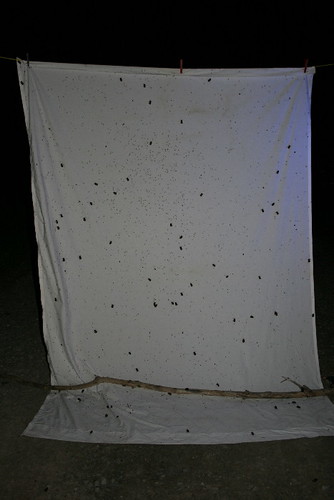
Earlier in the month I did some mothing down at the research station. Or tried to, anyway. I didn’t actually end up catching very many moths, though I’m not sure why; it was fairly warm that evening. However, what I did end up getting lots of were beetles. In many shapes and sizes, but the most apparent were the June Bugs. These guys aren’t a lot of fun to have come buzzing in to a sheet at the best of times, since they’re clumsy and just as liable to run into you as the sheet. Having about 100 come in to the light was almost creepy. In this photo, those large dark spots are the June Bugs; there are 67 visible on the sheet, and there were easily a few dozen more on the other side, on the ground, and in the nearby vegetation.

Colewort

Hundreds of flowers

The colewort in the garden is also still going strong. Because the plant is ginormous, there are easily hundreds upon hundreds of flowers blooming on it. The colewort attracts a lot of insects, too, and has a fairly strong and pretty scent. Yesterday I watched a few interesting beetles, flies, and a tiger swallowtail dropped by to sample things. This wouldn’t be a bad plant for the garden of an entomologist, either, but it does take up a lot of room.

Chokecherries

Hundreds of berries

I noticed while making the rounds of the garden that the chokecherry tree is beginning to put out its berries. They’re still far from ripe, being a green the same shade as the leaves, but they’re nearly full-size now. The tree is covered in them, and staring up into the canopy creates an interesting effect, almost abstract in appearance.

Hail

Hundreds of hailstones (and raindrops)

The last couple of weeks we’ve had regular, near-daily afternoon thunderstorms. Many of the thunderstorms have included hail, often rather large hail. I tried to take a photo of some of the rather large hail, but couldn’t really capture it any better than this. It’s been strange just how much rain we’ve got this year. I heard something about this June being the wettest on record (so far), but can’t seem to corroborate that. All this rain is especially strange compared to last summer, which was the polar opposite – days upon days of nothing but clear skies and sunshine, not a drop of rain in sight. My parents actually had concerns over their well running low and had to implement a strict water conservation plan. Won’t be an issue this year.

I actually started this post last night (Tuesday), but have been quite busy filling my mom’s shoes while she’s gone. In addition to the dentist appointment, which was quick and went well, but still took a chunk out of my day. I have new respect for the amount of work my mom (or my sister, when she’s here and takes over) puts in around here, especially with the horses. I don’t think I fully appreciated just how much time was involved in caring for them.

In any case. Here’s to another happy hundred.

A few colourful moths

Sphinx_drupiferarum

I’m at my parents’ this evening, and it is chilly, unseasonably cool (it seems to me) for a mid-June night, nearly summer. I would ordinarily be outside, checking for moths on the blacklighted sheets I’d have set up, but it’s too cool for that tonight; approaching 10 C (50 F), the moths are, for the most part, tucked into sheltered spots waiting for a warmer night to fly.  Since it’s June, there ought to be many nights of 20 C (68 F) temperatures that would be much more ideal. I’ve got my trap running anyway, since it involves very little effort and hey, you never know. But I’m not expecting much when I check it in the morning; the couple times I’ve peeked out the window at it I haven’t seen anything at the sheet I set up behind the light.

In contrast, earlier this month I had some excellent, warm nights. I have yet to see any nights with a sheet covered in moths, but that’s probably just as well – my identification isn’t good enough yet for me to be able to pick through the common stuff to locate the more unusual species, and I would probably feel a little overwhelmed. Even just the couple of busy-ish nights I’ve had, with 50-80 species, have been enough to keep me busy for many hours the next day. Another disadvantage to not knowing anything is that I have to photograph every moth I encounter if I want to identify it, whereas if I already know 40 of those 50 species there’s not much photographing that needs to be done the next day.

The other problem with getting so many moths is trying to choose a select few to post to the blog. With such variety, how do you narrow it down? For the non-moth’er, the large or colourful species are the obvious choices, but even among that group there is quite a selection. I eventually settled on half a dozen that I thought were the most interesting from the last few weeks. Narrowing it down to just the species I had identified helped considerably as well.

The above moth is a Wild Cherry Sphinx (Sphinx drupiferarum), which came to the blacklight at my parents’ last week. I happened to be checking the sheet as it flew in, and I knew something that large had to be a sphinx, so I really wanted to catch it. Unfortunately, I didn’t have my large-moth containers there at the sheet with me. I didn’t trust it to remain (it still hadn’t settled on the sheet, but was buzzing across its surface), so I ended up catching it in one hand, creating a loose cage with my fingers. Good thing I did, too, as it’s a somewhat uncommon species, and one that The Moth Man hadn’t seen before, so we needed photos.

Silver-spottedGhostMoth

On a similar note, another uncommon species that he hadn’t seen so we needed photos of was this one, the Silver-spotted Ghost Moth. The reason this species isn’t often seen is less due to its abundance, however, and more because of its habits. Most moth’ers attract their moths to some sort of lure, either a UV light or sugary syrup concoctions. This moth rarely comes to lights, so it’s infrequently caught. It has a sort of lekking behaviour, where giant swarms of males form in the evening near the species’ host trees, alders, and female moths will come to check them all out. The moths are most often encountered in these swarms. In the case of my moth, it was the rare individual that did come to check out the light, and I found it sitting in the trap. This species is also unusual in that, taxonomically, it is more closely related to the wee bitty moths than the larger moths, but it itself is about two inches long.

Isabella Moth (Wooly Bear Caterpillar) - Pyrrharctia isabella

The caterpillar of this moth will be more familiar to most people than the moth itself. This is the adult form of the Wooly Bear caterpillar, that fuzzy, brown and black caterpillar frequently seen in the fall and perceived as a predictor of the nature of the impending winter. For such a distinct-looking caterpillar, the adult is rather bland, although its abdomen has an orange wash to it. The adults are known as Isabella Moths (Pyrrharctia isabella).

Pink-legged Tiger Moth - Spilosoma latipennis

There are a number of different species of tiger moths, which are generally characterized by being about an inch in size and fuzzy, with a fuzzy caterpillar stage. The Isabella Moth is part of this group, as is the above, appropriately named the Pink-legged Tiger Moth (Spilosoma latipennis). There are two tiger moths that are nearly entirely snow white, this one and the very similar Agreeable Tiger Moth. The primary difference is in the legs – the Agreeable’s are a yellow-orange instead of pink. I’ve seen a few Agreeables so far this spring, but this was the first Pink-legged I’d caught.

Harnessed Tiger Moth

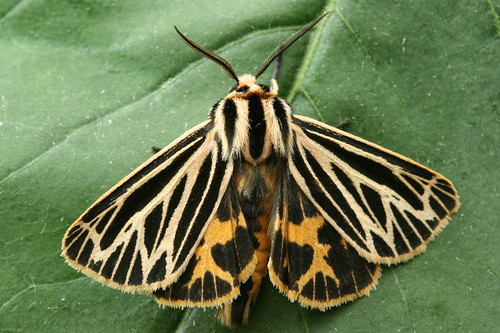
Yet another bunch of tiger moths have black and tan-striped wings. This one is a Harnessed Tiger Moth. There are half a dozen or more species with this sort of pattern, and telling them apart relies on the size of the stripes, the presence of cross-bars, and the colour and pattern of the hindwings. Last week I also caught a Little Virgin Tiger Moth, very similar but for the orangeish rather than pinkish hindwings, and thinner and more numerous stripes.

Stone-winged Owlet - Chytolita petrealis

When Blackburnian and I were at his mom’s place, we went for a walk through the bit of forest that backs onto her property. As we walked we kicked up many moths, about an inch in size and a bland tan colour. They were these guys, Stone-winged Owlets (Chytolita petrealis), so named for the stone colour of their wings (apparently; I think of stones as gray, not beige, personally). The long up-curved “snout” is actually a pair of palps, and are used as sensory organs. Many moths have palps, but they’re more exaggerated in some species than others.

Unicorn Prominent - Schizura unicornis

This last one is the subtle but beautiful Unicorn Prominent (Schizura unicornis). I’m not sure why it’s been called unicorn since it has no obvious horn (unlike the previous moth). I love the shades of mocha, peach, olive and teal in the wings of this moth. I couldn’t get him to do it again for the photo, but while he was sitting in the little jar I had him in he had his hind end and wings tightly furled together and raised up in the air, like a bit of peeling bark. The prominents are a varied bunch, with some mottled like this one, others smooth and sleek, and still others rather fuzzy like the tiger moths.

As usual, if you’re interested in browsing some of the other species I’ve caught, check out my moths photoset on Flickr.

Merry moths of May

Polyphemus Moth

I haven’t posted anything about moths in a little while. Part of this is that there haven’t been many moths to post about. The weather over the last month has been unseasonably cool and rainy. The few nice days we’ve had generally haven’t corresponded with times where I could get out to set up the lights, and the nights I would have had the opportunity to set up, were cold and not good for moths (there was actually frost a few nights ago!).

However, I have done a little bit of mothing. For instance, I went out last night, down to the research station where I set up the trap to leave running overnight since I was going to be in this morning anyway. And since I was down there, I thought I’d stick around for an hour or so and see what I could get in to a sheet. The answer: not too much. I got hundreds of mosquitoes and midges, but moths were scarce. On the other hand, the dozen or so I did get were more than I’d got to the sheet on previous visits to the station. So I shouldn’t complain too much.

The highlight was the above Polyphemus Moth. This giant moth, about the size of my open palm, is a relatively common member of the silk moth family. They have huge, globular, bright green caterpillars that spin large silken cocoons on tree branches (which I wrote about in an earlier post). I’m not sure if this is the actual resident from that cocoon, but I discovered him rustling in the grass not too far from my light, which in turn was not too far from where the cocoon was. One of the things having him up close like that allowed me to notice was that the centres to the spots on the wings are actually transparent. They look like holes in the wings, but are actually clear membrane. This is apparently a feature shared by many of the silk moths. It sounded like it was squeaking while I had it in the net I caught it in, but I’m not certain about that – I found reference to a few types of moths squeaking, but not silk moths.

Black-rimmed Prominent

This is a Black-rimmed Prominent. I discovered it, perched at the edge of the sheet not far from the trap, when I arrived in the morning and went to shut the trap light off and take the sheet down. The prominents are a striking group, many sleekly coloured like this. This particular species is found coast to coast in North America. The caterpillars feed primarily on the poplar family, which is not in short supply at the station.

One-eyed Sphinx

A couple weeks ago I had a warmish night while at my parents’ and set up a couple of traps to see what I could draw in. It was a pretty good night, with some 30 species of moths. As I was closing up shop for the night, taking down all but the trap, I discovered this guy hanging from the clothesline where I had one of the blacklighted sheets suspended. It’s a One-eyed Sphinx, so named for the single eyespot on each hindwing. The sphinx moths are a pretty neat bunch. Along with the silk moths and the underwings, they’re one of the most frequently observed and tracked groups of moths. There are moth’ers who are crazy about these groups but don’t pay a lot of attention to the smaller, less striking groups. This one was about three inches across or so.

Ruby Tiger Moth

That same night I got this very orange, fuzzy moth. This is a Ruby Tiger Moth. The tiger moths as a whole are generally a very fuzzy group. The adults have fur shawls draped across their shoulders, and (if you peek under their petticoat), furry undergarments. Even the caterpillars are fuzzy. The very common and familiar Wooly Bear caterpillar is a member of the tiger moth family (it becomes the Isabella Moth, a gentle beige moth, very toned down compared to its boldly-pattered larvae). The Ruby is found throughout the northern states and nearly all of vegetated Canada (barren polar ice sheets excepted).

Agreeable Tiger Moth

This is another tiger moth, this one the Agreeable Tiger Moth. I’m not sure what specifically about it makes it Agreeable, but it did seem like a very laid back, cooperative moth while I was photographing it. There are a whole bunch of white tiger moths, which are very beautiful in their simplicity and purity. One of my favourite things about many of them are their thighs – in this case, an orangey-brown, but in some they’re bright pink or orange.

Lappet Moth

And then the week before that, back in early May, I had another pretty good night at my moths, catching a number of new species for me, including this one, the Lappet Moth. The great thing about starting out in something is that everything’s new and exciting. This is not an uncommon moth, but I was nonetheless stoked to catch it because of its really neat appearance. The flanges on its sides are actually the hindwings poking out from under the forewings. It’s found throughout North America, feeding on a variety of deciduous trees.

6842 - Straight-lined Plagodis - Plagodis phlogosaria

One last moth to share today. This one, caught the same night as the Lappet, is a Straight-lined Plagodis. I got a second one the following week, as well. Another species found throughout North America, it’s associated with deciduous and mixed forests, the larvae feeding on a number of deciduous tree species. BugGuide.net, one of my primary online reference sources for identifying insects, indicates that it’s also called The Scorched Wing, as stated by the University of Alberta’s entomology department. I rather prefer this latter name myself. There are many moths with very colourful and creative common names, yet another thing that appeals to me about moths. That said, there are some great bird names, too, especially when you get down to the tropics.