Look carefully

Ant on dandelion

On Tuesday I bought myself an early birthday present. I’ve been wanting a good macro lens for a while. In the winter I got a Canon close-up lens, basically the equivalent of a magnifying glass that you screw on to your existing lens like a filter. It worked fairly well, but unfortunately the lens that I had wasn’t top quality, it was the entry-level telephoto lens that came with the camera kit bundle. Sure does me fine for a beginner DSLR-er, and the price was definitely right (next step up is megabucks, relatively speaking), but because it’s low-end the optics are soft and the photos are never crisp. Generally this can be corrected with digital sharpening in Photoshop, but with the addition of the close-up lens, which softens the image a tad more, it was really hard to get good sharp shots without a tripod and ample light.

So I’d been eyeballing a dedicated macro lens. I find macro photography fascinating, because, unlike most wildlife photography, it’s a world that we don’t ordinarily see with our unaided eye. We also tend to overlook a lot of the small stuff, and I wanted to be able to capture these things to share with others. I wanted a lens that wasn’t afraid to get in there, and that would produce good sharp photos while doing so. The answer was the Canon EF 100mm f/2.8 USM Macro (quite a mouthful of a name!). I did a lot of research, and the general consensus was that the Canon 100 was the best bang for the buck at that price level. I couldn’t find a bad review. So I bought it.

fly

I took it out to test-drive it that afternoon, swinging by the Leslie Street Spit, which wasn’t too far out of my way. It was unfortunately quite windy, and a little cool, and I had other errands to run after, so I didn’t stay out too long. I focused on the dandelions that were growing along the edge of the parking lot and nearby path, pretty much the only wildflowers growing yet in these disturbed areas. There didn’t seem to be anything visiting them, no bees, no butterflies, no insects of any sort. Until I looked closely. There, crawling around at the base of the petals, deep within the flower head, was a teeny-tiny ant. It had a slight purple sheen to it, and its antennae were tipped with pollen. I don’t really know what it is (aside from colour and general size, ants are so similar to each other…), but it does resemble the Odorous House Ant in the Kaufman guide to insects. I gather it’s not limited to houses, despite its name, and the “Odorous” comes from its habit of emitting butyric acid, which smells of rotting coconut (presumably someone who lives where coconuts grow, and subsequently rot, would know better what this smells like).

The above fly, although also on a dandelion, was from a couple days later, when I was back at my parents’ place. It was also the only insect I found on the flowers. Like the ant, flies are difficult to identify, but this might be Cheilosia sp., a type of flower fly from the family Syrphidae.

Click beetle

Later that day my mom and I returned to the same pond site where we found the salamanders for another check-up visit on the status of things for a program she’s doing next week. We decided to walk down the trail through the woods a little ways, looking at the wildflowers and seeing what was blooming. We were mostly focused on the flowers, so nearly overlooked this beetle, even though it was sitting out in the open on a leaf.

It’s a click beetle, though species is uncertain. Click beetles are named after a characteristic noise they make. They have a spine on the underside of their thorax that snaps into a groove a short ways further back. It’s the snapping of this spine that produces the distinct clicking noise. The noise is primarily used to distract predators, but the spine can also be useful for flipping the beetle back right-side-up if it gets turned over. The action can be quite violent sometimes, jumping the beetle some distance into the air.

Asclera ruficollis

Further down the trail I stopped to photograph some trilliums and found this brightly-coloured beetle perched on the edge of a flower. I discovered, when I went to look it up in the field guide, that there are quite a number of long, narrow black beetles with red collars. This particular one had the unique characteristic of two bumps on the red thorax that made it easier to distinguish from the others, but I still had to submit the image to BugGuide.net to get an ID for it. It’s Asclera ruficollis, a beetle of the northeastern woodlands. Adults are found feeding on the pollen of wildflowers during the spring period, from March to May.

Pseudexentera sepia?

The last bug of this post was a little moth that flitted across the trail as we were walking. I tracked it a short distance off the path, where it came to rest on a dead log. If I hadn’t watched it land, though, I may have been hard-pressed to locate it again. It’s just a small moth, maybe a centimeter (half an inch), and cryptically coloured so it blends in with the wood (it looks fairly obvious here because I’ve isolated it with the camera, but believe me, it wasn’t). I think it’s a species of Pseudexentera, though I don’t really know which one. I could even be wrong on the genus. All those micros can be so tricky to ID! There just aren’t a lot of field marks on their tiny wings to reference.

Going out with my new lens in hand, I was looking for little things to photograph, but I was somewhat focused on the flowers. The lesson here: look carefully and pay attention, there’s lots out there that you can just walk right by without even noticing!

Wings of a warm week

Blacklight and sheet

This past week we’ve had beautifully warm temperatures. Up to 20 C (68 F) or more on some afternoons, warm enough to wear a t-shirt (some warm-blooded types might also pull out the shorts or skirt, but I need for it to be at least 25 before I’d feel comfortable with bare legs. Either that, or sitting in the sun with no breeze). These warm daytime temperatures translated into warm nighttime temperatures – a regular occurrence come late May, but in April are worth taking advantage of for mothing. Some early-spring species live for these warm April evenings, and there are many that are more difficult to find as the season wears on.

Moth trap

As indicated last post, early this week I was at my parents’, out in the middle of the countryside. The rural setting there, it turned out, and the relatively diverse habitats on the property resulted in an excellent collection of species observed over the two nights. I ran the blacklight and sheet in the self-portrait of the first photo for a few hours of the evening, shutting down about midnight, and then had my trap set up which ran the whole night. In the pic it’s shown with a blacklight, but I actually had the more powerful mercury vapour bulb in it, which I think helped with the night’s catch. Although the blacklighted sheet didn’t do too poorly, either, really. It wasn’t a wide array of equipment; I also had two more blacklights and an extra sheet to what I put out, but I didn’t want to have to spend a lot of time taking it all down. And, as it turned out, I didn’t really need it anyway.

Released after photographing

I ended up with a conservative estimate of 42 species, but there was probably a few more than that – I haven’t yet ID’d all the little small guys, and there’s a good chance that, with my inexperience, I may have written off some stuff as variations of other more common species. This isn’t too shabby for mid-April, as I understand it. Most of these species have emerged from overwintering as larvae or pupae, but a few overwinter as adults. They tend to be the raggedy ones, at least in the spring. Later on in the year the raggedy moths are just worn with age. As I photographed them I released them on to a concrete statue of a raccoon my mom has beside their front stoop. Because they go into a sort of torpid state they didn’t move very far after I placed them on the statue.

Lettered Sphinx Lettered Sphinx

This was possibly my favourite moth from the two evenings. I caught five of them total, three on one night, and two the other (it’s possible that one or both of the two were among the three caught the next night, I suppose). It’s a Lettered Sphinx, one of the smaller of the sphinx moths, and fairly blandly coloured compared to many other sphinxes. I loved the way it curls its abdomen up when at rest. I didn’t realize what it was at first, something about photographs of sphinxes makes them look bigger than they really are. This was actually one of the larger moths I caught, but it was still less than 4cm (perhaps 1.5″) long. For whatever reason, these moths only came to the mercury vapour bulb at the trap, I didn’t have any at the sheet.

Dogwood Thyatirid - Euthyatira pudens

Another that only came to the trap was this Dogwood Thyatirid. Considering the abundance of Flowering Dogwood, the larvae’s host plant, at my parents’, it wasn’t a great surprise to discover five in the trap over the two nights, either. They’re a pretty nice moth, with a hint of pink to the whiteish patches that just doesn’t really come through in the photos well.

The Joker - Feralia jocosa

This moth was the opposite, I had five individuals over two nights that only ever came to the blacklighted sheet. Now why would that be? I hypothesize that the blacklight produces a slightly different wavelength of UV light that the different species orient to with greater or less preference. But really I don’t know. This striking green moth is The Joker, and was the very first moth on the very first night. Considering that up to that point most of the moths I’d seen were rather drab, this really made my evening. And, I gather, they only get better from here.

Caloptilia stigmatella

Here’s another one that I was pleased to see. It belongs to the genus Caloptilia, and it’s tiny, less than a centimeter long. This group of moths are among the leaf miners that create trails through deciduous leaves. Like the sphinx moths, when I first saw photos of these guys I thought they were substantially larger than they really are. I thought they were pretty neat-looking, propped up on stilts as they seemed to be. I got one to a sheet last fall, and immediately recognized it (it’s really a rather distinctive shape and posture), but was a little shocked at how tiny it was. Little moths (the so-called micromoths) are tricky to photograph because they tend to come out of torpor very quickly, basically as soon as you disturb them, because their small size means their bodies warm up and resume normal function very quickly. I got two of these guys, both in the trap. The first one I only got a photo of it on the carton it was resting on while in the trap; as soon as I nudged it to try to get it onto something more photogenic it took off. This one is waving its antennae furiously as it contemplates leaving.

Grote's Sallow - Copivaleria grotei

This last moth I like because of the intricate mottling and nice mossy-green shading to the pattern. It’s a Grote’s Sallow, and I think I got five between the two nights (what is it about the number five?). Imagine this guy tucked into a crevice on an old, jagged-barked tree trunk. He’d blend right in and you’d never know he was there.

It’s hard to pick just a few species to highlight of the dozens I got, but those were definitely among my favourites. Those interested in checking out more of what I got can visit my moths series on Flickr.

I’ll wrap up with this photo of Lettered Sphinxes snickering behind a Curve-toothed Geometer’s back.

Group discussion

Cocoons, big and small

Argyresthia thuiella? cocoon

I’ve had this cocoon sitting around since mid-March, a loose end without a blog companion to parade the web with. I also didn’t know what it was, although I imagined a Google search would turn something up quickly enough. However, recently I had two things happen. The first was I finally received my copy of Stephen Marshall’s book Insects (the first copy that was sent was lost by Canada Post, something I’ve never personally had happen before; the seller was kind enough to courier the second parcel overnight – I didn’t specifically need it overnight, but I thought it was a nice gesture). In flipping through it recently I came across practically the exact photo of the little cocoon I’d taken. The second was that I got some partnering photos to post it with. They’ll come next.

This first one, above, is the itsy-bitsy cocoon of a cedar leaf miner. It’s one or the other of a couple moth species from the genus Argyresthia that occur around here, but likely Argyresthia thuiella. This little moth is tiny. You can tell just by looking at its cocoon that it’s going to turn into a small moth. It has a wingspan (not length) of about 8mm as an adult. I happened across it while looking for bagworm moth cases (I didn’t find any), and just by chance spotted a little dash of white on the underside of a cedar branch.

You can notice the dead brown sections of cedar “leaf” nearby. These are areas that have been mined by the larva of the moth. On a deciduous leaf you’d see little trails, but the structure of the evergreen leaf hides it. Larvae overwinter inside the mined tunnels, then come out to pupate in late March or April, with adults emerging in May to June and hanging around for a couple months. They lay eggs mid-summer, and the larvae, once they hatch, spend the rest of the fall munching on cedar leaves. They overwinter in the tunnel and the cycle begins again. I gather that at the peak of their flight season, approaching a cedar where they’re gathering and laying eggs can result in momentary clouds of moths as they take off at the disturbance and swirl before landing again.

Polyphemus moth cocoon

This second photo I encountered while tracking the Yellow-bellied Sapsucker at TTPBRS last week. It’s the cocoon of a silk moth, I’m pretty sure a Polyphemus Moth. I know that the Polyphemus occurs down there because several years ago, in the first fall season I was volunteering there, we found one of the caterpillars dangling in a mist net, either having fallen off a branch above, or dropped by a bird when the bird that was carrying it flew into the net (there was no bird in the net, so if that was the case, the bird had escaped by the time we checked it). We took the caterpillar home with us, curious about what it was. Shortly after bringing it home it spun itself a cocoon, which sat for some time on the top of a dresser. When it finally emerged, it had turned into a beautiful, big, rich brown moth with gorgeous big eyespots on its hindwings. In sharp contrast to the previous moth, this one has a wingspan of nearly 6 inches.

The name Polyphemus comes from the mythical cyclops with the same name, mentioned in The Odyssey by Homer, and presumably refers to the moth’s giant eyespots. It’s the most common and widespread of the silk moths found pretty much across the continent north into southern Canada. There’s a neat series of photos of a newly-emerged adult moth at BugGuide.net. When a moth or butterfly first leaves its cocoon its wings are small and crumpled. The moth then has to pump haemolymph (the same blood-substitute body fluid that the jumping spider uses to jump) into its wings to extend them before they dry. If they dry before they’re fully filled out, or if the moth is in cramped quarters without room to extend them, the wings will be deformed and the moth most likely unable to fly.

Mystery cocoon

This last one… I don’t know what it is. When poking around the sides of the building at TTPBRS (the same building where I found the jumping spider), I found dozens of these little coils of sand grains stuck to the walls. They weren’t especially clustered, although they did seem to mostly be on the south and west sides of the building (the sunny sides). They’re only 7-8mm in diameter. I thought they were the neatest little things, and whatever made them had to be fairly common. The closest thing I could find was the cocoons of antlions, which make spherical balls of sand, but they’re found actually in the sand, not stuck to a wall, and they’re round, not coiled. I posted an ID request to BugGuide.net, and will add an edit if I figure it out.

Edit: I have an answer! The folks at BugGuide.net have come through: it’s the cocoon of the Snailcase Bagworm, Apterona helix. It belongs to the same family, Psychidae, as the bagworm moth I posted about previously. It was accidentally introduced to North America from Europe in the 1940s, and is now found in many states and provinces on both sides of the continent. The coolest thing about this species is there’re no males – the females reproduce parthenogenically (unfertilized eggs). Also cool, the adults are wingless, and the moths spend their entire lives within their case, only crawling out once they’ve laid their eggs, at which point they die.

Early spring moths

The Infant

I hadn’t intended for yesterday’s post to ramble on quite so much as it did. When I sat down to start to write, I had only planned for a single introductory paragraph explaining the background of my interest in moths. Somehow, when I place my fingers on a keyboard, they get carried away, and words just start to flow out.

Speckled Green Fruitworm Moth

So the initial purpose of yesterday’s post was to talk about the start of the mothing season. On Monday evening the weather was reasonably warm and clear, so I visited TTPBRS for an hour or so and hung up my sheet and blacklight to see if I could draw anything in. I just got a single moth, but I was pleased to get anything at all given that it was still so early in the season. The first moth of spring was the above individual, a Speckled Green Fruitworm moth. It’s a widespread and abundant species, and one of the first to come out in the spring, even though they overwinter as pupae, not adults. They’re extremely variable, with individuals ranging from the buffy-brown of this one, to grayish, to whiteish.

This variability can really throw me off with some of these species ’cause you think you’ve got something different or special and it turns out to be just another fill-in-the-blank-here. And then you’ve got other species that look so similar to each other they can be hard to tell apart. I guess that’s not all that unlike birds. You’ve got the variable Dark-eyed Junco with all its different-coloured subspecies, which can all occur together in some parts of the country, and then you’ve got the Willow/Alder Flycatcher complex, where the two species are only really distinguishable by song.

Moth number two was the top introductory photo, a day-flier called The Infant, found at my parents’ the following day. Being out in mid-day, basking with its wings spread in the sun in the lee of the barn, being brightly coloured, and then also the way it fluttered, it all reminded me of a butterfly, but it wasn’t any butterfly I was familiar with. Of course, the shape and position of the wings, and the lack of club tips to the antennae, all gave it away as a moth in the end. It’s a common and widespread early moth of the north, usually found near birch, its foodplant, and could be seen (along with a few other day-flying early-spring species) on a hike in the woods on a warm afternoon.

Spring Cankerworm

That evening I set out a couple of sheets hoping to perhaps catch a few moths. Well, was I ever surprised to eventually get not just a handful, but 50 moths to the sheets in four hours after dusk. Of this 50, 24 were the above species, by far the most common of the evening. This may be because their larval food is maple, birch, cherry, and a few other deciduous species, all quite common in the forests around my parents’ (in fact, the one sheet was actually hanging from the branches of a maple). They overwinter in the soil and pupate to emerge in early spring. The females are flightless, lacking wings altogether, and resemble something like a cross between a spider and a beetle.

The Half-wing The Half-wing (dark morph)

The above two moths are of the same species, The Half-wing, so named because females of this species are also flightless, but sport cute half-sized wings to at least resemble a moth. Yet another species whose flight period is restricted to early spring, these were caught in moderate numbers at the sheets, as well, the second-most common with 18 individuals. The species has two colour morphs, the white individual at left, and a dark melanistic morph, at right. I caught two of the dark guys, and originally thought they were a separate species before I looked it up. They’re closely related to the Spring Cankerworms, though separate in genera.

Morrison's Sallow

I caught a few other less common species, as well, including the above Morrison’s Sallow, which overwinters as an adult (this is a particularly ratty individual), and a few “micromoths”, little guys less than an inch long, which are more challenging to identify (so I haven’t yet).

The weather has cooled down, and we may not have another good evening for moths for a little while, though the long-range forecast suggests next weekend may be fairly warm. In the meantime, I’ll be looking for some of the day-fliers on the sunny afternoons.

Going beyond birds

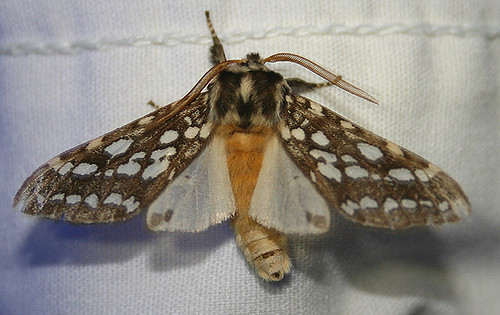
Silver-spotted Tiger Moth

Silver-spotted Tiger Moth

I’ve been birding since 2000, when, as a first year student in university, I decided I wanted a job in my field rather than a boring office job, and was offered an opportunity to work for the Toronto Zoo doing an “inventory” of their breeding bird community. This is not a long time, compared to many birders, particularly given my age. I came into birds late in life; most serious birders I’ve met have started either in their early-teens (13-14 seems to be the age something twigs for a lot of people), or as a young child. Myself, with the rural setting for my childhood, I was certainly aware of the birds, and knew all the common backyard stuff, but the birds that you have to go out to look for in order to see I didn’t get to know till that job at the zoo.

I have had the advantage of having spent a very large portion of the last five years out in the field, nearly every day. When you’re out there seven or eight hours every day you hone your identification skills rather quickly. Just about anything likely to be encountered on an average day at any time of year here in southern Ontario I would feel pretty comfortable identifying now, by sight or even just sound. Some of the less common birds of our region I could identify by sight but perhaps not sound, and I will be the first to admit that some groups (gulls, for example) I generally stink at – though mostly for lack of interest in learning (nothing against gulls, but they just don’t hold my attention for very long).

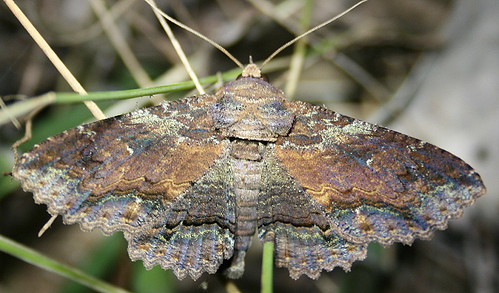
Lunate Zale

Lunate Zale

So what do you do when you’ve reached your desired level of proficiency with something? Well, you could try to hone it further (suppose I could buckle down and learn those gulls). You could try investigating deeper (learning to identify the different subspecies). You could travel to new areas (works best if you have money and time to travel). Or you could branch out into something different.

White Underwing, Catocala relicta

White Underwing

Lacking money and any real desire to get nit-picky with bird identification, I’ve opted for the latter. Even early I started learning butterfly identification (the obvious second choice to a birder – you’re standing there watching the birds with butterflies dancing about your feet anyway), as well as odonates (the dragonflies and damselflies). I got familiar enough with these groups to be able to identify all the common things. But for whatever reason, I never really got caught up in them the way I am with birds.

Pale Beauty Moth

Pale Beauty

Then, last summer, I traveled west, to British Columbia, for a job. The job didn’t work out quite as planned, and I spent three weeks staying with the organization’s gracious president, twiddling my thumbs and waiting for word on the situation. While there, I discovered he had a blacklight. And I thought, what the heck, let’s throw a sheet up and see what I get.

Violet Brocade Moth

Violet Brocade

Well, that hooked me. I don’t know what it was, specifically. Perhaps the amazing diversity and beauty of the moths that came in. Perhaps the mystery of these nocturnal creatures that makes them so hard to observe. Perhaps the fact that they’ll come to you, wherever you are, and you never know what you’re going to get. TheMothMan has well over 500 species of moths recorded for his little (and I do mean little) urban Toronto backyard. Perhaps it’s that moths are everywhere.

Ailanthus Webworm, Atteva punctella

Ailanthus Webworm

While I don’t think they’ll ever trump birds on my priority list, they may eventually run a close second… we shall see (I dislike making such bold predictions). So far, with the exception of those nights in British Columbia and one hosted by TTPBRS in early September, all my “mothing” has been done in the off-peak (for moths) late fall and, now, early spring periods. The moths are just starting to come out now, on the warmer nights, but these cool-weather moths are generally more drab. The flashy species are mostly found in the warmer months, and I’m rather looking forward to looking for them in the next few months.

Unidentified moth

Unidentified Eucosma sp.

Doesn’t matter where you live, attracting moths is pretty easy, and I almost guarantee productive (unlike trying to bird from your suburban backyard, where House Sparrows and starlings are your most likely guests). Any night where the temperature is warm (>10C/50F), hang a white sheet from a clothesline or against the side of your building, and set up a light in front of it. Although a regular white bulb will work okay, bulbs that emit rays in the UV spectrum, such as blacklights (cheap, less than $5 at Home Depot) or mercury vapour bulbs (considerably more expensive but brighter so will draw more in) will give you the best success, since the moths are attracted to the UV wavelengths. Make sure your white sheet is the sort that glows in the dark – some types of fabric don’t phosphoresce, which decreases its effectiveness.

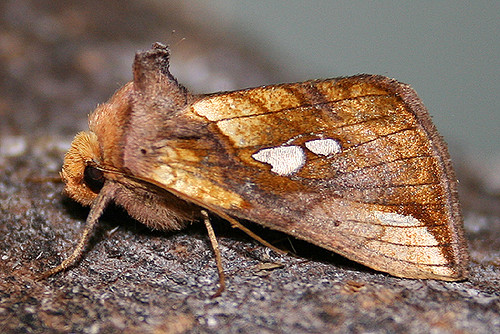
Lempke's Gold Spot Moth

Lempke’s Gold Spot

The above photos are all ones I took either in British Columbia, or at the TTPBRS moth night. They’re only a few of what I have, primarily of some of the brighter species. If you’re interested in seeing some of the rest of my extremely modest collection of moth photos (mostly from BC at the moment, and taken with flash; I’m refining my technique), visit my moth set on Flickr.