PFG to Moths contest winner

First off, thanks to everyone who sent in answers to the cover species and/or blogged and tweeted about the contest! I got a great response from folks, and I was pleased to see how well everyone did. Even considering the lack of a full printed field guide to live-image moths. ;) I went through everyone’s entries, put your names in a hat, and the winner of a signed copy of the new Peterson Field Guide to Moths of Northeastern North America is…

Jennifer Hansen!

Congratulations, Jennifer! I’m afraid you’ll still have to wait a little while before receiving your copy, but rest assured it’ll be coming. :)

For those of you who didn’t win but would still like a copy, don’t forget that you can now preorder the book from Amazon.com.

Here are the answers to the identifications:

3666 - Archips dissitana - Boldy-marked Archips
3666 – Archips dissitana – Boldy-marked Archips

9485 - Papaipema baptisiae - Indigo Stem Borer
93-2494 – 9485 – Papaipema baptisiae – Indigo Stem Borer

8641 - Drasteria grandirena - Figure-seven Moth
93-0915 – 8641 – Drasteria grandirena – Figure-seven Moth

5204 - Diaphanis hyalinata - Melonworm Moth
5204 – Diaphania hyalinata – Melonworm Moth

2401 - Atteva punctella - Ailanthus Webworm
2401 – Atteva aurea – Ailanthus Webworm

5058 - Pyrausta orphisalis - Orange-spotted Pyrausta
5058 – Pyrausta orphisalis – Orange-spotted Pyrausta

2589 - Podosesia syringae - Lilac Borer
2589 – Podosesia syringae – Lilac Borer

7033 - Nemoria lixaria - Red-bordered Emerald
7033 – Nemoria lixaria – Red-bordered Emerald

7859 - Eumorpha pandorus - Pandorus Sphinx
7859 – Eumorpha pandorus – Pandorus Sphinx

6105 - Cnaemidophorus rhododactyla - Rose Plume Moth
6105 – Cnaemidophorus rhododactyla – Rose Plume Moth

9314 - Alypia octomaculata - Eight-spotted Forester (side)
93-1979 – 9314 – Alypia octomaculata – Eight-spotted Forester

7922 - Pheosia rimosa - Black-rimmed Prominent
93-0012 – 7922 – Pheosia rimosa – Black-rimmed Prominent

1058 - Polix coloradella - The Skunk
1058 – Polix coloradella – The Skunk

10520 - Morrisonia evicta - Bicolored Woodgrain (light)
93-2802 – 10520 – Morrisonia evicta – Bicolored Woodgrain

7715 - Dryocampa rubicunda - Rosy Maple Moth (side)
7715 – Dryocampa rubicunda – Rosy Maple Moth

10670 - Feltia jaculifera - Dingy Cutworm Moth
93-3498 – 10670 – Feltia jaculifera – Dingy Cutworm

Brown Scoopwing and Reniform Helotropha

37-7653 - Calledapteryx dryopterata - Brown Scoopwing

First, thanks to everyone who’s sent me entries for the contest so far! It’s been great to see so many folks interested in moths (or at least interested in the book?). I’ve had a couple of people comment that they wanted to enter but didn’t have the time this week, so I thought I’d extend the deadline by a couple of days and give you guys the weekend to sort through the identifications. New deadline: midnight PST on Sunday, Aug 28. That’s 3am for EST readers. Winner will be announced on Monday. More details in the original post.

And on to other things. I had the guy above show up at my light a few nights ago. It’s a Brown Scoopwing, Calledapteryx dryopterata, Hodges #7653. The first time I saw one of these guys, the first year I was mothing, I was so excited to get it. Because, really, what a neat shape! I think even more than the bright colours, it was the weird shapes that I got really excited about early on (and still do, to an extent).

I’ve got this species at all of the houses I’ve lived since starting mothing, but for some reason I’ve always taken rather crappy photos. We actually had to solicit a photo for this species for the field guide because neither Dave nor I had one of sufficient quality. How could that have happened? It’s not even as though they’re particularly uncommon, either, such that we just never got the chance. They’re annual. In small numbers, yes, but still annual. So when I saw this guy at the light the other night I jarred him up so I could take a photo. Now I have one.

We’re pretty close to the north end of their range here. They’re not found up on the Shield, and we’re sort of at the edge of the Shield. Strangely, my annotated checklist for moths of Ontario says that the related species Gray Scoopwing is actually more common in the province. (Or perhaps “less uncommon” would be a better phrasing.) The Gray Scoopwing is found right up through the Boreal, too. And yet I’ve never seen a Gray Scoopwing, but I’ve seen Brown Scoopwing everywhere I’ve been. The Brown’s caterpillars feed on viburnam, while the Gray prefers honeysuckles. Lots of viburnum everywhere I’ve lived, so maybe I just haven’t had enough honeysuckle around.

93-2443 - 9453 - Helotropha reniformis - Reniform Helotropha

And this second moth was a new one for me; or at least, I don’t have a photo of the species labeled anywhere in my file folders, which are pretty complete, if not that well organized. (Thank goodness for file searches.) It’s a Reniform Helotropha, Helotropha reniformis, Hodges #9453, and #93-2443 under the new numbering scheme. It’s associated with sedges found in wet habitats, which is sort of funny because our current home has the least amount of wet habitat near the house of the three places I’ve done the most mothing. If I’d have expected this species to show up anywhere it would have been at the lake house, but even my parents’ old house had some large vernal ponds and a good-sized swamp within view of the house. But the moths, they do whatever they want to do. It’s not the first time I’ve been surprised, and won’t be the last.

Peterson moth guide update, and a contest!

We have a cover! AND a publication date!

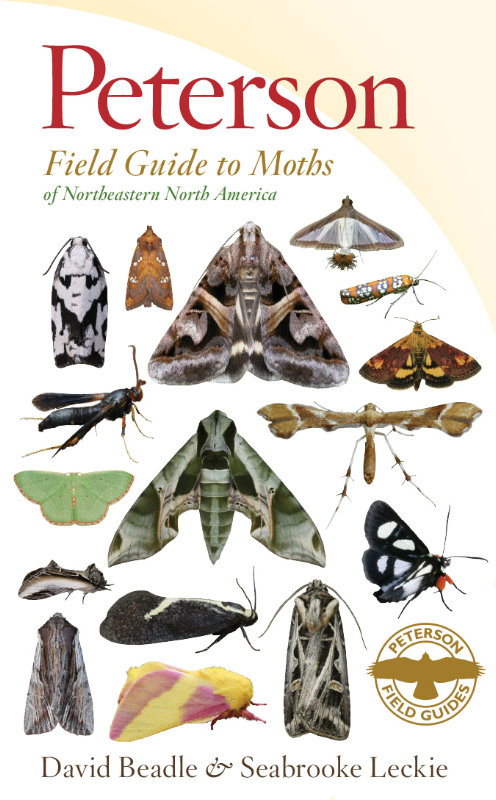
I’ve been away since last Friday, visiting my sister, and have been only minimally checking in with email. (Also the reason for the lack of posts; I did have my computer, but it’s harder to find the time to organize a post when away from home.) We received the official cover earlier this week, and I got the okay to share it with all of you – so here it is! The new cover of the Peterson Field Guide to Moths of Northeastern North America!

The Peterson field guide series is undergoing a small makeover, the most prominent difference being the covers of the guides. The bird guides have one of Roger Tory Peterson’s beautiful paintings on them, but the rest of the titles in the series will be a mosaic of an assortment of species from the guide plates. All of the images you see here are the actual images that will appear for those species on the identification pages of the guide.

Since I started this blog I’ve really wanted to run a contest – so here’s my very first one! Yay! Here’s what you have to do:

There are 16 species of moth on the cover. Tell me what they all are to be entered into a drawing – when the book comes out next spring, I’ll send the winner a free signed copy of the guide.

If you don’t know them all, you can send me a partial list. Common names are fine, but please include Hodges # and/or scientific name to make sure we’re both thinking of the same species. You’ll get one entry into the drawing for every 4 species you guess correctly. If you need an identification reference to look them up, this website can be very useful. If you need/want to see a larger version of the cover, click here.

If you share this contest on your own blog and/or Twitter and send me the link where I can see and verify it, I’ll put your name in the drawing once (or once more, if you also guessed the species). Send me your list of species (and/or blog/Twitter link, if applicable) by next Thursday, August 25, using my Contact Me form. I’ll contact and post the winner next Friday. The book won’t be mailed till next spring, of course. ;)

Which brings me to the second half of the announcement. The publication date for the moth guide has been officially set for April 3, 2012!

A few online retailers already have pages up for the guide. If you’re the sort to like to take care of these things early so you don’t forget, you can now pre-order your copy from Amazon.com (other sites have pages but no pre-order option).

Primrose Moth

Primrose Moth, Schinia florida

I’ve taken up jogging recently, much to my surprise. I never pegged myself as a jogger. The primary reason, aside from a lack of desire to do anything that so obviously resembled exercise, was that I was unlikely to be able to stick to the pace: I’d be inclined to stop and check things out and I’d do a whole lot more peering than jogging. I like to run, like the feeling of my blood pumping and the wind rushing past my face, but I’m not in shape to run very far (not to mention that whole stopping to look at stuff thing) so I’d usually just do our first field, a couple hundred meters, and then resume my walk.

But then I discovered audiobooks and suddenly I’m yearning to go exercise, if only so I can find out what happens next in the story. (I’m also wishing dinner took longer to prepare and I had more dishes to wash…) It’s my trade-off – if I go do this boring thing I wouldn’t ordinarily like to do, I am rewarded with story. So I’ve started jogging, to try to get myself in slightly better shape than my leisurely hiking keeps me. We have the rail trail at the foot of the property, and I take the dogs down there, jog some distance down it and come back.

At the farthest point of my loop there are quite a number of Evening Primrose (Oenothera biennis) plants growing at the trailside. A few days ago I noticed as I passed one that there were a couple of pink moths with their heads tucked into the yellow blossoms. Primrose Moths! I’ve been checking primroses for the last few years, but have never turned up any of these pretty little moths (the only individual of the species I’d encountered had come to my blacklight). I’ve also never had such a large patch of primroses to check before. Naturally, I didn’t have a camera with me – I was jogging, after all, and the last thing I needed was a camera thumping against my side.

Primrose Moth, Schinia florida

I figured they’d be long gone the next day when I came back that way, so once again I didn’t bring my camera. The two I’d seen were gone, yes, but I discovered another on a flower in a different spot. So yesterday when I went out I grabbed my little point-and-shoot, which virtually never gets used except in unusual circumstances like this, shoved it in the back pocket of my shorts and hoped there’d be one there.

I wasn’t disappointed, though it was close to the end of my sweep and I was worried I might not turn any up, now that I had the camera with me. (Animals are typically quite camera-shy, you know. They usually only appear when they know you’re not carrying one, or you have the wrong lens.) I found a single individual, head deep in one of the yellow blooms. I still haven’t quite figured out macro mode on the point-and-shoot, but I ran off a bunch and a few of them turned out alright.

Primrose Moths (Schinia florida) seem to be widespread, occurring from the Rockies east, but uncommon or locally common. Their host plants are evening primrose, but rather than eat the leaves the caterpillars target the flower buds. The adults are usually found tucked into the flowers during the daytime, though they’ll sometimes come to light at night, too. I thought they just rested in the flower, but when I looked closely at this one I could see it had its proboscis extended down into the flower, so I assume it was actually sipping nectar.

Incidentally, the primroses are night-bloomers, with their flowers starting to close up by the heat of mid-day, something I hadn’t realized prior to now. This would explain why sometimes when I went out I didn’t see many fully-open flowers (and the moths were all on flowers that were fully-open). So note to self (and others): look for Primrose Moths mid-morning, when the day is warming up but the flowers aren’t yet closed.

Canadian Sphinx

49-7807 - Sphinx canadensis - Canadian Sphinx

We have quite a bit of phlox growing in our garden here; at least five patches that I can call to mind without benefit of actually walking through the garden. All shades: white and purple and pink. They’re pretty flowers, especially in large clumps, even if they are prone to fungal rusts. They’re also very appealing to sphinx moths.

Most of what we observe at the phlox are the diurnal Hummingbird Clearwings, Hemaris thysbe. These guys are regularly seen in the garden visiting the phlox, the blazing-star, the beebalm. I see them about in the afternoon and sometimes just at dusk.

And then, every now and then, we spot something different visiting the patch of phlox beside the front door, right as dusk is falling. Dan called my attention to this one this evening. This was a new species for the phlox: a Canadian Sphinx, Sphinx canadensis. In fact, I think it may even be new for me; I have no images of the species among my photo records (I lied and told Dan I did, when he asked if I’d seen it before, thinking that I’d got it at my parents’ old house years ago, but when I went back and checked my records it turned out I’d been thinking of something else).

It seems to be an uncommon to rare species but one with a fairly wide range through the northeast. The caterpillars feed on the rather disparate species White Ash and blueberry spp. We don’t have blueberry here, but there’s lots of ash about (and I guess at least some of it, therefore, must be White).