Hologram Moth

93-1179 - 8897 - Diachrysia balluca - Hologram Moth

A few nights ago I got this fabulous moth to my mercury vapour light. This is the appropriately-named Hologram Moth, Diachrysia balluca. The large patch on its back is iridescent, shining green to bronze, depending on the angle of the light. Hints of this colour can be seen elsewhere on the wing as well, set into a lavender-gray base. And in case that wasn’t enough colour, it’s got this wonderful orange head.

This species ranks among my favourite moths, and yet this is only the second individual I’ve ever seen. The first was one I caught in 2008 at my parents’ old house in the Toronto area. It’s somewhat odd that I haven’t encountered it much, really. It has a fairly large range and is found throughout Ontario; and its foodplants aren’t particularly uncommon as it includes Trembling Aspen and Rubus spp. among its preferences. And yet in three summers of mothing here I hadn’t caught it till now. Where’s it been? Who knows. That’s one of the things I love about mothing: you never know what’ll turn up.

———

An aside. As anyone who keeps their own blog will know, blogging is a time-consuming activity. A single post can run from an hour to three, depending on its length and how much research you do; mine in the past have averaged on the longer side of that range. I’ve struggled to keep posting the last few months, though not for lack of content; simply for lack of time and energy. I keep meaning to improve, and keep failing. So I’ve had to seriously consider how I want to handle the future of the blog. One option would be to discontinue posting… but I don’t think I’m ready for that yet, even after three and a half years of blogging. I’m still taking photos, I still want to share them. The issue is I don’t want to spend two hours writing up a post (even though I want to share all that info! All those photos!). So the solution I’ve come to, after a serious heart-to-heart with myself, is simply to make the posts shorter. One or two photos, a couple hundred words. The blog won’t be quite the same as it was for the first few years, but it won’t be defunct, either. Life is all about compromises.

———

An additional note to thank whomever it was that nominated my blog for the Canadian Weblog Awards. I got an email the other day notifying me of my blog’s nomination in the categories of Best Written and Nature. I don’t expect to actually win, but it’s flattering to be nominated!

Nominations are open through October, so if you know a Canadian blog you think should be nominated (whether or not you’re Canadian yourself), you should pop over and do so.

Sunday Snapshot – Frontenac Biothon highlight

93-0559 - 8490 - Pangrapta decoralis - Decorated Owlet

This weekend I was down in Frontenac Provincial Park participating in the Frontenac Biothon, a fundraiser for Frontenac Bird Studies, Dan’s bird research and monitoring project. The weather, which had been forecasted to be rainy all weekend, actually turned out pretty good, and despite a few hiccups (what event ever has no hiccups?) I think everyone had a good time.

Although we all kept track of species from all taxonomic groups, we each focused on different areas according to our “expertise” (which I put in quotes because while we’re all experts on birds, none of us have comparable experience in any other group, really, except perhaps for moths in my case). I focused on plants and insects. My personal final species tally across all taxonomic groups probably stands somewhere around 350 species, but I’ll have to go through my lists to tally everything up.

I saw many interesting things over the weekend, but the above moth was most definitely the highlight for me. I saw at least a dozen different types of moths moving about the low vegetation during the day, and this individual was one of the ones I flushed up at the forest edge. It wasn’t till it settled that I realized what it was: a Decorated Owlet, Pangrapta decoralis, Hodges #8490.

It was a lifer for me. It’s found throughout the northeast but I get the impression that it’s somewhat uncommon, or perhaps locally common, as this is the first time I’ve encountered the species and also we had to solicit an image for the field guide for it because neither Dave nor I had one ourselves. The caterpillars feed on blueberry, something that doesn’t grow around our house here and wasn’t really common in the area where we lived at the lake house, either. I wish I’d got a better photo, but unfortunately I’d only brought my all-purpose landscape lens, and it was rather flighty anyway (so lacking a fridge there was only so much I could do). Still, better a poor photo than none at all!

More on the biothon to follow…

Toadflax Brocade

Calophasia lunula - Toadflax Brocade - Hodges#10177

Goodness, is it really that late already? Just a quickie this evening, then. Still working on computer issues…

I discovered this guy on the weekend while browsing my garden. The lilac is one that I dug from the house I grew up in, before my parents moved out a couple of years ago. It didn’t put out any blossoms that spring, probably just trying to recover from suddenly finding itself independent, its sucker root back to the main plant now severed. It settled in well to its new location, and last year it put out half a dozen blooms. This year it’s feeling even better, with double that number. I almost feel bad that in a year or two it’s going to be dug up and moved again, just when it’s really getting comfortable; but Dan and I hope to buy our own place in the next few years, and my garden plants, including this childhood lilac, will be coming with me.

So I was peering closely at the blossoms, both to admire them and to inhale that beautiful lilac scent, when I noticed this moth hidden among the flowers. This is a Toadflax Brocade, Calophasia lunula. I haven’t seen one yet this year, so it was a pleasant surprise. They’re easily recognizable by their small size and tented shape, and the small white crescent set in the buffy wing. They’re not a native species to here. They were first introduced in 1962 in Belleville, Ontario, which is not that far from here. Several subsequent releases through the 60s and onward have established their populations across much of the continent. They were brought over with the intention of acting as a biocontrol for Yellow Toadflax aka Butter-and-eggs, that ubiquitous roadside wildflower which is also non-native. Studies have shown that the caterpillars will defoliate about 20% of plants, but that’s not really enough to do much for population control. Ah well. They tried.

PFG to Moths, status update

And, I suppose, an update on me. I’m still here! And just fine, though I’ve been really busy the last few weeks. I’ve been working five days a week at Innis Point Bird Observatory since the end of April, which amounts to the same number of hours as if I were working a typical 9-to-5, except I’m getting up before 3:30am every morning to do it and then I spend seven hours largely on my feet. Needless to say, by the time I get home I don’t have a lot of energy for things, and what energy I do have has to be judiciously distributed among my main priorities. Lately one of said priorities has been the moth guide; since I know all of you are eagerly looking forward to getting your hands on a copy the moment it’s available, David and I have been working the last couple of weeks for its prompt return to the publisher to ensure no delays in its publication.

I’ve found being involved behind-the-scenes on this project incredibly enlightening as to what goes on in the production of all those volumes resting on my bookshelves. I’m not sure I’d ever really given much thought to how they came to be, or if I did it was simply along the lines of author writes book, publisher publishes book. But there many more steps, and a lot more people involved, than that. The author(s) writes the book, sure, and submits it to their editor. But their involvement doesn’t end with the manuscript’s submission. The editor goes over the whole thing and sends it back for correction/revision. Then a copyeditor goes over the entire book again. That’s the stage we’re currently at.

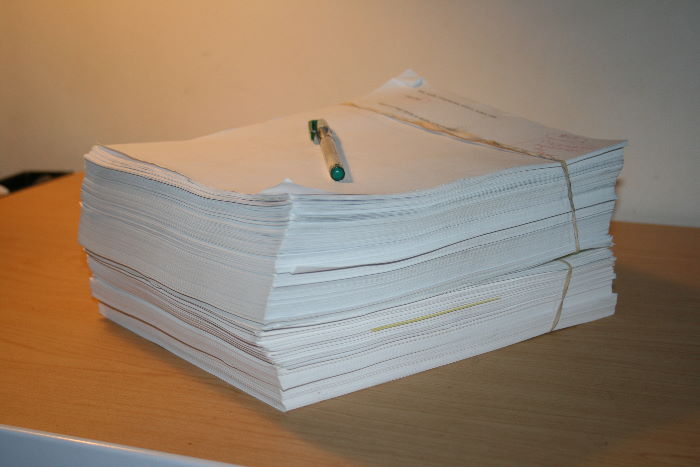
The copyeditor is a godsend. Their job is to make sure the author doesn’t look like an idiot. They go through the manuscript with a metaphorical fine-toothed comb, cross-checking the details to make sure no mistakes or dumb goofs have slipped in. And believe me, when you’re working with something of this complexity, mistakes will slip in. It may be something as simple as forgetting to write in the host plants for one species. It may be misspelling the name in one spot. Realizing you left out an oft-used technical term from the glossary. Omitting the male/female plate labels for a species. Inconsistencies in vocabulary, calling the tree a tamarack in this account but eastern larch in this other; or calling a species a leafroller here but a leaffolder there. (Works of fiction also have copyeditors, incidentally; they’re looking for inconsistencies in plot or scene or other loose threads.) I must admit, I had gone through the manuscript before submitting it last fall, so I was a little dismayed be the red pencil all over it when the 4.5 inch stack of paper was returned to me. Dismayed, but very grateful.
I thought it might take me six or eight hours to work through all the corrections, and figured I could get it done in one full Saturday of work. But, as it seems I do at every stage so far, I severely underestimated how long it would take. (I honestly have a whole new respect for the authors of the field guides on my shelves. It might not be complicated, but it’s a helluva lot of work.) Some 30 hours later I finally bundled up the last of the papers into the box they were sent in and took them back to the post office. Needless to say, this has taken up most of my spare waking hours for the last couple of weeks, and I didn’t have many to spare to begin with.

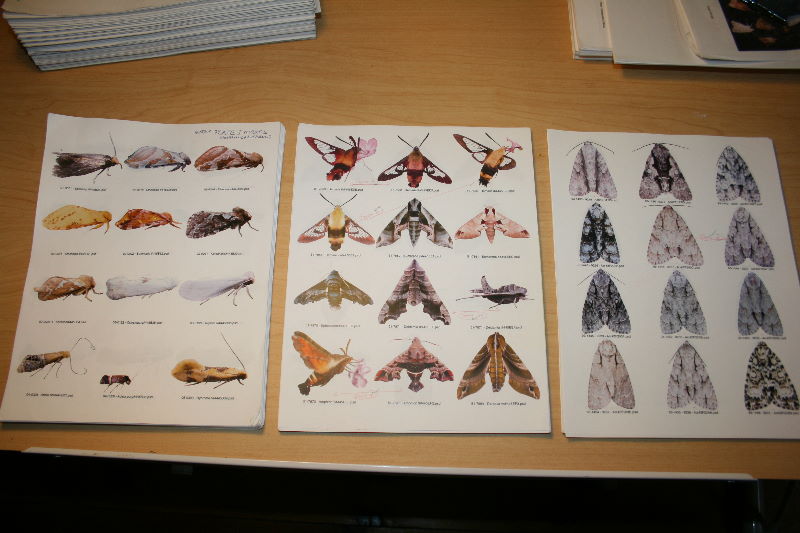
Still, it was pretty neat to see the book moving forward. The part that really made it seem real to me, like it was actually going to become a bunch of pages bound inside a cover, were the images for the plates. All laid out together in rows, the moths clipped out and on a white background, it was already starting to feel like a guide. Once the publisher receives my box next week the materials go on to composition. Some poor person will spend the next several weeks taking all of our bits and pieces from their many sources and bringing them together in one spot, for species after species. We’ll have an opportunity to look over the first couple that get done, to ensure that it all looks correct before the compositor does four hundred of them. Then once the compositor is done, we’ll have another round of proofing, this time going over the laid-out plates. It’ll really be starting to look like a book then.
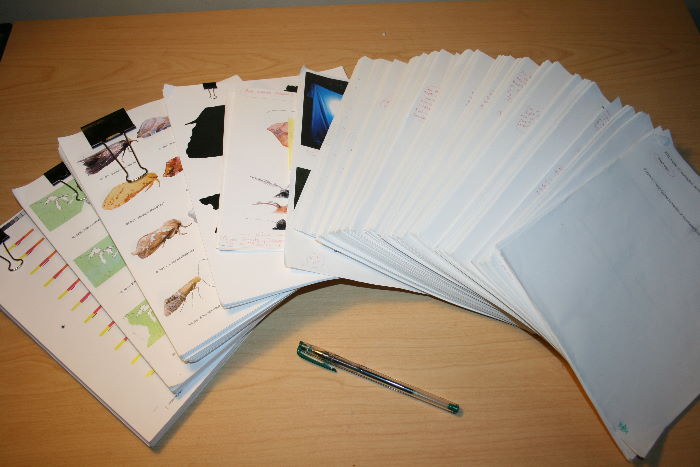
Here are all the different components of the book, sent to us for our review of the copyeditor’s mark-up. From left to right: the graphics illustrating the flight period for each species, the range maps for each species, the plate images, the endplate (inside-cover) silhouettes, the terminology diagrams for the introduction and the endplates, the photos for the introduction, and then the full manuscript, including the intro and end materials and the species accounts themselves. Each species has components in five spots (flight period, map, image, species account, checklist entry) and trying to keep track of everything can get a little confusing!

Now that that’s been mailed back, I’m hoping to get myself back into the habit of posting every two or three days here. I’ve got a huge backlog of photos that need clearing out, and now that summer’s arrived there’ll be more coming in every time I go out hiking. The posts might be a little shorter, but shorter is better than not at all. ;)
