
Moth-hunting

Canoe Lake

!!!!! I prepared this last Friday (the 22nd), and thought I had posted it then. I just now noticed that WordPress didn’t publish it (or I forgot to hit the button?). Ordinarily I double-check to make sure it appears okay, too.

In the meantime, I’ve recently started a short-term job working as the bander-in-charge at Innis Point Bird Observatory – a post I also held last spring. I’m up at 3:45am (and getting earlier each week) so despite that I’m home by early afternoon I’m actually shorter on time. I’ll try to post regularly, as I can. Now, if only spring would hurry up and start happening instead of this dreary trickle we’ve been subjected to this year.

My image-editing program broke this week. If there’s one thing that inconveniences a photographer more than a broken camera, it’s broken editing software. I’m not quite sure what went wrong, but it required a full re-install, which meant digging out the installation files, uninstalling the previous copy, re-installing the program again, and then organizing all my internal settings again (I like my software to be just so). I’ve been putting it off because it’s a pain, but I finally got around to it this evening because I have some photos, taken today, that I’m looking forward to sharing.

I’ve been planning for a little while to make a trip back to the area where we used to live, near the lake house, to look for Infants, those early-spring day-flying moths. Although I could, in theory, find the species just about anywhere where the host species grows, they were just so abundant along the road near the lake house. But not only that; there was also that rare one that I found there, and I was keen to see if I could locate it again. I had intended to make a trip down last spring, but between one thing and another I never made it. I resolved I would definitely go this year.

Birches along Canoe Lake Road

And then this spring turned out to be cold. Cold and rainy, and slow, slow, slow in coming. We’re lagging about two weeks behind where we’ve been at this date the last couple of years. Our wildflowers are only just beginning to bloom. Insects have yet to emerge in any numbers. Migrant birds are running behind schedule. And we’ve only had a couple of those absolutely gorgeous days that one looks forward to at the start of spring. I’d been waiting to make my trip down to Frontenac, first for nature to get a move on, and then for a good day weather-wise to go. I was looking for something in the high teens Celcius (sixties Fahrenheit), sunny, and preferably not too windy. I waited… and waited, and waited.

Finally, today, I bit the bullet. It was a mild day, if not really warm, it was sunny, and the wind was light enough that in the shelter of the forest it wouldn’t be a problem. Given that on Sunday I’m beginning work running the bird banding (migration monitoring) program up in Ottawa, I was out of chances to get this trip in. So today it was.
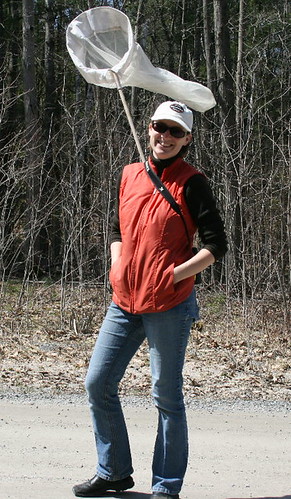
Moth-hunter

Since I had a particular goal in mind I wanted to be prepared in case I should actually find my target species. I brought my camera, of course, but two lenses: the wide-angle for landscape shots and my macro for insects and flowers (I also had the telephoto, but after a bit of debate decided to leave it in the car). I brought my binoculars, for (hopefully) checking out any fluttery insects from a distance to decide if they needed to be snuck up upon. Also for looking at birds. I brought my bug net, just on the off chance that the moth wasn’t being cooperative and settling on the road for a photo; I could scoop it out of the air if it came down to it. I brought moth jars, and stuffed three of them in my back pocket to have close on hand. And I brought a cooler containing ice packs (which I left in the car), so that when I snagged the uncooperative moth and put it in a jar I could then put it in with the ice packs to cool down (hopefully) for a photo.

I walked about 5 km (3 mi) along the roads from where I parked my car, checking out the spots where the moths had been most frequently encountered a couple of springs ago. I saw quite a few other things, but lepidoptera were not in great abundance, and I didn’t find any of the moths at all. I’d gone with the expectation that I probably wouldn’t find the rare species, but I didn’t even see a single individual of the common one. Was I too late in the season? Was it too cool out? Too windy? Too much road traffic? (Being Good Friday, I had probably fifteen cars pass me in the two hours I was out there, which is pretty busy for that area, at least compared to what it was when we lived there.) Maybe it was simply that I jinxed myself by being over-prepared.

Round-lobed Hepatica

I was a little disappointed to not find any at all, but it was still a really nice outing. I spent two hours outdoors enjoying the sunshine and checking out flora and fauna. One of the first things I noticed was that the hepaticas were all out in full bloom. We don’t have hepatica up at our current house, but none of our other wildflowers are blooming yet, so this was a pretty nice surprise. Various shades of purples and pinks and whites, little patches of colour dotting the forest floor.

Coltsfoot

Also blooming was coltsfoot. Some patches of it can be quite large. It seems to like damp or poorly-drained areas (but not wet), and also favours disturbed habitats; I find it most often in the ditches along road edges where the ground gets a bit soggy. It’s an interesting plant in that the flowers come up before the leaves do.

Bloodroot

I saw two individual blooms of bloodroot. The landlord has some planted in our garden, right near the foundation of the house, and they’ve been up and blooming for about a week now, but I haven’t seen any yet growing wild in our woods. These are one of my favourite wildflowers, so I was pleased to discover a couple.

Male Wood Duck

As I was heading back to the car, having turned up nothing, I paused to listen to a funny bird call. I didn’t immediately place it, but it was easy to spot the caller, perched up in a tree: a Wood Duck! I can never quite get used to seeing a duck perched in a tree, despite knowing that Wood Ducks come by their name honestly. Both the male and female were perched there, though I didn’t immediately see the female and she wasn’t visible in the photo I took. Presumably they were scouting for a nest cavity. Wood Ducks will nest up to 2 km (1.2 mi) from water if cavities are hard to find; these guys weren’t nearly that far, only a few hundred meters.

Morrison's Sallow

While I was standing still, watching the ducks, I noticed (and was noticed by) a moth. It flew back and forth and up and down the section of road a few times, but when it came close to me it seemed to be attracted to something. I thought at first it was maybe the white bug net, or my white hat, or perhaps the orange vest. It landed on me a few times (once even on my sunglasses!) but when I went to peer at it, or even when I flipped the on switch of my camera, it took off again. It seemed disinclined to settle on the road for some reason, but I stayed patient with it, hoping it might put down somewhere. Well, it did – on my camera lens! It started dabbing with its proboscis, obviously picking up the salts from my palm (I wasn’t sweating, so there couldn’t have been much). I was able to coax it off the lens and onto my palm, where it started walking about and then up my arm. It finally stopped at the edge of my shirt (which was pushed up to my elbow; not the most convenient for photos, macro lens notwithstanding).

Check out the little hairs on its proboscis; I presume these are used to trap nectar when it’s drinking.

Morrison's Sallow

After taking a few shots, I touched it gently to try to get it to move back to another position, but instead it let go of my arm, folded its wings and dropped to the ground. This is a defense mechanism used by many species when disturbed: a fast and inconspicuous way to escape from a potential predator.

Once it was on the ground I could finally get a good look at it to identify it: it’s a Morrison’s Sallow, a relatively common species at this time of year. But since the Infants were a no-show, I’d take what I could get. :)

Pseudexentera sp. or related

This was the only other moth I found. There were a couple of these, and I haven’t bothered identifying it to species, as moths in this group can be tricky. However, it looks like a Pseudexentera sp., or something closely related. Little micromoths often encountered out during the day.

Spring Azure

I saw only two butterflies; one was what looked to be a Compton’s Tortoiseshell, fluttering in the tree canopy, and the other was this little guy, a species of blue. I always have to double-check my blues when I get home to be sure, but it turned out I correctly guessed on the ID of this one: a Spring Azure (Celastrina ladon), one of the first blues to be seen. Or, it could be the very closely related Lucia Azure (C. lucia), which the Kaufman butterfly guide notes, “The ‘spring azure’ in the northeast may actually be C. lucia“, though beyond this no notes are offered for specificity or overlap in range.

So all in all, a good outing, even without the Infants. Perhaps next year!

A few more moths

Three-spotted Sallow, Eupsilia tristigmata

It’s been a slow start to the spring. The weather has been cold, cold, cold, rain, rain, and a little bit of snow thrown in there for good measure. Even our sunny days have mostly been cool. We’ve only had a couple of days where I’ve been inclined to go out without a jacket. Fortunately when Dan’s dad was up to visit last week the afternoon happened to be one of our gorgeous days, and we managed to get the gardens all cleared up, between the three of us. I haven’t really had another opportunity since then.

Where I’ve noticed this cold weather most has been in the moths. There just haven’t been any, really. The first moth this year (first macromoth, that is) was really late compared to the last two years (March 17 this year, versus March 8 and 6 in the previous two, respectively). And I didn’t see another macromoth until last night – which, for the record, is now April.

To put this in perspective, by this time (April 5) in 2009 (the only spring where I actually kept count for the first couple months), I had tallied nearly three hundred individuals. This year I have eight macros and perhaps half a dozen micros.

So forgive me if I get a little excited over my handful of moths.

The leading species here is a Three-spotted Sallow, Eupsilia tristigmata. It’s yet another of those early-season Eupsilia species, two of which I’ve already recorded for this year (Morrison’s and Straight-toothed). In fact, I got another Straight-toothed last night, as well, but didn’t feel the need to photograph it. Three-spotted seems to be more common here at this house than it did at the lake house – I got hardly any there, but I catch them regularly here. They look somewhat the same, but the large, dark spot beside the orbicular spot is diagnostic of this species (the Straight-toothed, recall, has the large spot flanked by two tiny white ones).

Aurora Semioscopis, Semioscopis aurorella

The other three moths I have are from the night before. This first one is a semioscopis, the first one I’ve seen this year. The semioscopises (semioscopi?) are gray with longer, somewhat teardrop-shaped wings, and are another of the early-season groups, often one of the first I encounter at the start of the season. This one’s an Aurora Semioscopis, Semioscopis aurorella.

Hasty Acleris, Acleris hastiana

The last two are both the same species, showing slightly different markings: Hasty Acleris, Acleris hastiana. The aclerises are a huge group, many of them confusingly patterned, and can be encountered all year, but a few members of the genus, including this one, overwinter as adults and as such are often one of the first moths encountered in spring.

Their cold-hardiness makes them irritatingly difficult to photograph, however, because your fridge is a rather balmy 4°C, and there’s a good chance you caught them fluttering at the light after the temperature had already dropped to 2°C. The fridge is not going to put them into any serious state of torpor. Even putting them in the freezer, which usually knocks a macromoth into torpor within a couple of minutes, does little for these micromoths. I tend not to get many good photos of them as a result…

I’m ready for the mothing season to begin in earnest any time now. I’d been planning a trip down to the area of our old lake house, where I’d encountered all the Infants (Archiearis infans and Leucobrephos brephoides); that spring they were out and flying by last week of March, but I’m still waiting for appropriate weather this year. Soon, I hope!

Hasty Acleris, Acleris hastiana

Silkmoth cocoons

Promethea Moth cocoon

First, apologies to all you folks who subscribe to the blog who may have been pinged with two nonsense posts over the weekend. I was doing some work with the site, having finally decided to bite the bullet and roll my personal website into the account I already had set up for my blog here at WordPress.com. Since the top banner now reads my name, rather than The Marvelous in Nature, I had to insert a static header for The MiN on the blog page. As reader Dave smartly deduced and commented, I did this by using a sticky post – not realizing it would go out on the RSS feed! Fortunately, I think I’m done fiddling (for now). Swing by the website to see the new look, if you haven’t already.

On to other things… I thought I should post about these before they get to be really old news. A few weeks ago, on a relatively mild day for mid-February, I’d taken Raven down the road for her walk. I don’t normally go out along the road, since we’ve got plenty of acreage to wander which has the benefit of being somewhere that Raven can be off-lead. But the temperature that day was above freezing, which made the snow wet and heavy such that it would clump in my snowshoes if I tried to use them. And yet, it was still too deep to be able to hike without the snowshoes. So I went down the road.

As I was walking back, my eyes scanning the bare tree branches along the edge of the wood, I saw something attached to one of the tree’s branches. It looked like a dried leaf. Which isn’t actually all that unusual, because trees do sometimes retain a leaf here or there, or one of them gets caught on a twig in the fall. But something about this particular one looked different, almost out of place. So I braved the roadside snowdrifts to go investigate.

Promethea Moth cocoon

Which turned out to be completely worthwhile. The dead leaf resolved itself, as I got closer, to be a cocoon. It was about two inches long, thick and heavy. On a whim I decided I’d bring it home, and hopefully when the moth inside emerged I’d be able to see who its maker was. I had a pretty good idea that it would be a silkmoth of some sort, just by the size of it. Not many other moths would make a cocoon that large.

I pulled out my copy of Tracks & Sign of Insects after I got back to the house. There’s a pretty good section on cocoons, and given the size and visibility of silkmoth cocoons, they are reasonably well-covered in the book. I expected I’d probably find my cocoon in there, and sure enough, there it was: on page 224, a photo of a cocoon that was almost an exact match. I read through the text to be sure, but it seems that there’s only one moth that makes a cocoon like this.

Which is the Promethea Moth, Callosamia promethea. The caterpillars of this species roll themselves in a leaf to pupate, but before they do they secure the petiole (stem) of the leaf to the branch it’s growing from with a copious amount of silk thread. This binding prevents the leaf from dropping from the branch in the fall. The only other species that make narrow, tapered cocoons out of leaves like this either don’t occur in my area, or don’t bind the leaf to the branch so that it drops in the autumn and spends the winter among the leaf litter.

Promethea Moth cocoon

I spent the rest of the walk back scanning the trees, but didn’t spot anything else until I’d nearly reached our driveway. By that point I’d stopped looking closely at the branches, and it was almost by chance that I happened to spot a second cocoon hanging from a branch about 18 feet high, just to one side of our driveway. It was the same type, and I returned to the house to get a long-handled hook with which to pull down the branch. Both cocoons are now on our screen porch, waiting for warm weather. Promethea Moths generally emerge in late spring, so it may not be till June that they come out. I’ll definitely be posting a follow-up once they do, though! Surprisingly, I’ve never seen this species before, so it’ll be a new observation for me.

The start of the mothing season

93-2591 - 9936 - Eupsilia morrisoni - Morrison's Sallow

Yesterday was beautiful, with gorgeous clear skies during the first half of the day and lovely mild temperatures. It was the first such day we’ve had this year. I took the dogs out for a walk around the property, my coat tied about my waist and my sleeves rolled up my wrists. It was that nice out. If I didn’t have things I needed to take care of back at the house, I could’ve spent the afternoon sitting out in the sun, soaking it in.

The first warm, sunny day usually brings out the insects, too. There wasn’t too much happening out in the fields yet – a few spiders, some flies – but I had a pretty good feeling that I might get a moth or two to the lights. I wasn’t disappointed. When Dan went out to check, early in the evening, there was already one there. By the time I’d located my moth jars and stepped out myself, another had joined it.

Officially, the first one to arrive is the guy up top: a Morrison’s Sallow, Eupsilia morrisoni. So, he gets recorded as the first moth of the year! Interestingly, it was the same species as I got as my first-of-season two years ago, in 2009.

93-2581 - 9915 - Lithophane grotei - Grote's Pinion

The one that came in to join him was different: Grote’s Pinion, Lithophane grotei, another late-fall/early-spring species that overwinters as an adult. It’s possibly the most common species of pinion I get here.

93-2587 - 9933 - Eupsilia vinulenta - Straight-toothed Sallow

When I came down to check the light again a bit later, more moths had arrived! Four more, in fact, came in before I went to bed. All four of these latter moths were Straight-toothed Sallows, Eupsilia vinulenta, which, like the previous species, overwinter as adults and come out at the first sign of warm weather. The Straight-toothed has two colour morphs: one with a white spot, and the other with an orange spot. I got two of each. I didn’t bother jarring the last white one, though, so only took photos of three of them.

Considering I’d been crossing my fingers to get even one macro species, I was pretty stoked with this haul! Well overdue, in my mind – the last two years have seen the first moth of the season on March 6th and 8th respectively. The winter cold was very persistent this year.

I feel I can officially recognize the start of spring now!

First moth!

First micro of spring! - Acleris sp.

Look what showed up at the porch light yesterday! I was taking the puppy out for perhaps the third time since dinner when I spotted this guy hanging on the outside of the storm door. Heaven only knows what it was thinking being out yesterday. While the day was, admittedly, warmer than today was, it still only barely cracked freezing at the afternoon high. By the time I found it clinging to the door it was -3ºC (26ºF) and no moth in its right mind ought to be out at that temperature.

Not having been expecting to see any moths for at least another week, and my mothing equipment therefore still all tucked away in the basement, I had to dig through the kitchen catch-all bin (that drawer that every house has that seems to accumulate all the odds and ends) to find a moth jar that had got tossed in there sometime last year. I carefully knocked the moth into it and stuck it in the fridge, which was several degrees warmer than outside, but still sufficiently cool that the moth would remain in torpor.

First micro of spring! - Acleris sp.

This guy’s just a little micromoth, not much bigger than your pinkie nail. It would be extremely unusual (never say never, but pretty close to) to see a macromoth out at those temperatures, but micros can hack it in part because of their small size. These little moths are long and thin, with a very high surface area:volume ratio. This means they can absorb any ambient heat more quickly, and require less of it, than the more chunky species. Sunshine warming their hiding place on a wind-less, mild day, even if it’s not substantially above freezing, may be enough to bring the moth out of torpor. (And room temperature is enough to bring a fridge-torpid micro to life within a few seconds – gotta be quick with the camera!)

They also just seem to be a lot more cold-tolerant, continuing to be active well below temperatures that would put a larger moth to sleep. Almost invariably I see micromoths at the porch lights a few nights before the macromoths show up. Still, a February date is a record early for me. Despite a warm couple of days at the end of last week that melted a fair bit of our snow, winter still has us in its grip. And if you’re the sort of person to believe the weather forecast, we’re not likely to see the sort of weather that brings out the moths for at least the next couple of weeks.

I took a couple of photos of this guy hoping to put an ID on him, but micros are tricky. I believe this is a member of the genus Acleris, based on shape, but after browsing MPG and BugGuide, I’ve drawn a blank for a particular species.So many of the species are incredibly variable, and others lack any substantial identifying markings. And some are similar enough or cryptic enough to require examination of the genitalia (under a microscope, using a dead moth since the live ones aren’t likely to cooperate and it requires dissection anyway) in order to determine a definitive ID. I thought those white patches of scales within tan-ish streaks might prove useful, but I didn’t see any good matches.

So it goes down as Acleris sp. for now. On the other hand, I’m not too fussy about it. As much as the micro gets me excited, the real first moth of spring will be counted when the first macro turns up at the light. ;) Meanwhile, this guy is still living in my fridge, since the temperature outside is still well below freezing, and at least my fridge is not. I might get a chance to put him back out on Monday.