Broccoli lovers

Broccoli flowers

We were treated to a surprisingly mild day today – around 20°C (68°F), which is beautiful for this time of year. It would have been nicer if it were sunny rather than overcast, but in late October in Ontario you really can’t be picky. I took Raven for a walk (despite that we stayed on our 30 acres, I wore my orange vest just to be on the safe side as I’d heard gunshots from the neighbour’s property earlier in the afternoon) and then bedded down the strawberries before returning indoors.

I never got around to harvesting the last of the broccoli this season. It was my first year growing broccoli, and I kept waiting for it to get a bit bigger, but before it got bigger it would undergo a growth spurt and start flowering. I got a few heads, but the last couple I missed. When they started flowering I decided just to leave them; maybe I could get some seeds off them when they were done.

I noticed, while I was in the garden tending the strawberries, that the plants are still flowering merrily away. Aside from the odd clover here and the stray aster there, they’re pretty much the only thing in the landscape that still is. This fact hasn’t gone unnoticed. The warm weather this afternoon had some late-season pollinators out looking for flowers to forage on, and they’d all converged on this small patch of yellow blossoms. I’d left my camera up at the house while I took the straw down to the garden, and couldn’t resist going back for it to document some of what was crawling over the plants.

Red-belted Bumble Bee at broccoli flower

There were three bumblebees (three!) visiting the broccoli flowers. At first I thought this one was Tricolored Bumble Bee (Bombus ternarius), by default due to the orange, though there are actually a few species that sport the orange bands on the abdomen. The most common in the east is Tricolored, but we also have B. sylvicola (no common name) and Red-belted Bumble Bee (B. rufocinctus).

I spent a while puzzling over the photos on BugGuide.net, trying to decide what the differences were between the species, before getting frustrated and Googling a North American bumblebee identification page. I discovered this great ID page, which is found at Bumblebee.org. It seems to have originally begun as a UK site – if you Google “bumblebee guide”, most of the first couple of pages are UK sites, and I get the impression they’re much more into their bumblebees there than we are here.

In any case, that fabulous ID key (now bookmarked!) pointed me to Red-belted Bumble Bee, primarily due to the orange butting up against the black on the abdomen – the other species all have a yellow band between them.

Eastern Common Bumble Bee at broccoli flower

Bumblebee species #2 is, I’m fairly certain, a Common Eastern Bumble Bee (Bombus impatiens). This species appears to fly quite late into the fall, with BugGuide having records as late as November for Ontario. It’s also very common, and not at all picky in its habitat or food plant selection. Anywhere and everywhere will do for these guys.

Eastern Common Bumble Bee at broccoli flower

I don’t know about this one. It looks different from #2 – the blacks look blacker, the spot on the thorax larger, a wider band of yellow on the abdomen – but it could simply be individual variation. Or, it could be a male Red-belted, which show no red belt (just black). I think I’m leaning toward Common Eastern, however… it seems like it has a black head, whereas Red-belted would be yellow, I think.

sweat bee at broccoli flower

The only other bee visiting the broccoli flowers was this little green sweat bee. There are three genera, all with shiny green representatives, and all looking fairly similar. This individual might be Augochlora… or then again, it might be Augochlorella or Augochloropsis

bee mimic fly at broccoli flower

This one looks like a bee, but is actually a fly (note the big eyes that touch each other). There are a number of species of flies that are bee or wasp mimics, their disguise providing them with protection against possible predators. Some are incredibly convincing. This one looks to be a member of the genus Eristalis, a group whose larvae are aquatic scavengers.

Cabbage White caterpillar on broccoli

I was watching another fly when I noticed one of these guys camouflaged against the stem. A green caterpillar, so well hidden it had taken me several minutes before I noticed one. Looking more closely, I ended up spotting half a dozen. There are three species of green caterpillar that might be found on brassicas such as broccoli, but this one, with the thin yellow stripe, will become a Cabbage White butterfly, a very common species.

black scavenger fly with Cabbage White caterpillar on broccoli

As I investigated, I spotted one caterpillar who was receiving some special attention from a little fly. It took a bit of hunting, but I believe the double-bulbed abdomen makes this a black scavenger fly, a member of the family Sepsidae, and probably within the genus Sepsis. Google “sepsis fly” and you get quite a number of results of studies looking at copulatory behaviour in the genus… From what I can tell, however, the family are more interested in dead than live material for laying their eggs on/in, and so this guy may not have had any real interest in the caterpillar after all.

ichneumonid wasp on broccoli

Then there was this little wee guy. This one really is a species of ichneumonid wasp, and really is parasite of other insects. There are quite a number of species of ichneumonids, and I’m not precisely sure which this might be. I suspect, however, Hover Fly Parasite (Diplazon laetatorius), based on the black body and red legs with white stripes. It’s a widespread species that parasitizes the larvae of a wide variety of fly species.

Tarnished Plant Bug on broccoli

These hemipterans weren’t new for me, though I had to look up their names again. Tarnished Plant Bugs (Lygus lineolaris), or perhaps a related species. It’s a fairly widespread species in the east, and adults are active most of the year, into quite late in the fall. Their larvae are generalists, but particularly like agricultural and commercial crops such as soybean and cotton (and, apparently, broccoli).

Diamond-back Moth on broccoli

And the final critter crawling about the flowers was this tiny moth. It’s a Diamond-back Moth (Plutella xylostella), an introduced species that was probably accidentally imported in the mid-1800s. Caterpillars feed on plants in the family Cruciferae which – you guessed it – includes broccoli. Unsurprisingly, adults occur wherever these crop plants are grown (pretty much everywhere), and have a very long flight season.

Extending the feeding season

Poplar leaves with green spots from Ectoedemia larvae

One of my primary reasons for starting up this blog, nearly three years ago, was that it would encourage me to learn new things about the world around me. And so it has. Most of the time it’s through my discovery of something interesting or unusual that I come across while out hiking (or sometimes it comes to me), and which I then look up more info on once I get home.

Recently, I was approached about whether I might be interested in slightly revising my book review of Tracks & Sign of Insects, which I’d posted here on the blog back in May, for inclusion in a Vermont-based magazine called Northern Woodlands. The magazine is an interesting mix of articles, somewhere at the meeting place of forest “management”, forest exploitation, and forest appreciation. I admit to being a bit of a purist – the thought that some people feel the need to “manage” their forests in order to make their forests “healthier” really bothers me, and while I recognize the need for lumber and tree harvesting (and even don’t mind most forestry practices, to some degree), it still hurts my heart a bit to see a forest put to that use.

So when I got my copy of the magazine in the mail, I skimmed over all those articles. There are still quite a number that fall into the “appreciation” category, however, and more than once I found myself thinking, I didn’t know that, that’s so neat!

Poplar leaves with green spots from Ectoedemia larvae

One such article was relatively fresh in my mind while I was out walking our own woods a couple of days ago. We don’t have very much woods, or at least not walkable woods, here on our 30-acre parcel (most of it is down the road at the 100-acre bit). Much of what occurs here is wet, especially at this time of year. There’s a small patch near the back which I sometimes cut back through and then wander along the strip of forest at the edge of the property (actually just the edge of a larger expanse of woods, but the fence of the property line runs through it and only a little bit bleeds over from the neighbour’s land onto our own).

I was watching my step as I came around through the trees, making sure I didn’t trip over anything, when I spotted these leaves. A month ago, before I’d received the magazine, not only would not have known what was going on here but I probably wouldn’t have even noticed them in the first place, mixed in with the rest of the fallen leaves (see top photo). But there’d been a short half-page article on them in the magazine, and so stopped and gathered a bunch together so I could take a photo to share with you guys here on the blog.

Poplar leaves with green spots from Ectoedemia larvae

You’ll have noticed that they’re all poplar leaves, and that all of the leaves seem to have one section of the leaf, in most cases between the first and second major diagonal veins, which has remained green. A closer inspection reveals a small blemish at the base of this green strip, butted up against the mid-rib and the lower vein. If you examine this under magnification (some folks carry pocket loupes in the field with them, but if you lack one you can flip your binoculars upside down and look through the wrong end, holding the object a centimeter / half inch away from the lens, to the same effect) you’ll see a little worm tucked in the blemish.

The worm is a caterpillar of a moth in the genus Ectoedemia. It’s just a little moth, less than a centimeter/half inch long, with long, narrow, blue-gray wings and a fluffy orange head. The caterpillars are late feeders – perhaps a strategy to avoid the predation pressure of breeding birds searching for food for their young? – feeding on the leaves well into the fall. So late, in fact, that the leaves drop from the trees while the caterpillars are still munching on them. It does the caterpillar no good to be chewing on a dead leaf, so it ends up secreting a type of plant hormone that keeps the leaf alive for a while longer. The article doesn’t specify, but I suspect that, given this strategy, the caterpillars cocoon within the fallen leaves and then pupate and emerge as adults in the spring.

Ectoedemia sp?
I think this might be an Ectoedemia sp. Or it might not be. Those little micros are so hard to ID. (Also hard to photograph well, but that's a different problem.) But if it's not, well, the Ectoedemia sp. adults look an awful lot like this, anyway.


Moth night

Moth night for rare Charitable Research Reserve
Me (left) and new moth enthusiasts checking out a Large Tolype

Despite being in what I hope are the final throes of preparation for the moth field guide, I wanted to post about this before it lost relevancy.

A couple of weeks ago I was invited by rare Charitable Research Reserve, a non-profit that manages some 900+ acres outside of Cambridge, Ontario, to come to their site and do a talk and moth night for a group of about a dozen of their volunteers. After some initial waffles (largely due to my shyness and reservations regarding speaking to groups) I decided to accept. I was very glad I did, because I think the evening went quite well.

We started out inside, where I gave a powerpoint presentation, an introduction to moths and mothing. I wanted to try to imbue a bit of my passion for moths into my audience, or at the very least foster an appreciation for the insects. My target was 45 minutes to an hour, but going in (and not having done the presentation before) I was simply hoping to reach half an hour. As it turned out, I did fill the full time allotment. Dan, who had joined me for moral support and stood at the back watching, said it was the most nervous he’d ever seen me (I did feel pretty nervous). My friend who works for rare and was the one to extend the invitation, said I didn’t appear nervous at all. So hopefully that’s how all the other people saw me, too! They laughed when I tried a joke, no one fell asleep or looked bored, and one younger girl who looked like she might have been in her teens even kept studious notes through the whole thing.

Moth night for rare Charitable Research Reserve

Following the presentation we went out to where I’d set up my moth sheets and lights earlier in the evening. We had two mercury vapour bulbs and a blacklight going, in addition to the two security lights on the side of the building, plus we’d put out some sugar bait to try to draw in some nectar feeders. The night was cooler than was ideal, but we still got a good assortment of moths – some 31 species by my tally.

Examining moths

I took my “moth jars” (prescription pill bottles obtained in bulk, never been used for pills) and had folks visit the lights and bait and bring back moths they found. I’d do my best to identify the species (there were only a few I wasn’t certain of, fortunately). As new species were ID’d I set them up on a couple sheets of paper and wrote their common names underneath. People could compare the moth they brought back to those already caught, or simply look at and admire the moths in the jars. I got the impression that the volunteers found the variety interesting, even though they weren’t the flashiest of species – autumn moths tend not to be as bright or wildly shaped as summer moths.

7670 - Tolype velleda - Large Tolype

This guy was probably the star of the show. This is a Large Tolype (Tolype velleda), an autumn-flyer that’s related to the common Tent Caterpillar Moth. They’re pretty neat-looking moths – all fuzzy with a dark, blue-speckled mohawk down their back – and it happened to be one of the first ones to show up at the lights. I think it set a good tone for the evening!

7670 - Tolype velleda - Large Tolype

A few of them came in to the lights over the nearly two hours we were out there. One of them landed on the cement walkway, and I picked it up to move it to a safer location. It immediately went into its characteristic defensive posture, curling its legs and abdomen and playing dead. I brought it back to the ID table thinking it would interest the folks there for the few minutes it remained like that, but in fact it stayed curled up for the rest of the evening.

8316 - Orgyia leucostigma - White-marked Tussock Moth

The other species to turn up weren’t quite as strange to look at, but were still interesting, I thought. This one is a tussock moth, a group of moths that have fuzzy caterpillars with tufts of long hairs sticking up in patches. Adults all have this deltoid shape, and typically rest with their front legs sticking out like this guy is doing. The tussocks can be a little hard to identify, but I believe this one to be a White-marked Tussock Moth (Orgyia leucostigma).

9427 - Meropleon diversicolor - Multicolored Sedgeminer

And this last one was probably only appreciated by me at any great level, and that was largely because it’s a relatively uncommon species. It’s a Multicolored Sedgeminer (Meropleon diversicolor), and its caterpillars feed on (you guessed it) sedges. Although I’ve mothed at a few locations now (all of which had some wet areas with sedges), the only place I’ve caught it has been here at Tay Meadows.

So it was a good evening, and I think I’ll be less reluctant about doing one again in the future now. :) In fact, rare have indicated they’d like to ask me back again in June (during the peak mothing period), so we can enjoy some of the colourful and amazing moths on show then. I’d look forward to it! Thanks to my friend Julia at rare for making this event happen.

Moths and ants

Hummingbird Clearwing, Hemaris thysbe

First, a note to say that The Moth and Me #13 is finally up at Today in NJ Birding History. Better late than never, as it’s got a great collection of moth-themed posts pulled together into one spot. Make sure you swing by to check out all the mothy goodness!

And second, I thought I’d take a break from work on the moth guide long enough to share a couple of recent insect sightings. The first, above, is actually a moth as well: a Hummingbird Clearwing, Hemaris thysbe. Dan was the first to discover these guys out in our garden, noticing them visiting the phlox in the evening. I’d been watching for them, but had yet to see any. I’ve even planted some Liatris, Blazing Star, expressly because I knew the clearwings liked to visit them during the day. I don’t know what I’d do without Dan to find all these neat things for me.

Hummingbird Clearwing, Hemaris thysbe

Dan caught one of the moths using my butterfly net and tucked it in the fridge to cool for photos. The top photo is of the moth after its photo session, still cool enough that it sat quietly on Dan’s finger. They were relatively unwary, as insects go, allowing for fairly close approach as they went about their business in the garden. My Liatris just has a couple of flower spikes, but we have wide swaths of phlox and it was to this latter plant that they seemed to primarily be coming.

Hummingbird Clearwings are not much smaller than their namesake garden birds, and from a distance quite resemble them as they hover at the flowers sipping nectar. They are day-flying moths, and can be encountered anytime during the daylight hours, though I find them to be more active in the evening. In the larger patches of phlox I find I often notice them first by sound, rather than by sight, as their wings beat so fast as to produce a loud buzz, more distinctive even, perhaps, than that of a hummingbird’s wings.

Hummingbird Clearwing, Hemaris thysbe

They are one of the most readily seen of the sphinx moths in our area, if only because the majority of the others fly at night. In a garden with appropriate nectar flowers – phlox, liatris, and bee balm are favourites – they’re not even that uncommonly seen, but if your garden lacks good plants, or if your surrounding area is missing the caterpillars’ host plant (hawthorn, honeysuckle and Prunus species such as cherries or plums), you might never see one. I was in university before I saw one, which surprises me a little, as there were certainly plenty of the host plants where I grew up, and my mom maintained a beautiful garden of perennials. Was I just not looking for them before that?

Hummingbird Clearwing, Hemaris thysbe

I really wish this photo had been in focus, but at least you can still see the moth. And in particular, you can see its long proboscis, curled as it flies from one flower to another. The proboscis is a hollow tube that the moth uses to suck up nectar, and in this species is nearly as long as its body. Often the length of the proboscis corresponds to the length of the flower tubes that the species prefers to visit, and indeed both phlox and bee balm are long-tubed flowers.

(This reminds me of the Darwin’s Comet Orchid, Angraecum sesquipedale, a Madagascar species with an incredibly long nectar spur that is only pollinated by a species of sphinx moth with an incredibly long proboscis – 12 inches long, in fact. I first saw this in a nature documentary on tv, but through the wonders of the intarwebs, you can watch the segment here on YouTube.)

Ants with aphids

On to other observations. A couple of days ago we made our last visit of the summer to our Blue Lakes MAPS site. It was quiet again – we suspect widespread breeding failure in our region, as the last few visits have been universally slow at all of our stations, a period when typically we’d be catching lots of young-of-the-year as they disperse from their natal territories. Even the woods were quiet, with very little bird activity, just the odd small flock here and there and hardly any late-summer birdsong. Given that birds were sparse we had to pass the time in other ways: reading a book, taking a nap, or, you know, looking at other things.

There were a handful of small saplings near the side of the path in one of the clearings that were absolutely covered in ants. After a couple of empty net checks I finally took my camera along to try to peer a bit closer.

Ants with aphids

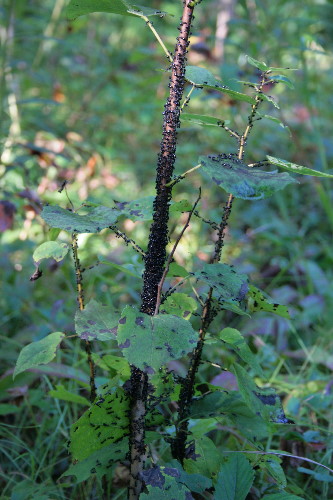
The ants were only on these four or five trees, all of them Trembling Aspen (Populus tremuloides). They were congregated thickly along the thin twiggy trunks and side-branches, with very few bothering with the leaves. I had a feeling I knew what was going on, and sure enough, upon close inspection I could detect aphids on the bark where the ants were thickest. I blew a few of the ants off to try to get a photo of the aphids (below), but the ants were quick to move in to take their sisters’ places, so I had to be quick. It’s not the greatest of photos, as I just had my wide-angle lens with me and not my macro, but it’s sufficient for getting the idea, anyway.

Ants with aphids

I’m not sure what species of aphid this is, though Chaitophorus stevensis, a specialist on Trembling Aspen, is a possibility. Some aphids will pierce the soft bark of young twigs or stems, while others will target the thin membrane of leaves or leaf veins. These ones seemed to be of the former group. The ants are there as “farmers”, tending the “herds” of aphids and harvesting the sugary secretions of honeydew much the way humans maintain herds of Holstein cattle to collect their milk. The aphids benefit from having the ants around, too, as the ants stand around with their formic-acid shotguns and chase off any wolves or competing farmers from their herd.

Of course, the aphids aren’t entirely given a choice about their situation: in some ant-aphid relationships, the ants will actually bite the wings off the aphids to prevent them from leaving; in others, chemical secretions from the ant stunt the development of the aphids’ wings. The same chemicals on the ants’ feet that they use in laying communication trails for other ants are also used as a tranquilizer, keeping their aphid herds calm and subdued (though it could be argued that actually the aphids are simply recognizing which side their bread is buttered on and using the chemical trails as a boundary marker so they don’t inadvertently wander off too far).

That’s all for this week. Back to the grindstone!

Biothon moths

Hunting for insects
A self-portrait (posed, of course) of me in "action" for the biothon, equipped with my sweep net and my favourite field guide.

Last weekend was the first annual Frontenac Biothon, a bio-blitz fundraiser event for Frontenac Bird Studies, which Dan runs. We had a team of five people – Dan and myself, and three friends of ours from the Toronto area – out to Frontenac Provincial Park for our 24-hour count. We booked a couple of campsites at the north end of the park, which were canoe-access only, and operated as our “home-base” for the biothon. While we fell just short of our target of 500 species (our final tally was 441), I think everyone had a great weekend (I sure did), and we learned lots that will help make future editions even more successful. If you’re interested in reading a bit more about the biothon as a whole you should check out the summary Dan did at the Frontenac Birds blog.

Examining a blacklit moth sheet
Me checking out the blacklit sheet (photo by Julia Marko Dunn, one of our biothoners)

As the member of the team with the most experience with invertebrates, I was heading up the six-legged component of the bio-blitz. I spent the afternoons trying to wrangle up a good selection of bugs, and while I could probably have done a bit better if I’d been in more open/meadow habitat than in the forest area where I was, I still got a reasonably decent list. My biggest contribution, however, was through my moth light. I brought my blacklight and sheet, and we lugged in one of those self-contained emergency batteries to power it for a few hours (no mean feat as those things weigh several pounds). We got about 60 species of moths, give or take a few, which I was fairly satisfied with considering we only ran the light for a couple of hours and just had the low-wattage blacklight, not my mercury-vapour.

Since we didn’t have a cooler to place them in I didn’t bother saving anything till the morning. The shots aren’t great, as a result, but they were just for sharing here anyway.

Imperial Moth

Imperial Moth. This was the largest moth species that we had come to the sheet, and the only silkmoth species. I think by the time we shut the light off there were three or four of them. Quite impressive, but they kept fluttering up and down the sheet and disturbing the other stuff that’d settled there. The bug beside this one is a caddisfly.

Harris's Three-spot

Harris’s Three-spot. This was my favourite of the evening, and its eye-catching pattern meant it also appealed to the other non-moth’ers in our group. I’ve only caught this species there at the park – besides at the biothon, I got a couple of individuals at our lake house our first summer there.

Brown Scoopwing

Brown Scoopwing. These guys are always neat to see come in, they have such a unique shape. There’s also a Gray Scoopwing in our area, but I believe those are the only two species. Hard to mistake it for anything else.

7906 - Datana contracta - Contracted Datana

There were two species of Datana that came in, at least that I could identify as separate species: Contracted Datana, above, and Walnut Caterpillar Moth, below. We have six species of Datana included in our field guide to moths, and they all look very similar to each other. Another caddisfly joining the moth in the photo below.

7907 - Datana integerrima - Walnut Caterpillar Moth