Reaching maturity

Horse Chestnut

Time just seems to fly by. I can’t believe we’re at June already! It seemed like just yesterday the snow was melting and I was chomping at the bit for warm weather, green leaves, birds and moths. Well, they’re all here, and they seem to have snuck up on me quite unexpectedly. They say this begins to happen as you get older, but I would hardly qualify myself as such just yet – and if time flies this much at this age, I can’t imagine how it’ll be zooming in another few decades. They also say time flies when you’re having fun, so I suppose that indicates how I’ve been feeling about life lately. I find myself whistling to myself while doing chores a lot more now than I ever did in the last couple years.

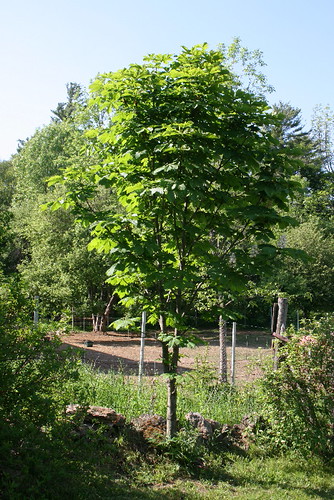
Speaking of time flying… I was at my parents’ earlier this week; I had a dentist appointment that I had been putting off for some time, and then opted to spend some time in the countryside before I returned to the city. It was a gorgeous, sunny afternoon when I arrived, and I grabbed my camera and headed out to wander about the property for a bit and enjoy it all. In my wandering I spotted the Horse Chestnut above.

My sisters and I planted this tree as a chestnut when I was quite young. I can’t recall exactly how old now, but probably no more than ten or twelve. At the time, my parents took us to music lessons that were held in the basement of a small church. Just outside the church were a couple of beautiful, mature chestnut trees. The three of us loved to stop and browse through the fallen chestnuts, looking for ones whose cases were whole and unblemished, trying to find the perfect, smooth chestnut. We’d usually come home with pockets full of them. I don’t remember what became of most of them – they were likely either used in games we made up, or were lost. But during that period a couple got planted.

Horse Chestnut

This tree is exactly the same age as the first one. We didn’t have any idea of ideal conditions to grow a chestnut tree. In fact, we probably weren’t thinking of the long-term at all, but just planted them as a bit of fun. The first tree grows in an open patch that gets sun through most of the day, the second is in a well-shaded area at the edge of a stand of trees. I don’t know what the rationale behind choosing these two spots was, although the latter was along a path my dad kept mown at the time that we used to play along.

While the first tree grew and flourished in the bright sunlight of its open location, the second remained rather stunted, growing to about a foot high and then seeming to remain at that size for years. It had trouble with rabbits, too, and for a while we had to put a wire cage around it to protect it. I’m not sure what changed; no trees or branches have fallen to open up the sky any more for it. However, it slowly began to grow again.

This week as I arrived for some reason I paused and looked at the tree, growing a short distance from the driveway as it was. And I was somewhat amazed to note that it was now about as tall as I was, with a good canopy of leaves on it. How long had I not been paying attention to it? In my memory it’s still a little sapling two feet high.

Horse Chestnut racemes

Both trees are now somewhere between fifteen and twenty years old. The second has a long way yet to reach maturity. But on the first tree, as I was standing there pondering how quickly life slips by while you’re busy living it, I happened to notice a few white racemes of flowers on a couple of its lower branches. And I thought, what a lovely metaphor for my own stage of life – the two of us, the tree and I, both poised on the edge of maturity. I consider myself a very mature person, but with 30 in sight I feel like I’m reaching maturity – that age at which all those things that one associates with being a “grown-up” actually happen, when people settle into careers, families, homes, and life begins to feel more stable, less uncertain. These are the first flowers the chestnut has produced. I counted seven racemes, nearly all on the lowest, oldest branches.

Horse Chestnut raceme

The Horse Chestnut isn’t a true chestnut at all (which are in the genus Castanea, members of the Beech family), but a member of the genus Aesculus, which also includes the buckeyes of North America. It’s sometimes written horse-chestnut or horsechestnut to avoid confusion with the other group, and to simplify common names of the different species. It’s not native to North America, but is commonly grown as an ornamental, and has since escaped into the wild. You can see why it appeals – the lovely white flower spikes, hinted with pink, are eyecatching in the spring. And what about chestnuts roasting on an open fire? I will admit never to have tried this, however; also, the nuts are slightly poisonous raw, and I presume this is the reason for the roasting.

Children, especially those from the UK, play games with the large seeds – in fact, in some places the tree is known as the Conker Tree, after the children’s game of securing a string to the chestnut and taking turns trying to smash someone else’s with your own (the winning chestnut being the one that doesn’t break). I never played this game, either, though Blackburnian did as a kid. The seeds were also used by militaries in the two World Wars to create acetone, which was then used in the production of armaments. Historically they were also used for whitening and cleaning natural-fibre fabrics, as they’d produce a soap-like liquid when ground and mixed in water.

Horse Chestnut blossoms

Horse Chestnuts are one of my favourite trees, undoubtedly in part for the memories I have of them from my childhood, but also for their interesting leaves, flowers and seeds. I hope someday, when I’m well into my mature years and settled into a home of my own, that I might have a mature Horse Chestnut to shade my home and accompany me through middle age.

April redux

Jumping spider

Towards the end of April I happened across a few observations that I thought would be interesting to post as a wrap-up to earlier topics.

This first one is going back to the jumping spider that I watched pounce at (and miss) a smaller brown spider. The following week I came across the above perched on one of the legs of my tripod. It was huge! Well, relative to my first little guy. It was easily a centimeter and a half long. Black and hairy, with striking orange markings, hard to miss. But the most eye-catching thing about this little spider was its fangs, a radiant metallic green.

The spider belongs to the genus Phidippus, but I’m unsure of the species. The metallic fangs are characteristic of this group, and are used in impressing females in courtship dances. The genus is primarily restricted to North America, and includes some of the larger jumping spider species. Julie Zickefoose apparently has a little black one that keeps her company while working. His name is Boris.

Jumping spider with prey

A bit earlier, I had found this guy hanging out on the wall of the station building. Unlike the individual from my original post, this one had had better luck hunting. He’s munching on a midge, which are extremely common down there.

Worn Compton Tortoiseshell

I came across this butterfly at the end of the morning one day. It was flitting from one tree to another and paused at this birch briefly. I identified it as a Painted Lady, and didn’t really give it much further thought. Then, while preparing the photos for this post I decided I should just double-check that it was a Painted and not an American, because I couldn’t remember which one had the spot on the wing. Well, turned out it was neither. I hunted through the entire Kaufman guide to butterflies twice before realizing that it was an extremely worn, rather orange Compton Tortoiseshell. The first one I’ve ever seen. But now I wonder if I’d been seeing them but writing them off as the more common Ladies.

Worn Compton Tortoiseshell at sapsucker well

It was pausing at the birch trees, and when I looked closer I realized it was drinking sap from fresh sapsucker wells. This species overwinters as an adult and comes out in early spring, much the way Mourning Cloaks do. Because it’s still quite early for nutrition in the form of flower nectar, they take some of their food from other sweet sources, such as sap wells (mentioned in the original post about the Yellow-bellied Sapsucker).

Mourning Cloak at Pussy Willow

And finally, returning to the Pussy Willows. The same day I had the tortoiseshell, I also observed three or four Mourning Cloaks visiting the buds of this Pussy Willow. For the same reason that the tortoiseshell was sipping at the sap wells, these Mourning Cloaks were drinking the nectar available from the female flowers of the willow. I love the velvety red-black of the wings in sunlight. Most butterflies I see that overwinter as adults look a little ratty in the spring. The tortoiseshell had a chunk missing from its wing like a bird had snapped at it. This Mourning Cloak seems to be missing a piece from its hindwing.

April showers bring May flowers

Fancy Daffodil

Fancy Daffodil

I’ve always liked that phrase. A selection of blooms from my mom’s garden. I’m cheating a bit, these were all taken in April. But most of them were the last couple days of April – that’s close enough, isn’t it?

Daffodil
Daffodil

Hellebore
Hellebore

White Trillium
White Trillium

Frilly Daffodil
Frilly Daffodil

Snowdrop
Snowdrop

Red Trillium
Red Trillium

Crocus
Crocus

Tenting it with the family

Eastern Tent Caterpillar eggs

Boy, has this week flown by! Here we are at the weekend already and I feel like the week’s only just begun. Part of this has been the progression of a new project. TheMothMan and I are starting work on a new field guide to the common moths of northeastern North America, which we’re pretty excited about. I haven’t wanted to say anything till I felt it was sure to go ahead, but we just secured an agent to represent the book so it looks like it should be more a question of where, rather than if, it gets published. Our agent also represents such notable naturalists and authors as Julie Zickefoose, David Sibley, Pete Dunne, Lang Elliott…. excuse me while I geek out for a moment. How often does something happen to bring you two degrees of separation from your idols? It’s only slightly less thrilling than if I’d met them in person.

Okay, composing myself… back to the topic at hand. Moths as well, as it turns out. Or rather, their larvae.

The above photo I took a few weeks ago, at the beginning of April. It completely encircled a small branch of a small tree, with white egg surfaces on top, but a crusty golden layer across the bottom. It wasn’t very big, perhaps a couple centimeters at most in its longest direction. I filed it away as “unknown insect egg mass” and there it stayed for a couple weeks. Then, while looking up something completely unrelated (always the way, isn’t it?) I stumbled across a photo in the ID Request section on BugGuide.net that looked just like my egg mass.

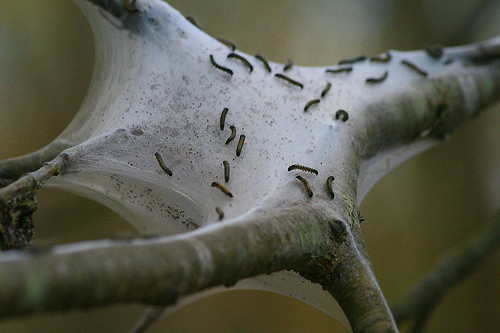
Eastern Tent Caterpillar tent

They were Eastern Tent Caterpillar eggs. They were especially conspicuous against the dark bark of the tree they were on, or I may not have noticed them at all.

This week, when I arrived at my parents’ for a couple days, I was struck by the huge number of web tents in the trees. I wondered if there really were an unusual number this year, or if it was just that I was taking more notice this year, what with the motivation of potential blog entries making me more attuned to these sorts of things. Either way, there seemed to be lots of them, two or more in a few trees even.

My mom pulled out her handy dandy Stokes Guide to Observing Insect Lives and we looked it up (my images are nicer… :) ). Over the winter we’d investigated Chokecherry Tentmakers. Thinking that I’d seen several webs in the chokecherry out front, I’d suggested it was these. In fact, they don’t appear till later in the summer. The only web tents found at this time of year are those of the Eastern Tent Caterpillar (Malacosoma americanum).

Eastern Tent Caterpillars

There are two primary species of tent caterpillar: the Eastern and the Forest. The Forest is associated mostly with oaks and maples. The Eastern is found on trees of the Rosaceae family, most notably apple (cultivated, wild, and crabapple) and cherries (cultivated, Black and Chokecherry), as well as hawthorn, pear and plum. Indeed, when I really stopped to look, all the tents at my parents’ appeared to be in the chokecherries, the crabapple, and the cultivated apple trees. And the little tree where I’d found the eggs at the station was also a young apple. When I checked back this week, sure enough, there was a little tent.

Eastern Tent Caterpillar tent

The most obvious sign of their presence, of course, is their web tents. When the caterpillars hatch out of their egg cases they migrate along the branch till they reach a major fork, where they set up shop. This is another feature that tells the tent caterpillar apart from the webworms; tent caterpillar nests are never out at the end of the branches. The young caterpillars all band together in an amazing show of cooperation, building the first little nest to get them started.

As time progresses and the caterpillars eat and grow, they build more layers on the nest to expand it. They lay down silk on the outside of the nest, and as it dries it tightens, eventually separating from the layer it was laid down upon. This creates a stratified effect within the nest. As the caterpillars grow they need more room, but they also require additional layers as the existing ones become filled with frass and moulted skins. The caterpillars leave a hole or two in the webbing, usually near the apex but potentially anywhere, by which they come and go from the nest. You can see the hole here. They tend to lay down the most silk on the side that faces the sun most directly. Usually this is the southern or southeastern side, which allows them to catch the morning rays more efficiently to warm up at the start of the day.

Eastern Tent Caterpillars

You can see in this picture, of a relatively new nest beside my rather dry fingertips, just how small the caterpillars are to start off. They use the nest for a number of purposes. The first and perhaps most obvious is for protection from both predators and the elements. When not feeding, the caterpillars huddle inside the tent. They also use the outside of the tent for basking or huddling to raise their body temperatures prior to heading off to feed, which you can see them doing in this photo. They pack together like this to reduce individual heat loss due to air movement. The stratified layers within the nest also help them thermoregulate, as the silk traps heat like a mini greenhouse. By moving in or out as needed they can adjust their temperature.

Eastern Tent Caterpillars

As the caterpillars move about, they are constantly laying down silk secreted from a spinneret at their tail-end. In going to and from the feeding areas they end up creating silken trails along the branches. They appear to follow these trails when moving, but they’re actually following a trail of pheromones that are also laid down by individuals. Initially, or once a particular source is depleted, individual caterpillars will go on “scouting” trips, looking for good food sources. So that they can find their way back to the nest they leave a scent trail to trace their steps. If they found a really good source of food, on their way back they lay down a stronger, more specific pheromone trail that tells the nestmates where the good stuff is. Well-traveled trails will be strongly defined with silk, while new or lightly-traveled trails may be barely visible.

Eastern Tent Caterpillar hatched eggs

Here you can see the empty egg cases of the little caterpillars, with a silken trail leading away towards the nest. The eggs are laid by the adult moths in the late spring or early summer, about 200-300 in a single egg mass. It doesn’t take long for the caterpillars to develop within the eggs, only about three weeks. However, they then remain dormant until the following spring. They hatch out just as the leaves are beginning to unfurl. Occasionally, the caterpillars from two or more egg masses laid close by to each other will come together to form a single colony. I think that’s what happened in the case of this bunch, since I found at least three empty egg masses within the same branching system, but only one nest.

Eastern Tent Caterpillars

The caterpillars will eat and grow and shed their skins and eat and grow some more for 4-6 weeks. They’ll go through six larval stages, or “instars”, each one still a caterpillar, but getting progressively larger. In their sixth instar they stop laying silk down on the nest or trails, instead conserving it for pupating. It’s during this stage that you usually find the caterpillars on sidewalks, benches, roads, and elsewhere, as they disperse from the nest to find a safe location to spin their cocoon and pupate. The cocoon is usually tucked into a corner or crevice, and is fuzzy and imbued with a yellow powder.

Eastern Tent Caterpillars

The caterpillars come out of their nests three times a day to feed, all corresponding with the times of lowest predator (especially bird) activity: at the crack of dawn, in early afternoon, and at dusk. The only deviation to this pattern is in their final stage, when they only emerge at dusk. They back this up with a chemical deterrent. Apple and cherry tree leaves, in particular, contain small amounts of cyanides, which the caterpillars ingest. When disturbed they produce cyanide-laden fluids to dissuade predators.

Eastern Tent Caterpillars

Tent caterpillars are much-maligned because they’re a defoliator. I recall as a kid being under the impression that tent caterpillar nests, when found, should be cut from the tree and burned to prevent spread of the infestation. What a dramatic reaction! An individual nest will not do significant harm, and in fact even an outbreak of the insects will not do any lasting damage to a tree. The caterpillars rarely kill their host trees, usually only if the tree was already weak or damaged prior to infestation. Any defoliation caused by the insects will generally regenerate later in the summer, once the caterpillars have headed off to pupate. Of course, depending on the size of the colony, it may be possible that that year the tree doesn’t produce any fruit. I think this may be where their bad rap stems from – they would be nuisance pests in orchards where they may stunt the fruit crop for the year. They are likely also perceived as unsightly in suburban settings (both their nests and the resulting defoliation). But really, they’re pretty harmless.

The only potential problem the caterpillars may cause is they’ve been implicated in Mare Reproductive Loss Syndrome (basically abortion by horses). The going theory is that the hairs of accidentally ingested caterpillars may puncture the intestinal walls and provide a conduit that allows bacteria to enter the uterus.

Eastern Tent Caterpillars

I like to cheer for the underdog (unless there are obvious good/evil sides), and so I support the tent caterpillars, much as I back Purple Loosestrife and Brown-headed Cowbirds (subjects of future posts, I’m sure). They’re a good food source for many creatures, including as many as 60 species of birds, maturing just when the birds are looking for bugs to take home to feed the kids.

Cute newt

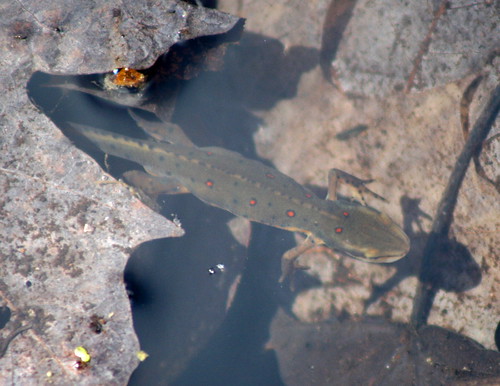
Red-spotted Newt

In the last week or so I’ve managed to accumulate quite a backlog of potential post subjects. This is largely because I’ve been out looking at things, rather than sitting indoors in front of a computer, and with spring progressing there’s the potential for a lot of interesting observations. For the same reason that I’m getting lots of good stuff, I’m also falling behind on writing about it – it’s hard to write when you’re not at the computer! I rather suspect that a number of these subjects will be tucked away for safekeeping, to be pulled out at a future date when things aren’t coming quite so fast and furious, or when I’m stuck indoors and haven’t been out to observe much. Julie Zickefoose refers to a person who sequesters posts for lean times (such as herself) as a “blog ant”, referring to the ant’s habit of building a larder in the underground (think of the Aesop’s fable of the ant and the grasshopper). I’m probably more akin to a packrat than an ant – an ant, it would suggest, is discerning. My blogging habit more closely resembles my living habits, where I store things that may come in useful, and when I decide I need something I go back and look over my cache for something that might work.

None of that has anything to do with this post, of course. I’m not writing about packrats, or ants (although I do have some ant photos tucked away). Rather, today’s post is on salamanders, who I’m pretty sure don’t participate in caching behaviour. While visiting my parents this week, my mom and I went out to a local site where she often does pond study field outings with schoolgroups for a local non-profit. It’s a relatively small, but still nice pond, set in the woods back from the road. They usually scoop up some water or sediment and poke through it to see what they can find, learning about the aquatic environments in the meantime. So, to be prepared for what they might encounter, my mom wanted to scout the site and see what was happening.

Red-spotted Newt

Along with a handful of different invertebrate species, there were a couple species of frogs heard, and these guys. This is a Red-spotted Newt, a subspecies of the widespread Eastern Newt. A newt is actually a type of salamander, one belonging to the family Salamandridae. The Eastern Newt is the only representative of this family in North America, although they’re fairly widespread on other continents, primarily in the northern hemisphere. There are in fact 10 different families of salamanders, but the other ones we typically think of here in North America, such as the Jefferson’s or the Spotted, are mole salamanders, family Ambystomatidae. Most other salamander families aren’t differentiated by name the way the newts are, however.

Red-spotted Newt

The Red-spotted Newt inhabits still or slow-moving waters such as ponds or small streams. They generally prefer moist woodlands, with sufficient debris or submerged vegetation in the water to be able to hide under. The ones we saw were all doing that, they’d cruise languidly along in the warm surface waters (the water was less than a foot deep in the very gradually-sloping pond edges, so it was pretty much all surface water) but as soon as I made an attempt to come in with the net they’d dive under the leaf litter at the bottom. They never went very far, but they disappeared completely.

They eat aquatic insects and insect larvae, small molluscs and crustaceans, and even small frogs and tadpoles. They have an amazing lifespan – females can live up to 12 years in the wild, males up to 15. I suppose this difference could be due to the greater energy demands on a female in creating and laying eggs, versus the relatively energy-“cheap” effort of creating sperm. One study notes that female survivorship from year to year is generally lower than that of males, though a reason isn’t provided.

Red-spotted Newt

At just 7-10cm (2.5-4 in), they’re not large creatures. They also aren’t very difficult to catch, once you know how. I started out trying to catch them by surprise by swooping in quickly before they could dart away. Although I successfully got the first one this way, the drag of the net through the water reduced its speed to the point where speed was not the answer anymore; the salamanders were all easily able to dart off before the net reached them. Then I discovered that if you came in quite slowly, they would just sit there, and you could practically scoop them up without them moving.

Red Eft (Red-spotted Newt)

The species has three life stages. The first is as “larvae”, the salamander equivalent of a tadpole. Eggs are laid in the spring, and take about a month to hatch into young. These are gilled, and spend the next 2-3 months in the water hunting small aquatic prey. They hatch at less than a centimeter (less than 1/2″), but grow quickly; within a couple months they’ve reached nearly 4 centimeters (just under 2″). At this point they metamorphize into their second stage, pictured above.

The second stage is called a Red Eft, and is terrestrial. They can remain in this stage for as many as 4-7 years, depending on latitude and the richness of the local habitat. This is the most commonly seen stage of the species’ life history, likely because of the bright colouration and also their on-land habits. It is in this stage that dispersal takes place, with individuals undertaking long treks of 800m or more where they may encounter new ponds. While their olive-green back is useful for camouflage in the water, on land they have a different strategy. Newts in non-larval stages have toxic skin that is used as a deterrent to predators, but the skin of the efts is ten times more toxic than in the adults. Their bright orange colouration is a warning to creatures wanting to make a meal of them (this special warning colouration is termed “aposematic”).

Red Eft (Red-spotted Newt)

Of course, I didn’t know this at the time that I was looking at them, and I happily (though gently) picked them up to get a couple of side-on photos that better showed their faces and bellies than a top-down view of them sitting in the water. Fortunately, I suffered no ill effects from the encounter. The back is more toxic than the belly, and despite this defense, newts are often preyed upon; predators get around the toxicity by targeting the newt’s underside. The newts rely on a learned avoidance by predators, where young predators that attempt to take a newt for dinner will remember the distastefulness of it and not try any others. This may result in the loss of one newt, but the protection of many others. Some predator species have an innate avoidance of aposematically-coloured creatures.

Red-spotted Newt

The eft I caught was found in the water. This is an unusual spot for one, as they generally stick to the land, and it could be that it was preparing to metamorphize into the third life stage, the adult (perhaps resulting in a lowered toxicity level). Only the olive adults mate, which means that sexual maturity isn’t reached until often three or four years of age, or potentially up to seven or more if the efts metamorphize late. I wonder how old some of the newts I was looking at actually were.

Red-spotted Newts

The adults have an amazing homing ability, like that of homing pigeons. Displace a newt from familiar territory and it can still find its way back. It orients using magnetic fields, but also uses its sense of smell (to detect water) and sight (to orient against the sun) to guide it, although in experimental tests even newts with no smell or sight could successfully find water. Displaced newts will automatically orient downhill, which is reasonable, since water usually lies in the lower areas. I wouldn’t’ve thought that newts would find themselves displaced often enough to have needed to evolve such a complicated system.

I probably saw more salamanders in that single outing than I had in my life prior to that combined. They don’t occur in the ponds on my parents’ property (or, if they do, certainly not in great numbers like they were here, and don’t hang out in the open). I will admit to never having made a special outing to look for them before, either, though. As is the case with so many things, if you actually go looking for something, you can amaze yourself with how common it actually is.