
 Yes, I’m doing it again! Due to either popular demand or a temporary lapse in sanity, I’ll be tackling the third and final volume of the Peterson Field Guides to Moths series – this one for Western North America.
The book will be similar in style and scope to the previous two installments. Moths will be shown on full-colour plates in natural resting positions, rather than pinned, and will be accompanied by brief descriptions and life history information to help with identifications. As always, the familiar Peterson arrow system will highlight useful field marks on the plates.
Unlike both the previous volumes, which treated a quarter of the continent each, this book will cover the entire West, from about the 100th meridian (which Tragically Hip fans will 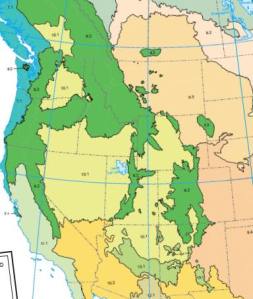 know is where the Great Plains begin; though more true for Canada than the US). The primary reasoning for not doing the West in quarters, as the East was done, is due to the longitudinal ecoregions created by the mountains – because of the way we create our range maps, there would be a lot of redundancy in producing two guides.
The new guide is expected to be about the same length as the previous guides – 1900 species and roughly 680 pages. I’ll do my best to provide a good coverage of specialty species from the deserts. Maps will be provided for all but the smaller micromoths, which tend to have on average less available occurrence data.
It will just be me on board for this book; my co-author on the other two guides, David Beadle, had to bow out due to other commitments. I’ve asked for an extra year to complete all the work that needs to be done on this book, as a result. If I meet my deadlines and nothing goes awry (not always guaranteed, in publishing!) the Western moth guide should likely be released in January 2026.
 seabrookeleckie.com