March Moths (and a few PFG to Moths plates)

Goat Sallow - Morrison's Sallow - Three-spotted Sallow

With the gorgeous weather yesterday, I knew there’d be moths flying come evening. I put my mercury vapour light out, even going to the trouble to dig out and pin up my white sheet in front of it. And I wasn’t disappointed! I got a great diversity, 15 macromoths of 11 species, and another dozen or so micros of the agonopterix and acleris variety.

I collected up one individual of every species except the Straight-toothed Sallow, which was the First Moth of 2012. The top shelf of the fridge was satisfyingly crowded. Since I’ve already got dozens of photos of these species on the plain background I usually use for species portraits, I thought I’d do a collage, in groups.

The above group is all the sallows (again, minus the Straight-toothed, which I sort of wish I’d brought in just for completeness). Top left: Goat Sallow, Homoglaea hircina; top right: Morrison’s Sallow, Eupsilia morrisoni; bottom: Three-spotted Sallow, Eupsilia tristigmata.

Small Phigalia - Half-wing - Spring Cankerworm

There are three early-spring geometers that you can pretty much count on on any given night in March and early April. I was pleased that all of them turned up last night – just singles of each. Top to bottom: Small Phigalia, Phigalia strigataria; The Half-Wing, Phigalia titea; and Spring Cankerworm, Paleacrita vernata. Having this photo with them all in the same shot helps emphasize the size difference between Small Phigalia and The Half-Wing.

Dowdy - Dimorphic - Hemina - Grote's Pinions

And finally, the pinions. The third group of overwinterers who’re likely to come to lights early in the season. I was surprised there were so many species last night, ordinarily I just get the bottom one here. Top: Dowdy Pinion, Lithophane unimoda; middle left: Dimorphic Pinion, Lithophane patefacta; middle right: Hemina Pinion, Lithophane hemina; bottom: Triple-spotted Pinion, Lithophane laticinerea.

These guys have distinctive shapes and so are easy to pick out, usually. There are two shape types: the long, narrow gray ones, and the bow-winged (look at the outer edge), shoulder-padded ones. Within each of the shape groups there are a number of look-alike species. For instance, Hemina and Wanton Pinions look very similar, but Heminas tend to be orangier with more diffuse markings than the grayer Wantons. Likewise, Grote’s and Triple-spotted can be hard to tell apart, but Triple-spotted typically are a smoother gray with the ST line often sparser/dotted or nearly absent compared to the rougher-gray Grote’s.

Since we’re still a month out from the release of the moth guide (but only a month! April 17!) but the pinions are flying now, I thought I’d scan in and post the identification plates for the group. Enjoy!

For all of these, click on the image to see a larger version.

Pinions1

Pinions2

Pinions3

Cats / tracks

woollybear

I’ve been waiting for a really nice, sunny, mild day to head out with my cordless drill to clean out our nestboxes, and the weather conditions were perfect for it this afternoon. I took photos and will follow up on that on probably Wednesday.

While I was out there, though, I saw a number of other critters enjoying the sunshine like I was. I spotted a few fuzzy caterpillars, mostly Woolly Bears like the above. They emerge so early, I don’t actually know if they spend any time eating before they pupate. There wouldn’t be a whole lot to eat yet. Although, I did spend some time raking out our garden, and the first shoots of daffodils and croci are coming up, as is the rhubarb. And quite a number of plants stay evergreen under the snow. So maybe there would be enough.

giantleopardcat

On the way back to the house I came across this guy, who I initially mistook from a distance to be another Woolly Bear, but who turned out, upon closer inspection, to be a Giant Leopard Moth caterpillar. I still get inordinately pleased whenever I discover one of these guys, even though they’re not uncommon here. We didn’t have them where I grew up (or if we did, I never noticed them); it wasn’t till I moved east that I started seeing them. So I still get that thrill of somethingcool! when I find one.

As I was walking back from the last nestbox I noticed a robin off some distance away in the forest, making a lot of noise in the leaf litter. I’d brought my binoculars with me (something I don’t always do, since I do most of my birding by ear these days and it’s one less thing to carry around) so I was able to watch him closely. After a moment or two he picked something up, dark and thick and C-shaped, carried it a short distance, then plunked it down in the leaf litter. I’m fairly certain it was a dark fuzzy caterpillar like one of the two above. I think he might have been trying to de-bristle it prior to eating it.

track1

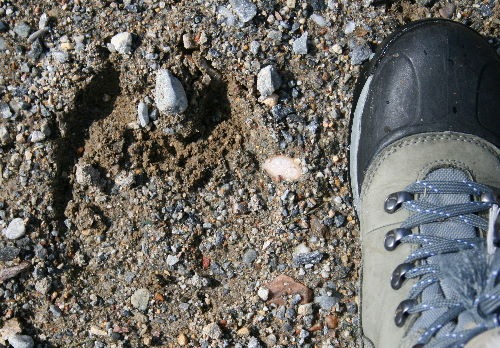
I made a brief detour out to the rail trail and walked down to the creek, and discovered these tracks out there. What first caught my eye was the size of them. Certainly much bigger than any deer I’d seen around here. They’re cloven like deer and domesticated ungulates (except horses/donkeys), but there was really only one animal I thought could make something that large, at least that I would reasonably expect might be found walking down the rail trail. Which is a moose, of course.

track2

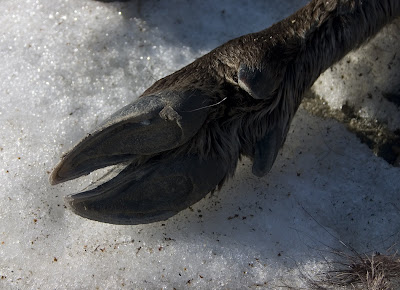
Having seen a moose in our back fields last fall, this wasn’t quite the stretch that I might have otherwise thought it. It’s possible he’s hung around the area, in one of the swamps nearby, keeping out of sight. I took a few photos and double-checked my tracks guide when I got back. They seem to be potentially confusable with domestic cows, with the main distinguishing feature being the front of the track – the hooves are pointed in moose, but rounded in cows.

You can’t see it as well in the first photo, but you can tell in the second that the front of the tracks are pointed. It was pretty clear in person, too, that the paired hooves were long and tapering at the front. They were relatively fresh… I didn’t notice them on my way out, only on my way back, though that’s not to say that they weren’t there and I just missed them on the way out. I tried following them to see where they went, but they seem to curve out from the fenceline and then back into the fenceline. I can only presume he jumped the fence, then got spooked after walking only a short distance down the trail and jumped back. And yes, moose, like all deer, can jump:

Who Knew? - Moose Jumping a Fence Photo by Bruce Barrett (nordicshutter) on Flickr; CC-licensed (the only such photo I found of a moose jumping, though there are others that are not CC)
Returning birds

returnees

Although it’s probably the first moth of the year that I look forward to most as far as signs of spring go, it’s definitely the return of the first avian migrants that marks the arrival of the season for me. In particular, Red-winged Blackbirds. Where I grew up there was a small swampy wetland area at one corner of the property, and every spring the song of the Red-winged Blackbirds would ring out from that swamp just as the snow started getting mushy and the ground muddy. They’d show up at the seed scattered below the feeders, and would perch in the tree branches above the house. Even before I started paying attention to birds, their return was a sure sign of spring. The sound of a Red-wing singing immediately recalls memories of my childhood to my mind.

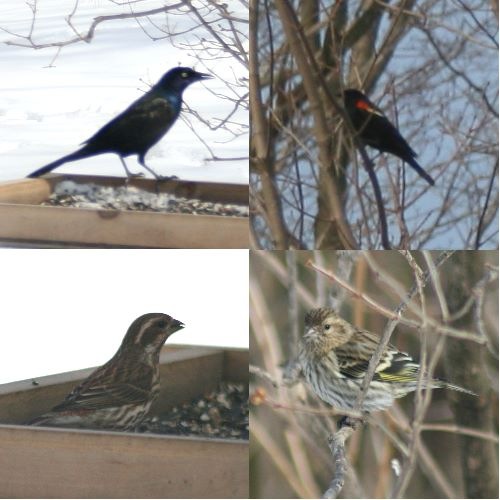
The same warm front that enticed the first moth out of hiding last Wednesday brought with it the first Red-winged Blackbirds. They’d shown up at my mom’s, an hour or so south of us, last weekend so I knew it was just a matter of days before they arrived here. Red-wings, like all blackbirds, are diurnal migrants. They roost, often in large flocks (especially in the fall), overnight and then move during the first half of the day. They put down by the afternoon so they have some time to forage before going to rest at night again. When I went out for my afternoon walk with the dogs on Wednesday, and all during it, I watched for Red-wings without seeing any. It was only upon returning to the house that I heard the distinctive chuck of a Red-wing in the trees by the feeders (the photo above is a record shot of that bird). Spring has officially arrived.

The next day, Thursday, we got our first grackle. I have no similar associations of grackles with spring, other than that they’re usually on the tail of the Red-wings (who nearly always arrive first by a few days). Just the one so far, that I’ve noticed. On Saturday, Dan spotted a pair of Pine Siskins at our feeder, and today, a Purple Finch. Dan said he’s seen siskins around all winter, in low numbers, but they must hunker down by the time I’m out for my walk with the dogs in the afternoon; I haven’t seen one since December. Ditto on the Purple Finch.

All of these birds are temperate migrants, moving a short distance south of their breeding range to slightly milder regions – though not necessarily a whole lot milder, as some blackbirds and grackles do spend the winter in Ontario, along the shores of the lower Great Lakes. The siskins and finches winter around here, but many travel farther south, beyond our border; their movements aren’t really migrations proper as they’re more food dependent and vary from year to year, but they often follow similar timing when they happen. The individuals we saw this weekend may represent some of these returning, rather than locals, though we can’t really tell.

As far as the two blackbird species, the timing of their return tends to be with the first warm fronts that bring spring-like temperatures to a region. They can get by on seed, but they’re also insect-eaters when there’s insects to be had. If you see Red-winged Blackbirds sticking their bills into cattail heads, for instance, they’re actually looking for small moth caterpillars that spend the winter there, rather than gathering fluff or eating the seeds.

I don’t have a photo of the first Red-wing from last year, but the first grackle seems to have showed up on March 21 (or at least, I have seven photos of a grackle from that day, and I pretty much never photograph grackles except the first one to arrive because it’s so exciting). So it might be he’s a little ahead of schedule. The date I have in my head for the arrival of Red-wings is March 15. This is carried over from my home where I grew up, too, which is more southern than where I live now. I don’t really have any data to back this notion up, but it does seem to me that the blackbirds being back already is earlier than normal. That first one last week was on March 7.

There is some concern about climate change causing the timing and pattern of bird migration to shift. Many birds use temperature cues rather than day length to know when to migrate. Before humans arrived on the scene, birds and the food they depend on had evolved together so that everybody’s life cycles were all carefully timed. Birds would arrive back from migration timed just right to be able to set up territories, build nests and incubate eggs so that the insect population that they depend on to feed their nestlings peaked just as the eggs started hatching. Early nesters who come back too soon because they’ve been fooled by abnormal weather patterns risk their own survival (should the weather turn foul again – this is especially dire for birds like swallows that catch their food on the wing) and/or that of their nestlings (if there’s not enough food available yet when they hatch).

My mom posted about this and talks about it in a little more detail. She also includes a link to a CBC radio broadcast on the topic, which happens to interview some Canadian birders and biologists I know personally. Worth a listen if you’re interested.

First moth of 2012

firstmothof2012

Yesterday was beautiful. (I felt the need to start the post this way because every first-moth-of post I’ve done has started with these words, I discovered.) I took an extra-long walk with the dogs in the afternoon, soaking up as much of that lovely southern-warm air and gorgeous sunshine as I could, to store up against today, which is overcast and wet and blustery. We return to winter for a few days, but the mild temperatures are forecasted to return next week, happily.

With the weather so mild yesterday, I figured there was a pretty good chance that the first moth of the year might make an appearance. So I dug out my mercury vapour bulb from where it had spent the winter, set up my tripod and put it out. I turned it on just before 7pm; finally, at around 10:30pm, as I was beginning to consider the evening a bust and turning it off for the night, the first (and only) moth arrived.

I’d been expecting a little wee guy, most likely an agonopterix of some sort, which tuck themselves into woodpiles and other cracks and are quick to warm up. We still had a good 7 or 8 inches of snow on the ground, and I thought that might affect the potential for moths. So when I spotted this guy fluttering around over my head, I felt a rush of excitement. I was worried he’d fly off before I could catch him!

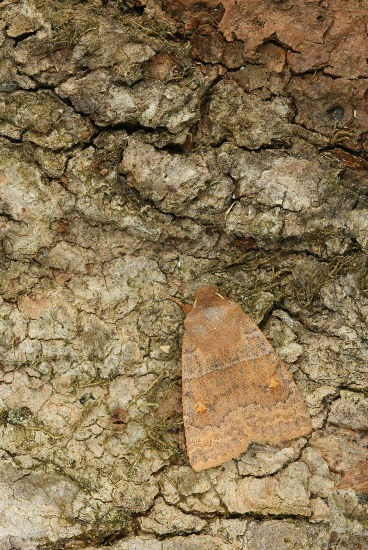
But he didn’t. The first moth of 2012 iiiis…. a Straight-toothed Sallow (Eupsilia vinulenta)! (Of course, the element of suspense is sort of lost when you head up the post with the photo of the individual in question.) He’s arrived about on schedule, compared to past years:

  • 2011 – March 17 – Morrison’s Sallow (Eupsilia morrisoni)
  • 2010 March 7 – Goat Sallow (Homoglaea hircina)
  • 2009 – March 6 – Morrison’s Sallow (Eupsilia morrisoni)

In actuality, last year’s first moth was an unidentified micro in late February, but the weather hadn’t been very warm so it felt less like the first moth of spring and more like a fluke moth of winter. Winter really hung around last March, too, and our first spring-like days weren’t till the middle of the month. Also, the true first moth of 2010 was on March 2, an Inornate Semioscopis (Semioscopis inornata); but I wanted to compare the first macromoths across the years so it didn’t fit.

You’ll notice that three of the last four years, the first moth has been a Eupsilia species. Another early species that I haven’t yet recorded first but is generally seen in the earliest days is Three-spotted Sallow, Eupsilia tristigmata. This whole genus is cold-weather moths, appearing late in fall and early in spring. They all overwinter as adults so they can emerge on those first mild days. Their caterpillars all feed on tree species, so they get out early, lay their eggs on the bare branches, and the caterpillars hatch as the tender new leaves are emerging.

I’d placed my bets on a Morrison’s Sallow being the first moth of the season… so I was wrong, but not by much!

National Moth Week

9631 - Callopistria mollissima - Pink-Shaded Fern Moth
Pink-shaded Fern Moth, Callopistria mollissima, #93-2192 / #9631


It’s late winter and mothing season is on the horizon – just another couple of weeks, at most, and the first moth of the season will arrive here at my porch lights. They’re calling for pretty warm daytime temps on Wednesday, and as long as the rain holds off I’m hopeful we might get one or two that night. It’s been nearly four months since we had the last ones of fall, and I’m looking forward to their return. I’ve been meaning to post about the following for a little while, so as we gear up for the start of the season it seems like a good time.

Great Britain has run a National Moth Night for a number of years now. Theirs is a three-night affair, with moth’ers all across the UK participating, recording and reporting their finds. This year the UK’s event will be held from June 23 to 25. It will be in August in 2013 and July in 2014; they shuffle it around so that all of the mothy months eventually get sampled, since many moth species have short and/or specific flight windows.

Till now we haven’t had anything comparable in North America (though I did join in the UK night on two nights in 2009). But David Moskowitz and Liti Haramaty of East Brunswick, NJ, decided to remedy this, putting together North America’s own National Moth Week (don’t let the name or logo fool you; it’s actually open to all moth’ers everywhere, including outside of North America). The premise is the same – on a set of specified dates, moth’ers everywhere go out with their lights and sugar bait and see what they find. They’re working on setting up methods to collect data from participants, much the way they do in the UK.

This year, National Moth Week has been scheduled for July 23-29. On one, a few, or all nights that week, go out with your mothing equipment and record what comes in. You can either run your own night(s) or join in on a public event in your area – check out this webpage for a map of participating moth’ers, including public events.

There will be some contests for people taking part in the event – for instance, highest species total or most participants at an event. A few people have donated prizes; there will be a few signed copies of the new Peterson moth guide, for instance, as well as books from David Wagner and John Himmelman. But you need to register your participation in order to be eligible!

I’m planning to hold a public moth night that week, though I haven’t yet set a date or location for the event. I’ll probably start figuring that stuff out in July, and will post an update (and reminder to participants) then. In the meantime, mark your calendars! I’m looking forward to seeing what we all turn up.