Scotch Pine wasps

Scotch Pine

This Thanksgiving weekend Dan and I returned to the Toronto area for dinner with his family. The weather was gorgeous, and while there we took the dogs for a walk to a bit of natural habitat just down the road. The house is in a suburban area but backs onto a nice patch of woodland habitat, one of the largest such patches in the immediate vicinity, so there’s often some interesting goings-on there. I heard Carolina Wrens, which don’t really occur out here (they’re rare and very local), and Red-bellied Woodpecker which is also rare this far east but relatively common there. We have Northern Cardinals here but they’re sparse and in low numbers; down there, you hear them nearly every time you step out.

Despite that, there wasn’t a lot of time for naturalizing, but I did pause to ponder this tree when I came across it in a small meadow. It wasn’t the tree that caught my interest so much as what was going on with it: it was crawling with wasps. (The tree itself is a Scotch Pine, a non-native species that’s often planted in plantations or urban areas because it’s hardy and fast-growing. This one seems to have planted itself naturally.)

Yellowjackets on Scotch Pine

It’s a shame my camera doesn’t do video, because only video could have captured the numbers of wasps really well: the branches were alive with them, crawling between the needles and flying from one spot to another. There are seven wasps in this photo alone – multiply that by so many branches. I presumed that they were all converging on this tree because it was exuding sap for some reason, perhaps the way new buds are sticky to the touch. I wasn’t keen to stick my hand into the branches to find out if the twigs were sticky, however, so I just took a number of photos and then hurried to catch up with Dan, who by that time had made it halfway across the meadow.

Yellowjacket with scale insects

But when I got home and started looking more closely at the photos, I noticed small brown bumps on the twigs. On some of the twigs, but not all of them. And the twigs with the most wasps seemed also to have the most bumps. Coincidence?

Some poking about Google and a quick reference of my Tracks and Sign of Insects, and I think I have an answer. I suspect these bumps to actually be scale insects, which are usually small, featureless domes scattered along twigs. They could be Pine Tortoise Scale, Toumeyella parvicornis, which is small and reddish and includes Scotch Pine among its targets. Like aphids, as they feed scale insects will produce honeydew, a sweet secretion resulting from their diet of sap. This honeydew, in turn, is very attractive to nectar-feeding insects such as bees and wasps.

Spider wasp sp.

The most common species of wasp on the tree was Eastern Yellowjacket, but I noticed at least one other yellow-and-black species, one mostly black species with a single yellow band, possibly two species of metallic green sweat bee, and the above, which I think is a species of spider wasp (family Pompilidae), though none of the ones shown in my Kaufman Guide to Insects or in the group’s photos on BugGuide seem to match. The Kaufman Guide does note about the family, though, that “Many visit aphid colonies for honeydew secreted by those insects.” Also present on the tree were quite a number of ladybugs. Ladybugs may be interested in the honeydew, but are probably there to feed on the scale insects themselves.

Bear sign

Bear-moved rock and Jack

A few weeks ago I noticed that a couple of the large rocks that sit beside the trail in our back fields had been shifted out of the ground. These are not small rocks, as Jack demonstrates, and there’s only one animal that would have done this: a Black Bear. Although we’ve never seen a bear around here in the couple of years we’ve lived here, we know they’re around just from the sign they leave. Shifting rocks is one of the easiest and most frequently spotted. Bears typically flip or move rocks to see what might be living underneath. Anything that doesn’t get out of sight quickly enough is fair game, but typically ants and grubs would be among the most common food items found this way.

Bear?-dug hole and Raven

I’ve also noticed a few random holes dug in the grass which I’ve wondered if bears might have created. They’ve been in the areas that I know the bears have been traveling, so it wouldn’t be a stretch. A number of weeks ago, around the time that I noticed the holes appear or maybe just before, we’d had some flights of citronella ants, so I wondered if the animal had been digging to unearth citronella ant colonies. Could they smell anything else from the surface? The other possibility for these holes is that they were made by skunks, which also root around in the earth looking for food. I don’t know enough about the physical sign of skunks to be able to say what their holes look like, though the photos I turn up on Google look a little different.

Scat photos coming up, so those grossed out by that sort of thing might want to stop reading here… :)

.

.

Bear scat - eating black cherries

The discovery of bear poop on the property really drives home that these animals have been passing through unseen, though. I found the first pile a few weeks ago. Dark, and filled with some sort of reddish fruit that I couldn’t readily identify. Nothing that I knew was fruiting at that time seemed like a good match. However, something someone posted to Facebook about the same time commented on finding bear scat with black cherry remains in it, and in Googling that it looks like that might be what this is. The reddish bits are the skins, and the lighter things are the pits. I tend to forget about wild cherry species because they’re usually in the woods and their fruit aren’t especially showy.

Bear scat - eating apples

Then yesterday, as I was heading out with the dogs, Dan suggested I check out a pile of scat he’d noticed on one of our trails. It hadn’t been there the day before, so the animal that had left it had passed through overnight. It was also bear, simply from the size of it. What was curious about this was that it was full of apple skins – prodding it with a stick to break it apart so I could examine its contents, it even smelled strongly of apple.

We’ve got a small grove of apple trees near the house, and Dan commented that he’s heard animals eating the apples there on occasion in recent evenings, and the dogs certainly show an interest in something that’s been foraging there when they’re let out the next morning. Could it have been the bears? There are also a couple feral apple trees on the 100-acre woods and no doubt our neighbours’ properties, so they could easily have been feeding there, too.

Bear (cub?) scat - eating apples

Not far down the trail there was another little bit of scat. This was darker, and quite a bit smaller, but it was just as full of apples as the first one was. The only other wildlife that I know for sure will eat apples is deer, and they, like most herbivores, create pelleted droppings, not tubular. Omnivores and carnivores typically create tubular droppings, and of those candidates the size of this could perhaps be raccoon. Would they eat apples? I don’t know; they’re pretty opportunistic.

What I actually thought these might be, though, given their proximity to the other scat and the identical content, were the droppings of a bear cub; the larger pile would be from its mother. Bears give birth in late winter, Jan-Feb, and by the early fall they’re already weaned from their mother’s milk. However, usually they’ll stick with her for another year, learning how to forage and live on their own. Females only mate every second year, with the between year being used to continue raising their half-grown cub.

I don’t worry that there are bears around, even mama bears with cubs, because, as the Peterson Field Guide to Mammals says, “Many are killed in the misguided belief that they pose a threat to humans. Black Bears are usually shy and retiring and very seldom dangerous.” If there is a bear around, no doubt she’ll have heard me and departed looong before I even realize there’s one in the area, if I ever do. Instead, I just find the sign she’s left behind.

During the break…

leaf

During the break…

…I’ve been hard at work on the moth proofs. I’m at 45 hours (and counting) spent bent over my drafting table, red pen in hand. Most of these hours have been spent in drawing in the arrows that I dearly hope all you good folks are going to make effective use of in identifying your unknown moths. Doing it forced me to really pause and think about what features I refer to when I recognize a species, how it is I know a species is what it is and not something similar. I’ve learned some interesting and, on occasion, surprising things about the identification of even the moths I’m already familiar with.

White Underwing

…I’ve been setting out my moth light most nights it’s warm and dry enough. Trying to lure in some interesting species so I can take their photos to include among the selection we’ll send to our book’s designer for use on the title pages. We sent them some already, but they turned out to mostly be the wrong orientation. A few nights ago I had some eight underwings come in, half of which were White Underwings like this guy.

leaves

…the leaves have been turning. In the past few years our autumn colour has peaked around Thanksgiving weekend, which here in Canada is the second weekend of October. Next weekend, this year.

fall trees

But it feels like our trees have already peaked. There were vibrant colours among our fields last week, which I’d appreciate when I took the dogs out for some exercise and so I could straighten my back for a brief period.

fall maple

I wonder if it’s because of how dry and sunny it’s been this year? There seem to be a whole lot more reds than there were the year before. The maples in our yard have turned fairly orange, but last year they seemed more yellow (though maybe it’s my imagination). Reds are controlled by light levels and temperatures (I explained the process in more detail in this post), with bright, cool days producing the most colour, so perhaps. The cool weather has definitely arrived, though we managed to hold off our first fireplace fire (the sole source of heating for our home) until October 1, which I thought was doing better than usual.

Milkweed snow

…the milkweed has peaked, too. We had a stretch of beautiful sunny days where all the pods seem to split and the fluffy seeds puffed out, waiting to catch the wind. I couldn’t resist kicking at the stalks as I passed, spreading the down in a snowy blanket across the grass.

Tiny Woolly Bear

…and the Woolly Bears have started trundling from the plants where they grew up to look for a spot to spend the winter. This has got to be the tiniest Woolly Bear I’ve ever encountered. I presume he’s very young, relative to most of the ones I find. I hope he finds someplace cozy

PFG to Moths, status update 2

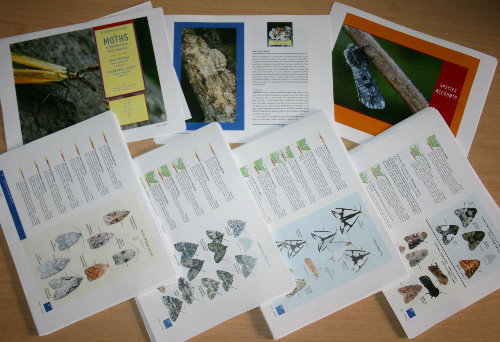
Back in May I posted a status update on the Peterson Field Guide to Moths of Northeastern North America. Then, we’d just received the bits and pieces of the manuscript, all 4.5 inches worth of printed paper, with notes from our copyeditor. We went over all her corrections, made changes and additions as necessary, and sent it back. The good folks at Houghton Mifflin have been hard at work in the intervening months; in addition to creating the cover, the designers have been busy laying everything out into actual book format. We’ve had some back and forth as questions popped up, and got to see a couple of preliminary pages, but today UPS came by and I got to hold the very first printed proofs of the guide. Looking like a book. How awesome is that? Happily, today’s stack of paper is only 1.5 inches tall. We’ll go through the pages, mark in any changes or adjustments and send it all back again – and the book will be one step closer to being in your hands!

Blackbirds

Grackles

I’ve spent most of the last week away from home, making my usual travels about Ontario. The morning that I left I got up unusually early (for me) and headed straight for the shower. When I got out I noticed a lot of chatter outside the washroom window. A few dark shapes swooped by, from the trees opposite to someplace down below. The washroom overlooks our side yard, but you can see a little of the front lawn from there; and on our front lawn were dozens of blackbirds. I hurried for my camera, but naturally it was downstairs and had the wrong lens on it. By the time I got it swapped out and returned to the living room window, most of the birds had departed, leaving just a few dozen in front of the house. They hadn’t gone far, though, just to the woods at the far edge of the meadow, perhaps a hundred yards away. So I slipped on my shoes and headed out with my camera.

I could hear them the moment I stepped outside. Blackbird flocks are remarkably noisy; it seems that every bird has something to say. Below their voices, though, was another sound. I might almost have guessed it for running water, if I didn’t know we didn’t live anywhere close to a burbling creek. I made my way through the dewy grass for the woods and peered through the branches. Sure enough: easily a hundred or more blackbirds, mostly grackles, shuffling through the leaf litter on the forest floor, the rustling of the dead leaves sounding like water.

The forest birds represented only a portion of the flock. The rest of them were foraging among the grass at the field, or in the lower branches of the woods’ edge. A foraging flock of blackbirds seems to be constantly on the move. The whole time I stood there birds were flying along the edge of the trees, always in the same direction, dozens at a time. They’d fly out from the trees, or up from the ground, forward a few dozen yards, and then land again. The flock rolls along like this, the birds in the rear leapfrogging to the front and foraging for a while until they’re again at the back. It’s really neat to watch because it looks like the flock never ends, with birds constantly rising up and streaming forward. This was why the birds passed through our front yard so quickly. It makes it hard to get an accurate idea of flock size, too, but I guesstimated there were at least a few hundred in this one.

Grackles and blackbirds

Interestingly, the day before there had been a large flock farther back in our fields, hanging out in the treetops. It might even have been the same one. Blackbird flocks are often heard before they’re seen, which was the case with this one. Hundreds of voices make enough din to carry fairly long distances. These groups may serve one of a few purposes: congregations of waterfowl or shorebirds are often tied to localized food resources, and Canada Geese and other formation-flying species will travel together for the decreased energy costs of flight. There may also be an element of safety in numbers involved.

I’m not sure why blackbirds gather together in the fall. There aren’t very many species of passerines (songbirds such as the sparrows, warblers, blackbirds, etc) that will congregate like this; blackbirds (grackles, Red-wings, Rusties, cowbirds, and related) and starlings will flock together, as will swallows. Neither the Birds of North America account for Common Grackle nor that for Red-winged Blackbird make any suggestion as to why these species flock together in the fall, though both accounts note that they do. They’ll actually migrate, during the day, in large flocks like this (many if not most other passerines will migrate individually at night), so perhaps the flocking behaviour does provide for some safety in numbers from diurnal hunters such as hawks and falcons. Blackbirds remain in large mixed-species flocks through the winter, too, often numbering in the hundreds of thousands or more. The Birds of North America account for Red-wings notes that “Very large flocks may stretch for miles.” Needless to say, the flocks we observe up here during migration never get that large.

The flock from that previous day wasn’t foraging the way the morning group was. Instead, they perched high in the treetops, talking loudly amongst themselves. At some unseen signal they lifted off together, swirling about and re-settling in some other tall trees farther into the forest. I suspect they were staging – preparing to depart south. I’m not sure why birds stage like this, either. Are they counting heads to make sure everyone’s present before they leave? Maybe they’re waiting for the appointed hour and these were the individuals to arrive so far (“The bus leaves at five, but try to show up early to make sure you don’t get left behind”)? Everyone hanging out while they do their warm-up stretches in preparation for the long flight?

The noisy flocks are just another sign that summer’s drawn to a close. Soon, they’ll all be gone, nearly all of them for points south of the border, and we won’t see them again until March.

Grackles and blackbirds