
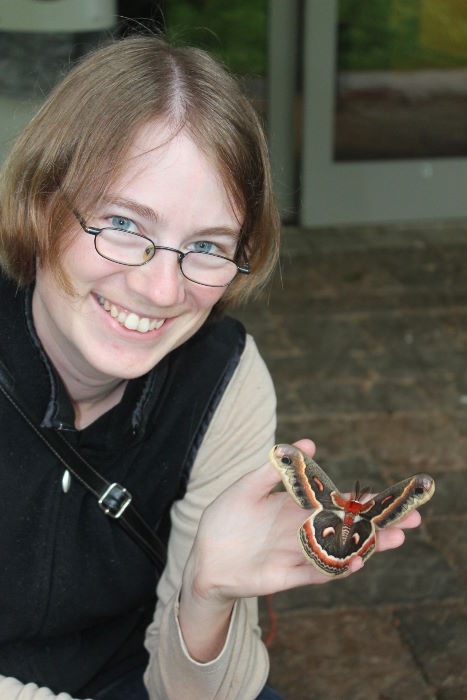
When I visited the Ned Smith Center for Nature and Art, near Millersburg, PA, during the book tour, I got an opportunity to meet my very first Cecropia Moth (I’m posing with it, above). It was a captive-reared individual that one of the guys involved in the event had raised himself from a caterpillar; it had eclosed (emerged from its cocoon) that day or the day before, so he’d brought it to share with the attendees. Another person brought a female they’d reared to the event in Athol, MA, hoping she’d lure in some males (she didn’t, but she was still beautiful). (A third person brought a captive-reared female Luna to the event in Detroit, MI, and there was also a captive Luna at the Ned Smith Center; and someone else brought a reared Polyphemus to the Ithaca, NY, event – I was grateful to all these folks, it was so great to have these flashy silkmoths there to show off!)
They’re indeed impressive moths. They’re also not that uncommon, so it’s a bit of a surprise that I’ve not encountered one before at my lights; I’ve got the other silkmoths, the Luna and Polyphemus, Imperial and Io, but never the Callosamia or Hyalophora species that share this sort of pattern. I’m supposing they’re not as attracted to lights as the other species are; some species of moth aren’t.

Then last night I came around the corner to check my moth sheet and there this guy was, waiting for me! Looking a little natty, with that big tear up his left forewing, and some nicks out of the edges, but it didn’t matter; it was a Cecropia, the first wild individual I’d ever seen, and also my first for Ontario. I went searching for a container I could put it in, to hold it in the fridge till the morning for a photo.
I had a bunch of larger containers stacked at the side of the house, and as I bent over to grab them I suddenly realized…
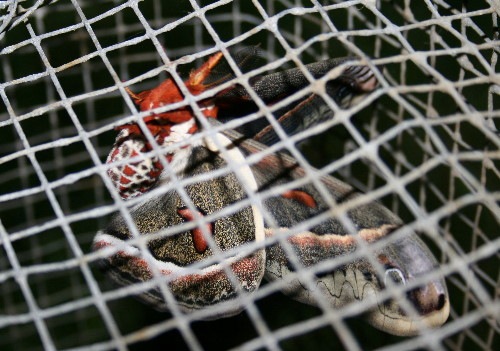
…the silkmoth cocoon I’d collected last week had hatched, and there was a fresh Cecropia Moth hanging inside of the wire cage I’d put it in.
And suddenly it all made sense, why there was a Cecropia at my light this evening. The differences between the sexes of Cecropia are somewhat subtle, involving the size of the antennae (larger in males, for detecting the female’s pheromones) and abdomen (larger in females, as it’s full of unfertilized eggs), and I’m not really experienced enough to tell the difference; but I’m guessing this one was a female, and after she emerged she started releasing pheromones (“calling”) that drew the male in.

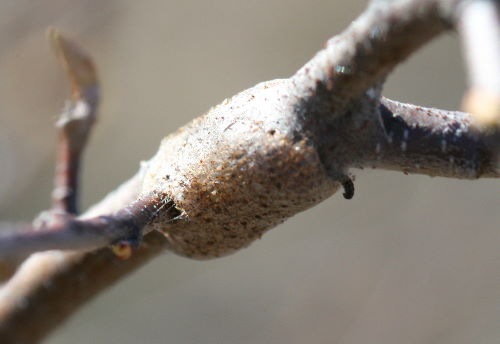
This is the cocoon (now empty). Last winter (’10-’11) I discovered two Promethea Moth cocoons that I collected and hoped to see hatch out (they’re also moths I’ve never seen adults of) but they turned out to both have been parasitized. This winter I found two cocoons that I was pretty sure were Cecropia, though I thought might perhaps be Polyphemus, which are very common around here and build similar-looking cocoons. I didn’t want to collect them up and have them hatch in captivity while I was on the tour, so I waited till I got home. By that time one was already empty, but the other still had something in it; I hoped it was a moth, not a parasite.
I cut off the small branch it was attached to and brought it home, making a wire cage to protect it and also to contain the moth once it emerged. I’d been checking on it regularly, but I guess I hadn’t looked yesterday. Cecropias apparently typically emerge around mid-morning, which I guess gives their wings time to expand, dry and strengthen prior to the night’s flight.

By the time I shut the light off and went to bed, three male Cecropias had come in to my sheet. I collected them up and set them together for this photo, before carefully moving them out into dense vegetation, just in case they didn’t fly off once the light was turned out (some moths, once they’ve arrived at the sheet, don’t leave again; and silkmoths would be pretty obvious to predators).
I find it interesting how much variation there is in the pattern of their wings. The one on the top, for instance, has very bright, well-marked spots, while the middle one has very little white in the spots. Of course, this is pretty well true for most species of moths, that there can be quite a lot of variation, but it’s more noticeable in some than others.
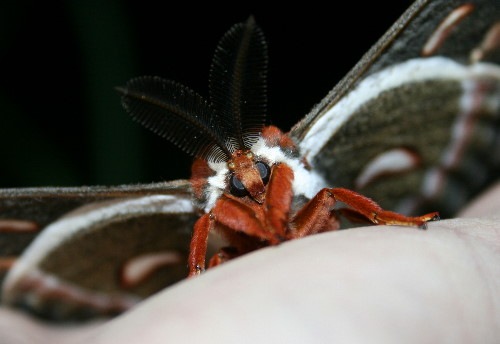
One of the males, showing off his feathery antennae. The receptors on these are so sensitive to the female’s pheromones that he can (supposedly) detect her from up to a mile (1.6 km) away. Which is pretty astounding, when you think about it, even considering that these moths are North America’s largest, at up to a 6 inch (15 cm) wingspan. On one of my checks one of the males was just arriving, and as he fluttered about the area, circling around the light and along the house wall, between his size and the way he flew you could almost have sworn he was a bat if you didn’t get a good look.

This is the moth that hatched out of my cocoon. I saved her for a photo today, and she’s back in the fridge again to wait for this evening; I didn’t want to release her mid-day when her giant size would make her pretty eye-catching to predators as she flew away. I’ve been toying with the idea of catching one of the males she calls in and putting them together in a captive space, to hold her until she lays her eggs in order to raise them. I think that would a lot of fun, to watch the caterpillars develop and end up with a large brood of adult moths that could be released next year. But I think it would also probably be a lot of work… So I’m yet undecided. I’ll keep you posted.

 seabrookeleckie.com