The Marvelous in Nature

Teeth on the outside

Shelving Tooth, Climacodon septentrionale

We’ve now had Raven for two weeks. It sure doesn’t seem that long, although she’s settled in and feeling more adjusted to things. She’s finally housebroken, and will even whine at the door when she needs out (rather than us having to keep to a schedule). She’s learning commands; so far she knows sit, down, stay and shake a paw (I’m sure the latter will prove invaluable). And, I’ve been taking her on walks down the road.

There were many reasons I wanted to get a dog, but on the purely selfish side of things one of them was to force me to get out and get more exercise, which I am horribly lax about if I don’t have something to make me. I’ll have good intentions for a while, but invariably they’ll lapse. So having a dog would make me get out, I wouldn’t have a choice, because it would be for the dog, not me. I do way too much sitting around anyway, it’s just that sitting around is so easy. So far I’ve been enjoying the walks, though we’ll see how I feel come January…

Shelving Tooth, Climacodon septentrionale

It was while out on one of these walks last week that I happened to spot some intriguing fungi on a tree along the side of the road. It looked like bracket fungi, stacked up horizontally in the crevice of the tree trunk. It occurred to me that I’d seen a small patch of this stuff on a tree further down the road, in the other direction, but hadn’t paid it much attention other than noting its presence. I returned this afternoon to get some photos of it, too. It was higher up than I remembered.

Shelving Tooth, Climacodon septentrionale

It took me nearly a week to finally remember to grab my camera with all the other gear I was picking up as I took Raven out, and when I returned to the tree today to take its picture, all the fungi were gone, scraped off and dumped in a pile at the foot of the tree. I was a little surprised, but then, it was adorning a tree that was at the foot of someone’s driveway, so perhaps they found the stacked-pancake appearance unsightly. I also thought, perhaps they view fungi as the cause, not as the symptom, and scraped it off thinking they’d save the tree. Heheh, I thought, the fungus is there ’cause the tree’s already dead inside so scraping it off won’t help, but nice that they cared enough about their tree to worry about it.

Shelving Tooth, Climacodon septentrionale

Well. The last laugh was on me, of course. I had spotted another tree sporting the same fungus deeper in the woods between that one and home, so I took Raven back and put her in her crate before returning and hiking the short distance into the forest to get photos. I examined the fungus closely, making sure I paid attention to the underside, taking several photos for the blog, then went back to identify it.

I’d recently gone on a bit of a spending spree and ordered myself a dozen or so books online. Some of these were reference books for work I’m doing, but a few were guidebooks. One was the Lone Pine Field Guide to Mushrooms of Northeast North America. Mom had taken this book out of the library way back in the winter to help us identify some of the winter fungi that were in the woods on their property, and I’d really liked it. It took me a while to get around to buying my own copy, but I’m glad to have it on my shelf. It’s to this book I now turned.

Shelving Tooth, Climacodon septentrionale

Placing it into a group was easy. The first inclination would be to classify it as a bracket fungi, since it was growing on the side of the trunk in horizontal shelves, in the manner of a bracket fungi. However, the underside was covered in fine hairs or spines, giving it an almost furry, fuzzy texture. This placed it in the Tooth Fungi group, the teeth of which offer an increased surface area from which to produce and distribute spores. There were only a few pages of tooth fungi to browse through, and sure enough, there at the end was mine: Climacodon septentrionale, commonly known as Shelving Tooth, or Northern Tooth fungus, a widespread and common species. Although two of the three sets of fruiting bodies I’d found were at or below eye level, it’s apparently more frequently seen higher up on the trunk.

Shelving Tooth, Climacodon septentrionale

And the last laugh? Well, it turns out that Shelving Tooth grows on the trunks of living hardwood trees, particularly maples, where it invades wounds and causes heartwood rot. Sometimes the rot can be severe enough to weaken the tree to the point that the trunk will snap in strong winds. I’m not sure if scraping off the fruiting bodies will be enough to stave off heartwood rot in that big maple, but it sure doesn’t hurt to try.

Web masters

Fall Webworm, Hyphantria cunea

Today was the first day of fall, as of 11:44 morning. It’s interesting how “they” know with such precision just when summer rolls into fall. It’s always seemed to me that the calendar’s division of the seasons is so arbitrary, segmented into three-month blocks that were chosen to most closely approximate the time of year they represented. But the actual seasons are defined by something much less tangible than dates on a calendar. Technically fall only just arrived today, but for me, it’s been fall for the last three weeks. You can smell it in the air.

There’s always the cues from nature, of course. The changing colours of the trees. The goldenrods and asters blooming. The birds and monarchs heading south. The shortening days and cooler nights. Now, one would figure that the critter ensconced in the wispy cobwebs above would fit into this category, as well, simply by its name – the webs were made by the caterpillars of the Fall Webworm, Hyphantria cunea.

Fall Webworm, Hyphantria cunea

These particular photos were taken when I visited my parents’ a couple weeks ago. It was the second week of September by then, but many of the webs were empty, their occupants departed, and had probably been there for at least a couple weeks already. I had noticed some on the road near my own home at the start of September. It would seem a portent of the impending autumn that the webs should show up at the beginning of the month like that, and I rather suspect that, even though they can be observed year-round in some areas, they really are most frequently seen in the fall, hence the name.

The Fall Webworm is a moth, the adults varying from all white in the north to heavily spotted with black or brown in the south. It’s a type of tiger moth, which includes many hefty-bodied species that don’t resemble tigers at all. Despite the superficial appearance of the nests to those of the Tent Caterpillar, they aren’t closely related. You can tell whether your infestation is of tent caterpillars or fall webworms, for one, by the time of year. Tent caterpillars are springtime species, while the webworms, as their name implies, are a fall species. Also, tent caterpillars usually build their nests in the crotch of a branch, and it rarely gets much larger than a foot across for the largest.

Fall Webworm, Hyphantria cunea

Webworms, on the other hand, start out at the end of a branch. The female moth lays up to 1,500 eggs on the underside of a leaf, covering them with hairs from her abdomen to protect them while they develop. The larvae hatch and begin spinning a silk web containing the surrounding leaves. While tent caterpillars march out several times a day, following silken trails, to munch on leaves, the webworms wrap their food inside their web so they remain more protected. The downside to this approach, however, is that once the leaves inside the web are all eaten, they can’t just change the trail they follow. So they end up expanding their nest to encompass more leaves, and then even more. By the time they’re ready to leave the nest they could have wrapped up the entire branch. A very large colony of webworms is capable of enshrouding the full tree. Sometimes very large trees, like the one in the first photo that was nearly as tall as the nearby telephone pole.

Fall Webworm, Hyphantria cunea

Caterpillars go through 11 instars, or larval stages. There are two different, distinct races, distinguishable by the colour of the head: larvae of the north have a dark head, while those of the south have a reddish-orange head. Northern caterpillars also have white hairs coming out of black and orange bumps, while southern caterpillars have brown hairs coming out of reddish-orange bumps. Earlier instars are generally paler.

Fall Webworm, Hyphantria cunea

Like with the tent caterpillars, the webworms rarely kill their host trees, even though they may completely defoliate them and leave them looking barren and dead. Because their timing coincides when the tree is starting to wrap up its growing season and thinking about dropping its leaves anyway, it doesn’t lose a whole lot (tent caterpillars work the other way; they eat before the tree gets going, so it still has time to recover during the summer). Webworms are generalists, not targeting any one specific type of tree; their larvae have been recorded on 120 species of tree and shrub in North America.

It’s found right across North America, from southern Canada south to northern Mexico. However, it’s also found in Europe, as a non-native invader. It was introduced to Yugoslavia sometime in the 1940s, and has since spread to encompass much of the continent. It was also introduced to Japan in 1945, later spreading to China and Hong Kong. Throughout its entire range it’s been documented on 636 species of trees, and is considered one of the most, if not the most, polyphagous of insects (fancy scientific name for generalistic feeders). Basically, anything deciduous is fair game.

Fall Webworm, Hyphantria cunea

Most of the caterpillars have left their nests now, the webs empty of larvae or leaves, just frass remaining, trapped between the web layers. They’ll trundle off to find a safe place to pupate, in the bark and leaf litter at the base of trees. There, they’ll spend the winter, cozily wrapped up in their silken cocoon, interwoven with bits of detritus from the soil. Next spring, the adults will emerge, once the risk of frost has passed, around May here at my latitude, and they’ll start the cycle again.

Today at Kingsford

Raven - goin' crazy

Today at Kingsford I am feeling exhausted. It’s 8:30 and I’m just about ready for bed. Boy, I knew that puppies were a lot of work, but I don’t think I was fully prepared for just what we were signing up for. The exhausting bits are those like the above…

Raven - goin' crazy

…or this…

Raven - all tied up

…or this.

Actually, it’s not so much the tailing after her to untangle her or empty her mouth (which I seem to have to do a lot) just in and of itself that’s exhausting, but rather the having to be at constant attention, with one eye always on her, so you can never fully relax or focus down on a project. I’ve read that a puppy can sleep for “as much as” 16 hours a day, and the sources generally recommend letting the puppy rest and not keeping them up. I don’t know what sane puppy parent would possibly be doing that. They may sleep 16 hours, but that still leaves 8 hours a day that they’re curiously getting into everything! I very much value my snippets of downtime while she’s sleeping during the day…

So I’m a little behind on catching up on reading or answering my comments or other little tasks like that. I’m sure I’ll have lots of time to get back on top of that once she’s grown out of her puppyish energy… in a couple years…

Raven - who me?

Who, me? Trouble? Naaah, couldn’t possibly. Look how sweet I’m being…

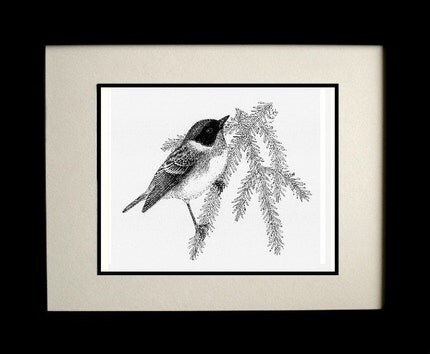
Some shameless self-promotion


Northern Hawk-owl – pencil

I think I’ve mentioned in passing once or twice that aside from maintaining a blog about nature stuff I’m seeing, I do have other pursuits as well. One of these was a post I made way back in March, where I included a sketch I did from the field, of a snow-covered trail. I’d made a semi-resolution to try to do more field sketching this year. Well, I haven’t, just so many other things to do, to look at, to photograph.


Northern Waterthrush – ink

That doesn’t mean I’ve abstained from drawing, however. In fact, I’ve done considerably more this year than I do in an ordinary year. Most of it has been on commission. The primary project that’s been keeping me occupied lately is illustrations for a book on the birds of Niagara County, Ontario, edited by noted Ontario birders Kayo Roy and John Black. The book is currently in process (good thing, or my drawings would be a tad late), and I believe will be published sometime early next year.


Hooded Warbler – ink

I’ve been asked to do the warblers for the book. I’ll be the first to admit that I’m no Julie Zickefoose, or Debby Kaspari, at least not yet. Hopefully with a bit more practice, and some more years under my belt, I’ll be drawing like they do. But I still feel that I draw well, and am happy with the works I do. It was an honour to be included in the Niagara Birds project. There’s no up-front compensation for the drawings I do for it, but it will be great exposure for me, and practice, plus I do have the opportunity to sell the originals once they’ve been scanned in by the layout designer.


Black-throated Green Warbler – ink

To this end I’ve set up a storefront at Etsy.com through which my pieces will be available for purchase. I’ve tried to price them fairly – both for myself, in terms of receiving reasonable compensation for the time put into them – but also for the buyer, since I’m still a relative nobody in the art world (perhaps I always will be, or perhaps in twenty years I’ll be the next Robert Bateman – okay, I’ll probably never be a Bateman, but it’s nice to fantasize).


Bay-breasted Warbler – ink

My shopkeeper name there is simply Seabrooke, and the store address is Seabrooke.etsy.com. In addition to the Niagara warblers, I also have a pencil drawing there that I did for the Ontario Field Ornithologists’ October issue of OFO News, and a few gouache paintings that I did last year for my own enjoyment. I’ll be putting up the rest of the warblers as they get done and scanned in for the book, as well as other works where I have the original to sell. I invite my readers to swing by and check them out if interested.


Yellow-rumped Warbler – ink

Today at Kingsford

Turkey Vulture

Yesterday afternoon as I was aimlessly staring out the window waiting for a burst of inspiration, or motivation, or something else to help me get to work and stop procrastinating, I saw this big, dark shape fly in and land in the large maple in the yard outside. It took me a moment to realize it was a Turkey Vulture (Cathartes aura) – for one because it happened to be a juvenile, with a dark head rather than the bright pink one of adults, but also because I simply wasn’t expecting a vulture to swoop down and land in our yard. Vultures are cool birds, with many interesting habits, including vomiting when disturbed or threatened as a predator-dissuasion mechanism (would work for me), and defecating down their legs to help cool down in the summer through evaporative processes (since birds don’t sweat). Their head is bald because they spend so much time with it buried in gooey, unpleasant places where feathers would get matted and ruined – you get a neat view of a bird’s ear as a result. They are the ultimate air-thermal gliders, it’s unusual to see a vulture flapping. We’ve seen vultures soaring overhead from our property, but this was the first time I’d actually seen one on the property.

This morning I spotted another first-visit bird. Likewise, I had heard Pileated Woodpeckers (Dryocopus pileatus) calling while I was on the property, and had even seen them flying from the neighbour’s to another spot, but hadn’t actually seen them in our yard. This female was out on the same big tree the vulture had perched in, but was too quick for me to get a shot of her there. She flew over to a tree that was more hidden (at least to me, the viewer) behind leaves and branches, and this was the best shot I could manage. There’s lots of Pileated workings in the dead snags on our property, so I knew this wasn’t the first time they’d been around, but it’s the first time I’ve seen them here since we moved in. Pileateds are the biggest of the North American woodpeckers (only the Ivory-billed, which may or may not still exist, was larger), but are remarkably widespread, found throughout the east, across the boreal forest, and south through the montane forests of the west. Only three North American woodpeckers are more widespread: the Northern Flicker, Downy and Hairy.

Pileated Woodpecker