The Marvelous in Nature

Something fishy

Bluegill

Here’s something new for the blog – fish! I think I may have mentioned fish in passing in one or two previous posts, but never as a topic of discussion. For the most part this was because I was never where there were fish to observe. The only fish I really encountered in Toronto, aside from the schools of little minnows that one sees skirting the shore in the sandy shallows (there’s a good bit of alliteration for you!), were giant, overgrown carp that were hard at work digging up the bottom of a little bay we surveyed in the summer. I’ve spotted the odd salmon moving up-river to spawn, mostly when I was in BC a few years ago. But that’s pretty much it. My parents’ waterbodies don’t have fish because they’re shallow and vernal, and fish can’t survive the drying up in the summer, or the freezing in the winter.

When we made our first visit to view the house, we went down to the dock to look around. Peering in the water we spotted these guys, above, whole bunches of them, several of which might have been 6 or more inches long. These were easily the biggest “real” fish (carp don’t count) I’d seen in quite a long time. I have to go back to my childhood, canoeing in the little man-made lake in town, to recall good looks at largeish fish like this. Although he likely won’t admit it, I suspect that finding these fish loafing near the dock was one of the things that really sold Blackburnian on the house (the other being the view as we stepped out of the car).

In his younger days, Blackburnian was really into fishing. He owns at least three rods and reels of different types, and has two tackle boxes full of lures, as well as his own 14-foot punt boat and trolling motor. For various reasons he stopped when he got in to university and hadn’t touched the gear in nearly ten years. As soon as we had signed the lease for this house, one of the first things we did was return to his parents’ place and collect up all his fishing stuff. His dad brought up the boat not long after we moved in, and he’s been out nearly every day in it.

Initially I tagged along to enjoy the water and the scenery, but it didn’t take long for him to persuade me to let him show me how to fish. I will admit that I was a little intrigued; I’d never been fishing before, and it was a whole genre of creatures that I knew virtually nothing about. The thing about fish is because they live in a completely different environment from humans you either have to go to them through snorkeling or scuba diving, or bring them to you. I’m not able to do the former, so if I was to learn about fish, that left the latter.

Me with Bluegill

This is me with my first fish caught. I’m laughing because it’s such a teensy-weensy little fish. This is the same species we saw off the dock on that first visit, in the first photo. It’s a Bluegill, Lepomis macrochirus, and it’s quite abundant in the lake; based on our fishing observations, I’d rank it third-most common, although it’s hard to say, really. One website (for Wisconsin, but good enough) I found indicated that young Bluegill will only read an inch or two in their first year, but will continue to grow steadily as they age. The largest fish are also the oldest. This one, at four to five inches long, is likely three years old.

Large Bluegill

This is the same species. The colouration is completely different from the little guys, and it completely threw both Blackburnian and me off for a bit. As it turns out, older adults don’t show the vertical striping as prominently, and they develop much stronger colours. The adult males, especially, become quite vibrant, with bright red breasts. This guy indicates how the species gets its name. When all I was seeing was the little guys I wondered why they were called Bluegills and not Bluefins, since the fins were much more distinctly blue in the little ones, especially when you see them in the water. In this mature fish, however, the blue gill covers and chin are pretty obvious. The main feature that seems to stay constant across all ages is the unadorned black “ear flap” on the gill covers. I estimate this guy to be between 9 and 10 inches long. The same website said he’s likely about 10 or so years old. Bluegill rarely live much over 10 years, so this guy was a real senior.

Pumpkinseed

This is probably my favourite of all the fish in our lake, and also happens to be the most abundant. This is a Pumpkinseed, Lepomis gibbosus, I presume named for its shape rather than its colouration. The Pumpkinseed and the Bluegill are both members of the Sunfish family, Centrarchidae, as well several others in Ontario’s lakes. The family is native to North America, primarily the east, but they have been widely introduced in the west and on other continents because of their appeal to anglers (and also their appeal on the dinner plate – indeed, many of these small fish are grouped together by anglers and colloquially labeled “panfish”). Many sunfish have bright colours such as these two, but some are more drably patterned. Sunfish are identifiable by the spines on the front half of the dorsal (back) and anal (rear belly) fins. You can see the spines folded back under my thumb in this photo. They’re sharp, so care must be taken when grasping the fish.

Care also has to be taken, when holding the fish in a body grip like this, to make sure your hands are wet while handling the fish and that you try to avoid touching more of the fish than you have to. Fish are covered in a slimy mucous layer which acts as a physical immune system, a barrier that helps keep out infection and foreign bodies. Dry hands, or touching a fish to any other dry surface, will remove this mucous layer. This body grip is only really practical on smaller fish, though, and in many cases is really the only option for holding them. Medium-sized fish can be held vertically for a short time without injury by their very strong lower jaw, composed almost entirely of sturdy cartilage. For fish that are too big to fit in a palm, this is usually the safest way to handle the fish without risk of injuring it. Large fish, the ones that you see on fishing shows being hoisted up as trophy catches, are usually held horizontally with one hand on the jaw and the other (wetted) hand supporting the belly, since the fish is designed to be suspended in water, and the weight of such a large fish that is out of water or not otherwise supported has the potential to injure organs. A few fish have big, sharp teeth, and these are generally gently grasped behind the head and gills, around what might be considered the fish’s “neck”.

Removing a lure from a pike
Carefully removing the lure from a toothy-mouthed pike

I’ll admit that I had some reservations initially about fishing, I didn’t really like the idea of using a hook to catch something. After doing a lot of research, though, I’ve allayed most of those concerns. First and foremost, research indicates that upwards of 97% of fish captured using an artificial lure survive without any ill effects (live bait is often swallowed into the stomach, which is much more dangerous to the fish to try to remove). To give the fish the best chance of surviving it’s necessary to reduce the amount of stress placed on it – much like bird banding, in that respect. Trying not to play the fish on the line too long, and not holding out of the water for long periods (or at all, if possible), will minimize its fatigue and general stress. Handling it properly and being careful not to remove the mucous membrane is also important. If practicing catch-and-release, using a barbless hook will minimize both the amount of time the fish is in hand as you’re removing the hook, and also the damage caused by it. A properly hooked fish (and careful removal of said hook) doesn’t bleed.

Not surprisingly, the effects of hooking a fish has been the subject of a lot of research. It’s hard to deny that a fish, like all vertebrates, feels some pain. Studies suggest that fish do have some nerve endings in their mouth but are more desensitized than ours, because they’ll often eat prey items that are prickly or otherwise not happy about being eaten, and delayed resumption of feeding is more likely due to psychological reservations than fear of pain (“Fool me once…”). On the other hand, fish in frequently-fished locations are often recaught, suggesting the effect doesn’t last long. Fish tagging has provided good information about recaptures, longevity, etc. One of the biggest benefits to angling is from a conservation standpoint – groups dedicated to recreational fishing and hunting are among the biggest promoters of conservation, actively involved in conservation or restoration projects.

I’d like to look into fish tags, a little like bird bands, and see what regulations and such exist in applying them. It would be interesting to learn more about the fish that use our bay and lake, and perhaps even get to know some individuals. Considering how drab a fish looks when standing over the water, viewing it from the top, they really are very striking creatures.

More fish tomorrow!

The loony bin

Common Loons

When Blackburnian and I were out boating yesterday evening, we came across a pair of loons who were exceptionally obliging for photographs. While we cruised slowly by in the boat, the remained on the water, looking reasonably unperturbed. At the closest we were about 20 feet away. I ran off a series of photos, trying to make the best of the opportunity in the less-than-ideal lighting, from a moving boat. A little while later, presumably the same pair flew overhead as they made their way from one end of the lake to the other. Again, very obligingly, one of the individuals circled around and flew nearly straight over the boat, the setting sun glinting off his wings and body.

Common Loon

More than any other, the bird that characterizes the northern landscape to me is the Common Loon, Gavia immer. It’s probably because these birds aren’t encountered during the breeding season in southern Ontario, so I only ever see them when further north, in combination with their vociferousness, which means they’re more likely to be detected than other species. In truth, the species is actually encountered further south than I may have guessed; the Atlas of the Breeding Birds of Ontario, published last winter, indicates breeding records for Common Loons as far south as the Prince Edward County area on Lake Ontario in the east, and and a spot perhaps 20 km west of where my parents live to the west. In fact, only the southern couple hundred kilometers of southern Ontario don’t record the species.

Common Loon

Their abundance, as mapped by the same Atlas, is much lower in southern Ontario than it is elsewhere. Highest abundance in the province is found in a few pockets in northern Ontario, particularly in northwestern Ontario. Up there, in 100 square kilometers (about 24,710 acres or 36.6 square miles) one may encounter as many as 8 birds per 25 randomly-completed point counts (the Atlas’s unit of measurement for mapping abundance). Their abundance is higher there because of the profusion of lakes and water bodies. In southern Ontario their abundance is lower, generally averaging no more than 1 or 2 birds per 25 point counts, with strongest abundance corresponding to the areas around Algonquin Provincial Park and the Frontenac Axis. The Frontenac Axis is an area of the Canadian Shield, the rocky, rugged granite landscape, that extends south to eventually join up with the Adirondacks in New York.

The loons are commonly seen here on our lake and surrounding area. We’re on the edge of the Frontenac Axis, and the landscape reflects this collision of the two regions, the granite Shield and the flatter limestone that dominates most of southern Ontario. We have the deciduous forest of the south along our road, but across the lake, in Frontenac Provincial Park, there is quite a bit of mixed forest, with a strong component of coniferous trees. The region is also characterized by many lakes; indeed, Frontenac County also has the casual name of “Land O’ Lakes”. And the lakes are full of fish.

Common Loons

A pair of loons needs on average about 70 hectares (173 acres) per pair to raise a family. That’s an immense amount of lake, and so usually there’s only one pair per lake. In areas where the lakes are small, a single pair may claim ownership of more than one. The reason for this is in their diet; not only finding, but being able to catch enough fish of a suitable size to feed two adults and raise a couple chicks to adulthood requires a large area to forage in. In areas where fish are abundant, the loons’ territory may be smaller; where fish are scarce the territory will be larger. The Atlas reports the range of territories, as recorded in a 1973 study, to be anywhere from 7 to 200 ha (17 to 494 acres), which is a pretty broad range. In any case, the pair of loons that we’ve observed on our lake, our neighbouring lake, and flying overhead, are most likely all the same individuals moving about between the different water bodies.

Common Loon

I love the loon’s crisp black-and-white pattern, punctuated with a blood-red eye. Unsurprisingly, given its appearance and haunting, lonely call, the species is a prominent figure in many cultures. Native American tribes have different stories that feature the loon, from the Chippewa tale of a loon that created the world, to those of British Columbia who believed the call of the loon predicted rain (this wouldn’t be difficult; loons call all the time, and it rains all the time in BC). The tale of how the loon got its necklace is a frequently-told one in the Ojibway and many other cultures, and I remember reading a children’s book about the story.

In modern culture, the loon is found on the Canadian one-dollar coin (called the “loonie” for this reason, not because we’re crazy to add yet another coin to what we carry around in our pockets), which was introduced in place of the paper bill in 1987. It was also found on the $20 bill of the previous Canadian currency design series (which was “birds of Canada”). The loon is the provincial bird of Ontario, and the state bird of Minnesota. And of course, the loon is the cottage country bird.

Common Loon

Loons are good fliers, mostly due to the stamina they have from making a living by diving for their food. Despite this, loons have exceptionally high wing-loading – a term that refers to the aerodynamics of the bird and the amount of lift created by the wing in flight (specifically, how much weight, or load, is placed per square inch of wing). A bird with low wing-loading means the wings create more than enough lift to keep the bird easily airborne. A bird with high wing-loading has just enough lift to get themselves off the ground and into the air. Like with the oceanic alcids, a loon’s wings are designed more for efficiency when diving, and the birds are so borderline when it comes to wing-loading that the loss of even a few wing feathers may be enough to render them flightless. During their spring moult prior to the breeding season they drop all of their flight feathers at the same time in order to reduce the amount of time they’re flightless (in the meantime they escape threat by diving, which is the reason they can get away with such a moult pattern – most birds moult feathers sequentially so they can still fly away from danger). Like a jet on a runway, loons need to get up speed to generate enough lift to take off, and can’t take off from land; instead they either need to face into the wind or “run” along the water’s surface as they flap to generate lift.

Loons are better divers. They use their feet to propel themselves underwater, and use their wings for additional thrush and for steering. A loon’s feet are set well back on its body to maximize efficiency underwater, much further back than the average bird, or even the average waterbird. As good as they are for swimming, this placement means a loon’s legs are nearly useless out of water. Loons have trouble walking on land because their legs aren’t centered under their center of balance. There are a handful of reports of loons making overland migrations, mostly young birds travelling from a quiet but fish-depauperate lake to a choppier or busier, but fish-full, lake a short distance away, urged on by their parents who must have decided it was too much work carrying fish back and forth to the youngsters.

Generally speaking, however, the furthest a loon will travel along land is usually the short distance from the water’s edge to its nest, which is built either on floating mats of vegetation or close to the water along the shoreline. Because of this close proximity to water, loon nests are especially vulnerable to storms and boat wakes. Nests are more frequently found on smaller lakes that are less likely to have a lot of boat traffic, particularly speed boats, but also which aren’t as prone to driving waves that build across long open expanses of water. Our lake would be perfect for them. A Common Loon’s diet is made up of small fish of many species: pike, perch, bass, sunfish and trout. Between our lake and the one next door, we’ve got all of those, in seemly good abundance. Loons prefer clear-water lakes because most of their hunting is done by sight, and our lake has excellent visibility.

Common Loon

This is one of my favourite shots of the pair. Loons are such majestic birds, and rarely fail to stir some emotion through either their striking plumage or haunting call. Their populations in Ontario have been fairly stable over the last 20 years, and possibly even increasing a bit in the south. Bird Studies Canada organizes a citizen science project called the Canadian Lakes Loon Survey that helps in monitoring numbers and breeding success. Botulism outbreaks periodically occur among populations causing widespread mortality, with the most recent major outbreak being in 1999-2002. Acid rain has also been determined to be a factor in breeding success, as it reduces fish population levels and also can cause heavy metals and other pollutants to leach from the surrounding landscape and build up in the food chain. There was a period where lead shot from hunters, and lead weights from anglers, was causing loon deaths from lead poisoning. The birds ingested the pellets mistakenly thinking they were pebbles, which the birds use as grit to help aid digestion, breaking down the hard bones and exoskeletons of their prey.

In the last couple of decades these lead products have been banned from a number of jurisdictions, although in many places lead shot has been banned from use in waterfowl hunting, but is still sold in the form of lead sinkers for angling. Fortunately, even in areas where there is no ban, hunters and anglers voluntarily choose non-lead alternatives. Unfortunately, the lead that was put into the environment over recent decades will remain there for a long time, ban or no ban, and will continue to poison birds for a while even after it stops being used. Recent events regarding the poisoning of seven California Condors this summer, due to lead shot in carcasses they scavenged, has given the issue national publicity, and will hopefully result in more proactive choices by sportsmen and women, and potentially further bans on the product, as well.

We’re glad that we have a pair of loons here, and that they seem to be doing well. Adult loons take off not long after finishing breeding, but young loons stay near their nesting grounds well into the fall, so we can look forward to having them around for some time yet.

Parenting with eight hands

Dock spider on boat

Yesterday afternoon, Blackburnian went down to the dock to check on the tarp over the boat, as it had been raining for a bit and we were concerned that the batteries that power the little electric motor might have been exposed. They weren’t, but when he pulled back the tarp from the front he exposed this spider and her nest.

It’s a dock spider, probably Dolomedes scriptus, a relatively common species. We’d noticed a little dock spider hanging about our dock over the last week. I use the word “little” in the relative sense – full-grown dock spiders are anything but little. Because of their preference for water, they are often found in association with cottages, which generally have a lot of water around. Cottages also have more people around than the average pond or stream in the woods, so the spiders are more likely to be observed. I tend to think of them as northern “cottage country” species as a result, but they are found through much of eastern North America.

Adult dock spider

The group of spiders are also known by a couple of other names: “Fishing spider”, which usually refers to members of the genus Dolomedes, or “Nursery web spider”, for the family Pisauridae. The name dock spider is obvious in its origin. Dolomedes get the name fishing spider because the spiders prey on water organisms, often water striders, but also take small minnows and tadpoles, and anything else unlucky enough to pass their way, from the water. They either lie in wait in a location above the water (such as on the dock), or they’ll stand on the water themselves, using the same mechanism as water striders to avoid being pulled under the surface. When suspended above the water they must rely on their eyesight, but by standing on the water they can use the water’s surface as a very large web and detect the vibrations of potential food sources.

Dock spider and spiderlings

The name nursery web spiders, on the other hand, comes from the parental care the spiders invest in their eggs. The female will carry the egg sac around in her chelicerae (the fang-like things at the front of her mouth) until they’re nearly ready to hatch. Then she’ll affix it somewhere and build thread over the sac. The web provides protection to the young spiderlings, as well as a substrate for them to climb on. The adult will guard the nest until the spiderlings leave about a week later.

Dock spider egg mass

The spiderlings usually hatch within 24 hours of being affixed to a surface. We discovered this firsthand, since we’d taken the boat out the night before, and when Blackburnian returned the following afternoon there was the family of spiders. He called me down to have a look. We have to assume that the spider had crawled into the crumpled tarp while we were out, and then was on the underside when the tarp was spread over the boat again, but she could also have got there on her own volition, since the boat pulls up right next to the dock.

Dock spider building nest

The female seemed, for the most part, unconcerned with my observation. Rather, she was preoccupied with fortifying the web she’d built for the spiderlings. I watched her for a little bit as she did this. She’d walk across the web trailing silk from her spinnerets. It wasn’t a single strand, like I would expect, however, but rather a fan of silk that spread out across a greater area. Much faster!

Dock spider nest threads

When she got to the edge of the nest she would affix the silk to the substrate, in this case the boat hull. I assume the glue is the same thing that makes the webs sticky, but perhaps concentrated, and also purposefully pressed onto the surface. This photo makes it look like there’s only three lines coming into each point, but there was more than that.

Dock spider spiderling

The little spiders are teensy tiny when nthey hatch, only a few millimeters, and are yellowish instead of the dark brown of their parent.. They remain in the webbing for their first week of life, then disperse off on their own. While their mother is usually not far away, the spiderlings also respond to potential danger by huddling up into a mass (based on the premise of safety in numbers).

We took the boat out again today, and weren’t sure what to do about the spiders. Eventually we decided to remove the adult, who could potentially bite if I got too close (I didn’t know, but didn’t want to take chances, either), but leave the spiderlings in their web. They seemed to deal with the experience just fine; the boat doesn’t go very fast, so they were never in wind they couldn’t hang on in. At points I noticed they’d huddle up along the rear edge of the nest, but generally they were about and moving around.

Dock spider and spiderlings

We replaced the tarp when we got back; we’ll have to see if the female returns or if the spiderlings are on their own now. Hopefully they disperse quickly – their nest is right where I like to put my legs when we’re cruising around the lake…

Arrival of the dog-days

cicada17

I’ve noticed a couple of these old, empty husks clinging to vegetation at our new home over the last week. They’re the empty exoskeletons of cicadas that have metamorphosed into adults. Cicadas are somewhat grotesque, as bugs go, with large eyeballs set wide on a broad head, a thick thorax and abdomen, and large, clear wings with strong veination. These larval exoskeletons are even more so. Despite their appearance, however, cicadas are harmless to humans, and they have no interest in crops so aren’t considered a commercial pest, either.

cicada18

Mostly they’re just loud. They’re the insects that make the long, sustained buzz that we tend to associate with the hot, dry, and sunny days at the height of summer. When you’re close to the cicada while it’s making this noise the sound can be as much as 120 dB – that’s louder than a jackhammer! Only the males make the noise. Most insects, like crickets, make noise by rubbing two body parts together, often the hind legs or wings. Cicadas are different in that they use a built-in mechanism to make noise. They have a set of tympanic membranes on the sides of their abdomens called “tymbals”. The tymbals have muscles that connect to their inner surface that pull the membrane inwards when they contract. This produces a clicking sound. As the muscle is relaxed and the membrane returns to its normal position, another click is heard. By doing this extremely fast and many times over, the cicada produces the buzz we associate with them. The male’s abdomen is also mostly hollow, which acts as a resonating chamber to increase the volume of the sound. Cicadas “hear” through a membrane mechanism much like a frog’s ears, which could be damaged by the loud noise he makes with his abdominal tymbals, so the male “turns them off” while he’s calling.

cicada19

There are two types of cicadas. The most famous are the periodical cicadas, the ones that are on 17- or 13-year cycles and come out en masse in huge swarms in a single summer. This strategy developed to make it difficult for a predator to specialize on the adults of the species; since both 13 and 17 are prime numbers, a predator specialist would also have to be on a 13 or 17 year cycle (if the cicadas were on a 15-year cycle, for instance, a 5-year cycle predator could sync up with them easily).

The other cicada species have much shorter life cycles, usually between two and five years, and adults are present every year, giving them the name annual cicadas. Despite that I would have to have lived through at least one periodical cicada emergence, I’ve never observed it firsthand. Annual ciciadas, on the other hand, I’ve observed regularly. As I was returning to the house from the dock this morning I happened to come across this one, still in larval stage, climbing up the side of a tarp.

cicada20

He looked like he’d come straight out of the sand. Cicadas spend virtually all of their lives underground. The adult females lay their eggs in the twigs and branches of trees, and the larvae, once they hatch, drop to the ground and burrow into the soil. They feed on the sap from the roots of the trees. Their front legs are broad and strong, adapted for digging, with well-developed hooks on the ends.

After several years the larval cicada finally reaches a size where it’s ready to metamorphose. It climbs out of the dirt and up onto a plant or the trunk of a tree. In the case of the cicada I found, it had decided the tarp provided a suitable substrate. The cicada sets its hooked feet firmly, then splits open the skin on the back of the head and thorax and pushes its way out. Cicadas undergo incomplete metamorphosis, meaning that they don’t have a pupal stage the way butterflies and many other insects do. Instead, they go directly from their final larval stage to the adult, crawling out of their skin in their final adult form. It comes out pale; as the insect’s exoskeleton hardens, it will darken. The adult will eventually be olive green and black.

cicada16

I figured that this one was looking to find a spot to metamorphose, and I was right. I sat down and watched most of the insect’s emergence. When it was mostly out it sat and recovered some energy for a while. It stayed in that position for at least 15 minutes; when I eventually decided that it wasn’t going to be doing anything imminently I went inside to get lunch started, as Blackburnian and I had plans to go out this afternoon. I check on it once while waiting for one side of a grilled cheese sandwich to brown, and it hadn’t moved. However, in the space of time it took to butter another sandwich and put it in the frying pan, the cicada had emerged completely and unfurled its wings.

It was an interesting process to watch, because I could see the insect, while still in its larval skin, shifting to make sure its claws were firmly dug into the substrate, and then appearing to apply pressure to its back to split the skin. Once it was starting to emerge I could see it working to pump haemolymph, the insect’s equivalent to blood, into the soft wings and body parts. It would have been neat to capture some of it on video, or to take a time-lapse series of the process.

However, I did my best to get a series of photos of the emergence of the cicada, start to finish. Photos below of the process. You can see in a few of them the long, tube-like piercer the insect uses to suck sap from trees. I believe this is a Dog-day Cicada, Tibicen canicularis.

cicada15

cicada14

cicada13

cicada12

cicada11

cicada10

cicada9

cicada8

cicada7

cicada6

cicada5

cicada4

cicada3

cicada2

cicada1

And all that’s left is the empty shell.

So I guess if the Dog-day Cicadas are emerging, that means the dog days of summer must be officially arrived.

I and the Bird #81

TheMarvelous-Lake

Editor’s note: Apologies for the late posting of this edition! I moved to a new home (see my previous post for more details) last week and we didn’t anticipate that it would take us a week to get the internet situation sorted out with the company, who seem to be a bit disorganized. We finally got things running today, which put the crunch on me for the post. But better late than never!

They say that a picture is worth a thousand words. There are writers, however, whose words can convey more than a single photo ever could. Bloggers include these both and cover the whole spectrum in between.

If you think about it, blogging is a bit of an art form. Figuring out what you want to say, and how best to say it, what approach will grab the interest of your readers, but also contain all the information you want to share. Knowing what needs to be included, and what should be discarded. There is no single best way to produce an excellent post, but they all do have something in common – interesting content.

Blog carnivals bring together interesting content, in this case about birds, from many different blogs into a single central location, but the posts included in each edition are as varied in style as the subjects they cover. In this edition of I and the Bird the subjects range from hornbills in Malaysia to a trip to the optics factory, and posts from mostly photos to mostly text. There’s something for everyone and all different tastes.

It seems to me that a blog carnival is a little like an art gallery, with pieces from many different artists all brought together into one space for the visitor to peruse and contemplate. Take your time to enjoy the artwork, in whatever form it takes – this gallery never closes.

Cicero-Eagle

Title: Eagle Island
Artist: Eileen, Cicero Sings
About the piece: Eileen shares a close encounter
with a magnificent Bald Eagle.

BirdEcology-Hornbills

Title: Plain-pouched Hornbill: Migration or flocking?
Artist: Ingo, Bird Ecology Study Group
About the piece: Ingo discusses the flocking behaviour of
Plain-pouched Hornbills to fig trees in Malaysia.

GrrlScientist-Eclectus

Title: Evolution of the Enigmatic Eclectus
Artist: GrrlScientist, Living the Scientific Life
About the piece: Looking at the selection pressures that drove the
dramatic dimorphic colouration of the Eclectus parrot,
and their unique mating system. Also check out
GrrlScientist’s post on conjoined Barn Swallows
.

Aimophila-Nighthawk

Title: Eveninghawks
Artist: Rick, Aimophila Adventures
About the piece: Noting an interesting field characteristic
in the Lesser Nighthawk.

BiolRamblings-WinterWren

Title: The Winter Wren is multiple species!
Artist: Nick, Biological Ramblings
About the piece: Recent research indicates that the eastern
and western populations of Winter Wren are two
separate species; Nick tells us why.

BiolRamblings-Bustard

Title: The Mega-Avi-Fauna of Africa: Kori Bustards (Ardeotis kori)
Artist: Shawn, for Biological Ramblings
About the piece: Shawn shares his encounter with the magnificent
Kori Bustard, one of the largest birds of Africa.

Confessions-Thrushes

Title: The Thrushes
Artist: Jennifer, Confessions of a Reluctant Birder
About the piece: Jennifer is better known for her blog A Passion for Nature.
Despite the title of her new companion blog, she seems
anything but reluctant when it comes to birds.
Here she presents an identification quiz to the
six thrushes that breed in southwestern New York.

MarysCorner-Cormorants

Title: Brandt’s Cormorants
Artist: Mary, Mary’s Corner of the World
About the piece: Mary takes us on a trip out to Fisherman’s Wharf
near Monterey, California, to look for Brandt’s Cormorants
– and finds lots!

BenCruachan-Rosella

Title: Down memory lane.
Artist: Duncan, Ben Cruachan’s blog
About the piece: While recovering from a bug that put him under
the weather, Ben recounts memories of some interesting
birdy encounters he had while out walking with his dog.

Gallicissa-hawk

Title: Making Emma happy – part 1
Artist: Amila, Gallicissa
About the piece: Amila picks up a couple of friends who are visiting
Sri Lanka and takes them out on a birding and
natural history tour of the local landscape.
Not only do they see some really neat birds,
but the other critters they find are equally fascinating.

GregLaden-Smithsonian

Title: A New Field Guide to the Birds from The Smithsonian
Artist: Greg Laden
About the piece: Greg reviews the recently published Smithsonian
bird guide, and its pros and cons.

Trevor-GoldenWhistler

Title: Golden Whistler
Artist: Trevor, Trevor’s Birding
About the piece: This stunning little bird showed up in Trevor’s yard.
He shares his observations of its visit.

WrenRefl-Hitchcock

Title: Alfred Hitchcock Sky
Artist: Wren, Wrenaissance Reflections
About the piece: Wren shares photos of a surreal experience
reminiscent of Hitchcock’s film.

ItsJustMe-Nuthatch

Title: Another Rescue
Artist: Liza Lee, It’s Just Me
About the piece: A Pygmy Nuthatch finds itself lost inside Liza Lee’s kitchen
and she recounts its rescue and release.

Birdfreak-RTPMonth

Title: Roger Tory Peterson Month
Artist: Eddie, Birdfreak.com
About the piece: Eddie declares August to be Roger Tory Peterson Month,
in celebration of one of birding’s founding fathers
.

DCBirding-Cerulean

Title: Robo-birding
Artist: John, A DC Birding Blog
About the piece: John discusses new technology that might provide
a solution to surveying areas that are typically difficult
for humans to reach, in order to better understand bird
distribution, abundance, and population trends.

Weeta-Heron

Title: Beach, in greys and blues
Artist: Susannah, Wanderin’ Weeta
About the piece: An overcast day at the beach and Susannah
and these four are the only ones at the water’s edge.

Audubon-Hummingbird

Title: Hummingbird Festivals
Artist: Rob, Audubon Birdscapes
About the piece: Hummingbirds are one of the most broadly popular
bird groups, and Rob gives some of the festivals organized
to celebrate and enjoy North America’s smallest bird.

BirdChaser-Skillz

Title: Mad Birding Skills
Artist: Rob, The Birdchaser
About the piece: All of us know a birder with Mad Birding Skillz
and wish we could have even a little of that prowess.
Rob explains why he isn’t one of those birders.

PinesAboveSnow-book

Title: A Muse of Evanescence
Artist: Julie, Pines Above Snow
About the piece: Julie reviews the book A Summer of Hummingbirds
and reflects on Emily Dickinson’s influence on
other poets and people.

DrewWeber-Loosestrife

Title: Birding ‘The Muck’
Artist: Drew, The Nemesis Bird
About the piece: Drew takes us along as he birds a local wetland
colloquially known among birders as “The Muck”
(a very unflattering name for such a beautiful place).

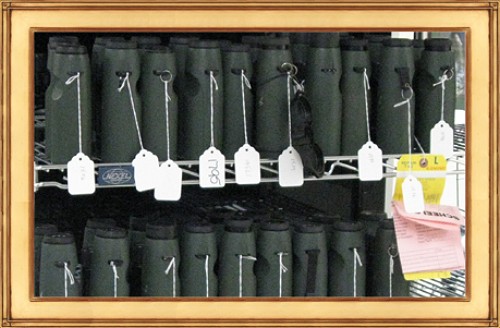
10000Birds-Optics

Title: Corey and the Optics Factory
Artist: Corey, 10,000 Birds
About the piece: Just like Charlie visiting Willy Wonka’s chocolate factory,
Corey gets to peek behind the scenes at the North American
Swarovski Optiks headquarters – as close to a
birder’s dream factory as one might get.

TheMarvelous-COLO

Title: At home with the birds
Artist: Seabrooke, The Marvelous in nature
About the piece: Aside from explaining the circumstances behind
why this I and the Bird is a little late getting up,
I also discuss a bit about our new home, including the
abundant birdlife that we share the area with!

Thanks for touring this art show!

The next gallery exhibition will be hosted by Kathie over at Sycamore Canyon. Send your submissions to Kathie at kathiesbirds1 (AT) msn (DOT) com by August 19, or to Mike at 10,000 Birds.