The Marvelous in Nature

At home with the birds

Dusk

Well, here I am, finally! I didn’t intend to be gone quite this long, but through various mix-ups, miscommunications and snags, we only just got our internet hooked up today. We opted to go for a bundle deal with one of the primary companies around here, and have been rather unimpressed with how things have gone. Our phone was hooked up two days late, and our satellite television still isn’t working quite right (we have a service person out today to have it looked at). Hopefully the last of all this will be sorted out today.

But, we made it, without incident, and we’ve otherwise settled in. We unpacked the last of our boxes yesterday, and there’s just a few last tidying-up details to take care of. It’s certainly feeling like home already. We’re just loving the location. Although it’s a bit further from town than we’d probably originally have considered, it’s still an easy, reasonable drive for once- or twice-a-week trips for supplies. If we were the commuting sort, it would be an average commute in to the “big” city (big being a relative term; compared to Toronto, virtually all of Ontario’s cities, with the possible exception of Ottawa, are moderate in size).

Dawn

The scenery and wildlife make it all worthwhile, however. Right across the lake is a provincial park, and the non-park shore has a pretty low population density itself. It’s not a small lake, at about 3.5 km long, but there’s only a couple dozen buildings along its outer shore. There’s hardly ever anyone out on the lake, at least that we’ve noticed. This weekend was a holiday long weekend for most people, and even then, while there was an increase in boaters, it still wasn’t busy, by any means. During our housing search we checked out a couple of other places that were located on lakes, but they were very busy, and noisy. Not our speed, really.

The birdlife here has been amazing, and we’ve only been here a week. We’ve tallied 63 species so far at our home, on the lake, or within a short walking distance along the road. To put that in perspective, our yard/neighbourhood list back in Toronto was less than 30 after five years of living there. August is perhaps the quietest time of the bird-season (April through October), when all the breeders have stopped singing, but the migrants haven’t really started to arrive yet. And in winter, while the diversity is lower, they’re coming to your feeders and are easy to observe. We anticipate some great birding through the rest of the year. The park has a checklist of 170 species to date, so we still have lots yet to see!

REVI2

Red-eyed Vireos are abundant, in any flock of birds there will be at least two or three of them. For the first few days after we arrived, there were Red-eyed Vireos hanging around in the trees just off our deck. At first we just saw the adults, but shortly a fledgling showed up with them. This photo was taken from the deck, looking down into a little shrub the family was sitting in. Also in the trees around the house has been a regular family of chickadees. Young chickadees are very vocal, loudly begging for food from their parents, so we can always tell when they’re outside.

CERW

A few mornings ago, Blackburnian was on his way down to the dock with his morning coffee when he heard some commotion along the road, a mixed flock of birds moving along the trees of the road edge. He grabbed his binoculars and went out to check them out. Among the flock was a family of Cerulean Warblers, and, knowing that I’d like to see them, he came back in to get me. Ceruleans are an endangered species in Ontario, sparsely distributed through the southern part of the province and only found in certain local patches. However, in these areas they can be locally common. One of the spots recognized as being among the best places to find breeding Ceruleans is not too far east from us, and we’re at the western edge of their eastern Ontario stronghold. It’s a great place for them; around here there is extensive forest cover, because of the low population density and the rocky landscape, which makes farming impractical.

YTVI

Although this isn’t a great photo of it, this was one of the birds I was most pleased to catch a glimpse of. It actually sat rather obligingly for a little while in this open spot on the branch, catching the morning light nicely to illuminate his bright colours. It’s a Yellow-throated Vireo, and it’s a bird that’s been on my jinx-bird list (those birds that seem to elude you no matter how hard you try to find them) for quite a while. I had heard a few singing before, but try as I might I’d never been able to see one. I hadn’t actually expected them to be breeding this far north and east, I tend to think of them as a Carolinian species, but consulting my recently-published copy of the Atlas of the Breeding Birds of Ontario, I see that they actually occur in a strong band along the southern edge of the Canadian Shield, as well, and their largest pocket of high abundance in the province is actually the Frontenac Axis.

Black-and-white Warbler

Black-and-white Warblers are also abundant in the area, if not quite so much as the Red-eyed Vireos. I haven’t seen any adult males, with their bold black throats, but I’m not certain whether that means the birds I have seen are females and immatures, or if the adult males have already moulted into their winter plumages. There’s a surprising diversity of warblers in our area. Back in Toronto and area we had a small handful of species that might breed commonly. So far here we’ve tallied 10 species of warblers, all of which would be local breeders, with the potential of another 10 or 11 that we haven’t encountered yet.

RTHU2

The first birds we observed at the house were a pair of Ruby-throated Hummingbirds on our first viewing of the place. One of the first things we did outside once we moved in was to fill up the hummingbird feeder. The previous residents had a feeder in place, but it didn’t look like they’d been keeping it filled. It didn’t take long for the hummers to find it. Since they did they’ve been regular visitors. They decided quickly that we weren’t any serious threat, and will often feed while we’re only half a dozen feet away.

COLO

And finally, the quintessential cottage-country birds, Common Loons. We didn’t notice any when we were viewing the house, but we were only here for an hour or so each time. Once we moved in they became quite apparent – but more by their calls than by spotting them. They call regularly every evening and periodically through the rest of the day. They seem to be done breeding, and move often from our lake to any of the many others in the area. On the same morning that we were out looking at the Cerulean family, a family of five Common Loons flew overhead, calling to each other, as they moved to the lake on the other side of the road.

We also noticed a phoebe had built a nest on the security light above the deck stairs, and occasionally hear one singing in the area. I was worried that we wouldn’t have scrub and meadow birds around here and that I’d miss birds from my parents’ like the Eastern Phoebe, Eastern Kingbird or Indigo Bunting, but they’re all here. There are Osprey and Red-shouldered Hawks frequently seen along the lake edge. We also have some more northern birds that I was hoping to get in the area, such as White-throated Sparrow, Common Raven, or several of the warblers. We’ve heard Red Crossbills on a few mornings, though it’s hard to say if they’re post-breeding dispersals or early “winter” irruptives.

And that’s just a small sampling of things! The rest of the local wildlife is just as varied and abundant… but that’ll be another post.

See you on the flip side

Moving boxes

Tomorrow’s moving day! We started packing yesterday and have nearly finished everything today. There are a couple dozen boxes and a dozen garbage bags of soft stuff all piled up near the door, ready to be moved out into the truck. We pick the truck up this evening, load everything from the storage locker and what we can move out from here, and then finish the last of it tomorrow morning before hitting the road.

We’ll be leaving this view:

Apartment view

For this one:

Lake

I’m pretty happy with that trade-off! Although, as city views go, ours isn’t too bad. I’m looking forward to taking my tea down to the dock our first morning there and sitting and watching the lake, a relaxing experience you just can’t get in the city.

Our internet and tv get set up on Thursday, so hopefully I’ll be back online at the end of the week. I’m sure I’ll have lots to share!

See you at the other end!

Anti-sunblock

Giant Hogweed (Heracleum mantegazzianum)

On Friday this week my mom and I spent the morning painting the outbuildings on their property to match the new house colour. There wasn’t a lot of stain left, and we used up the last of it without finishing the first coat. Since we were going to need another can, and we had a few other errands to run in town, the two of us made a trip out in the afternoon. We took the backroads home from town, a route I don’t often have occasion to travel anymore, since ordinarily I’m taking the major highways between my home and my parents’. It was nice to see some of this countryside that I haven’t been through in a while.

Along that road there’s a number of wet spots where these giant plants grow. The stuff is called Giant Hogweed (Heracleum mantegazzianum) and is – you guessed it – an invasive species. It’s related to our native Cow Parsnip (H. maximumin), and is in the same family (Apiaceae) as the also-introduced but much more frequently encountered Queen Anne’s Lace, among others. It bears some resemblance to the wild carrot of roadsides and pastures, with broad, spreading flower heads and deeply incised leaves. However, it grows to be three to four times larger, reaching on average 2-5 meters (6-16 feet) high, with some extraordinary individual plants as tall as 7 m (23 ft). The flower stalks are all a reddish-purple colour that helps distinguish the species from other similar-looking plants such as Cow Parsley or Water Hemlock (neither of which grow as tall as the hogweed).

Giant Hogweed (Heracleum mantegazzianum)

The plants were all mostly finished blooming by this time of year, but can be quite a roadside spectacle when they’re all in bloom, the many clustered plants, with their giant white umbrellas, looking like congregations of oversized Queen Anne’s Lace. Later in the summer, once they’re done blooming, they develop large seed pods, each the size of a pumpkin seed. A single, large plant can produce as many as 100,000 of the things. This was the stage most of the plants were in when we stopped to check them out. My mom, who has more opportunity to travel that way, living in the area as she does, watched as they grew, bloomed, and started growing seeds. I just caught the end of the show. The plants only flower in their second or third year, so these have been present for a while.

Giant Hogweed (Heracleum mantegazzianum)

The patch had started out some years ago not that large, but has spread out into the surrounding wet areas. This particular area of hogweed now lined both sides of the road and extended into the wet forest a short distance, as well as lining the edges of the cattail stand. You can see some distance patches on the far side of the cattails in this photo. It is an aggressive weed, choking out the native vegetation without much difficulty, aided in large part by its size. The individually biennial plants also grow from a perennial tuberous root system, such that once it’s expanded into an area it’s not likely to relinquish it again without intervention.

The species is native to central Asia, but was introduced to Britain and France in the 19th century, primarily as a garden ornamental, and is now found through many European countries. It was probably brought to North America not long after for the same reason. Since then it’s escaped the gardens it was planted in and is now found throughout wet areas in much of the northeastern and northwestern regions of North America. In Ontario it’s found through many localities in the south of the province, now occurring as far north as Haliburton county.

Giant Hogweed (Heracleum mantegazzianum)

Giant Hogweed prefers wet areas such as riverbanks and marsh edges, but ditches are also a perfectly acceptable habitat. Given the disturbed nature of roadside ditches, sturdy plants such as this are a natural to settle in, and it doesn’t take them long to spread out into other areas from there. Along this stretch, the giant leaves of the huge plants nearly envelop the guardrails from view.

You can easily see how such a species could begin to crowd riverside walking trails or boardwalks, if given a chance. With most plants this wouldn’t be a problem. However, Giant Hogweed (and in fact all members of the genus Heracleum, including Cow Parsnip) contains a chemical that is as dangerous to encounter as that of Poison Ivy. The sap, and all of the oils that coat the surfaces of leaves and stem, contains a type of compound called furanocoumarin. Whether or not you can pronounce the stuff, it will still create an extremely adverse reaction with your skin.

Giant Hogweed (Heracleum mantegazzianum)

Brushing up against the leaves or stem of the plant will result in the oils being spread across your skin, much like touching Poison Ivy does. The reaction it produces is different, however; the oil of Giant Hogweed doesn’t create an allergic reaction the way Poison Ivy does, but is rather a phototoxic plant. This means that getting the oil on your skin will make your skin extremely susceptible to burning upon exposure to UV rays such as sunlight. It’s sort of the opposite of sunblock, enhancing the effects of the UV rays instead of reducing them.

It takes 10 minutes for the oils of the plant to set in to your skin, but after that any exposure to UV light will cause the skin to redden and itch, and subsequently blister like a bad sunburn (which is effectively what it is). The burns will usually become purple or blackish scars, persisting for potentially several years. If you can remain inside, or completely covered up and protected from any UV rays, you’ll be fine, no reaction will occur. Wash the area with soap and water and try to remain protected for several days before going back out in the sun. Getting the oil or smoke from the plant in one’s eyes, however, can cause temporary or permanent blindness.

Giant Hogweed (Heracleum mantegazzianum)

Like with Poison Ivy, the effects of the oils seem to be contained to just a small group of animals. The insects appeared to be unaffected. We found a small plant at the edge of the road that was still blooming, and being visited by small wasps. As with the common Queen Anne’s Lace of the meadows, the flowers of the Giant Hogweed will attract local native pollinators. Wikipedia notes that its introduction to France was “much appreciated by beekeepers.” The flower heads can often be heavily infested with aphids, but I didn’t happen to notice any while we were there (though I admit I wasn’t specifically looking).

Giant Hogweed (Heracleum mantegazzianum)

There are control programs in place in some areas to try to manage this invasive plant, but methods are complicated by the danger of touching or inhaling its oils. If well-protected with full skin and eye coverage, it is possible to physically cut down the flower stems and broad leaves. This weakens the tubers (which can be as deep as 60 cm, or 2 ft), making them easier to pull up and destroy successfully. However, probably more effective, and certainly more efficient, if a bit less environmentally friendly, is the application of herbicides to the plants. Even once the plants themselves are removed, however, the seeds that the plant has dropped can persist and germinate for up to 15 years later.

Giant Hogweed (Heracleum mantegazzianum)

The Apiaceae family contains quite a number of unpleasant plants. Besides the invasive hogweed, there’s also Water Hemlock, native to North America, and Poison Hemlock, native to Europe, that are extremely poisonous, with ingestion of the plant in even a small amount causing death within as little as 15 minutes. The latter was the hemlock that was given to Socrates (not related to the hemlock tree, which is what most people likely associate with the name hemlock). On the other hand, quite a lot of the family’s members are also commonly eaten – including carrot, parsley, celery and parsnip, just to name a few. I wonder how many people it took to figure out which was which?

The Royal Oak

Royal Oak at Speyside School

This is the very first school I ever attended. Some twenty-odd years ago I arrived here for my first day of kindergarten. I remember very little about my time there, just small snippets such as the sandbox in the kindergarten room, or playing in the schoolyard. I was only at the school for that one year, after which it was closed due to low enrollment, and the students sent to other local schools. It was too bad, because this one was very convenient to home, being at the end of my parents’ road. Since its closure as a public school it was used for two years as a Catholic school while their new building was constructed in Milton, and then subsequently for a bit by York University, for their teacher education program.

These days the school is vacant, and looks forlorn, forgotten. The weeds grow high in the front yard, and the trees are unkempt. Overgrown bushes crowd out windows that are covered with metal grills to protect against vandals. Fresh graffiti defaces the front door, and old vandalism on the outer walls has been covered over with brick-coloured paint. It’s a sad, lonely place now, it hasn’t seen a child in a long time. The only cars regularly seen there are the local ambulance when it parks while on-call, and the occasional police car as they sit patrolling for speeders. The heat to the building was turned off long ago, and the building itself is no longer usable.

Royal Oak at Speyside School

In front of the gymnasium grows this magnificent old oak tree. Its boughs are strong and spreading, its trunk more than two feet in diameter. It looks like it may have seen better days as well, with the bark beginning to crack with age and a few dead branches in its crown, but it’s generally still very healthy.

Last year it was given an Ontario Heritage designation. The tree has an interesting history, and has done a bit of traveling. It arrived in Ontario as an acorn in 1937, sent overseas from England with many others taken from an oak tree in Royal Park in Windsor, distributed throughout the commonwealth to commemorate the coronation of King George VI and Queen Elizabeth I. The little local school, then a one-room schoolhouse known as Dublin School, was one of the lucky sites chosen for the three acorns allocated to the township. The schoolhouse’s teacher arranged an evening planting ceremony and the community came out to participate.

In 1960, a new brick multi-class school opened a short distance down the highway, amalgamating the students from all the surrounding one-room schoolhouses, which subsequently closed. Dublin School was sold to a private individual for retrofitting into a home, but money was raised to have the 23-year-old, 20-foot-high oak tree moved to the new Speyside School. In the 48 years since it was relocated to its current home, the tree has grown and for the most part flourished. In a recent assessment it was measured at 13.5 meters (44 feet) tall and 79 cm (2.5 ft) in diameter.

Plaque for Royal Oak at Speyside School

When Speyside School closed its doors in 1986, acorns from the Speyside Royal Oak were planted at the four schools that the Speyside students would now be attending, so while the crown of this tree no longer shades children playing at recess, its offspring do. A motion was made to designate the Royal Oak as a heritage tree last year, in recognition of its cultural and historical value in the community, and a formal plaque was placed on a large stone at its foot. An article was run in the local newspaper at the time, but because the school is no longer used or visited by the community, I think its story will gradually fade into obscurity. At the very least, however, the heritage designation protects it from being harmed or cut down for the rest of its natural lifespan, which could potentially be 500 years or more.

Royal Oak at Speyside School

Considering that this individual is just 71 years old, it’s still in its youth. The tree is an English Oak, Quercus robur, a species native to Europe and bordering portions of Asia and Africa. The species can grow to heights of 35 m (115 ft) or more in good conditions. It’s related to our White Oak, and shares the same broad, round-lobed leaves. As with the White Oak, the acorns mature in a single season, taking about 6 months to develop (some oaks, such as the Red Oak, mature the following season, requiring 18 months to develop).

Royal Oak at Speyside School

I didn’t see any acorns developing on this individual, and I wonder if that’s a reflection of some aspect of its current health, or if they simply haven’t developed yet. It looked like the leaves were being enjoyed by somebody, however. On the underside of a couple of the leaves in the photo above I could see the cast-off skins of caterpillars. I’m not certain of the species. Bits of the leaves are missing, probably from the same caterpillars, and they’re speckled brown from another pest. Likely most insects or fungi that would affect our native White Oaks would also find the English Oak attractive.

Royal Oak at Speyside School

In terms of use by humans, oak has long been used in building because of its inherent strength and hardness. Wood from this species especially was used in the construction of ships until the 19th century. The attractiveness of its grain patterns when sawn into planks has resulted in its use as decorative paneling as long ago as the Middle Ages, and it can be found, among other places, lining the debating chamber of the British House of Commons in London. It’s often used for constructing wine barrels, and lends a distinct taste to the finished wine. The wood of the European oaks, including Quercus robur, are particuarly preferred over the North American oaks for the greater refinement they imbue to the wine. Oak bark is rich in tannins and has often been used by tanners in preparing leather (this same tannin content can make oak leaves and acorns dangerous to horses, however, and horse owners are encouraged to fence off oak trees from fields).

In an interesting bit of trivia, in an episode of the British version of Who Wants To Be A Millionaire?, the million-dollar question was “If you planted the seeds of ‘Quercus robur’, what would grow? A: Trees B: Flowers C: Vegetables D: Grain”. The player got the question right.

Royal Oak at Speyside School

It’s amazing how attached a community can become to a local, long-standing tree. Two years ago, in 2006, the city was planning on widening a section of road in the south part of the county. This road-widening would require the removal of a 250-year-old native White Oak. There was a public outcry to this decision, and so the town gave the community the opportunity to save the tree – if they were able to raise the $343,000 that it would cost to divert the road around it, within 6 months. Amazingly, they did it, and the tree still stands, while traffic detours around it.

As much as it’s hard to think of what either of these trees have been silent witness to over their lifetime so far (the 250-year-old took root sometime in the 1760s), it’s even harder to imagine what they will see over the rest of their lives – in the case of the Speyside tree, potentially another 400 years or more. The changes to come will likely be as dramatic and profound as the changes this land has seen over the past 400 years. If we’re lucky, we as a species will still be here; if we’re even luckier, so will this oak tree.

The death-defying frog

Wood frog

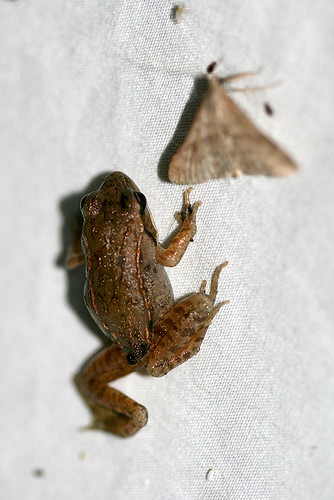
Last week, while out checking my moth sheet at my parents’, a frog came up and found me. He hopped right up and on to the white sheet, where I couldn’t miss him. Perhaps he was jealous of all the attention the Gray Treefrog got a few weeks earlier, but he certainly seemed to want his own feature story. What could I do but oblige?

He was small, and his colours seemed underdeveloped, which made me wonder if he was still an immature, not too far removed from his water-loving days. Still, despite the indistinct markings, they were clear enough for me to confidently identify him as a Wood Frog, Rana sylvatica. Adult Wood Frogs will have a dark chocolate-coloured mask, which has contributed to their colloquial names of bandit frog or masked frog, though these names are rarely used. They’re the only species in eastern North America with this facial marking. The top of their eyeball is golden while the bottom is dark, blending in with the mask pattern that crosses it. They have two lines that run laterally down the length of their back, a white “moustache” along their upper lip, and a small dark patch at the front of each shoulder, but generally otherwise they’re brown and fairly nondescript. If the mask isn’t well-developed, as in this individual, they’re not very distinctive.

They vary in size according to age and sex. Males are smaller than females, and the small size of this little individual may also have meant it was a male. In breeding season the males will develop a swollen “thumb” that they use in gripping the female during mating, but it wouldn’t be apparent at this time of year. Wood Frogs may live up to 4 or more years; males begin breeding their first summer as an adult, but a female doesn’t breed until her second.

Wood frog

Wood frogs are North America’s most northern-occurring species, and the only one found above the Arctic Circle. They range from coast to coast in Canada, found from the Aleutian Islands in Alaska, through northern and interior British Columbia and the three territories, east to Labrador and the Maritimes. In Ontario, they’re found right up to the Hudson Bay coast. They are also Canada’s most wide-ranging species. They’re less widespread in the states, found mostly in the northeast, with small local populations in Colorado and Wyoming.

Part of the reason for this distribution is their choice of habitat. They’re found in the boreal forest and the deciduous forests of the northeast. Although individuals may move up to a kilometer during their summer foraging activities, they’re rarely found far from water. More specifically, they must be near vernal pools, small ponds and wet depressions that dry up partially or completely in the summer, their primary breeding habitat.

Wood frog

Even before the Spring Peepers start peeping, the Wood Frogs emerge and congregate at vernal pools to breed. They are quite often the first frogs heard calling just as spring starts to arrive. Males will gather at the breeding site, calling loudly and sounding a little like a duck quacking. However, they only call until the females arrive, which may be right away or up to two weeks later, after which they’re infrequently heard.

Females may lay up to 2000 or more eggs, secured to the base of a submerged shrub or other vegetation. Eggs are laid in a large mass, and later females may add their eggs to the initial groups. Laying eggs together like this creates a large, dark ball, which warms up in sunlight more quickly than individual or a string of eggs would, important in early spring when the water can be very cold. Mating takes place in early to mid-April, as soon as the pond’s water is accessible. Because the pond is likely to completely dry up in the heat of summer, it is mandatory that the frogs’ tadpoles get as early a start on life as possible.

Although the tadpoles in vernal pools are under constant threat of their habitat drying up before they’re ready to leave, they’re also protected from fish and many other predators found in larger water bodies that can’t tolerate the drying out. It takes a tadpole anywhere from about 45 to 85 days to go from egg to frog, with the wide range depending largely on water temperature. Warm conditions can speed up the process considerably (which is good, because warm conditions can also speed evaporation). Usually the tadpoles are out well before the water dries up completely.

Wood frog

Newly-metamorphosed froglets and adult frogs that have finished breeding will spend the rest of the summer hopping around the woods surrounding the vernal pools, foraging on typical frog fare: crickets, earthworms, slugs, spiders, beetles, and whatever other similarly-sized invertebrates they happen to come across. During this period they may roam hundreds of meters from their home pond, and about 20% of young froglets will disperse to other nearby ponds, maintaining gene flow.

When fall rolls around, the frogs return to the upland forest area near their pond and start preparing for the winter. Part of this involves converting the glycogen in their bodies into glucose. Glucose acts as a sort of natural “antifreeze”, preventing the fluid inside their cells from developing ice crystals which will puncture the cell walls. The frog then buries down under the leaf litter, but, unlike many other frogs that will burrow down below the frost line, the Wood Frog remains near the surface. Slowly as the weather turns cold it stops breathing, its heart stops beating, and its brain shuts down – for all intents and purposes, becoming clinically dead. The internal (but extracellular) fluids of the frog freeze almost solid. The frog remains protected from the elements by the surrounding insulation of the leaf litter and snow, but still able to withstand ambient temperatures of as low as -6 C (21 F).

Wood frog

With the melting of the snow and the warming weather, the process reverses. The sun’s warm rays hit the dark leaf litter, warming the ground and the frog hidden within it. Slowly the frog’s internal fluids melt to become liquid again. About an hour later its heart then begins beating again, and it starts to breath. Brain function returns to normal, and the frog’s body begins to convert the glucose back to glycogen again. Within a day the frog can resume normal activity.

Several species of frogs have evolved the ability to survive such winter freezing, nearly all being early spring breeders. Spring Peepers, Boreal Chorus Frogs and Gray Treefrogs all freeze during the winter. The advantage to such an adaptation is that it allows the adults to start breeding as soon as temperatures rise above freezing. Virtually all of these species are terrestrial forest species that take advantage of vernal pools and need to lay their eggs as early as possible.

Naturally, scientists are very interested in this amazing ability, since it would have application in tissue and organ preservation, and the practice of cryonics (freezing whole living organisms to be resuscitated later). Given that a frog may live to age four or more, it may go through this freezing process three or more times in its life. Check out this documentary clip (from YouTube) to watch a frozen frog come back to life: