The Marvelous in Nature

Construction workers

Carpenter Bee sawdust

My parents’ house is an old century farmhouse, onto which a three-room addition was built. Two rooms are on the same level, but the one at the back is slightly raised, and the roof is at a shallower pitch. Where the two meet there’s a slight overhang, which has been edged with the same trim that runs along the front of the house. For the last few weeks, there have been small piles of sawdust collecting on the shingles under the eaves of the house here. In rainstorms they all get washed away, but in short time they have returned.

There are actually termites in Ontario, and they have been reported from Halton County where my parents currently reside. However, termites tend to be subterranean creatures, building tunnels on the surface of objects (such as walls) when they want to move someplace. While termites might be the creature that immediately jumps to mind at seeing such evidence, sawdust observed so high off the ground and without any apparent tunnels most likely belong to another culprit.

I climbed up onto the roof while I was painting that bit of the exterior wall, and got a second clue. From the bit of trim above the sawdust piles, I could hear very distinct, very loud chewing. Because of the way the roof slopes I could look up and under the eaves and see if I could spot whatever it was, expecting a vertebrate of some sort, but nothing was there. Annoyingly, while I was trying to check things out, and then later as I was painting, a bumblebee kept coming up and hovering around me. I’d back off and let him disappear and then continue on.

Carpenter Bee female

I overlooked the most important clue: the bumblebee. Which, it turned out, was not a bumblebee at all. I came home and looked up bumblebees. They are all generally solitary insects, nesting underground. I had this vague notion of “carpenter bee”; I knew carpenter ants, carpenter beetles… I googled Carpenter Bee anyway. The very first webpage that came up, an information page at Penn State, started out by saying, “People who complain about bumblebees flying about under the eaves of their homes are probably being annoyed by carpenter bees.”

Well. Mystery solved. Here in eastern North America, the species we have are Eastern Carpenter Bees, Xylocopa virginica. They are large, chunky, bumblebee-sized bees that are also marked in black and yellow fuzz. The primary visual difference is that bumblebees always have fuzzy abdomens with a bit of yellow, while carpenter bees have completely black, fuzz-less abdomens. Of course, I didn’t know this at the time. I also think I had at some point learned that bumblebees nested underground, but was forgetting that at the time. Bumblebees will generally have no interest whatsoever with your eaves.

Carpenter Bee female

Carpenter bees, on the other hand, are very fond of eaves. Or really, dead, unpainted wood in general. Carpenter bees, as the name implies, will construct their nest burrows in dead wood. In the wild they would ordinarily do this in snags, dead branches or fallen logs, on the underside or the lee side of the wood. However, they’re not especially picky about the wood they use, and the processed wood we humans use to build our homes and outbuildings, as well as fence posts and boards and other outdoor constructions, will suit them just fine. If you want to make sure the bees don’t target your buildings, make sure they’re all varnished or painted, which generally discourages them.

Females do all the nest-building. The individual in the photo above is a female; she can be told by her longer, pointy abdomen and her all-black face (males have a splash of yellow across their forehead). Females also have larger heads with more widely-spaced compound eyes (those of a male come close to touching at the top). Females use their powerful mandibles to carve out the tunnels. She looks like she might be holding a wood chip from her tunnel in the photo above.

Carpenter Bee holes

They start out with a hole approximately 1 cm (less than half an inch) wide, building straight in to the wood for an inch or so, usually against the grain, and then make a right turn and build the rest out perpendicular to the entry tunnel, this time with the grain. They generally prefer wood that’s at least two inches thick, so the 1×8 boards that formed the trim on the eaves didn’t actually present a very thick tunneling substrate.

The tunnel will end up being 4 to 6 inches (10-15 cm) long when completed, and it takes a female on average about 6 days to complete an inch of tunnel, which means anywhere from 30 to 42 days to do the whole thing. She pretty much spends her whole life focused on that activity, and when she’s done and has laid her eggs, she’ll die.

Once the tunnel is complete, she’ll systematically start filling it with future bees. She’ll begin by forming a ball of pollen and regurgitated nectar and placing it at the end of the tunnel. She’ll lay an egg on the ball, then seal it off into its own compartment using chewed wood pulp to form the barrier (perhaps that’s what she’s carrying that woodchip for in the photo). She’ll form 6 to 8 compartments within the tunnel, each with a single egg. This is a lot of work for just 8 offspring, not all of which will survive to adulthood and reproduction age.

Carpenter Bee nest holes

Carpenter bees are not truly social bees, the way honeybees are; every female has the potential to reproduce, and there’s no queen organizing the group. Each female will build her own tunnel. However, they will often congregate in the same general area. This is partially because a female will tend to reuse the nest she hatched from, or build her new nest nearby. A single board can be targeted and eventually become riddled with nests while other boards may be left untouched. In cases where these holes are excavated in a structural beam they may cause concern, but generally speaking carpenter bee damage is mostly cosmetic.

From the laying of the egg to the emerging of the adult takes about seven weeks, though the timeframe may be longer or shorter depending on local temperatures through that period. The adult will emerge from the chamber where it developed by chewing its way out through the partitions along the long tunnel to the entrance. Adults will generally emerge in mid- to late-August, and will spend the rest of the summer and fall feeding on nectar from flowers (an interesting habit they have is to not always go through the mouth of the flower, but instead sometimes pierce the base of the flower to get at the nectar without pollinating it).

In the fall they’ll return to the tunnel where they hatched from, and they’ll spend the winter there. In the spring they’ll emerge, and the females will start building their tunnels. The males, while the female is hard at work, will patrol the area. Males are harmless, as they have no stinger and cannot sting, but they are curious and may come over to check you out if you wander into their area, which can be very disconcerting. Females do have a stinger and are capable of stinging, but are generally fairly docile, ignoring you if you’re just simply in the area, and will only sting if handled.

Carpenter Bee larvae

When I went up to paint the walls on other side of the house, I discovered this scene underneath the eaves. It looked like the half-developed contents of one of the tunnels had been pulled out by something. Scattered on the shingles were a few chunky larvae, one of which that looked like it was halfway into turning into a pupa, as well as some thick orange chunks. I’m not sure what the orange chunks are, but I suppose them to be the pollen balls that the larval grubs are provisioned with.

I have no idea why these were all on the shingles. If it had been a predator one would think that the grubs would have been eaten, not left to roast on the hot roof. It takes the adult female about a day to provision and seal off each cell, so I was wondering if perhaps the egg that had been laid first had already pupated and emerged as an adult, and as it chewed its way through to exit the tunnel it ended up knocking all the others out. But that seems a bit of a stretch. Maybe a rival female went in and pulled everything out so she could use the tunnel? Also seems a bit of a stretch. I couldn’t find anything online to suggest the reason for it.

Carpenter Bee female

The book Insects, by Stephen Marshall, indicates that Eastern Carpenter Bees used to be more restricted to the United States, but in recent decades have been moving north into southern Ontario. Given their strong site fidelity I’m not sure how quickly they spread, or why they would be moving north. However, this may explain why this is the first year we’ve noticed their presence there. They sure seem to like the spot now that they’ve found it!

Carpenter bees are, like most bees, important pollinators in an ecosystem, and many people will tolerate their presence in their buildings despite the damage because they provide a valuable services to their flowers and trees. Unfortunately, pollinators the world over are in decline due to habitat loss and widespread pesticide use, as well as other pressures. A group called Pollination Canada runs a citizen science project where you can make observations on your local pollinators that will help scientists to better understand what’s going on with this very important group of insects.

Pink flamingos for the yard

Edit: This post was recently included in the 200th edition of the Friday Ark. Pop over for more great posts.

Caribbean  Flamingo (Phoenicopterus ruber)

The frequent rain this spring and summer has meant that hay farmers have had trouble harvesting their crops, and my mom ran out of her winter supply some time ago. She’s been stretching her reserves with the help of a few bales from a neighbour, while waiting for her hay dealer to have new hay available. In the meantime she’s been investigating other potential sources to tide her over. We swung by a farm at the corner of my parents’ street on our way out to town this week, to see if they had a few bales they might be willing to sell.

For most of my childhood I remember it as a horse farm, with hay growing out front and a couple of horses hidden in the back field. The farm was sold about 10 years ago, and the new owners have a menagerie of different creatures. The owner breeds birds, primarily parrots but also a number of species of exotic waterfowl. And, in a fenced off area containing a small bubbling pond, flamingos.

Caribbean  Flamingo (Phoenicopterus ruber)

There they were, real live flamingos, in all their splendid pink glory. What a funny choice for a pet bird, I thought. They weren’t alone in the enclosure, the waterfowl also paddled in the pond. The flamingos were the most numerous, however; I think there were eight individuals. My mom spoke with the owner regarding the hay, but also chatted about the birds. My impression was that he sells his birds’ offspring. I wouldn’t have thought there was a big market for backyard flamingos, so I’m not sure who his buyers would primarily be, whether they’re private enthusiasts or zoos or wildlife parks or what. (Perhaps Wren of Wrenaissance Reflections would like a few for her yard, to join her current flock?) I didn’t think at the time to ask a lot of questions about them, being more focused on admiring the birds themselves, though I’m sure he would have been kind enough to provide the answers; an oversight of mine.

Their legs seem ungainly, extraordinarily long for their body size. The length of their legs is useful for keeping their body above the water while they’re wading, looking for food. Of course, with legs that long, you need an equally long neck to be able to reach the ground if you’re in shallow water. They look even stranger in flight than they do on the ground, with their long neck sticking out one end and their long legs sticking out the other, their wings spread out to each side, and hardly any body left. My neck gets tired just looking at them. If I were a flamingo, I’d curl my neck in to my body like a Great Blue Heron does. None of these birds were going anywhere, though, I believe the owner had all of his birds pinioned or feather-clipped, since the enclosure was open-topped.

Caribbean Flamingo (Phoenicopterus ruber)

I’m not positive what species these are, since at the time I just assumed them to be Greater Flamingos and didn’t ask. However, there seems to be quite a bit of confusion on the web, and trying to find representative photos of the different species is tough. They’re either Greater or Caribbean Flamingos (Phoenicopterus roseus or P. ruber), but the two were once considered conspecific, so some photos may still be labeled under the old classification. I think these are Caribbean, however, based on the eye and bill size – the Greaters seem to have tiny eyes and huge bills, while Caribbeans are more balanced (as much as they can be with such a honkin’ big snoz). There’s also a Chilean Flamingo (P. chilensis), which also used to be considered conspecific but has now been separated. However, it’s easy to tell apart by its gray legs. I like a straightforward field mark.

The Caribbean is native to Cuba and Mexico south to Venezuela and the Galapagos. It’s occasionally sighted in Florida, but most of these are considered to be escapees because it is so commonly kept in captivity. However, at least one banded individual was initially from the Yucatan, and some others may be genuine vagrants from Cuba or elsewhere nearby.

Caribbean  Flamingo (Phoenicopterus ruber)

Flamingos are pretty neat birds. Aside from their bizarre shapes, they have some interesting adaptations. Their colour is primarily obtained through their diet. When the bird is growing in new feathers, which it does once a year, the red pigments contained in the shrimp that make up the majority of its diet are deposited into the feathers, giving them the flamboyant salmon pink colour. The owner indicated that the colours are brightest in fall when the feathers are fresh; as the feathers age, they fade in colour. In captive birds, these pigments are usually obtained through supplements added to their foods (for instance, processed shrimp in the birds’ regular pellets). It’s the pigment molecules that are important; without them, a flamingo will grow in white feathers. This premise applies to many species of birds, mostly red or orange ones. The American Birding Association magazine Birding recently ran an article about such pigments affecting the plumage of Baltimore Orioles – check out the pdf for more info on the phenomenon (Blackburnian is one of the authors!). A well-fed bird will have more brightly-coloured plumage, which is a good indicator to potential mates of the health of the individual.

Caribbean Flamingo (Phoenicopterus ruber)

Flamingos have really interesting bills, backwards from the bills of most birds. In most birds, the upper mandible is larger than the lower one (especially pronounced in the birds of prey), but in flamingos it’s the opposite – the lower mandible is the larger one. It’s also bent in a funny way that you don’t see in most birds. The reason for it is their feeding habits. Flamingos are filter-feeders, straining out invertebrates from the water, primarily brine shrimp. They have hair-like filters called lamellae, which are very similar to what a baleen whale uses to feed. Feeding is accomplished in a similar manner, by taking a mouthful of water and pushing the water out through the lamellae, trapping the critters against the filter. The bill is bent backwards so that when the bird lowers its head to the water, the bill is parallel with the surface, facilitating feeding.

Caribbean Flamingos (Phoenicopterus ruber)

Young flamingos are gray, and obtain their pink plumage in their first moult into adult feathers. They also have relatively straight bills, which straighten out and take on the distinctive colouration as the chick ages. It takes about two months from hatching for a chick’s bill to become developed enough for it to filter-feed. During that time, the parents feed it a milky secretion produced by glands lining the upper digestive tract. The “milk” contains the proteins and nutrition the chick needs, as well as white and red blood cells. The only other group of birds to produce “milk” to feed to their young are the completely-unrelated pigeons and doves of the family Columbidae. Flamingo “milk” contains more fat and less protein than pigeon “milk” – somewhat interesting as one would think the adults’ diet of shrimp would contain less fat and more protein than the pigeons’ diet of seeds.

I poked around the internet to see if I could find out how much a flamingo would run you, but I couldn’t find anyone who even indicated they bred flamingos, much less who had a price list online. I did find a store that sells flamingo pellets, however – the food will set you back $120 CAD for a 50 lb bag. I have a feeling that, like many tropical birds, the sale and transport of flamingos is regulated due to their inclusion on the Convention on International Trade in Endangered Species (CITES), and so you have to jump through a few hoops and piles of paperwork to obtain captive birds. Which would explain why I don’t see any listings for them online. Would make a pretty neat yard addition, though…

Daylilies and dragonflies

Meadowhawk sp.

This is the time of year when my mom’s garden really reaches its peak. It’s a perennial garden, with many different types of flowers, shrubs and plants, but with a focus on daylilies. There are hundreds of cultivars of daylilies, you could fill up acres collecting every one. Mom doesn’t have that many; her collection is somewhere around a hundred cultivars, and was mostly limited by the space in the garden. Most daylilies flower from mid-July through August, and during this time the garden is a riot of colour. The only natural flower colour that seems to be missing is blue, which they haven’t managed to create in the species, perhaps because blue is a structural pigment and isn’t formed through the same processes that produce reds, oranges and yellows. Each bloom on a daylily only lasts one day (hence the name), and a walk around the garden each morning will be just a little different from the previous day, with some cultivars blooming, others not, multiple flowers on some, and first blooms of the summer.

Meadowhawk sp.

For the last couple weeks, we’ve noticed that the garden is full of these guys, little dragonflies, short and small by dragonfly standards, in red and orange. Dozens of them, all hanging around the garden. They’re meadowhawks, a type of skimmer. About the same length as the damselflies, they can be easily distinguished by their chunky bodies and wings, and oversized eyes. They’re fairly common dragonflies, but there are several species and telling some of them apart can be tricky. A number of species have orangey wing markings, but for those that don’t (and this includes the ones that occur here), the best characteristic is the face. Around here we’re likely to get White-faced, Cherry-faced and Ruby Meadowhawks. There is some overlap in face colour, just to make things confusing, but generally the White-faced have a pure white face, the Ruby has a straw-coloured face, and the Cherry a reddish face (although eastern individuals can be olive-yellow). The book Dragonflies Through Binoculars states that Ruby and Cherry-faced cannot be separated by face colour in the east. The Stokes Beginners Guide to Dragonflies also warns, “A meadowhawk with a dull yellowish or ivory face cannot be identified with certainty in the field.” Rather, definitive identification requires examination of the genitalia under a microscope. And, to throw a wrench in the works, Through Binoculars indicates that all three species hybridize in the northeast, such that intermediate individuals may not belong to one species or another but are instead hybrids.

Meadowhawk sp.

The brown individuals are all females, or possibly immature males. Male meadowhawks remain this brownish colour for about two weeks before obtaining the bright red of maturity. During this time they’re separable from the females by examining their genital structures, but I didn’t look that closely. It’s interesting how much of dragonfly and damselfly identification comes down to the genitalia. How do the insects know which species another individual is when courting? Are there little visual clues that we haven’t seen, or are too small for our naked eyes? Or do they use behavioural cues? It would be embarrassing to try to hook up with a female just to find your lock and key don’t fit; good thing dragonflies don’t get embarrassed.

Meadowhawk sp.

More than most other dragonflies I observe, meadowhawks like to perch at the tips of tall pointy things that stick out from the surrounding foliage. It was tough to get a photo of one actually on a daylily bloom because they would favour the long grasses, tall thistle stalks, and even the unopened daylily buds over the flowers themselves. Like all dragonflies, meadowhawks are predaceous, feeding on other insects, using their speed and agility to catch them. I imagine that perching in an exposed location like that offers them the best view of their surroundings, and potential prey, and also allows them to dart out after something without having to navigate around plants. If you watch a meadowhawk closely you can see it turning its head to focus on different things.

Meadowhawk sp.

I’ve noticed the occasional individual will adopt this pose while resting. It’s called the “obelisk position”, and its purpose is to minimize the surface area of the dragonfly’s body that is exposed to the sun. Since insects have no physiological ability to thermoregulate, they must change their behaviour to prevent overheating. Whereas we would simply sweat and cool down through evaporation, a dragonfly must either seek shade or, where shade isn’t available, or is impractical (such as in hunting in open areas), minimize their exposure to the sun. While most dragonflies are associated with water edges, meadowhawks, as their name implies, are often found in meadows or other open areas that may have minimal shade. Notice how small the dragonfly’s shadow is on the fern frond.

Also interesting to note, the above individual appears to be a male changing from its immature brown into its mature red colouration. You can see the red starting on the top of the abdomen in a couple spots.

Meadowhawk sp.

In taking close-up photos of a few individuals, I noticed that the pattern of colours and spots on their large compound eyes varied from one individual to the next. For instance, the above individual looks like it has pupils and is smiling at the camera, while the one below has more diffuse spots on its eyes. I wonder if this is a difference in species, in sex (since immature males are the same colour as females), or simply individual variation?

Meadowhawk sp.

We’re moving!

House as seen from the lake

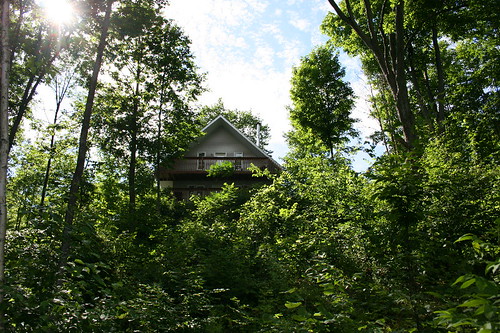
After some five years here in Toronto, Blackburnian and I decided it was time for a change, time to move on. Neither of us are city people, and when circumstances allowed that we could move back out to the country, we jumped on it. We’ve spent the last three weeks or so driving around a good portion of southern Ontario checking out house listings, which, it turns out, are few and far between when you’re looking for a rental (we want to both save up a bit and also make sure that we really want to be in the area before we commit to investing in a home). Yesterday we spent a long day on the road, checked out four listings, two of which we absolutely loved. The view from the one of them finally won us over, and we went back today to take care of paperwork. While we were out that way (it’s nearly three hours from where we currently live, so not exactly around the corner!) we revisited the house to take some measurements and also some photographs to share with people.

View from the upper balcony

It was the view that really drew us to the place, and the general setting. It’s right on a shallow lake, with the house at the top of a small rise, looking through the trees at the water. It’s surrounded by forest, with small open patches here and there. Unfortunately, both days we visited it was later in the day, past the hour when birds would be active and singing, but it’s starting to get late in the summer to hear much anyway. The timing of the move isn’t great for experiencing the local bird life (we may have to wait till next spring for most of the residents), but we’ll get to see all the migrants through the fall and feeder birds in the winter, and in the meantime there’s still lots of other wildlife to be seen.

Lake

A view looking up the lake from the dock. It’s a relatively small lake, and quiet. Apparently most of the water traffic is human-powered, with just the odd motor boat going by. The other shore is only about 200 meters/yards away, an easy paddle, or even an easy swim if one was so inclined. The other shore is part of Frontenac Provincial Park, another reason why boat traffic is quiet. A short canoe paddle will take you to miles of hiking trails through relatively untouched wilderness.

Looking back from point

Part of the 2 acre property swings out into a little point. This is looking back toward the dock and shoreline from the point. The water in this area is fairly shallow, only a couple feet deep through most of it. The water is pristine and clear, and you can see right down to the gravelly bottom. There are plenty of fish in the water, and what I would consider to be larger stuff (fisherpeople would scoff at that description, I know), bass and sunfish and others that are easily six or eight inches long. There are even bass spawning beds in the gravel just offshore (Blackburnian had to point them out to me; he used to fish and knows all this stuff much better than I do).

Muskrat

To make up for the lack of birds while we were there, other stuff put in appearances. Here’s a muskrat that was paddling around in the lilypads just off the dock, while we were standing there.

Black Rat Snake

And a Black Rat Snake that we startled from the shrubs at the edge of the lawn (I’m actually not sure who was more startled, the snake or us). It’s the first one either Blackburnian or I have seen in Ontario, where their range is extremely limited, and the species is declining and listed as threatened. They’re only found in a few patchy locations in the southwest, and in the Frontenac axis in the east. Unfortunately, I only had my wide-angle lens on the camera, not anticipating to be taking photos of wildlife. It seems that there will be lots of good fodder for future blog posts from there!

Main deck

Not sure if you can tell, but I’m excited to move! We officially take possession August 1, but are hoping to arrange to be in a few days earlier, if possible, both so we could overlap the move with our last day at this apartment, but also simply because we’re really looking forward to moving in!

Desktop pond

Desktop pond

This week I returned to my parents’ to help paint the exterior of the house. Nearly all of my time over the two days was wrapped up in that, with only a bit of time for wandering about outside, so I didn’t get any photos. The one area I did spend a bit of time looking at was the water garden I mentioned a couple weeks ago. I was looking for Gray Treefrog tadpoles, the possible offspring of my midnight singer, and the garden’s proximity to the house meant I could wander over for a break and poke around.

Peering closely, I spotted a few hanging at the walls of the trough. Tiny and black, their body only a few millimeters, perhaps an eighth of an inch. With their tail, not more than a centimeter, less than half an inch. At this age, I have no idea if they’re treefrogs or another species, though the former seems most likely given the circumstances. Once tadpoles get older, there’s a great identification table put together by a professor at Trent University (Peterborough, Ontario) that I’ll be able to reference, but it won’t be a lot of help right now. For all I know these guys could turn out to be Leopard Frogs, or even American Toads, although I haven’t noticed either hanging around the water garden (that doesn’t mean they couldn’t’ve popped by, however).

Predaceous diving beetle larva

Also while checking out the water garden, I noticed these fearsome looking creatures. There were several, all at least an inch long. They’d hang from the water surface with their head hanging down, I presume breathing at the surface. Mom and I brought one inside to check out more closely; it turned out to be a predaceous water beetle larva. These things are ferocious, sometimes called “water tigers” or “dragons of the pond” for their hunting habits. They’re large enough to take small vertebrates as prey – and this includes young tadpoles.

Tadpole

I really wanted to see what these little guys turned into, and I didn’t feel that they really had a good chance of reaching that point with these tigers in the trough. After some thought and a bit of research, I decided to collect some of the tadpoles and bring them in to let them grow in a protected environment. To that end I grabbed a large, shallow tub, filled it with some of the water from the trough, added some algae and surface plants for food and shelter, and then collected some tadpoles. It was late in the day by the time I did, and I suspect a number were already tucked away at the bottom or in corners, but even still, all I could find were five lonely little tadpoles. I brought the five back with me and they’re now sitting here beside my computer, my own little desktop pond.

Fairy fern and duckweed

I brought two types of plants, which I hope will keep the water well-oxygenated. The red ones on the surface are called Azolla, also known as Fairy Moss, Fairy Fern, Duckweed Fern, and others. They start out green, but when exposed to sunlight turn this striking red colour. Mixed in with them are some bits of duckweed, a commonly-found surface plant on still waters such as ponds. These plants happened to be purchased by my mom; Azolla can’t establish itself in our climate because it doesn’t survive prolonged freezing, but it would be possible to find duckweed on many ponds through our area.

The other type of plant lives below the water surface. I snagged a few clumps of filamentous algae, and there was a fair bit of it on the roots of the Azolla, as well. The algae’s purpose is twofold: first, to provide oxygen, but also, and more importantly, to provide food for the little tadpolets. Algae is one of the tadpole’s primary food sources. Many tadpole-raising websites suggest feeding pureed, frozen lettuce, but it seemed easier just to bring along the tad’s natural food item. It has the added benefit of reproducing on its own, so hopefully I wouldn’t need to keep supplying more of it.

Tadpole eating ostracods

The tadpoles supplement their diet with the occasional bits of protein. The websites I checked were unclear about just what constituted good protein for tadpoles, some suggesting they could get enough from algae, others suggesting you can buy such pellets from pet stores (intended for fish or captive amphibians or reptiles). Well, it turned out I brought some of that, as well.

All those little green spots are little invertebrates called ostracods. They’re bivalved, like muscles or clams, only tiny, and not actually related to the true bivalves. They’re sometimes called seed shrimp for their appearance under a high-powered microscope. To my naked eye (and even to my camera) they just looked like little dark dots, about the size of your average printed period, swimming around in circles.

The ostracods tend to feed predominantly on organic detritus, and indeed the few bits of …stuff (I couldn’t identify what it had originally been) that had settled out to the container’s bottom had clusters of little green ostracods on them. During the afternoon I watched as one of the tadpoles came up to one of the clusters and started chasing and eating some of the ostracods. Guess that’s their protein.

Predaceous diving beetle larva and caddisfly larva

I also had a few stowaways in the Azolla. Here are two critters side-by-side, a very small predaceous diving beetle larva (too small to be a threat to the tadpoles) and a caddisfly larva. The caddisfly has a neat little case made of bits of organic debris as well as what appear to be tiny snail shells. Both were less than a centimeter, maybe a quarter inch long.

Snail

There are a few snails in there, mostly this sort of conical type. The snails also feed on the algae, and that’s where I found them all. A number of sites say to avoid bringing snails in with your tadpoles, because they could bring disease, but I figured they came from the same water source, they’re unlikely to be a problem.

Predaceous diving beetle

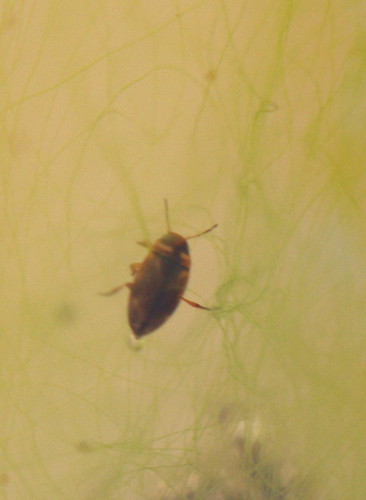
There are a couple of little predaceous diving beetles in there, adults, little guys. They’re smaller than the heads of the tadpoles. I assume they’re likely to also be feeding on the ostracods in there; there’s not a lot else for them. This may be what the larva, above, will eventually turn into.

Midge larva

Then there’s these guys. I found two of them. I think they’re a type of midge larva. They’d made themselves little homes out of the filamentous algae, kind of similar to what the caddisflies fashion in terms of being a tunnel, but dissimilar in that these larvae weren’t going to be dragging their homes anywhere. They were fairly active, but only insomuch as they would partly emerge frequently from their tunnel and then dart back in. I watched one for a bit and it appeared to be gathering more algae that it would wrap into its tunnel.

Hydra

This last one was really neat to find. There were two that I noticed, hanging on, it appeared, to the side of the container. It’s a hydra, a type of predatory invertebrate that uses its long tentacles to snag prey. I’ve never seen them outside of my invertebrate zoology classes back in university, so it was really neat to spot these guys. I gather they’re not uncommon; perhaps I’ve just not been looking in the right places. The critter on the left I think might be a type of daphnia, though I’m not sure.

Tadpole

Tadpoles generally take 6-8 weeks or longer, depending on species, water temperature and food availability, to metamorphose into frogs, so these guys may be sitting on my desk for a while. So far they seem to be doing quite well – and I’m finding just watching all the activity in the container to be rather distracting. I may have to move the container to the bookshelf so I can get some work done…