
The Marvelous in Nature

X-rated dobsonflies

Male and female dobsonflies

About a month ago, I got some really strange insects to my blacklighted sheet while out doing moths one night. Long, gray bugs with giant wings and feathery antennae, I wrote about them in this post. They turned out to be fishflies, a group of insects I’d previously never heard of.

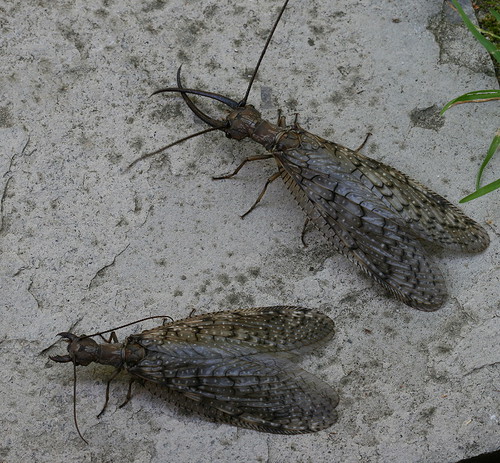
This weekend I found their cousins, the dobsonflies. I had actually heard of dobsonflies before, because one of the reviews I’d read for my new macro lens, prior to buying it, had had a close-up photo of a dobsonfly head. Still, I’d never actually seen one myself. There were four of them, three females and a male, attracted to bright white security lights on the side of a large building out near where Blackburnian’s mom lives. These happen to be Eastern Dobsonflies, Corydalus cornutus, the only species to occur in eastern North America. The other three North American species are found primarily in the southwest.

In the photo above there’s a male and a female. The male is the guy with the giant mandibles. The females were all mostly quite low to the ground and easy to reach. The male was another story, he was up near the top of the wall and I had to stand on a box and reach up with Blackburnian’s shoe to gently knock it down to a level where I could reach it. He was the one I really wanted, though, because he’s so impressive. Males reach about 4 inches (10 cm) long, nearly a quarter of which is the mandibles. Females are only slightly smaller at just over 3 inches (7.5 cm).

Female dobsonfly

I plucked one of each of them up, pinching their wings together over their back. When I snagged their wings they both reared their heads back, trying to grab me with their mandibles, or at the very least startle me. I knew that their wings were long enough that I was out of reach, so I didn’t buy into it, despite the ferocious appearance. While the female might be able to give you a pinch, the mandibles of the male aren’t really built for biting and can’t really do much for you. Most sources I read say that the adults don’t eat; however, one said that an older research paper indicated they would feed from honey water solutions or have been found at fermented baits (like what I’d put out for moths in cold weather). Either way, they’re not hunting their food.

Male dobsonfly

The male’s mandibles are, if anything, even more ferocious-looking than those of the female. As Blackburnian described them, the creatures look prehistoric. Given that they’re not used in eating, what are those huge mandibles actually used for? A commenter to my fishflies post suggested that they have a role in mating. Searching the net turns up little additional information. Many sites simply say the long pincers are used to grasp females during mating. One suggests their impressive length has developed through sexual selection, used to impress the ladies. Another indicates the mandibles are used in male-male confrontations, such as in competing for females (whether they actually fence with them or simply show them off depends on the species).

This site mentions a 1952 paper that describes the mating process: “As part of the premating ritual, males place their elongated jaws on the wings of the females perpendicular to the axis of the female’s wings. The male’s jaws also function in jousting with rival males. However, males were not observed to grasp the females as reported in older literature.” This second site has a slightly different description: “The male uses the mandibles during the mating process when capturing, prodding, and caressing the female, and they are also used when males fight one another. Prior to mating the male will flutter his wings, and both males and females will touch antennae.”

I had the opportunity to find out first-hand.

Mating dobsonflies

I actually missed capturing the first stage on camera. When I’d finished taking photos of the two of them I plucked them up, one in each hand, and carried them off to the garden where I placed them on a low brick wall. Not even giving it much thought, I’d placed them down nearly side by side. They didn’t take off upon release (they never do), but instead the male turned his head and I could almost hear the thought run through his mind: “Oho! A female! What luck!”

He dispensed with the foreplay, there was no touching of antennae as described on the pages I read. There was no showing off of mandibles to the female. In fact, the female seemed completely disinterested through the entire session. She just sat there, not moving, her antennae folded over her back, reminding me of how a mammal who is feeling unamused will lay its ears flat. I bet if I looked closely I could’ve seen her rolling her eyes.

The first thing the male did upon making his discovery was (as the first linked site said) turn perpendicular to the female and lay his long mandibles across her back. But he didn’t just rest them there, he appeared to actually put pressure on the lower half of her abdomen and then slid them backwards along her wings to the wingtips. He did this several times, and I presume the purpose was to squeeze out the spermatophores of any competing males. Dobsonflies transfer sperm in the form of gelatinous balls, so it would be fairly easy for a male to remove any left by a previous male, in order to ensure that his own sperm are the ones to fertilize her eggs. A lot of species, both invertebrates and vertebrates, will employ a similar strategy.

I finally decided it might be worth getting my camera to record. When I returned, he was reaching under the female’s “skirt” with his mandibles. I couldn’t tell exactly what he was doing – perhaps checking for the presence of a pre-existing spermatophore? Removing it, if there was one?

Mating dobsonflies

Once he felt satisfied with whatever he was checking for, he started fluttering his wings and curling his abdomen around toward the female. He tried to tuck it under her wings to make contact, but seemed to be having trouble for some reason. Actually, it looked to me that his abdomen just wasn’t long enough to do what he wanted it to do (isn’t this a common feeling with males?). He seemed reluctant to remove his mandibles from under her wings, which appeared to be the main problem, to me.

Mating dobsonflies

After making a few attempts from the left, he decided to try from the other side. He shuffled over and swung around to face the other way. Again he checked under her wings first.

Mating dobsonflies

Then tried from the other side.

Mating dobsonflies

This time he removed his mandibles from under her wings so he could straighten out and reach better. Success! During all this he was fluttering his wings like crazy and generally obscuring the female from view. From what I could see, she continued to simply sit there. It seemed funny that the mating of something with such a long, flexible abdomen would be of the facing-opposite-directions sort, rather than the male above (or below), facing the same direction, and simply curving his abdomen down to meet the female’s.

Mating dobsonflies

It didn’t take long, perhaps ten or fifteen seconds, and then he turned himself around again to face the female.

Mating dobsonflies

Finally, he rested his mandibles across her abdomen and they both sat there, still. I checked on them a few times as I went about photographing the rest of the moths I’d caught, and they stayed like that for at least ten minutes. Eventually when I went back the female had crawled off the top of the brick into the shade of the side, but the male remained where he’d been. I assume that this was the male mate-guarding the female until the spermatophore “took”, to prevent other males from removing his sperm before they had a chance to fertilize the eggs, despite what I’d read on one site suggesting it hadn’t been observed in the species.

I thought this whole thing was so neat. You know, it’s one thing to just simply see a species (cool as this species happened to be), but it’s quite another to observe a behaviour. Something I’m often guilty of, I find I tend to breeze by, looking at but not really watching what I’m seeing. I’ll identify the birds, for instance, often simply by ear, but I won’t really pay attention to what they’re up to unless there’s some commotion or something to draw my attention. It really is something I should do more – stop and smell the roses, as they say.

Why am I (still) (bird) blogging?

Baird's Sandpiper
This Baird’s Sandpiper, an uncommon-to-rare migrant in Ontario, has snagged some sort of mud-dwelling invertebrate for lunch.

July 10 marks the (approximate) three-year anniversary of I and the Bird, a blog carnival for all things birdy. Originally started by Mike of 10,000 Birds, he has hosted all three anniversary editions, as well. Each anniversary he’s challenged contributors to write on a theme. The first aniversary theme had bloggers discuss “why they bird, blog, and/or blog about birds,” while the second asked contributors “why their blogs were must-read material.” Many of the contributors who were part of those first couple of years are still writing today, and so it follows that this year’s anniversary question is “Why are you still bird blogging?”

This is an excellent question for people who have been at it for three (or more!) years. Blogging, for most people (at least the blogs I follow), is not a casual thing. Some people do have very easy-to-maintain blogs where they simply post a photo and a few words about it, or links to news stories, or such things like that. I think the majority of the nature bloggers I follow, though, spend considerably more time on their blogs than that. For instance, the average post on my blog takes me about an hour or two, depending on how much research goes into it. Even the “easy” posts, the ones where you know everything or you’re just talking about a trip you took, or that sort of thing, posts where all it takes is some image selection/editing/resizing and a bit of free association, those posts will still usually take at least half an hour start-to-finish. This is a fairly substantial time commitment that one has to make to a blog.

Hermit Thrush itching
Hermit Thrushes are over-the-wing head-scratchers – many other birds reach under the wing to their head.

My blog is young, only half a year old at this point. I think the qualifier “still” in “why am I still bird blogging?” hasn’t come to apply yet. I haven’t reached that stage that I think all bloggers inevitably go through of feeling a little tired of the time requirements involved in making frequent, thoughtful posts. The blog is still new, still fun and interesting. Who knows, perhaps it will always be that way, only time will tell. The qualifier “bird” in the question is also only loosely applied to this blog, since, while I do regularly talk about birds or bird observations, they make up only a small portion of my diverse subject matter.

I did used to update a more personal blog, one that I called my “bird journal”, which wasn’t shared with the general public but was instead mostly intended to share my birding exploits with other people I knew. I started that journal in January 2004. Initially I posted frequently to it, sometimes nearly every day. Over time, the frequency of my updates dwindled, until I was only posting once every week or two. My last post there was November 2007, after which I went into winter hiatus, when I tend to post infrequently because I’m simply not out birding a lot, and then started up this blog in the new year. The journal still exists in the blogosphere, but hasn’t been updated since.

Ruby-crowned Kinglet with bug
Ruby-crowned Kinglets eat gnats, flies, spiders, midges, and many other little bugs.

Something that this blog has that my other one didn’t is a readership. With my old journal, I had perhaps a dozen or so people who followed it regularly, nearly all friends, and I was essentially writing to them. It was a “hey, here’s what I’ve been up to lately” sort of thing, like sending out the annual letter with your Christmas cards only on a more day-to-day basis. Birding trip reports, documentation of interesting sightings, that sort of thing. I wrote to it partially to keep people updated, partially as a record for myself to look back on later. There was no sense of community in that journal. With this one I feel like I’m actually reaching out to a community of like-minded individuals.

Blackburnian and I are moving on from the research station after many good years there, and the volunteers threw us a farewell party. They’re all great people, the volunteers are, and I’m going to miss them. The party’s organizer made an informal speech about each of us, and in mine he called me a teacher; I’m a person who enjoys sharing things with others, seeing their enthusiasm about new things, watching people learn and grow. I’ve come to this realization slowly, but this is true. I love sharing information and teaching people who are likewise keen to learn and interested in the subject. In some ways I could see myself becoming a teacher, except it would need to be in a forum where all my students were there because they were interested and wanted to be, rather than in public school or such where you’ll have some students who are interested, but many more who are there just because they have to be. Perhaps someday, when I know more, I could lead nature walks or something like that.

Brown Creeper
Brown Creepers probe into bark crevices with their long beak and use their tongue to help extract hidden bugs.

The point of saying all that, though, is that that’s the reason I’m blogging. That’s the primary reason I started up this blog in the first place – it just seemed to me that there was so much cool stuff out there that you never know about till someone shares it with you, and I wanted to find it and share it. It helps that I love to write. My best friend and I have an on-going in-joke about the length of our emails (which were very rarely less than a couple thousand words). I’m sure even reading this post you can pick up on that – I could probably have summed it up in a single paragraph or less, but the words just flow out from my fingertips. Plus, I feel that any story can be summed up in a line or two, but there’s always more to the story than that, and it’s way more interesting than a single sentence can do justice to. “This is a Box Elder Bug that was laying eggs on a leaf” does accurately sum up the basic observation of this post – but aren’t the several additional paragraphs about the circumstances of its observation and its life histories and such much more interesting?

So why am I (still) (bird) blogging? To share my enthusiasm for nature and all the cool, wild, interesting, bizarre, beautiful, ugly and serene things in it. And knowing that other people are enthusiastic about and learning from what I’m writing about, too, is reward enough for me.

Pine, torn asunder

Tree hit by lightning

A couple weeks ago, when I was visiting my parents, my mom took me back into the woods behind their house and showed me this tree. It had been an old, massive White Pine, mature but still in good health. I love the pines on the property, the White Pines towering above the rest of the forest canopy, still catching the last rays of the setting sun even after it’s left the rest of the forest, the first to catch the early morning sun as it slides up over the horizon. They’re favourite perches for crows, who like to sit up in the highest tree and scan the landscape. They’re majestic in their strength, enduring, almost powerful.

So to find one of these giants torn asunder, lying on the forest floor, is a bit of a shock. It takes a powerful force of nature to topple such a massive tree: this one was hit by lightning.

Tree hit by lightning

We’re now experiencing an extended period of sunshine and nice weather, but for a while there we had thunderstorms virtually every afternoon. I remember talking to my dad on the phone one evening, and he’d commented that that afternoon they’d heard a crack of thunder so startlingly loud they knew it had to have hit nearby. It may have been this tree. They project so high over the canopy that they would be the forest’s inevitable lightning rods.

Lightning with many step leaders and a single massive discharge strike. Borrowed from the Wikimedia Commons.

I did a bit of research on how lightning works, though, and although lightning does generally target the tallest objects, they don’t necessarily always do so. Lightning works by the air particles beginning to ionize, or form directional charges, like the way a magnet has been ionized so that all of its molecules line up in the same direction creating a positive end and a negative end. The ionization spreads along the path of least resistance, but may spread out in multiple directions at once. These paths are called “step leaders” (note it’s leaders, not ladders, which is how I keep reading it). The direction is often, but not always, down towards the earth.

Lightning hitting the Eiffel Tower in 1902. Note the streamers coming up from the bottom. Borrowed from the Wikimedia Commons.

As these step leaders start to get close to the ground, the air near the ground begins to form strong charges and the equivalent of reverse step leaders, called “streamers”, form from objects on the ground, reaching up into the sky. When one of the step leaders contacts one of the streamers it forms an unbroken path of ionization that the cloud’s electrical charge discharges through. The streamer to be contacted is often the one that reaches the highest, but it doesn’t have to be, depending on the path the step leaders take. All objects, including people, send out streamers, which is why you can still be hit even if you’re near taller objects. Both streamers and step leaders glow, but are not as blindingly bright as the discharge.

Tree hit by lightning

The whole process, from the start of ionization to the connection of the step leaders and streamers, to the discharge of electricity, takes a fraction of a second. Prolonged lightning is actually multiple pulses of discharge flowing along the ionized path, but so quickly that it just looks like a long strike to our eye. The length of a roll of thunder represents the relative number of pulses (or “re-strikes”). The discharge is incredibly hot – hotter even than the surface of the sun. Anything it touches will be immediately burned, or, if liquid, vapourized, and if the medium doesn’t conduct electricity well, the excess heat created by the electrical resistance will cause the effect to be pronounced. This is what happens when lightning hits a tree. The sap within a tree is not very conductive, so rather than funneling the electricity through the roots into the ground, the sap vapourizes. Gas takes up more space than liquid, and so the result of this instantaneous vaporization is an explosion – tearing the tree to splinters. They’re a bit hidden in the ground vegetation in this photo, but there were splinters and chunks of wood everywhere.

Tree hit by lightning

Oak and elm are the most commonly hit types of trees, but pine ranks third. They have deep tap roots that reach the water table, and typically stand higher than other trees in a forest. The high resin content and needles also contribute to higher electrical discharge, though Wikipedia fails to elaborate on why. Trees are actually a good way of protecting a building from lightning strikes. Some species are more capable of dealing with strikes – trees that have massive root systems, which spread out in the soil and have a higher biomass than the above-ground portion of the tree, have the ability to dissipate lightning very efficiently. In most trees the lightning takes the path of least resistance, which is generally the wettest part of the tree, often outer layers where the sapwood is. This results in a burning of the bark, and possibly the stripping off of a small section of the trunk, but is generally easy for the tree to heal over from. Deeper wounds are more difficult to heal and usually result in the decay and death of the tree.

In the case of my parent’s pine, the strike went right down through the heartwood and tore the tree in two. One side has a trunk and crown that is still standing and intact, but it’s hard to say whether the damage to the lower part of the trunk will be enough to kill the remaining part of the tree. If it does die, it won’t be a terrible thing – the Pileated Woodpeckers will love it.

Some announcements

Willow Flycatcher

This is a post for news-y bits that I’ve been collecting over the last week or so. I thought I’d just hold on to them all and put them into a single non-nature post. Well, still nature-related, just not directly so.

First, I’ve participated in a few blog carnivals that all came out recently. Carnivals are a great way to sample the writings of many different people, as well as learn about many different, varied things. I invite everyone to browse over to It’s Just Me (aka The Egret’s Nest) for I and the Bird #78. Lots of great bird-related stories, from close to home to far abroad (no matter where home is for you!). Once you’re done there, check out Gossamer Tapestry for the latest Circus of the Spineless (a carnival dedicated to – you guessed it – invertebrates of all shapes and sizes), edition number 34. And finally, wrap it up with a visit to Earth, Wind and Water to read all about our arboreal neighbours in the Festival of the Trees #25.

Northern Pine Looper - Caripeta piniata

Some exciting news of a more personal nature, the field guide to moths that myself and The Moth Man will be co-authoring has been bought by Houghton Mifflin and will find a home in their Peterson field guide series. We have yet to sign the official documents, but the deal has been done, and I’m very excited to get started on the project! During negotiations it also came up that they’re planning a re-design of the Peterson series in the next few years, of which ours will be one of the first. It will be in the style of most bird books, with the images opposite the text and maps. We’re pretty stoked. Our deadline is 2010, so expect to see the book hit shelves in a couple years (if not before!).

[ACTUAL BLOG AWARD IMAGE REMOVED]

And finally, a few days ago Voice of the Turtle passed on a Tree of Happiness to me. The “award” or recognition includes the above image, which is written in Portuguese. Not speaking Portuguese myself, I had to run it through a web translator. Actually, I ran it through several, since none of them are perfect. Roughly, the words mean this:

You have just received the Tree of Happiness.

It is still just a little seedling, but depends on you to grow steady and strong.

Plant it in your heart, water it with smiles and kindness, feel the fragrance of its flowers, the sweet taste of its fruits and share its shadow with whom you want!

The good things are better still if we can share them with people dear to us; then be a generous person and share this tree with your friends.

So plant happiness where you go!

You’ll see how many people come closer.

Will you?

This would be better if I had an actual little seedling to nurture and grow and share, but in the absence of that, a recipient is supposed to list six things that make them happy, and pick six other bloggers who deserve such an award (presumably because their writing makes you happy, rather than that you think they need an infusion of happiness).

Things that make me happy (in no particular order):

1. Breathing the fresh air, feeling the breeze in my hair and the sun on my face, listening to birds sing, out in the quiet of the countryside on a warm day.
2. Sharing my knowledge with someone and watching them grow, or seeing their enthusiasm or amazement in the subject. Blogging falls into this category.
3. Doing good by someone. Anyone, friend, family or stranger.
4. Sitting in a puddle of sun with a book in my hands, a tea at my side, and a purring cat in my lap.
5. Spending time with Blackburnian. Catching up with my best friend or family.
6. Art supplies. I like playing with them, too, but really art supplies are my version of the woman’s shoe collection. Don’t send me into an art store unsupervised.

I started to list six blogs that I felt were worthy recepients. I got up to six, then realized there was no way I could pick just six blogs who exemplified the qualities set out in the Portuguese above. So instead, I point you to the blogroll in my sidebar. All of these bloggers show some or all of the qualities listed, or I wouldn’t have included them in my blogroll. If you haven’t visited these sites, I highly recommend you do.

A flower by any other name

Orange Hawkweed

Summer wildflowers are beginning to come out. I’m seeing many that I tend to associate with the hot, still, “dog days” of summer. Flowers such as chicory, daisies, vetches, bladderwort, Viper’s Bugloss, and others. One that I spotted recently was the above. I’ve always known this as Indian Paintbrush, so I was a little surprised to find, when I Googled “Indian Paintbrush”, that the actual wildflower of that name is not this plant and has nothing to do with it. (When Blackburnian asked what today’s blog topic was, I showed him a photo of the plant, and he said, “Oh, Indian Paintbrush?” So I’m not the only one to have thought that was its name! They do look very paintbrush-shaped.) So now what? I thought I’d try the wildflower ID tool that Winterwoman at A Passion For Nature posted about a little while ago, but it turns out it’s down while the site manager switches ISPs and gets everything up and going again.

So I did a search for Ontario Wildflowers, found a site that listed names alongside pictures, and located my flower. It’s Orange Hawkweed, Hieracium aurantiacum, and like virtually every other wildflower I’ve posted about lately, it’s not native to North America. (Incidentally, the true Indian Paintbrush is native.) It goes by several other names, including Devil’s Paintbrush and, in Europe, where it’s from, Fox-and-cubs. One website indicated that the name Hawkweed originated from ancient Greece, where they believed that hawks would eat the flowers to improve their eyesight (although it was actually used as an herbal remedy for sight problems, this not likely true, but a delightful image nonetheless). It’s a member of the aster family, Asteraceae, like daisies, dandelions, asters, and others, with many rayed “petals” around a central cluster of tiny individual flowers.

Orange Hawkweed

It was introduced to North America, possibly Vermont in 1875, as a cultivated garden plant. At some point it escaped from cultivation (this brings up images of plants growing legs and sneaking away) and quickly settled into disturbed habitats around human development. Among its favourite spots are roadsides, abandoned and regenerating fields, and waste places such as empty lots – the sorts of places where nothing’s established and it’s easy to gain a foothold over native plants, or where the conditions are harsh enough that few native plants would prosper. However, it’s also found in natural areas where conditions are suitable. It’s now found coast-to-coast, though it has a much stronger presence in the east, near its original “release” site. The species is on the noxious weeds list of many states and provinces, and is prohibited from distribution or cultivation in most of these. It has also been introduced to Australia, Tasmania and New Zealand, where it is also problematic.

Orange Hawkweed with skipper

Despite its non-native status, the flowers still attract many native insects. I’ve seen butterflies, such as this skipper, visiting them, as well as bees, flies and ants. The plants tend to be passed over by herbivores, however, and heavily grazed areas may end up with large populations of the flower, as the grazing down of native, palatable vegetation allows for the hawkweed to take root.

When the plants go to seed they’ll produce little tufts, like the seeds of dandelions. Each flower stem can have up to 30 flowers, each of which can produce as many as 30 seeds. They generally rely on wind for dispersion, however the invasive spread of the species is aided by hitching rides on passing animals and people (who can carry the seeds much greater distances). Once a seed and plant is established, it spreads locally through rhizomes (underground roots that can produce whole new plants some distance from the parent) and stolons (sideways stems that lie flat along the ground, putting down roots at intervals and starting new plants). Because of this vegetative reproductive strategy, pulling up individual plants may not necessarily remove the whole patch, as remaining bits of rhizomes or stolons have the potential to regenerate.

Orange Hawkweed with ant

Although it can be very widespread and abundant in some areas, at my parents’ there are only a few small patches. I seem to remember there being more, when I was younger. There also seemed to be more dandelions on the lawn, too, though, and daisies and Queen Anne’s Lace and New England Asters in the fall… Pollinator populations are falling, but I highly doubt that it’s enough (yet) that the wildflower community is being taken over by grasses, so perhaps it was just the slightly distorted memory of a child, when everything seemed bigger and grander.

Yellow Hawkweed

There are actually hawkweed species native to North America. Wikipedia lists 51 species of Hieracium in the United States. Flora Ontario gives 19 unique results for the genus Hieracium. All of the other 18 species are yellow. Identifying Orange Hawkweed is a breeze, but identifying the rest requires a bit more deliberation. I think the one above is Yellow Hawkweed (among many other common names), Hieracium caespitosum, because it appears to be the only one of Ontario’s species that tends to clump all of its flowers at the top of the stem, rather than branching them more spread out, in a more open pattern. It’s also a fairly common species, relative to the others. Unfortunately, like the Orange, it’s also an introduced species. I’m sure if I keep looking I’m bound to come across a native meadow wildflower eventually… (It really says something about the state of our ecosystems, doesn’t it?)