The Marvelous in Nature

Gray, but not really

Gray Treefrog

The weather cooperated for me, and I was able to get some mothing in on all three nights I was at my parents’. The nights were relatively warm, and there was quite a bit of activity at the blacklights, so I took my time browsing over the sheets looking for species I hadn’t seen yet. I have the one sheet set up on the clothesline, which is not far from my mom’s water garden, an old watering trough, not used for that purpose for many, many years and now filled with rocks and aquatic plants. While I was standing there, a frog started calling from the water. So I thought I’d have a peek and see if I could spot him.

After circling the garden a couple times I determined he was in one particular corner. I checked all the spots I thought a frog should be, along the water’s edge, in between the rocks, in the flower bed, couldn’t see him. I finally decided he must be up inside the water spout feature, an old hand pump that, decades ago, had been used to pump water up from the property’s well. The pump perches at the corner of the trough, with the pipe set in the water, such that one edge of what used to be secured to the ground now forms an overhang over the water. I figured he’d crawled under there. So I returned to the moths. On my next trip back from the house, my headlamp just happened to pass across the top of the pump – and there he was. Such a great ventriloquist!

Gray Treefrog

He’s a Gray Treefrog, though he’s not a very gray treefrog. The species’ name is Hyla versicolor, the latter part being a reflection on the frogs’ variable colouration – some individuals are the gray that gives the species its name, while others are bright green, brown or yellowish, and there’s a range of colouration between them all. In addition to this natural variation, Gray Treefrogs are able to change their colour, like a chameleon, though the process is not nearly as fast as in chameleons. They are covered in black mottling, the extent of which varies also according to individual and surroundings. A frog on a tree trunk can be nearly impossible to detect as it adjusts its colour and mottling to blend in. And, as if all that wasn’t enough, the frog’s colour is also influenced by the ambient temperature, with more or less black being shown according to whether they need to absorb the sun’s heat or not. Males will generally have darker throats than the females, but of course I didn’t have a female to compare to.

The treefrog’s normal “base” colouration is gray – dead frogs and those in unnatural surroundings will usually be this colour. So I’m not sure why this one’s bright green – perhaps he’d just crawled up from the grass and hadn’t had time to change yet.

Gray Treefrog

In all colour variations, there are three things that make this species of treefrog distinguishable from other frog species (other than the fact that no other frogs climb trees). The first is the black mottling on the back, usually in somewhat linear patterns to create borders to slightly darker areas (though some individuals may not show these markings). The second is the wide sticky pads at the end of each toe that allows the frog to grip the tree (or other surface) when climbing (all treefrogs show this feature, of course). And the third is that both Hyla versicolor and its nearly identical sister species H. chrysoscelis show yellow on the inside of their thighs, usually not really visible unless the legs are extended or one looks closely, like here. The two sister species share much of the same geographic range and are really only separable by call.

Websites also indicate that the species has a pale spot under the eye, and it took me a while to figure that out – I was looking for an actual white or pale dot, but they were using the word “spot” as in region or area, and were referring to the patch of skin bordered on each side by darker patches. Really, the “pale spot” is exactly the same colour as the rest of the frog, it just looks pale because it’s a small area bordered on by dark markings. In the case of my individual, his dark markings aren’t even very dark, they’re barely different than the light areas.

Gray Treefrog Gray Treefrog

He seemed strangely unperturbed by my being there. He’d pause for a moment as I moved from one side to the other, perhaps assessing the sound, but wouldn’t stay quiet for long. It’s prime breeding season, after all! It probably also helped that I had the headlamp on, and as I shone it in his face it hid my silhouette from view.

It’s amazing how much their throat can inflate. When not calling it’s just a loose pocket of skin, held close to the body, deflated and loose like a dewlap. When he fills it with air, it balloons to the size of his head. The throat sac isn’t involved in sound production directly, but rather acts as a resonating chamber, amplifying the sound so it broadcasts across a much greater distance. I read at one spot that this call can be heard up to a kilometer away (a little over half a mile).

The Gray Treefrog has a short, moderately high-pitched trill, which in my area is only really easily confused with the much longer, sustained trill of the American Toad. The trills of H. versicolor and H. chrysoscelis are distinguishable by differences in speed and pitch (length is the same; speed refers to the separation between the individual notes that make up the trill – usually in milliseconds). I rather suspect this would require some degree of experience with the two species to feel confident about labeling it one or the other. To complicate matters, the speed of the trill varies with ambient temperature, and is slower in cooler weather (which makes sense, being a cold-blooded creature).

Gray Treefrog

A close look at his eye, and ear. A frog’s ear is not a hollow tube like that of vertebrates, but a tympanic disc at the skin’s surface. It’s a little like having our eardrum right on the side of our head, instead of tucked well inside. The same general structures apply to convert the vibrations of the membrane into signals to the brain. However, a frog can also “hear” with its lungs. The change in air pressure, particularly with loud noises, will also create vibrations in the lung linings, which are sent to the brain much the same way as from the ear. Also, the lungs have a direct link between them and the ear, equalizing pressure, which is presumed to serve as a protection to the eardrum against the frog’s own incredibly loud calls. An average frog’s calls are 90-95 decibels – about as loud as a lawnmower or jackhammer. Eight hours of sound this loud can permanently damage your hearing. Unless you’re a frog!

Gray Treefrog

He certainly was loud, especially when I got right up close to him. He was also very alone. The nearest other calling treefrogs were at least 50 meters/yards away. Treefrogs tend to be more solitary than other frogs, not being as confined to an area of habitat the way wetland frogs are, so it wasn’t too surprising that there weren’t other males nearby. However, it seemed his efforts hadn’t yet attracted a female. He’s in a good spot, with a handy predator-free water body right there for her. She’ll lay potentially up to 2000 eggs, singly or in small clusters, over the course of the breeding season. I haven’t seen any eggs in the little water garden, but will have to pay attention for them now, or tadpoles if I’m not around for a stretch (the eggs will hatch in a remarkably fast 3-6 days after being laid, depending on water temperature). How neat would it be to have treefrog tadpoles in your water garden?

Life on a maple branch

Box Elder Bug laying eggs

One of the necessary chores that comes with keeping horses, of course, is having to muck out the stalls. It’s a pleasant sort of physical labour, where you feel you’ve had a good workout and been productive at the same time. If kept on top of every day it’s neither a lot of work nor very time consuming, but can add up quickly if neglected.

It was while I was busy doing this that I noticed today’s subject. I was returning from dumping a wheelbarrow load, my mind on other things (such as wondering how Mom still does this every day, at her age), and so wasn’t paying a lot of attention to bugs or other critters. If this bug had been anywhere else on the maple tree I probably wouldn’t have noticed, but it was at the tip of the very lowest leaf of the branch that hangs over the driveway, pretty much at eye level. And the bug was red and black. Hard to miss.

It was busy laying eggs. Naturally, I didn’t have my camera since I was working in a spot I wasn’t keen on the camera being, so I dashed indoors to grab it and came back to run off a few shots. She was oblivious, focused on the task at hand, I guess, And I was able to manipulate the leaf to pick up the best light (and also to keep it steady and easier to focus on in the light breeze).

Box Elder Bug

When I came back inside and looked it up in my Kaufman guide to insects, it was shown there as a Box Elder Bug, Boisea trivittata. I thought, Elder? What’s it doing on the maple, then? And it wasn’t alone. A few leaves above it was this solitary individual, who seemed to either be lost or looking for a mate as it roamed from leaf to leaf. A few leaves further I noticed a pair copulating (below). I’m not sure if the larger one is the male (as is traditional in many species) or female (since she’s the egg-layer and needs the size to haul them about). They certainly didn’t seem to feel out of place.

Box Elder Bugs

Well, it turns out the Box Elder is actually more often called Boxelder, and is not a type of elder at all, but rather a maple, a member of the genus Acer. The Eastern Boxelder Bug, as it’s called on BugGuide.net, is also sometimes known as the Maple Bug, and will lay its eggs on the foliage, seeds or bark of Boxelder and other maple species, and also ashes. So it wasn’t in fact out of place at all. The nymphs, when they hatch, feed on the seeds of the trees, as well as opportunistically on dead insects. The adults primarily feed on the plant’s juices.

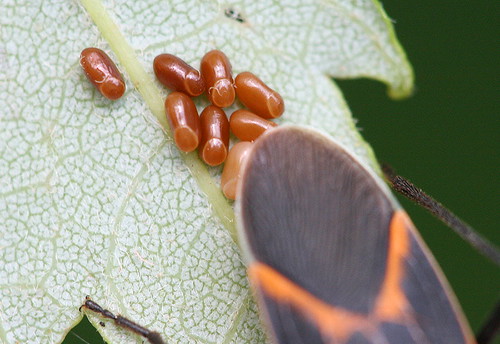
Box Elder Bug eggs

Apparently the adults are most often seen in the fall, but are also around in the spring. BugGuide indicates the spring period is primarily May, so what they’re doing out in late June, I don’t know. It could be that the May date applies to a different area than here, since the species is found across most of North America east of the Rockies. Supposedly they can be a house-invader in late fall, as they’re looking for a place to spend the winter, much like ladybugs, but I don’t think I’ve ever noticed them doing that here.

I left the female to it and she finished up laying. When I checked today there were about ten of these small, soft eggs, no bigger than the head of a pin. I don’t really know, but I would guess that the pale crescent you see on one end of the eggs is akin to the yolk of a bird’s egg – the fertilized cells sit on that, and that’s what the developing embryo uses for food.

Edit: Commenter Ted indicates, “The orange crescent you noted on the bug eggs is actually the outline of the operculum, which is the “cap” of the egg – when the nymph hatches, this cap will pop off and out will crawl the nymph. Eggs of most “true” bugs (order Hemiptera) have these opercula, as far as I can tell.” Thanks, Ted!

Parasitized caterpillar

The branch was surprisingly full of activity for just a little section of tree. While examining the bugs, I happened to notice a light green caterpillar just a few leaves over. I don’t know what species this is, and I couldn’t even tell you if it was a butterfly or a moth, though I’m inclined to think the former. I used to believe that moth caterpillars were hairy and butterfly caterpillars were smooth, but it turns out that either can be either, and so now I know of no reliable way to differentiate the two. The inchworms, though, those little guys with feet at each end, who inch rather than crawl, those guys are moths, as are the really, really fuzzy ones like the Woolly Bears.

I didn’t notice it at the time, but in looking at the photo as I cropped it down, I spotted a white glob at the back of the caterpillar’s head. I’m fairly certain that this is the egg of a parasitic insect, probably a fly. There are a number of species of flies that lay their eggs at the back of the head of caterpillars, where the caterpillar can’t remove it. When the egg hatches, the larva burrows into the caterpillar’s body, and lives there, without killing the host, until it’s ready to emerge (at which point the host usually dies). Some caterpillars, such as tent caterpillars, have evolved a response of rapidly twitching their front end back and forth when they see a fly so that it’s a much harder target to land on.

Caterpillar

Also in the area were many of these fuzzy caterpillars. Again, I don’t know what they are, but they were very brightly coloured, and the density and length of the hairs makes me think moths. There were many different instars, or larval stages, of these caterpillars on the branch, from the fairly mature one above, to a middle-aged and even rather young. On a few leaves I spotted the empty, shed skins (below) of caterpillars as they move from one instar to the next.

It’s amazing how much there is to see when you stop to look; if it hadn’t been for that one bug, laying its eggs on the low-hanging leaf, I would have just walked right on by, thinking the branch was empty.

Empty caterpillar skin

By the hundreds

Moth jars in fridge

Hundreds of moths

This is my 100th post. It arrived rather quickly, it’s hard to believe I’ve written that many entries already, on subjects as varied as fungus and flora, birds and bugs, earth hour and green parties (the events, not the political groups). I thought the hundredth post deserved special attention, to mark a milestone, but I wasn’t sure how by. I spent some time thinking about it, and finally decided upon a post of hundreds – recent observations of multitudes of whatever it is I’m observing.

I happen to be at my parents’ this week, taking care of the horses while my mom’s away at a conference. Unfortunately, they’re not as easy as goldfish where you sprinkle them some food and they’re good to go for a while. I don’t mind coming out to care for them, though, as it gives me an excuse to visit the countryside. One of the things I use that excuse to do is catch moths, of course. I had a few sheets up last evening, and this. It was on the cooler side overnight last night, about 15 C (60 F), but there was still a good selection of things coming in to the sheets and trap; this evening is warmer and there’s much more activity. Since I need to photograph everything in order to later identify it, I jar the moths I don’t know and tuck them in the fridge. It doesn’t take long for the fridge to fill up. The above photo is the state of things after last night.

Insects on Goatsbeard

Hundreds of bugs

In my mom’s garden there are a couple clumps of goatsbeard (Aruncus dioicus), a perennial native to North America and western Europe. It produces sprays of white flowers, which insects absolutely love. I highly recommend that any budding entomologist buy themselves a goatsbeard for their garden. It gets everything: butterflies, of course, but also day-flying moths, wasps, bees, flies, beetles. You can even find mosquitoes nectaring on the flowers. During the plant’s peak blooming period, which lasts a couple of weeks and is about this time of year, the blooms will be alive with activity, covered in bugs. Hundreds is not an exaggeration here. The longer you stand there, the more you see. It attracts some pretty interesting things.

Beetles

Hundreds of beetles

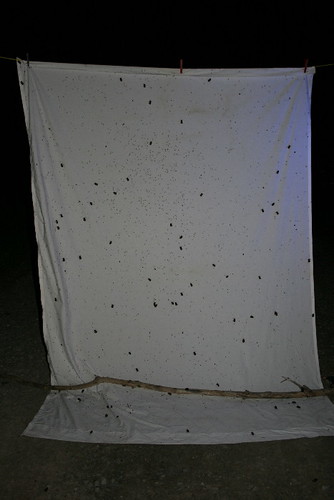
Earlier in the month I did some mothing down at the research station. Or tried to, anyway. I didn’t actually end up catching very many moths, though I’m not sure why; it was fairly warm that evening. However, what I did end up getting lots of were beetles. In many shapes and sizes, but the most apparent were the June Bugs. These guys aren’t a lot of fun to have come buzzing in to a sheet at the best of times, since they’re clumsy and just as liable to run into you as the sheet. Having about 100 come in to the light was almost creepy. In this photo, those large dark spots are the June Bugs; there are 67 visible on the sheet, and there were easily a few dozen more on the other side, on the ground, and in the nearby vegetation.

Colewort

Hundreds of flowers

The colewort in the garden is also still going strong. Because the plant is ginormous, there are easily hundreds upon hundreds of flowers blooming on it. The colewort attracts a lot of insects, too, and has a fairly strong and pretty scent. Yesterday I watched a few interesting beetles, flies, and a tiger swallowtail dropped by to sample things. This wouldn’t be a bad plant for the garden of an entomologist, either, but it does take up a lot of room.

Chokecherries

Hundreds of berries

I noticed while making the rounds of the garden that the chokecherry tree is beginning to put out its berries. They’re still far from ripe, being a green the same shade as the leaves, but they’re nearly full-size now. The tree is covered in them, and staring up into the canopy creates an interesting effect, almost abstract in appearance.

Hail

Hundreds of hailstones (and raindrops)

The last couple of weeks we’ve had regular, near-daily afternoon thunderstorms. Many of the thunderstorms have included hail, often rather large hail. I tried to take a photo of some of the rather large hail, but couldn’t really capture it any better than this. It’s been strange just how much rain we’ve got this year. I heard something about this June being the wettest on record (so far), but can’t seem to corroborate that. All this rain is especially strange compared to last summer, which was the polar opposite – days upon days of nothing but clear skies and sunshine, not a drop of rain in sight. My parents actually had concerns over their well running low and had to implement a strict water conservation plan. Won’t be an issue this year.

I actually started this post last night (Tuesday), but have been quite busy filling my mom’s shoes while she’s gone. In addition to the dentist appointment, which was quick and went well, but still took a chunk out of my day. I have new respect for the amount of work my mom (or my sister, when she’s here and takes over) puts in around here, especially with the horses. I don’t think I fully appreciated just how much time was involved in caring for them.

In any case. Here’s to another happy hundred.

Emeralds in the garden

Emerald Spreadwing - male

When I went out to photograph the wrens, I also poked about the garden a bit. It had rained all afternoon, so all the foliage was damp, but also vibrant. Not much was flying, as far as insect life, and I was mostly looking at the flowers (many of which, after a week of daily rainstorms, were looking a little bedraggled with their heads on the ground). But when I leaned in to the garden edge to peer more closely at something, a cloud of metallic-green damselflies rose from the vegetation, disturbed by my approach.

These may be the first damsels I’ve seen this summer in any numbers. I think I’ve seen the odd one here or there, but not many. Damselflies are the smaller, slimmer cousins of dragonflies, and can be told apart by the general size and chunkiness of their heads and bodies. Also, most damselflies will rest with their wings folded behind their backs, while dragonflies usually rest with their wings spread. These damselflies are the exception, however, and tend to rest with their wings open, though rarely as broad and flat as dragonflies. There are many species that do this, all classified in the group spreadwings.

Emerald Spreadwing - male

Dragonflies and damselflies together are part of the order Odonata. There are about 300 species of dragonflies, and 130 species of damselflies in North America north of Mexico. All but two of the 19 North American spreadwings are classified in the genus Lestes. In general they’re associated with the edges of ponds or slow-moving streams. There’s certainly ample water at my parents’, but the garden is some distance from it, so it was interesting to find so many of them there. Many of the spreadwings can be difficult to tell apart from one another, some requiring examination of the genitalia to do so, but I believe these were all Emerald Spreadwings, Lestes dryas.

Emerald Spreadwing - female

The females are browner than the males. There are very few species of Odonates where the two sexes are the same or very similar in appearance; generally you can tell them apart fairly readily. However, the surefire way of doing so is to look at the end of the abdomen. Although I didn’t get it in focus in this (or any, as it turned out) photo, you can still get the idea. In males, the abdomen ends in appendages that look like a pair of pincers. These are used to grasp the female gently but firmly around the neck during mating, and two damsels found like this are called “in tandem”. The female has a thicker tip to the abdomen, with a special structure that includes an ovipositor to lay the eggs. The female curves her abdomen around underneath her and touches the tip to a swelling on the underside of the abdomen just behind the male’s thorax (can sort of be seen in the second photo), where she receives the sperm. This is usually called the wheel position, and one can sometimes observe a pair flying together like that.

Emerald Spreadwing - female

Spreadwings, like all odonates, are carnivorous predators. Adults have strong mandibles and some of the larger dragonfly species may bite if handled, although it is little more than a strong pinch and doesn’t deliver any venom. They kill their prey by biting it, and “chew” it to ingest it, rather than eating it whole. They eat mainly small flying insects, such as mosquitoes, small flies, and others. The larvae are aquatic, with adults laying their eggs on vegetation, rocks or other substrates at the water’s surface. They look only vaguely like the adults, being not as thin and lacking wings. The larvae eat other aquatic insects, but may even take (very) small fish. Odonates undergo incomplete metamorphosis, meaning they lack the pupa stage that most insects have. Instead, the last larval stage crawls up onto some vegetation, where the skin on the back splits open and the adult climbs out.

Emerald Spreadwing - male

Because they’re predatory, both damselflies and dragonflies have excellent eyesight. They have a pair of large compound eyes that are their primary means of detecting prey, but also several occelli across their “forehead” that they use for sensing small changes in light and dark, which helps them to orient upwards. The eyes are another useful feature to separate damsels from dragons – the compound eyes of the latter meet at the top of the head, while those of damselflies are usually widely separated. The eyes are also very important for avoiding predators. Damselflies can be eaten by just about anything larger than themselves. They’re not as strong fliers as dragonflies are, and as a result are often meals for their larger relatives. Adults are also eaten by birds, frogs, and spiders (getting caught in their webs). The nymphs are eaten by larger aquatic insects, amphibians and fish.

Emerald Spreadwing - male and female

Here a male rests on a leaf just above a female. I’m not sure what happened to the male’s abdomen. It’s possible he had a close call with a predator, or when he emerged from his last larval stage his yet-to-harden abdomen was in a funny position. Most insects have very soft exoskeletons when they emerge from metamorphosis. It’s a little like a human baby’s skull – because it has to fit through a very narrow passageway, much of the skull is soft and doesn’t become fully firmed up until the baby is anywhere from nine months to about two years old. In insects the process is necessarily a little quicker – the adult itself may only live a week or two. Insects “wear” their skeletons on the outside, with their muscles attaching to the inner surface, rather than the other way around in vertebrates. The exoskeleton needs to be flexible enough to fit in the cramped space of the pupa or final larval stage, but when the insect emerges, it straightens, wings are expanded by pumping with fluid, and they harden through exposure to air. The air also helps to develop their full colouration, as they are often quite pale when they first emerge.

Unfortunately, there aren’t any really good printed references to the damselflies of North America, which is a funny oversight since there aren’t an overwhelming number of species. Part of the problem is that many can’t be conclusively identified by colouration alone. There are a few good regional field guides, however. In the east, one of the best is A Field Guide to the Dragonflies and Damselflies of Massachusetts, and in the west Introducing the Dragonflies of British Columbia and the Yukon (I’m pretty sure this has damselflies as well, as I recall referencing it while working out there a few years ago – it was part of my employer’s library, but I really liked it).

Home among the colewort

Wren box and colewort

One of the things I love about waking up at my parents’ house is the sound of the birds singing in the morning. Specifically, the House Wren, who has settled in just under the guest bedroom’s window. For the last half a dozen years he’s sung from the garden, adding some very bubbly life to the backyard. Although my mom had always put out seed for the birds, we only put up some birdhouses when I got into birding myself, in university. It didn’t take long for the wren to discover them; I think he moved in the next summer, and he, or his offspring, has been there since.

There are now six nestboxes set up at various spots on the property (one of which has two compartments). In any given year most get used. In previous years there have been Tree Swallows in one, and Eastern Bluebirds in another, but for whatever reason they’re absent this year. However, to make up for that, we have three House Wren pairs that have set up territories at three of the boxes. I occasionally hear them counter-singing at one another, reinforcing their territory boundaries.

The garden wren has three boxes to choose from, but picked the one right next to a large flowering colewort. To put it in perspective, in the photo above the shepherd’s hook the box is hanging from is about as tall as I am. The colewort is a pretty amazing plant, growing to huge proportions, and it completely dominates that section of the garden. When my mom first planted it I don’t think she knew at the time just how big it would get. She had intended to pull it up after the first year because it took up so much space, but ended up leaving it. The wren thinks this is great, as it provides lots of good cover, right near the nest. I’ve seen the little birds foraging in and under the bush frequently.

wren1

When I went out to wander about the garden this week, I noticed the wrens took great exception to my presence. They hopped about first the crabapple tree, then the nearby apple tree, chirring at me and expressing their displeasure. When I located one with my binoculars, I could see it was carrying a mouthful of food. I didn’t leave right away, and it ended up swallowing the food so it could more easily focus its attention on distracting me. Birds only carry food, and get this worked up, when there are young nearby, so I knew they must have a brood in the garden nestbox.

wren2

I hid myself behind the corner of the garden shed, and waited for the adults to calm down enough to return to the box. Eventually the one (I think the male) did, coming to perch on the top of the shepherd’s hook and scout the area. He had a fat mouthful of bugs. It amazes me how much they can cram into their little beaks, you’d think as soon as they opened their mouth to grab another food item the first would fall out, a little like watching a dog try to pick up two tennis balls. Birds have amazingly dexterous bills, considering that they’re not flexible or opposing like our fingers. Can you imagine trying to weave a nest using just a pair of chopsticks?

wren3

I leaned around and propped my camera up on the corner of the shed, hoping to remain out of sight, but the wren spotted me and decided it wasn’t safe yet to duck in to feed the youngsters. He took off for the crabapple tree again, mouth still full of insects. Birds generally won’t approach their nest unless they feel confident that the coast is clear. It’s less their own safety they’re concerned about, and more trying to prevent tipping off a potential predator to the whereabouts of their young. A lot of time, effort and energy goes into raising a brood of young, and by the time they get to the age where they’re needing to be fed a lot, often it’s too late in the season to re-lay. So it behooves the parents to be overly cautious – given the harsh realities of migration, there’s a good chance one or both of the parents may not return to try again next summer.

wren4

Eventually they did both settle down, and came in to the box where the hungry mouths were waiting. I think this is the female, as she was quieter, and appeared a mousier brown than the bolder male, who somewhat resembled a Winter Wren in the darkness of his patterning and barring of the chest. Of course, there’s also two colour morphs of the eastern subspecies of House Wren, a brown and a grey, and it could be the pair is composed of one of each, unrelated to sex.

wren5

Delivering the goods.

wren6

Off for another load. Young birds, like young humans, basically spend all their time eating and sleeping and growing. A newly hatched nestling will need to be fed every 15-20 minutes, which keeps the parents hopping to try to find enough food to fill as many as five or six hungry bellies.

wren7

About 40 meters/yards away, another male sang atop his chosen nestbox. I notice this one’s paler, but is definitely a male, so maybe the colour difference in the first pair is simply a morph after all. There wasn’t any evidence of a female associating with this guy, but she could be inside the house incubating. While she’s on the eggs, the male doesn’t have a lot to keep him busy and will spend most of his time singing and defending the territory.

wren8

He moved to some nearby saplings where the lowering sun’s rays illuminated his pale breast. It’s really a shame that a single photo can’t capture the burble of a House Wren’s song. Their mandibles tremble rapidly like the bird is shivering with joy as the cheerful notes tumble out of its mouth. I might see if I can borrow Blackburnian’s camcorder to get some video clips of the House Wren and other things.