The Marvelous in Nature

Shoo fly, don’t bother me

Greenbottle Fly, Lucilia sericata

While at my parents’ recently, taking photos of dandelions for a previous post, I happened to notice a fly on one of the flowers. It was diving in and burying its head among the petals, I assume collecting nectar. It was a metallic green, small and hairy. I had seen many of these before; I believe they’re greenbottle flies, quite possibly Lucilia sericata, and are a very common species found across the continent.

I decided to see how many different types of flies I could turn up in a quick tour of the property. I’ll add a disclaimer here that these IDs are all tentative, and I may have them incorrect – flies, like many groups of insects, are a notoriously difficult bunch to ID well. They’re easy to tell apart from other insect groups because they only have one pair of wings (unlike bees, wasps, mantids, butterflies, dragonflies, etc, etc, which have two pairs). Flies evolved from a four-winged insect, but their second pair of wings is reduced to vestigial knobs that serve the purpose of stabilizing the insect while in flight (I’m not quite sure how this is accomplished, beyond that it’s a sort of gyroscope effect).

Flesh Fly, Sarcophaga sp.

The greenbottles were common. Another common fly was this one, which I think is a flesh fly, perhaps Sarcophaga sp. The group name suggests a connection to animal flesh, and many species do lay their eggs in open wounds or in carrion. However, there are also many that will parasitize invertebrates of many sorts, or will lay their eggs in dung or manure. In the case of this genus, the females lay their eggs mostly in carrion. Blow flies are the first maggots to appear in a roadkill, with the Sarcophaga arriving later. However, the latter will lay live larvae, rather than eggs, to make up for that time difference.

There are 250 species of Sarcophaga in North America, which even though it sounds like a lot, is just a drop in the bucket compared to the total number of dipteran flies on the continent – about 17,000 species, more than the moths I’m attempting to learn, and utilizing a broader set of ecosystem resources – moths generally don’t have much to do with animals, while many flies, as we know, are common nuisances.

One of the things I love about this photo is you can see the sucker pads on the fly’s feet. These are what allow flies to walk along a wall or the ceiling, seeming to defy gravity.

fly10

This particular individual was grooming itself, and had its mouthparts exposed for cleaning. Most flies have some sort of sucker-like mouthpart that they use either for sponging up food (such as nectar), sort of in the manner a cat will lick up a bowl of milk, but some have a piercing mouthpart that they use to pierce and suck up their food, such as with biting flies like black flies. Mosquitoes, even though they don’t look it, are actually a type of fly as well.

Despite their reputation for spreading disease, most flies are fastidious groomers. There are some groups that inhabit unsanitary conditions and are attracted to manure, sweat, dead animals, and other things we tend to think of as dirty. However, the majority of flies don’t have much to do with such things, instead frequenting flowers or other food sources. If you watch a resting fly, chances are it will groom itself while it’s sitting there, running its legs over its wings, eyes, and other legs.

Bee Fly, Bombylius major

One of those flower-visiting flies is this bee fly, probably Bombylius major. They’re named bee flies not for their resemblence to bees (which they superficially do, particularly the bumblebees), but rather for their habit of parasitizing ground-nesting bees. This species is very widespread and relatively common. I watched it for some time visiting the forget-me-nots. It never strayed far from this patch, which was handy, because when I first spotted it I didn’t have my camera on me (I forget what I was doing now, but it was not related to photographing things), and it allowed me to run inside to grab it. It would hover in front of the flowers it was visiting, rather than landing on them to feed.

Flower (Syrphid) Fly, Helophilus fasciatus

Many of the “true” flower flies, belonging to the group Syrphidae, are mimics of bees and wasps. This presumably affords them some measure of protection against creatures who would ordinarily view non-stinging flies as a food item. They’re also known in some regions as hover flies for their habit of hovering in front of flowers, but not all hovering flies are Syrphids, and not all Syrphids hover. The group are valuable pollinators of flowers, and the larvae of many species prey on aphids. This one, probably Helophilus fasciatus, I think is likely a male – the females have longer abdomens with an extra black band than the male, and a long black stripe between the eyes that the male lacks.

Myzid Fly, Suillia sp.

This fly looks albino, with its overall pink colouration and orangey-pink eyes, but I believe its actually a normally-pigmented member of the myzid fly group, in the genus Suillia. There are 100 species in this family in North America, eight in this genus, but the life cycles of most aren’t well-known. In those where they have been studied, larvae are found in a variety of habitats where animal droppings can be found, such as in burrows, bird nests, or bat caves, or on carrion, dung piles, or rotting fungi.

Crane Fly

Crane flies, those long, gangly insects that look like oversized-mosquitoes, are actually members of the Diptera group as well. They’re kind of creepy in their long-leggedness, but are harmless. They are an extremely difficult group to identify beyond family, and even family is tricky, so I won’t try. Like skinks that will lose their tail if threatened, crane flies easily drop legs, so many individuals have fewer than six. Interestingly, there is a group of wingless crane flies that can be found on the snow surface in northern North America in the middle of winter. Larvae are, for the most part, herbivores or detritivores, and can be a major food source for many sandpipers and other shorebirds, especially in the arctic.

Black Fly

And finally, one of our favourites – the black fly. The have the other common name of “buffalo gnats” for their somewhat humpbacked appearance (presumably they would also bother buffalo, along with everything else). They bite people and other animals for the protein in the blood they take, which allows them to develop their eggs more successfully, although most species can produce viable eggs without taking blood. Larvae are aquatic filter-feeders, securing themselves on a rock or piece of vegetation by a sucker-like bit on their abdomen, and using a string of silk to tether themselves should get get swept off (much the way a spider that gets knocked off doesn’t usually fall all the way to the ground). There are 165 species of black flly just north of Mexico, primarily in the north, which amazes me. This particular individual was dead. Partly because it made it easier to photograph, but also partly because it’s hard not to swat at the things when they bite you. They’re the subject of a popular Ontario folk song:

The black flies, the little black flies
Always the black fly no matter where I go
I’ll die with the black fly a-pickin’ my bones
In north Ontario-io
In north Ontario

Another pretty alien

Dame's Rocket

Yesterday I returned for visit number four to the site I’m surveying for the City. Historically the site was a landfill for a nearby brickworks, and took the ash and brick waste from the industry. The brickworks, and therefore the landfill, were shut down in the mid-1980s. The landfill was capped and covered with clean fill, and allowed to naturalize. These days the only remainder of the site’s prior use is an old shed at the far end of the meadow, tucked into the trees at the base of the ravine slope.

Of course, the legacy of the site also lives on in the vegetation found there. Being essentially one very large disturbed site at the time it was capped some 20+ years ago, early successional, fast-growing, and introduced species are all prominent through the central open area. The surrounding slopes are predominantly mature natural forest, but through the meadow the trees consist mostly of sumac, Manitoba Maple, poplars, and young pines. The site has been part of a tree planting program the City runs, and I gather the goal is eventually to reforest the site. Interestingly, I notice a lot of the trees they’ve planted aren’t in fact forest trees, but rather shrubby stuff such as hawthorn.

Dame's Rocket

Along with the highly invasive garlic mustard that just seems to get everywhere, one of the common plants at the site is this lovely pinkish-mauve wildflower. It’s fairly common, I see it a lot in open fields, roadsides, abandoned properties, and re-naturalizing areas such as here. I didn’t really know what it was, but noting its resemblance to the phlox in my mom’s garden, I just labeled it a wild phlox.

In fact, it’s not a phlox, but this is a fairly common mistake. This is Dame’s Rocket, Hesperis matronalis, a native of Eurasia. Like so many of our introduced wildflowers, this species is a member of the mustard family, Brassicaceae. The easiest way to tell it apart from native phlox is by the number of petals: Dame’s Rocket has four (like all of the mustards), while native phlox has five.

Dame's Rocket

The plants are prolific seed-producers, and seeds are quite hardy. The plants spring up earlier in the spring than many native meadow wildflowers, which tend to bloom in the height of summer. As such, it’s not uncommon to see extensive stands of Dame’s Rocket in meadow areas. Seeds of the plant are often included in wildflower seed packages, which aids in its spread. They prefer full sun or partial shade, but can sometimes be found in open woods as well. The flowering stems are likely two-year-old plants; most plants produce only a basal rosette in their first year.

Dame's Rocket

There’s quite a variety of colour in a stand of the flower. It can vary from a deep pinkish-mauve to nearly white, with a full range in between. A few have variegated patterns on the petals. I’m not sure if this is a natural variation, or a result of gradual domestication. The flower was cultivated as a common garden plant in its native Eurasia, and brought over to North America in the 17th century for that purpose. These days it’s found scattered virtually across the continent, with the exception of the deserts and mangroves of the south, and most of the arctic tundra of the north.

Dame's Rocket

Even though it’s introduced, Dame’s Rocket does have good benefits for wildlife. It’s frequently visited by many insects such as bees and butterflies for its nectar. Seed-eating birds will eat its seeds in the fall. Even in North America there are insects whose larvae will feed on the foliage, one of the most common being the Cabbage White butterfly. I’m not sure that placing the bird house in the middle of the stand of flowers really offers the residents any benefits, but it does afford them a nice view.

Dame's Rocket

The genus name for Dame’s Rocket, Hesperis, is Greek for “evening”. The flowers of members of this group have very strong scents, which becomes much more noticeable in the evening. This strong fragrance also provides a couple of the other common names for the species: Night Scented Gilliflower, Summer Lilac, and Mother-of-the-Evening (the latter seems to imply that mothers are especially fragrant). Two other often-used names are Dame’s Violet and Sweet Rocket. I’m rather partial to “Gilliflower” myself, though.

Dame's Rocket

I seem to be featuring a lot of introduced species here. Eventually I’ll find a native one! The more I look, the more I’m amazed at how many introduced species there are. I’d be interested to know what percentage of the wildflowers we see are actually introduced, both as a proportion of species, but also a proportion of biomass. I wonder if you can find that information somewhere…

Dame's Rocket

Nothing to do with fish

Spring Fishfly - male

The weather was so warm while I was at my parents’, I couldn’t resist setting up to try to catch a few moths, even though it was a bit breezy and they were calling for rain in the early morning. Since I’m not living there, I have to take advantage of whatever opportunity I have during visits, and can’t be as choosy about the weather. I set up two sheets with blacklights, one near the house and one along the driveway about 100 metres/yards away. I also ran the trap overnight, just putting a glass bowl over the bulb to protect it from the rain that was supposed to arrive. I was hopeful for a few moths flying despite the breeze, and wasn’t disappointed. I ended up with somewhere between 80 and 90 species that evening – double the highest count I’d had there before, and more than enough to keep me occupied for hours photographing all the species new to me (which was most of them) the next day, even if it wasn’t quite up to par with TheMothMan’s 130 species he picked up at Rondeau earlier that week.

As observed in my post about the Giant Water Bug, the lights don’t attract just moths. You can get a good variety of insects, including many species of beetle, flies, midges, ichnumonid wasps, and others. Among the “others” I discovered a number of these guys. This is a fishfly, from the genus Chauliodes. I spent some time puzzling over the two different species on BugGuide.net, and finally decided that this was the Spring Fishfly, C. rastricornis. The most obvious difference I noted from the photos is that at the back of the head there’s two short dashes side-by-side, and in the Spring Fishfly they are dark-on-light, while in the Summer Fishfly (C. pectinicornis), they are light-on-dark. Time of year can also help, but we’re at the time where they start overlapping a bit so it wasn’t of much use to me. Both species are found through most of eastern North America.

Spring Fishfly - female

Males and females are dimorphic. The females are larger, and have straight, thin antennae, while the smaller males have feathery (pectinate) antennae. Like with moths, the males use these feathery antennae for detecting the pheromones of the females. I got both males and females in to the sheets and in the moth trap, perhaps half a dozen individuals total, though unfortunately the female I caught for a photo didn’t want to cooperate for me, so this was the best photo I got of her. Both sexes are quite large, easily a couple inches long. The first one I got in to the sheet quite startled me, because of its size and ferocious look.

Spring Fishfly - male

They spend most of their life cycle in the water or associated with it. Eggs are laid on vegetation near the water’s edge, and when the larvae hatch they crawl to the water where they can spend as much as two to three years. During that time they’re omnivorous – they’ll eat a lot of detritus, but also graze on the vegetation or opportunistically predate other invertebrates. Because of these feeding habits they prefer still water bodies with a good layer of detritus on the bottom. When they’re ready to pupate, the larvae leave the water again, finding a rotting log or dead tree where they pupate under the bark. The adults emerge after about 10 days, and will live for about a week to mate and lay eggs.

Spring Fishfly - male

Supposedly the fishflies don’t eat while adults, so I’m not sure what these things that look like mandibles are, or are for. Fishflies resemble the related dobsonflies, except that the dobsonflies have huge mandibles. I also don’t know what the purpose of the dobsonfly’s mandibles are, as they don’t eat as adults, either. In fact, there’s very little detailed information on fishflies, and it’s compounded by the fact that mayflies, those ephemeral insects that line the screen door and exterior walls of the cottage by the hundreds in the summer, are also known as “fishflies” in some areas. There’s also another genus of fishfly, Nigronia, which are more darkly patterened than the Chauliodes. I don’t know where the name “fishfly” comes from, as I don’t think any life stage of any of the species actually has anything to do with fish. However, the larvae of fishflies and dobsonflies are often used as bait for fly fishing…

Spring Fishfly - male

Although none of the references I looked at mention it, the adult fishflies have large compound eyes and therefore, I presume, excellent sight. Given that they don’t eat as adults, I assume it’s primarily used in locating mates and avoiding predators. There’s also three shiny bumps on its head between its antennae, which are ocelli, light-detecting organs that sense light and dark, but not detail the way the compound eye can. Ocelli are usually unable to perceive form, but are much more sensitive to light, and process information more quickly, than compound eyes. Ocelli are divided into two main types: dorsal (such as these) and lateral (on the sides). Dorsal ocelli are found especially on flying insects, where they use the light sensors to help orient themselves vertically while flying.

Reaching maturity

Horse Chestnut

Time just seems to fly by. I can’t believe we’re at June already! It seemed like just yesterday the snow was melting and I was chomping at the bit for warm weather, green leaves, birds and moths. Well, they’re all here, and they seem to have snuck up on me quite unexpectedly. They say this begins to happen as you get older, but I would hardly qualify myself as such just yet – and if time flies this much at this age, I can’t imagine how it’ll be zooming in another few decades. They also say time flies when you’re having fun, so I suppose that indicates how I’ve been feeling about life lately. I find myself whistling to myself while doing chores a lot more now than I ever did in the last couple years.

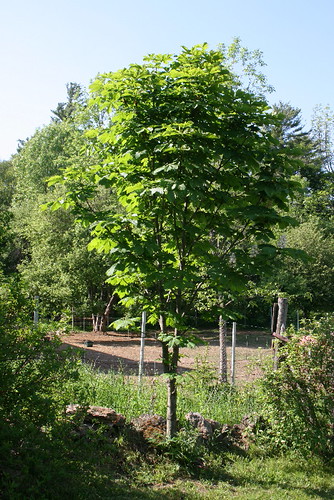
Speaking of time flying… I was at my parents’ earlier this week; I had a dentist appointment that I had been putting off for some time, and then opted to spend some time in the countryside before I returned to the city. It was a gorgeous, sunny afternoon when I arrived, and I grabbed my camera and headed out to wander about the property for a bit and enjoy it all. In my wandering I spotted the Horse Chestnut above.

My sisters and I planted this tree as a chestnut when I was quite young. I can’t recall exactly how old now, but probably no more than ten or twelve. At the time, my parents took us to music lessons that were held in the basement of a small church. Just outside the church were a couple of beautiful, mature chestnut trees. The three of us loved to stop and browse through the fallen chestnuts, looking for ones whose cases were whole and unblemished, trying to find the perfect, smooth chestnut. We’d usually come home with pockets full of them. I don’t remember what became of most of them – they were likely either used in games we made up, or were lost. But during that period a couple got planted.

Horse Chestnut

This tree is exactly the same age as the first one. We didn’t have any idea of ideal conditions to grow a chestnut tree. In fact, we probably weren’t thinking of the long-term at all, but just planted them as a bit of fun. The first tree grows in an open patch that gets sun through most of the day, the second is in a well-shaded area at the edge of a stand of trees. I don’t know what the rationale behind choosing these two spots was, although the latter was along a path my dad kept mown at the time that we used to play along.

While the first tree grew and flourished in the bright sunlight of its open location, the second remained rather stunted, growing to about a foot high and then seeming to remain at that size for years. It had trouble with rabbits, too, and for a while we had to put a wire cage around it to protect it. I’m not sure what changed; no trees or branches have fallen to open up the sky any more for it. However, it slowly began to grow again.

This week as I arrived for some reason I paused and looked at the tree, growing a short distance from the driveway as it was. And I was somewhat amazed to note that it was now about as tall as I was, with a good canopy of leaves on it. How long had I not been paying attention to it? In my memory it’s still a little sapling two feet high.

Horse Chestnut racemes

Both trees are now somewhere between fifteen and twenty years old. The second has a long way yet to reach maturity. But on the first tree, as I was standing there pondering how quickly life slips by while you’re busy living it, I happened to notice a few white racemes of flowers on a couple of its lower branches. And I thought, what a lovely metaphor for my own stage of life – the two of us, the tree and I, both poised on the edge of maturity. I consider myself a very mature person, but with 30 in sight I feel like I’m reaching maturity – that age at which all those things that one associates with being a “grown-up” actually happen, when people settle into careers, families, homes, and life begins to feel more stable, less uncertain. These are the first flowers the chestnut has produced. I counted seven racemes, nearly all on the lowest, oldest branches.

Horse Chestnut raceme

The Horse Chestnut isn’t a true chestnut at all (which are in the genus Castanea, members of the Beech family), but a member of the genus Aesculus, which also includes the buckeyes of North America. It’s sometimes written horse-chestnut or horsechestnut to avoid confusion with the other group, and to simplify common names of the different species. It’s not native to North America, but is commonly grown as an ornamental, and has since escaped into the wild. You can see why it appeals – the lovely white flower spikes, hinted with pink, are eyecatching in the spring. And what about chestnuts roasting on an open fire? I will admit never to have tried this, however; also, the nuts are slightly poisonous raw, and I presume this is the reason for the roasting.

Children, especially those from the UK, play games with the large seeds – in fact, in some places the tree is known as the Conker Tree, after the children’s game of securing a string to the chestnut and taking turns trying to smash someone else’s with your own (the winning chestnut being the one that doesn’t break). I never played this game, either, though Blackburnian did as a kid. The seeds were also used by militaries in the two World Wars to create acetone, which was then used in the production of armaments. Historically they were also used for whitening and cleaning natural-fibre fabrics, as they’d produce a soap-like liquid when ground and mixed in water.

Horse Chestnut blossoms

Horse Chestnuts are one of my favourite trees, undoubtedly in part for the memories I have of them from my childhood, but also for their interesting leaves, flowers and seeds. I hope someday, when I’m well into my mature years and settled into a home of my own, that I might have a mature Horse Chestnut to shade my home and accompany me through middle age.

Lion’s teeth

Dandelion

Is there anything as cheerful as a lawn blanketed with dandelions? Dandelions are one of my favourite so-called weeds. The bane of gardeners and lawn purists, and the backbone behind an entire herbicide industry, this sturdy plant pops up just about anywhere. But it’s hard to feel antagonistic towards something so cheery.

I was shocked to discover that the incredibly common dandelion is in fact not native to North America. It’s originally a plant of Eurasia, but has been spread throughout virtually all temperate areas around the globe, in both northern and southern hemispheres. The species group evolved about 30 million years ago on its home continent; its presence here in the Americas is just a tiny blip in evolutionary time.

The name dandelion refers to members of the genus Taraxacum. There is some debate among scientists about just how many species are included in the group, with estimates for just the British Isles ranging from 60 to 250 species. I don’t know a whole lot about the taxonomy of plants, so I can’t comment on what they use to define a species. The definition we learned in school is that a species can’t mate with other species to produce fertile offspring (it either can’t mate in the first place, or the egg won’t fertilize, or the embryos abort, or the living offspring is infertile, like in mules). Of course, we know this isn’t always strictly true, but it seems like a pretty good rule of thumb, so I’m surprised at all the confusion. Perhaps the new genetic barcoding projects will help clear things up.

Dandelion

The name dandelion is a corruption of the French name “dent de lion”, or Lion’s Tooth, a reference to the jaggedly toothed leaves. This seems to have been a historical French name, as they no longer call them that. Instead, the modern French name for the plant is “pissenlit” – separated, “piss en lit”, which means, of course, “piss in bed”. I thought this was hilarious. Can you imagine a plant with a name like that here? It apparently comes from the plant’s diuretic properties when consumed. The Italians and Spanish have something similar, and an English folk name is “pissabed”.

Going a different route, locally in Veneto, Italy, they’re known as “pisacan”, meaning “dog piss”, referring to their common occurrence in such favoured places of dogs. Novara, Italy, and the Polish are much more refined, with their words both meaning “to blow”, a reference to the plant’s seed heads. In Hungary it’s known as “dog milk”, commenting on the pale sap that comes out when the stem is broken, or “child chain grass”, an observation on how children can make chains by removing the flower heads and inserting the narrow top part of the stem into the hollow bottom part.

Dandelion

Dandelions are members of the family Asteraceae, characterized by family members bearing flower heads that have many individual flowers. In the case of the dandelion the individual flowers are difficult to separate from each other. I’m unclear about whether each yellow “petal” represents a separate flower on these plants or not.

The leaves themselves grow in a rosette, from which one or multiple flower stems may grow. In low-growing, open areas such as lawns, the leaves can spread out and kill surrounding plants by preventing light from reaching them, however where they grow with vigorous competition the leaves are usually more vertical, and the plant can grow fairly tall. Dandelions have a monsterous taproot, which can make them a real challenge to pull out of the ground successfully. If you break off the taproot, the plant has the ability to regenerate from what remains in the soil.

Dandelion

You can see the pollen-producing organs here, the older of which seem to have split open. I’m not sure exactly what’s going on, whether this split releases more pollen, or what the situation is. I’m also not sure where the female organs are. I’m sure I could easily have turned up some webpages on dandelion reproduction, but to me that’s not the most interesting thing about these plants.

Dandelion pollen is collected by many insects, and many others come to the flowers for the nectar. When watching the flowers on my parents’ lawn I saw bees, wasps, flies and ants all visiting the plants. Once the seeds mature, they are eaten by seed-eaters such as goldfinches. There are quite a number of caterpillars that feed on the foliage.

Dandelion seed head

Each fertilized ovary develops into a single seed, which is attached to the flower head. A small parachute of fine hairs grows from the seed, and carries it away on the wind. The seed head is called either a “clock” or a “wishie” – the latter, of course, being from the children’s game of making a wish as you blow the seeds off the seed head. The seeds can be carried some distance on the wind, but eventually will either settle to the ground when the wind dies, or be blown into an object, where the parachute breaks off and the seed drops to the ground. This is why you often see so many dandelions growing along the edges of walls or around the base of trees.

A single seed head can produce anywhere from about 50 to 175 seeds, depending on its size, and a plant can grow multiple seed heads. It has been estimated that some very dense stands of dandelions may produce up to 97 million seeds per hectare, or about 39 million per acre!

Dandelion

Dandelions are eaten in many places as a culinary dish. The dandelion greens can be served cooked or raw, much the way one would use spinach. Raw leaves have a slightly bitter taste, and usually only the young leaves and unopened buds are used in salads. Older leaves are generally cooked. They’re high in vitamins A and C, and contain more calcium and iron than spinach. Dandelion flowers can be made into a sort of wine, and the roasted taproot can be a coffee substitute. In the UK, a soft drink exists that is made from dandelion and burdock and is called, appropriately, “Dandelion and Burdock”.

Interestingly, Wikipedia also claims that the milky sap from the flower stem can be used as a mosquito repellant, though you’d have to clip a lot of dandelions to get enough to work, I’d think. It can apparently also be applied to warts as a wart remover, and other parts of the plant have historically been used for treatment of other ailments.