
The Marvelous in Nature

Baillie Birdathon

Magnolia Warbler

Magnolia Warbler

Over the last few years, every May I’ve been going out and participating in the Baillie Birdathon in support of the Tommy Thompson Park Bird Research Station here in Toronto. The Baillie is a fundraiser run by Bird Studies Canada in support of bird conservation initiatives in Canada. Participants have the option of directing a portion of their funds raised to a third-party organization of their choice – in my case, TTPBRS. This is the primary source of funds for the programs the station runs, so while I’m not much of a fundraiser at heart, I do try to do my part.

American Redstart

American Redstart

The idea behind the Baillie is that you pick a day, any day, sometime in the month of May, and tally all the species you observe in all or a part of a 24-hour period. You can be anywhere in the world, technically, but most participants tend to stay close to home, or bird a patch associated with their chosen organization. In my case, this would be Tommy Thompson Park, home base of the research station (the station does have programs outside of the park in other parts of Toronto, but this is the primary site).

Eastern White-crowned Sparrow

White-crowned Sparrow

I chose to do my birdathon on Tuesday. I cheat a bit when picking my day, since I’m not as limited by other constraints such as a weekday work schedule. So I wait till a day when things are just hopping, and that becomes my day. This was true of Tuesday. I’m not sure what prompted everybody to move in to the site that morning, since the weather wasn’t exceptionally favourable or any different from the previous few days, but there they were.

Chestnut-sided Warbler

Chestnut-sided Warbler

During the morning I tallied 23 species of warblers, including a few that were brand-spankin’ newly arrived overnight, “late” migrants that tend to come through in mid- to late May and June, such as Mourning or Blackpoll Warbler. There were also a few straggling “April” migrants, those that come through primarily in April or early May, such as Yellow-rumped or Palm Warbler. The best time for diversity is this mid-spring period, when both ends of the spectrum begin to overlap.

Scarlet Tanager

Scarlet Tanager

Since I’d done so well through the morning, I opted to head out to other areas of the park and see what else I could turn up. On my “hit list” were some rather notable misses that I’d somehow managed not to see during the morning – chickadee, cardinal, Brown Thrasher, all residents at the station. I also had my sights pegged on Scarlet Tanager, a few late-to-leave winter ducks, and some park specialties such as Black-crowned Night-Heron, Great Egret and Canvasback. I did manage to track down all these species with some hunting around.

Black-crowned Night-heron

Black-crowned Night-heron

However, I also missed a few that I’d figured would be pretty easy ticks. Savannah Sparrow, all these acres of meadow and where are you? Eastern Meadowlark, have you chosen not to nest here this year? And those several Orchard Orioles that have been hanging around the last week, disappeared. Rock Pigeon, what kind of birdathon doesn’t have a pigeon?
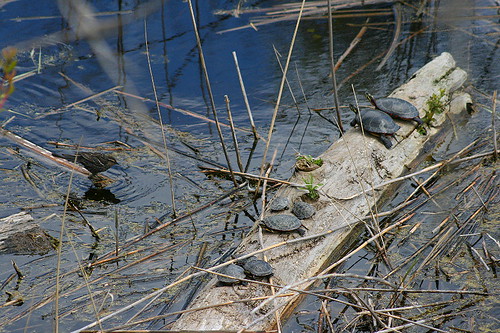
Turtles and blackbird

Red-winged Blackbird and turtles

I did get to see a couple of interesting things while out. One was the previous Black-crowned Night-heron, dead set on breaking off that branch to take back to the nest. He spent several minutes giving it his best shot, but eventually had to give up and moved off to another tree to try a different one. The second was the above female Red-winged Blackbird which was poking around at the edge of the pond looking for a good soggy old cattail leaf to take back to weave into her nest, while a line of turtles looked on.

Eastern Kingbird

Eastern Kingbird

I wrapped up the day with 82 species, which I felt was respectable given that I spent the first seven hours at the station, largely within the lab, and only birded for an additional three hours beyond that, during the afternoon lull period. Aside from the variety of warblers, the indisputable highlight of the day was a female Summer Tanager that very obligingly made its way through an area where I just fortuitously happened to be checking the mistnets. It had been discovered the day before by the station coordinator, and has hung about for a few days now. It’s the first record of the species for the station, and they aren’t recorded very often in Ontario in general during any given year.

Vodpod videos no longer available.

more about "A Few Birds of May on Vimeo", posted with vodpod

The TTPBRS coordinator pieced together a video of many of the species passing through the station currently. I could’ve sworn it included the Summer Tanager, but in re-watching it now I don’t see it, so perhaps he’s left that bit for another video. If you follow this link to the video’s page, you can watch it in HD (for those with HD-capable monitors – mine isn’t).

A mouthful of mud

Barn Swallow collecting mud

Yesterday while down at the research station I spent some time watching a pair of Barn Swallows collect mud from a little puddle we have out front and carry it off to build their nest with. They spent most of the morning working on it, or at least the portions where I was outside to observe them (yesterday was an exceptionally busy morning, and as it was the coordinator’s day off I was the sole bander, which kept me inside for a good portion of it). Once things had slowed down enough in the lab, such that I had a bit of time to grab a snack and catch my breath, I took my camera out to shoot a few photos of the pair.

Barn Swallow collecting mud

I believe the above two photos are of the male. The female Barn Swallow usually has a paler belly than the male. In Europe, where it’s simply called the “Swallow”, hers is nearly white. The species, Hirundo rustica, is found through most of the northern hemisphere, with six distinct subspecies across its range. The North American subspecies is H. r. erythrogaster, separated from others by the absence of a dark blue breastband separating the orange throat from the creamy belly.

I also noticed that the male appears to have a pale collar across the back of his neck, visible in these photos. I’m not sure what this is the result of, or even whether it’s just a plumage anomaly, or caused by an injury or somesuch. You see this sort of marking often with mammals, where the hair that grows in over a scar is white (this is the premise used behind branding livestock).

Barn Swallow trying out a leaf

Here he picks up a leaf, probably more out of curiosity than desire to use it in the nest, since he dropped it quickly.

Barn Swallows collecting mud

Both individuals of a pair will collect mud to build the nest with, and they were coming regularly to the little puddle, not much more than a few feet across. They would perch on the stones beside the puddle and were fairly tame, in that they wouldn’t fly if you walked by some metres away, providing you didn’t appear to be focused on them. The female is caught mid-step in this photo. I loved watching the two of them walk across the ground, since their especially short, stumpy legs meant they more waddled than walked. All swallows have very short legs, I presume so that they tuck out of the way and increase aerodynamics when flying, since much of their life is spent on the wing.

Barn Swallow taking mud for nest

After getting what he felt was a satisfactory beakful of mud he took off to add it to the nest. Barn Swallows spend so much time on the wing because that’s their primary foraging method. They’ll chase flying insects in the air, demonstrating swiftness and maneuverability characteristic of swallows. They’ll skim the water’s surface with their mouth open to scoop up water to drink, and will even bathe this way. The wings of swallows and other aerial foragers are built for spending long periods in flight while minimizing the energy required to do so, and are characteristically long and narrow.

Along with the other swallow species, and other aerial foragers such as nighthawks and swifts, North American Barn Swallow populations have been declining over recent decades. The cause of this is unclear, but given the similar foraging habits of the group, it’s likely at least in part caused by declines in the flying insects they rely on for food. For those of you old enough to have been driving for a while, think of the number of bugs you see stuck to your grill or splattered on your windshield in the summer these days, compared to a decade ago – when you stop to consider it, probably you’re not seeing as many as you used to. In just the last 20 years, the Ontario population of Barn Swallows is estimated to have declined by 60% (and an even greater 75% Canada-wide), meaning only 40% of the swallow population from 20 years ago still remains today. Twenty years isn’t a long period of time, and it’s disturbing to think what may happen to this and other species in another twenty – within all of our lifetimes.

Barn Swallows with mud for nest

There are hardly any buildings in the area, so I knew the pair had to be building on one of them. The obvious choice was a nearby building, the other side of the parking lot from the research station’s building, which sported a nice broad covered deck. I walked around and across the deck looking for their nest, but didn’t spot anything. As I was pausing to consider other locations, the pair returned with more mud, alighting on a nearby picnic table to decide whether I posed enough of a threat to not want to give away the nest location.

Barn Swallow applying mud to nest

Eventually the male decided I was harmless and flew up to the nest location, a spot I had completely overlooked. The nest was still in the early stages of construction, which is why I hadn’t spotted it immediately.

Barn Swallow nests are made primarily of mud layered up into a thick caked wall, and lined with softer material such as grasses, feathers, or hair. Before humans came about to offer excellent nesting locations, the swallows would build their nests on cliff faces or in caves, against the sheer vertical rock walls. They ordinarily either build it on a ledge, or butted up in a corner, but in either case it’s placed high up under an overhang. Human structures, with their eaves, rafters, porches, gables, etc, have been perfect for building nests on. Unfortunately, because of the droppings that tend to accumulate under a nest during the weeks it’s being lived in, they can also be an unwelcome tenant for some homeowners.

Barn Swallow on porch light

Perhaps because I’d moved in a few steps closer to get a better angle with the camera, or perhaps simply because I was still there, he was less inclined to go directly to the nest the second time he came back with mud. He flew up to the other light and stared pointedly at me until I turned to leave them to it. I’ll poke my head in next time I’m down to check in on their progress.

My milk snake brings all the boys to the yard

Eastern Milk Snake

I’m not a fan of most R&B/hiphop music, and I don’t even particularly like this song, but I couldn’t stop it from going through my head as I was doing the research for this page. It’s probably true that as a schoolkid, if I’d had a beautiful big Eastern Milk Snake like this it would’ve attracted a lot of attention. I spotted it basking on the road earlier this week. There wasn’t any sun, but the road pavement would still have picked up enough of the radiation that did manage to pierce the clouds to be just a bit warmer than the surrounding vegetation. Concerned for his longevity should he continue to stay there, I got out of my car, ran a few photos off, and then shooed him back into the nearby ditch with the help of a longish stick.

Eastern Milk Snake

Strictly speaking, the milk snakes, while they can give a painful bite, are not dangerous in the sense of being lethally venomous, so the stick was mostly to ensure my skin remained intact. It doesn’t use venom to subdue its prey, but instead catches it with its teeth and then constricts it to kill it. It is primarily a nocturnal hunter, and tends to be hidden during the day, under or behind objects. As adults their diet mostly consists of small rodents such as mice, but they’re opportunistic feeders, eating anything it can catch that’s small enough to fit down its throat, from birds’ eggs to frogs to invertebrates. A young milk snake will mostly eat invertebrates befitting its much smaller size.

The Eastern Milk Snake is actually a subspecies of the Milk Snake, Lampropeltis triangulum. The Eastern is the nominate subspecies, L. t. triangulum. There are 25 recognized subspecies of Milk Snake, ranging from southeastern Canada south to Ecuador and Venezuela in South America. In North America the Eastern has perhaps one of the largest ranges of the milk snakes that are native to here, found in deciduous forests from Quebec and Maine, west to eastern Minnesota, and south to northern Alabama. Different subspecies will achieve different lengths, ranging from 50 to 150 cm (20 to 60 inches). This one was on the smaller side of that range, perhaps a couple of feet.

Red Milk Snake (L. t. syspila), by Mike Pingleton, from Wikimedia Commons

Some of the other subspecies are known as kingsnakes, and/or resemble the highly venomous coral snakes. It’s surprising to think that the above snake is actually related to the one that we find around here. In fact, some of the milk snake subspecies may eventually be split off into their own distinct species, but for the time being they’re all one group. In the south, the venomous coral snakes can be told from the non-venomous milk snakes by a rhyme that goes, variously, something like, “red beside black, you’re okay Jack, red beside yellow, you’re a dead fellow.” If you look closely at the Eastern Milk Snake you can begin to see how the blotches may have started out as bands (or vice versa).

Eastern Milk Snake

If disturbed, the Eastern Milk Snake will sometimes rear back and rapidly vibrate its tail in the ground litter. This can sound a little like a rattle and with the brown spots along the back the species can sometimes be confused for a rattlesnake – obviously to its advantage since nearly everything will back away from the threat of a rattlesnake. The individual I came across was either too cool still to be active, or completely unconcerned about any threat I posed. I was able to get quite close (slowly, cautiously) with the macro lens on the camera, and it just sat there until I pushed it gently with the stick to encourage it to move.

Eastern Milk Snake

The Eastern Milk Snake resembles a couple other species found in the east. Both the Fox Snake and the Copperhead have similar blotchy patterns, but the milk snake is more slender, and has a distinctive pale Y or V just behind the head. Since coral snakes don’t occur this far north, it’s likely that the milk snakes of this region have evolved to resemble the venomous snakes that do, both in behaviour and appearance. This is called Batesian mimicry, when one non-venomous/poisonous species evolves a visual appearance that resembles another species which is, such that the non-venomous species benefits from predators’ experience with the real ones. The same thing is seen with the Viceroy butterfly, where they superficially resemble Monarchs through the north, and Queens through the south, according to the unpalatable species in the region.

The name Milk Snake may have come from the species’ habit of frequenting barns and barnyards, where there are plentiful rodents and cool, dark interioris. A myth arose from this association that it would suckle cow teats for the milk. The myth is false, but the name seems to have stuck.

Eastern Milk Snake

Milk Snakes lay eggs to reproduce. They mate in early May to late June and lay the eggs in June or July in sheltered spots such as beneath logs or rocks. The clutch of about 10 eggs, on average, hatch after about two months, in late summer. Like with most species, the first year of life is the most dangerous and the youngsters run the highest risk of death while they learn the ways of the world, but once they’ve made it through that first year they can potentially live as long as 12 years.

Eastern Milk Snake

In Ontario and Canada the Eastern Milk Snake is a species of special concern, and it may be partially due to persecution, run-ins with cars, and other human-related causes of death. However it’s apparently also a popular snake in the pet trade (probably more so the brightly-coloured subspecies of the south). To try to avoid this individual from becoming another casualty, I coaxed it over to the nearby ditch where it slowly slithered into the grass. When I peered over the edge to where it was sitting, its defensive response finally kicked in, and it coiled up its front part to show me it wasn’t afraid to strike if I got too close. I respected its privacy now that it was in a safer spot and returned to my car. Safe travels, buddy.

Morel of the understory

Morel

When I was down at the station on Thursday, I happened to spot a mushroom growing at the side of one of the trails. It’s a morel, a mushroom of the genus Morchella. Morels are one of the most distinctive of the mushrooms. They look a bit like crumpled sponges, with honeycomb-like creases and folds in the cap. They come in four identifiable varieties, that roughly correspond to species: yellow, gray, black, and “spike”, the latter having an exaggerated stem and reduced cap. The ones we have at the station are yellow morels.

Emerging morel

They’re a springtime species, coming up in late April or early May in our area, but as early as late February or early March in the far southern reaches of their range. They’re not uncommon at the site, I see them every year, usually predictably along certain trails. I just serendipitously spotted the one at trailside as I was walking through to check a net. Their colour makes them blend in with the debris that covers the ground at this time of year, but they’re fairly obvious once you spot them. They can grow to be quite large, in some instances to six or eight inches or more. Other individuals may be comparatively tiny, less than an inch. The very first one I spotted was perhaps four inches tall, but most of the rest were smaller, just two to three. Size is dictated more by the available resources the mushroom has to grow than by the species.

Group of morels

Morels tend to be associated with the east, and especially the Great Lakes region, but they can actually be found in many areas across the continent. The coastal side of the western mountain range is also a good spot to find them, but virtually every habitat, other than the dry desert habitats or the swamps of the southeast, can potentially be home to morels. Like virtually any other fungus, morels grow from a subterranean fungal root system called a mycelium. This mycelium may spread over quite a broad range of ground (I couldn’t find a number online, but one of our volunteers thought on the order of a hundred or more square metres, or over 1000 square feet), and the fruiting bodies, what we recognize as the species, can pop up at any spot within this network, where the microhabitat conditions are most ideal.

They are often associated with forest fire sites, where they grow prolifically in the first two or three years after the burn. The reason for this isn’t stated, but perhaps could simply be due to the sudden open canopy and abundance of nutrients in the soil. In non-fire areas the mushrooms can also be quite abundant, and are often associated with certain tree species, especially in the east. Old apple orchards are a good site, as are ash, sycamore, tuliptree, cottonwoods, and dead or dying elms. Cottonwoods are the primary tree species in the habitat surrounding the station, and the morels do well there. Despite these observations, morels are notoriously difficult to cultivate, especially on a large enough scale to be commercially viable, the way white mushrooms are. Most are wild-picked, and sold as delicacies.

Morel cross-section

Morels are highly edible, and in fact are a favourite among even some who aren’t so keen on mushrooms in general. Their subtle taste has been likened to mild fish (in some areas the mushrooms take the name “dryland fish” for this reason), and they’re recommended in dishes where the other flavours are likewise quiet, such as on pasta or rice. Mushrooms collected from the wild need only be lightly washed to be eaten; in fact, soaking them will ruin their flavour. However, they MUST be cooked prior to being eaten, as they do in fact contain a very small amount of toxin – it is enough to cause a reaction when raw, but is destroyed once the mushroom is cooked (although Wikipedia comments that occasionally even cooked morels, when consumed with alcohol, can sometimes cause a reaction). There are tons of recipes for morels on the web. I must admit I’m not a mushroom-eater myself (I have a thing about eating fungus), and so I’ve never personally tried them.

Although morels are generally pretty darned distinctive, there is another mushroom that can possibly be confused for them by novices. It goes by the name of false morel, for the reason that it superficially resembles the real morels. However, it is highly toxic and cannot be eaten (although the same volunteer recited a phrase he’d heard once: “All mushrooms are edible, but some can only be eaten once.”). It tends to be chunkier than true morels, and the folds in the cap more resemble the convolutions of a brain surface than the walls of a honeycomb. However, the easiest way to tell the two apart if you’re unsure is to slice off the top of the cap. True morels are hollow, while false morels are solid inside.

Double morel

Morel hunting is a popular pasttime among northeastern naturalists and fans of the mushroom as a culinary delicacy. There are morel hunting associations, morel festivals (many of which seem to take place in Michigan), morel photo groups, and morel discussion boards. They even have dedicated morel blogs, and have been recently mentioned on some other blogs I read: The Ohio Nature Blog, and Bill of the Birds (who, with his son, found a whole pile in their old orchard). There seems to be a whole subculture built around morel hunting! Of course, if you’re the lazy sort and prefer the eating over the hunting, you can order your own backyard morel-growing kit. When picking mushrooms from the forest, most sites say to pluck them by gently twisting at the base, such that you break the stem leaving the bottom in the soil so that the mycelium isn’t damaged and future morels can grow from it. I am prompted to include, as well, a reminder that nothing should be removed from public parks or nature reserves, following the philosophy, “take only photographs, leave only footprints.”

Midge on morel

This seems to have been, by most accounts, a good year for morels. Most hunters seem to be reporting bumper crops. After finding that first individual at the station, some hunting about turned up a few more, and then more after that. In fact, the more we looked, the more we spotted. There were probably easily a couple dozen individual mushrooms just in the few areas we searched. This is the most I’ve seen at the station, but I’m not certain if that’s because there are more this year, or I was just looking more closely this spring. Although the other volunteer took a batch home, I was happy to have fun with the hunt and just know that they were there, and leave them for the insects to enjoy.

Tiger of the rails

Tiger Beetle

I had been slowly making my way down the rail tracks for about half an hour before I spotted the first one of these – a Six-spotted Tiger Beetle. Metallic green and vibrantly flashy in the morning sunshine, I’m surprised I’d missed them to that point, since, even though I was somewhat distracted by the birds in the trees lining the rail bed, I had also been paying some attention to the ground, looking specifically for flowers with insects on them. The tiger beetle wasn’t at the flowers, admittedly, but it would be very hard to miss such a strikingly bright insect.

These are my favourite of the beetles. Appearance-wise, it’s easy to see why they appeal. There are many beetles, though, that are flashy, iridescent, eye-catching. The scarabs are especially known for it, as are the metallic wood borers. Many scarabs also have interesting horns or such, and long-horned beetles have outlandishly long antennae. We have some of all of these around here, but it’s the tiger that remains my favourite.

Tiger Beetle

Part of it is probably just that they’re quite common, a familiar beetle of early summer, and yet I’m always pleased to spot them. They tend to frequent trails and other open areas in or adjacent to deciduous woods. I tend to associate them with successional areas, spots with many young trees and shrubs, although I don’t know if this is because it’s a favoured habitat, or just simply where I happen to be more often. I’ve never seen one down at the bird research station, nor at my parents’, but they’re fairly abundant at the station’s summer banding research site, and were along the rails here, too. They’re not that big, at not much more than 13 mm (1/2″), but still large enough to catch your eye.

The adults of this species give the critters both their common and scientific names (Cicindela sexguttata). On most individuals, they have six yellowish-white spots that rim the outside of the elytra (wing covers). The number of spots on individuals can be variable, ranging from none or two up to six or eight. In the case of this one, it has an extra two spots in the inner area of the elytra, to form eight spots total.

Tiger Beetle

I think part of it is also their personality. Tiger beetles obviously don’t take their name because of any physical resemblance to the mammal of the same name, since I have yet to see a tiger that’s metallic green. Instead, their name reflects their personality, and their hunting behaviour. These beetles are predaceous, preying on other small invertebrates. They especially like ants and spiders, but anything small enough to be consumed can become prey. They move with lightning speed, using this to their advantage to snatch prey before it knows what’s hit it (much like jumping spiders do; obviously camouflage is not an effective tactic with these guys).

Maybe their fangs come in to the name, too. Look at the size of those jagged-toothed mandibles relative to the beetle’s head. These massive jaws are characteristic of the group, and are used in subduing and ingesting prey items. They also have very large eyes, which are important for spotting and tracking prey as it moves. It has excellent vision, and they’re very hard to sneak up on. The one downside to this macro lens is that it’s shortened my focal distance, so now I need to be within 6 inches of the subject to get the true macro 1:1 magnification. You get fabulous photos, but only if you can get close enough to take them. Patience is definitely required; either that, or setting your camera up pointed at a flower and waiting for the bug to come to you. Which won’t work so well for these guys.

Tiger Beetle

While I watched this guy, trying to get close enough to run off a series of good, sharp-focused shots, he pounce on and ate something. It happened so quickly, and I was sufficiently distracted, that I didn’t see what it was he ate. It appeared to maybe be a small spider. Whatever it was, it had many long, thin appendages sticking out of the tiger beetle’s mouth as he chewed on it.

There are 14 species of tiger beetles in Ontario, of which the Six-spotted is probably the most common. Certainly it’s one of the most generalistic, inhabiting a wide range of habitats and ranging across a broader portion of the continent. It’s found from New England, west through southern Canada to North Dakota, and south to central Texas and Florida. Sand dunes, gravel pits and beaches are among the best places to look for some of the other species, but rocky alvars and exposed rock or dirt in meadows or fields are also good spots. Not all of them are such flashy colours; many are dull browns and patterned to blend in with the ground, making them harder to spot (and also more easily overlooked, for someone who’s not actively looking).

Tiger Beetle

This guy seemed to be hungry. With his second pounce, he grabbed what appeared to be a bit of dead leaf. Eventually he dropped it, losing interest, or perhaps distracted by something else. Both adults and larvae are predaceous. Adult females mate in the spring and lay each egg in a short burrow in the ground, where, sometime in late June or July, it hatches into a worm-like grub with fangs. It digs itself a longer, vertical tunnel, which it lives in the rest of the summer. It eats similar prey to the adults, lying in wait within its tunnel for some unsuspecting insect to wander by. It spends its first winter in its tunnel as a larva, awakening in the spring once the ground warms up. Later that second summer, in August or September, it pupates within its tunnel. Although it becomes an adult that fall, it doesn’t actually emerge from its tunnel until the following spring, when it will mate and start the next generation’s 2-year cycle.

I tend to think of these guys as species of high summer, but the websites I referenced seemed to indicate they are more of a mid- to late spring species. None of them gave the lifespan of adults, but the Ontario website indicates a few can be found into fall. Some adult insects lack mouthparts to feed as an adult and die shortly after emerging and mating, but this is obviously not the case for these beetles. I’ll look forward to watching them this spring and summer as I do my surveys there and at the station’s summer site.