The Marvelous in Nature

Rail-bed bugs

Small carpenter bee - Ceratina sp., subgenus Zadontomerus

As is to be expected in just about any habitat, but especially open, sunny ones, there were lots of insects of varying types along the rail tracks. I decided to sit in front of a small patch of garlic mustard (good for something, at least) to try to snap a few photos of the creatures coming in to the flowers. It was while I was sitting here that I spotted the redstart and Yellow Warblers of yesterday. I got a few photos of them, but not of the little guys at the flowers. There was very little variety at the garlic mustard, it turned out once I sat and looked closely. In fact, the above was the most abundant insect along the tracks, and all I saw at the garlic mustard flowers. I snapped this photo just a short distance down the tracks, at some coltsfoot growing at the edge of the railbed. This is a small carpenter bee, of the genus Ceratina. Species for most insects can be very difficult to pin down, and this is no exception, however it belongs to the sub-genus Zadontomerus. These bees are solitary, making their nests in dead wood or stems. They’re pretty similar to the similarly sized and patterned sweat bees, except that the small carpenter bees have long tongues, as seen here.

Mining bee - Andrena sp.

Another bee I spotted along the tracks was this small mining bee. Mining bees are also usually solitary, and find or dig burrows in the ground. This one was scoping out potential nest sites, checking cavities between and under pebbles. She didn’t seem to find anything to her liking while I was watching. Female bees will collect up pollen and nectar into balls that they place in the burrows as a food source for the larvae. They lay an egg on each ball prior to sealing the burrow. Bees come out in the spring once the temperature reaches about 20 C (68 F), even sometimes while there’s some snow still on the ground, and are fairly common during this season.

Beetle

While I was watching the bees, I felt something land on my head and start crawling around in my hair. Thinking it might be one of the little bees, I gingerly shook it out of my hair, and it landed on a leaf on the ground. Turned out to be a little metallic-green beetle. I tried looking this one up, but couldn’t narrow it down past leaf beetles, family Chrysomelidae. There are a number of metallic beetles in this family, but none of them seemed quite the right shape. One fairly common (and introduced) species looked like an almost match except the back is pitted, and it’s not on my little beetle. So it remains a mystery, for the time being.

Leafhopper - Neokolla hieroglyphica

This final bug is a leafhopper. This is the only one of the four that I managed to determine a species name for. This is Neokolla hieroglyphica – the hieroglyph reference coming from the interesting markings on the insect’s face. The species appears to be somewhat variable in colour, and when I spotted it it actually looked more blue than the orangey it appears here in the photo. It was just sitting on a leaf on the garlic mustard plants I was trying to get photos of the small carpenter bees from. Female leafhoppers lay their eggs in the stems of various plants. I found a journal article documenting the way this species uses goldenrod, and another page that collected the species from a crop field (though it’s possible they were attracted to goldenrod in the crop field or something). There would certainly be a lot of goldenrod along the tracks.

Other insects spotted included Cabbage White butterfly (always on the move, and so very difficult to get a photo of), quite a number of flies, and one of my favourite beetles, the star of tomorrow’s post.

Birds on the rail line

Rails

A couple years ago (has it been that long already?) I did some bird surveys for the City of Toronto as part of an assessment and preliminary monitoring scheme for a park in the Don Valley. They’ve recently contacted me again, looking to see whether I would be available to do another set for a different site. They’re just looking for an inventory of the bird species found using the site, which doesn’t require lengthy or involved surveys, so I said I’d take them on. I’m just going to be doing area searches, once a week, from now through June, to get a basic idea of what can be found there.

Today I met the woman from the City who I’ve been corresponding about it with, at the actual site. The site is located in the southern Don Valley, only about a five minute drive from my home. I’m surprised not to have known about it, but I don’t drive that way ever. It’s actually a capped and regenerating landfill, a couple decades old, now used as a natural area for outdoor recreation. We walked into it briefly and scoped it out. She answered a few of my questions, I answered a few of hers. We didn’t spend too long there; since it’s not a very complicated project, there wasn’t a lot to be worked out. Once we wrapped up there, I grabbed my camera gear and walked back in, along a different trail, to see what I could see.

I happened across these train tracks. They obviously hadn’t been used in some time; the rails were all rusty, and there were plants growing up between the ties, right next to the steel. I decided to wander along their length a short ways; it had the advantage of not being used by the many other park users, and I had no worry about a train coming along to flatten me.

American Redstart and Yellow Warbler

Especially in the city, rail lines make really great green corridors by which wildlife can move from one area to another. Very rarely does the city come right up to their edge, usually there’s a green buffer of trees and other vegetation that borders each side of the tracks. Although it wasn’t the case here, oftentimes that’s the largest contiguous stretch of habitat within a neighbourhood. As a result, it usually has lots of creatures living in it.

One of the first birds I noticed upon stepping out on the tracks was a male American Redstart. He was singing his heart out from a Manitoba Maple that overhung the ditch on the other side of the rails. Although redstarts can have somewhat variable songs, their most characteristic and distinctive songs is a slightly rising warble ended with a downward buzzy-ish note sounding something like a sneeze.

American Redstart

I started pishing to try to call them forward to the front of the tree. Pishing is a birder’s term used in reference to a sound rather like “pishpishpishpishpish”, said very rapidly. Many birds will become curious or agitated by the sound and come in to check it out. The theory is that it resembles the distress call of another species, in particular the Tufted Titmouse. When members of the tit family start giving their alarm calls like this, it’s usually a call to other species to come help – “Danger! Here! Mob it, mob it!” If you can sound sufficiently like an alarmed titmouse, you should be able to create the same reaction. Sometimes the birds ignore you entirely, but in this case it was quite effective. At one point (captured here), the redstart actually swooped down low over my head, either searching for, or mobbing, the source of the sound.

Male redstarts take a couple years to get this nice crisp black-and-orange plumage. In their first summer as an adult they still sport the brown-and-peach colouration of the females, although it’s often mottled black, especially around the face. That fall, when they go through their complete moult, they’ll replace all their drab feathers with striking black ones. This delayed mature plumage fits into the dominence hierarchy; black males almost always get to mate, brown males only if there aren’t enough black males to go around. Not that that stops them. Brown males will float between the territories of black males, and when the older one’s got his back turned, the younger one will usually slip in for a quick fling with the missus. The females have no problem with this; the more males she mates with, the better her chances of having mated with a genetically superior male. This guy probably wasn’t going to stick around to breed, though – although they do nest in the Greater Toronto Area, he was probably heading further north to better habitat.

Yellow Warblers

There were a couple of Yellow Warblers hanging out in the same tree as the redstart, checking me out as I pished at them (you can see one with the redstart in the earlier photo). It appeared to be a male and an older female (differentiated from younger females by the brightness of her yellow plumage), but could have been two males. Yellow Warblers might be the most common warbler in the Don Valley, and probably much of southern Ontario. They’re usually found in riparian areas, in the scrubby vegetation that lines stream and wetland edges, but can occasionally be found in other habitats, as long as they’re similarly shrubby. It was a bit odd to see the pair at the rail tracks, since there didn’t appear to be water immediately nearby, but I will admit I didn’t know what was on the other side of the berm bordering the north side of the tracks.

Northern Cardinal

Mrs. Cardinal came out and gave me a good look just to make sure the fuss wasn’t anything worth getting too upset about.

Northern Cardinal

Mr. Cardinal did the same, but hung back in the vine tangles. Neither of them stuck around long once they determined that it wasn’t actually a titmouse getting worked up over an owl or something. The tangled thicket they were hanging out in was a good place for a cardinal nest, but I didn’t actually climb up to check the area out. Cardinals actually used to be fairly scarce through this area, some decades ago, but are now a dime a dozen. The reason for their expansion is usually credited jointly to the increasing popularity of bird feeders along with gradually warming average temperatures. It’s been observed that as the temperature isotherm for the January mean minimum temperature of minus 16 C moves north, so does their range. Their northern range limit is now more restricted by availability of their preferred habitat than by temperature.

Gray Catbird

A catbird was singing from a patch of sumac along the edge of the tracks, and stopped to come check me out as I pished. Catbirds take their name from the sound they make when alarmed – which sounds rather like the nasal mew of a cat. They’re a member of the family Mimidae, the mimics. Along with the Northern Mockingbird and Brown Thrasher, the Gray Catbird will pick up sounds from its environment and work them into its song repertoire. A single catbird may have dozens of different phrases. Male and female catbirds look the same; rather than looking at flashy plumage to choose a mate, female catbirds prefer males with larger, more complex repertoires, which presumably indicates greater intelligence and stronger genes.

There were also other birds along the corridor: a few American Goldfinches, an American Robin, a Baltimore Oriole, a Warbling Vireo… These guys weren’t as obliging for a photo, tending to remain higher up in the treetops, hidden behind leaves and out of the reach of my camera. There were many other bird species in the rest of the park, as well, but even just in this small stretch of train tracks I was pleased with the diversity I found.

Flowers for my mother

wildflowers1

Today is Mother’s Day. I’m at my parents’ today, visiting with my mother and other family members. I bought my mom flowers, though not the cut sort that die shortly after bringing them home. It’s a nice hanging basket, with a variety of blooms planted in it. I’m not sure what they all are, but I thought they were pretty, and it would be something she could enjoy throughout the summer.

wildflowers7

I definitely owe a lot to my mom. I wouldn’t be here if it weren’t for her, and I don’t mean that in the reproductive sense (although that’s obviously also true). Rather, me, sitting here in front of this keyboard, sharing observations on The Great Outdoors – I wouldn’t be here.

wildflowers6

My mom has been a great formative influence on me through my whole life. The decisions she’s made have affected me and my career path since before I was even born. If I had grown up in town, I undoubtedly would not have developed the interest in nature that I have today. It’s because of my upbringing in the countryside – exposed to, and in fact encouraged to play in, the mud, water, grass, snow – that my appreciation of the outdoors was cultivated early. I likely took interest in my high school biology classes, and subsequently followed that interest to university, because of this.

wildflowers11

It was because of mom that I happened into birds. She had returned to school after having us three kids, pursuing a university degree that she had long wanted to obtain – at first just part-time, while we were still young, then finished off her undergraduate once we were all older and more independent. Following this she went on to complete a Master’s degree (which I admire her for), where she, as an older student, came to be friends with the then-professor of ornithology. She worked on a few projects with him, and through his connections learned of an opportunity to do fieldwork with birds that would be perfect for me, a student looking for a field job in my first year of university. At the time I was undecided about my focus of study. “Birds,” I thought, “birds are cool, I could do birds.” And I’ve never looked back.

wildflowers10

She’s been incredibly supportive of the developments in my career. She encouraged me to follow opportunities I might otherwise have passed up. She’s supported me in my decisions, cheered me on from the sidelines. Both my parents have pushed us to really pursue our own dreams and desires, rather than theirs, or society’s. For that I’m grateful. None of us three kids are in a typical career of the sort you usually hear kids say when asked what they want to be when they grow up (this was evident early; I don’t remember what I wanted to be at age 6 or 8, but my sister wanted to be a pony).

wildflowers9

My mom was there virtually every day during the week and a half I recovered in the hospital from my surgery. She would come, keep me company. We would gather up my various contraptions and tote everything down to the elevator so I could sit in the glass atrium and enjoy the airyness and the sunshine. My entire family would have liked to have been there, but it’s hard to put life on hold if things aren’t serious, and once I was moved to a regular room, Mom became their ambassador. This sort of always-there-for-us manifests itself in everything she does for us girls, and there is much we would not have been able to accomplish, or that would have been much more difficult, were it not for her support.

wildflowers3

From Mom I have got my curiosity. I have learned to strive for what one desires. Not to let others make decisions for you. To have opinions, and stand by them, but to always be open to learning more. To participate, to give back, but not to sacrifice yourself and who you are. I have learned that you are your most valuable asset.

wildflowers5

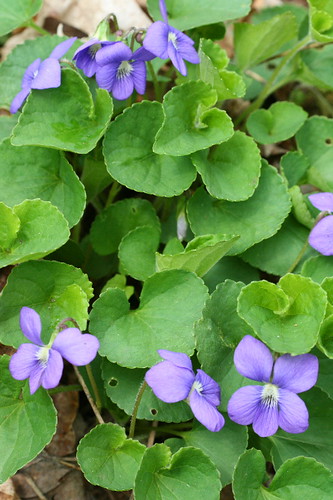
Tomorrow I am going with her to help her with an outdoor education class she’s running for a local group. We’re returning to the pond of yesterday’s post; while she has half the students at the pond studies part of things, I’ll take the rest down the trail to look at the forest ecosystem. I haven’t yet decided what to look at specifically, but will probably focus on wildflowers – eyecatching and pretty in a way many other things aren’t, to a group of non-naturalists. This selection are from our visit there last week. I do know the name of some of these, but not all. Surprisingly, my mom doesn’t have a wildflower guide (or it may be packed away), and I had the post all drafted up before realizing that. I will need to label these once I return home and can double-check them.

wildflowers2

Water bugs

Water beetle

The purpose of the visit to the pond last week was primarily to check out the creatures in the water, not the forest paths, as much as I enjoyed that. We didn’t see any of the salamanders on this trip; as plentiful as the newts had been a couple weeks ago, they were now conspicuous in their absence. In fact, there didn’t appear to be any macro-life in the pond, at least that was visible from the water’s edge. However, there was still lots of micro-life.

We scooped up a number of samples of pond water and bottom-muck, and let it settle out in a basin. Then we poked through it to see what we could find. Copepods were abundant, as well as a number of other little, microscopic creatures that were best observed with magnification. There were also quite a number of large critters, which could be observed easily (and photographed).

The above is a predaceous diving beetle, probably of the genus Neoporus. The group is also sometimes known as water tigers in their larval stages, for their predatory habit, but it also well suits this black-and-orange adult individual. Adults propel themselves with their broadly flattened hind legs, which they use as oars (but don’t confuse them with oarmen or boatmen!). I noticed while trying to get a photograph of this guy that whenever he stopped moving he’d go bottoms-up, with his head tipping forward to point toward the bottom of the tub. It was not especially helpful in getting a good photo, but this is how they collect air to breathe – in tipping forward like this they trap an air bubble underneath their wing covers which they carry with them while swimming. They’re not strictly aquatic; they can fly and will travel in order to exploit temporary water bodies.

Skimmer larvae

This is the larvae of a skimmer dragonfly. Dragonfly larvae, or nymphs, are entirely aquatic during this first phase of their life. Adult dragonflies lay their eggs in the water, usually attached to vegetation, where they develop and hatch. A dragonfly spends most of its life in a larval form. Some species can remain in the water as a nymph for up to five years, depending on the species and the local environmental conditions. During this period they’ll go through more than 20 instars, or larval stages, where they moult their skin to grow. The different types of dragonflies have differently shaped larvae; the skimmers are short and squat, like this guy. Nymphs are predaceous, feeding on other invertebrates, or even sometimes small fish or tadpoles. When they’re ready to metamorphose into adults, they’ll climb up a stem out of the water, where they’ll split their skin and crawl out as an adult form. The newly emerged adult will take a few hours to strengthen up and gain its adult colours.

Blackfly larvae

This is a blackfly larvae. I didn’t know what it was when I first spotted it in the water. It moves along much like an inchworm, securing one end, then moving the other, rather than crawling like a caterpillar, or wiggling like mosquito larvae. It uses suckers on its bulbous end in order to firmly attach to its substrate. If they happen to become dislodged, they remain secured to the substrate by a thin silken strand, much the way a spider that gets knocked or blown off will catch itself on a string of silk before it reaches the floor. This prevents it from getting swept away in the currents, but can also be used as a controlled way to move from one point to another within their habitat. They tend to prefer the faster-flowing segments of streams or creeks, but can be found in ponds as well. A small, leg-like appendage under the head can create a small current where none otherwise exists. They’re mostly filter-feeders, using “gills” near their head to sieve food from the water as it flows past, which is where moving water would be advantageous.

Water strider

I expect that most people will recognize this bug. It’s a water strider (also known by a dozen other names of a similar theme), usually found skittering across the surface of still water such as ponds or lake edges. However, they’ll also inhabit faster moving streams, and in fact this particular one came from the creek where we caught the crayfish, although there were also some on the pond surface as well. Predatory insects, feeding on other insects and invertebrates found on or near the water surface, they can scoot across the water as fast as 1.5 m/s (nearly 5 ft/s) – per second! They need this speed to be able to catch their prey before it takes off. They’re able to stand on the water through a combination of structural and chemical water-resisting features. They have a wax covering on their legs, but the more important factor is a series of tiny hairs with grooves that line each foot and spread out the pressure of their foot on the water surface, while simultaneously trapping air between the hairs, acting a little like snowshoes combined with waterwings. At certain times of year adult striders of some species can develop with wings, which allows them to disperse from one area to the other; in other species they always have wings.

Springtail

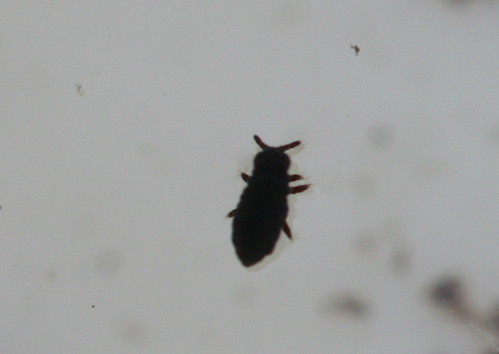
This was my favourite of all the little critters we swept up in our container. We got several of these, little tiny guys just a couple millimeters long. They sit on the water surface, much like the water striders. However, to move around, they jump like fleas. In fact, I think the name “water flea” would be much more appropriately labeled to these guys than to the microscopic Daphnia. They jump by using a mechanism similar to the click beetle in yesterday’s post. They have a long spike on their abdomen, resembling a “tail”, which is generally kept locked into place. When they want to jump, they release the clasp and the spike rapidly springs away from the body, pushing against the substrate (in this case, the water), and propelling the insect forward. It’s this jumping mechanism that gives the group its name. They can be found in nearly every habitat, even on the snow surface in winter – these ones are appropriately called “snow fleas”. Interestingly, unlike with the water striders, this speed isn’t for capturing prey, but rather for general locomotion and avoiding predators, as they’re primarily savengers, feeding on decaying plant and animal debris.

Look carefully

Ant on dandelion

On Tuesday I bought myself an early birthday present. I’ve been wanting a good macro lens for a while. In the winter I got a Canon close-up lens, basically the equivalent of a magnifying glass that you screw on to your existing lens like a filter. It worked fairly well, but unfortunately the lens that I had wasn’t top quality, it was the entry-level telephoto lens that came with the camera kit bundle. Sure does me fine for a beginner DSLR-er, and the price was definitely right (next step up is megabucks, relatively speaking), but because it’s low-end the optics are soft and the photos are never crisp. Generally this can be corrected with digital sharpening in Photoshop, but with the addition of the close-up lens, which softens the image a tad more, it was really hard to get good sharp shots without a tripod and ample light.

So I’d been eyeballing a dedicated macro lens. I find macro photography fascinating, because, unlike most wildlife photography, it’s a world that we don’t ordinarily see with our unaided eye. We also tend to overlook a lot of the small stuff, and I wanted to be able to capture these things to share with others. I wanted a lens that wasn’t afraid to get in there, and that would produce good sharp photos while doing so. The answer was the Canon EF 100mm f/2.8 USM Macro (quite a mouthful of a name!). I did a lot of research, and the general consensus was that the Canon 100 was the best bang for the buck at that price level. I couldn’t find a bad review. So I bought it.

fly

I took it out to test-drive it that afternoon, swinging by the Leslie Street Spit, which wasn’t too far out of my way. It was unfortunately quite windy, and a little cool, and I had other errands to run after, so I didn’t stay out too long. I focused on the dandelions that were growing along the edge of the parking lot and nearby path, pretty much the only wildflowers growing yet in these disturbed areas. There didn’t seem to be anything visiting them, no bees, no butterflies, no insects of any sort. Until I looked closely. There, crawling around at the base of the petals, deep within the flower head, was a teeny-tiny ant. It had a slight purple sheen to it, and its antennae were tipped with pollen. I don’t really know what it is (aside from colour and general size, ants are so similar to each other…), but it does resemble the Odorous House Ant in the Kaufman guide to insects. I gather it’s not limited to houses, despite its name, and the “Odorous” comes from its habit of emitting butyric acid, which smells of rotting coconut (presumably someone who lives where coconuts grow, and subsequently rot, would know better what this smells like).

The above fly, although also on a dandelion, was from a couple days later, when I was back at my parents’ place. It was also the only insect I found on the flowers. Like the ant, flies are difficult to identify, but this might be Cheilosia sp., a type of flower fly from the family Syrphidae.

Click beetle

Later that day my mom and I returned to the same pond site where we found the salamanders for another check-up visit on the status of things for a program she’s doing next week. We decided to walk down the trail through the woods a little ways, looking at the wildflowers and seeing what was blooming. We were mostly focused on the flowers, so nearly overlooked this beetle, even though it was sitting out in the open on a leaf.

It’s a click beetle, though species is uncertain. Click beetles are named after a characteristic noise they make. They have a spine on the underside of their thorax that snaps into a groove a short ways further back. It’s the snapping of this spine that produces the distinct clicking noise. The noise is primarily used to distract predators, but the spine can also be useful for flipping the beetle back right-side-up if it gets turned over. The action can be quite violent sometimes, jumping the beetle some distance into the air.

Asclera ruficollis

Further down the trail I stopped to photograph some trilliums and found this brightly-coloured beetle perched on the edge of a flower. I discovered, when I went to look it up in the field guide, that there are quite a number of long, narrow black beetles with red collars. This particular one had the unique characteristic of two bumps on the red thorax that made it easier to distinguish from the others, but I still had to submit the image to BugGuide.net to get an ID for it. It’s Asclera ruficollis, a beetle of the northeastern woodlands. Adults are found feeding on the pollen of wildflowers during the spring period, from March to May.

Pseudexentera sepia?

The last bug of this post was a little moth that flitted across the trail as we were walking. I tracked it a short distance off the path, where it came to rest on a dead log. If I hadn’t watched it land, though, I may have been hard-pressed to locate it again. It’s just a small moth, maybe a centimeter (half an inch), and cryptically coloured so it blends in with the wood (it looks fairly obvious here because I’ve isolated it with the camera, but believe me, it wasn’t). I think it’s a species of Pseudexentera, though I don’t really know which one. I could even be wrong on the genus. All those micros can be so tricky to ID! There just aren’t a lot of field marks on their tiny wings to reference.

Going out with my new lens in hand, I was looking for little things to photograph, but I was somewhat focused on the flowers. The lesson here: look carefully and pay attention, there’s lots out there that you can just walk right by without even noticing!