The Marvelous in Nature

Gold in the creek

Marsh Marigolds

Just a short ways down the road from my parents’ house is this little creek. I don’t know its name, or even if it has a name. It meanders through the woods to either side of the road, backing or crossing through various properties. I’ve always wanted to wander down its length, but never plucked up the courage to brave the potential encounter with a displeased property owner.

But I admire it from the road’s edge whenever I drive through. My sisters and I would come down here sometimes when we were young. We liked to drop sticks into the flowing water and see whose came out from the other side of the bridge first. I recall occasionally pushing through the vegetation, either to look at the little chub that swam in it, or to pursue the damselflies that danced along the water’s edge. In the summer it’s lined with grasses that will slice your skin like a papercut, so I either had to be especially keen or otherwise well-covered to want to approach the water.

Marsh Marigolds

Every spring I watch it for the first signs of the Marsh Marigolds. They’re such a cheery spring flower, and the first ones out in the creek corridor. There were some blooming last week when I visited, and I thought that was the show, but this week they abound. I’ve noticed they’ve been featured on a couple of other blogs that I read, in particular A Passion for Nature; they’re just that eyecatching.

Marsh Marigold

They’re part of the buttercup family, Ranunculaceae. There’s about 2500 species in this group of plants, found across all continents, but most prominently in the palearctic. Most species have flowers that are radially symmetrical (meaning it will look the same from any direction), though a few are bilaterally symmetrical (have a definite up/down/left/right). In their centres they have a small forest of pistils (the female organ) surrounded by stamens (the male organ). Insects come to collect pollen and also to sip at the nectar that is produced at the base of the pistils. In doing so, the pollen sticks to their bodies and they spread it from one flower to the next, easily done when the parts are all so close together.

All members of the family contain a compound called protoanemonin, which is toxic to people and animals. Many species also contain additional compounds, especially concentrated in the sap and in new shoots; buttercups and clematis contain glycosides, which are potent skin irritants, while Marsh Marigold, delphinium, monkshood and larkspur, among others, contain highly toxic alkaloids. One site recommends only handling these plants while using gloves. Some particularly sensitive-skinned people may find that necessary, but I’ve never had any reactions to handling any of these plants (for instance, buttercups – kids pick them and hold them under their chin to see if their chin glows yellow… which means something. Probably to do with love, since that’s a popular theme among kids games. But I’ve never heard of kids getting rashes from doing so).

Apparently these properties make it useful for a number of medicinal purposes, however, including removing warts (I guess the sap effectively burns the tissue). A tea made from the leaves can be a diuretic and laxative (that would be the poison aspect of it kicking in there), and other aspects of the plant can be used to treat fits, anemia, and even the common cold.

Marsh Marigolds

They tend to grow in discrete clumps, rather than as broad swaths of the flower. This patch was in the ditch right next to the road and I didn’t even need to get my feet wet to photograph it. They aren’t limited to streamsides, though that’s often the place they’re most easily seen since road bridges allow unobstructed views of the water’s edge. They can also be found in the soggy ground around wetland and marsh edges, and in bogs, fens, and swamps. Partial shade is their favourite, they’re unlikely to do well in heavily canopied forest swamps or wide-open marshes.

In some areas they’re a common garden flower, planted in water gardens or soggy areas. They grow well, and their showy, early flowers make them very appealing. They can be easily bought from many nurseries, and there are a number of different cultivars now available.

Marsh Marigolds

According to Wikipedia, the common name, Marigold, apparently refers to the flower’s use in medieval churches at Easter in celebration of the Virgin Mary. However, I know there’s more than one plant called marigold, so it may be that, like the North American robin, one was the species truly used and the others were just flowers that reminded the namer of the first species.

The species is also sometimes called Kingcups, though I’ve never heard them called that myself. They’ve got many local or little-used, but colourful names as well: Mayflower, May Blobs, Mollyblobs, Water Blobs, Water Bubbles, and the Publican, among others. I have no idea where they get “blobs” from, or even Water Bubbles, since they look like neither to me. I would suggest that these names were inserted into Wikipedia by someone as a lark, but I have actually seen them mentioned elsewhere, as well. Wikipedia suggests that these other names for the species reflect the plant’s persevering nature, especially through the often inclement weather of spring. I don’t get that either, really…

April redux

Jumping spider

Towards the end of April I happened across a few observations that I thought would be interesting to post as a wrap-up to earlier topics.

This first one is going back to the jumping spider that I watched pounce at (and miss) a smaller brown spider. The following week I came across the above perched on one of the legs of my tripod. It was huge! Well, relative to my first little guy. It was easily a centimeter and a half long. Black and hairy, with striking orange markings, hard to miss. But the most eye-catching thing about this little spider was its fangs, a radiant metallic green.

The spider belongs to the genus Phidippus, but I’m unsure of the species. The metallic fangs are characteristic of this group, and are used in impressing females in courtship dances. The genus is primarily restricted to North America, and includes some of the larger jumping spider species. Julie Zickefoose apparently has a little black one that keeps her company while working. His name is Boris.

Jumping spider with prey

A bit earlier, I had found this guy hanging out on the wall of the station building. Unlike the individual from my original post, this one had had better luck hunting. He’s munching on a midge, which are extremely common down there.

Worn Compton Tortoiseshell

I came across this butterfly at the end of the morning one day. It was flitting from one tree to another and paused at this birch briefly. I identified it as a Painted Lady, and didn’t really give it much further thought. Then, while preparing the photos for this post I decided I should just double-check that it was a Painted and not an American, because I couldn’t remember which one had the spot on the wing. Well, turned out it was neither. I hunted through the entire Kaufman guide to butterflies twice before realizing that it was an extremely worn, rather orange Compton Tortoiseshell. The first one I’ve ever seen. But now I wonder if I’d been seeing them but writing them off as the more common Ladies.

Worn Compton Tortoiseshell at sapsucker well

It was pausing at the birch trees, and when I looked closer I realized it was drinking sap from fresh sapsucker wells. This species overwinters as an adult and comes out in early spring, much the way Mourning Cloaks do. Because it’s still quite early for nutrition in the form of flower nectar, they take some of their food from other sweet sources, such as sap wells (mentioned in the original post about the Yellow-bellied Sapsucker).

Mourning Cloak at Pussy Willow

And finally, returning to the Pussy Willows. The same day I had the tortoiseshell, I also observed three or four Mourning Cloaks visiting the buds of this Pussy Willow. For the same reason that the tortoiseshell was sipping at the sap wells, these Mourning Cloaks were drinking the nectar available from the female flowers of the willow. I love the velvety red-black of the wings in sunlight. Most butterflies I see that overwinter as adults look a little ratty in the spring. The tortoiseshell had a chunk missing from its wing like a bird had snapped at it. This Mourning Cloak seems to be missing a piece from its hindwing.

April showers bring May flowers

Fancy Daffodil

Fancy Daffodil

I’ve always liked that phrase. A selection of blooms from my mom’s garden. I’m cheating a bit, these were all taken in April. But most of them were the last couple days of April – that’s close enough, isn’t it?

Daffodil
Daffodil

Hellebore
Hellebore

White Trillium
White Trillium

Frilly Daffodil
Frilly Daffodil

Snowdrop
Snowdrop

Red Trillium
Red Trillium

Crocus
Crocus

Tenting it with the family

Eastern Tent Caterpillar eggs

Boy, has this week flown by! Here we are at the weekend already and I feel like the week’s only just begun. Part of this has been the progression of a new project. TheMothMan and I are starting work on a new field guide to the common moths of northeastern North America, which we’re pretty excited about. I haven’t wanted to say anything till I felt it was sure to go ahead, but we just secured an agent to represent the book so it looks like it should be more a question of where, rather than if, it gets published. Our agent also represents such notable naturalists and authors as Julie Zickefoose, David Sibley, Pete Dunne, Lang Elliott…. excuse me while I geek out for a moment. How often does something happen to bring you two degrees of separation from your idols? It’s only slightly less thrilling than if I’d met them in person.

Okay, composing myself… back to the topic at hand. Moths as well, as it turns out. Or rather, their larvae.

The above photo I took a few weeks ago, at the beginning of April. It completely encircled a small branch of a small tree, with white egg surfaces on top, but a crusty golden layer across the bottom. It wasn’t very big, perhaps a couple centimeters at most in its longest direction. I filed it away as “unknown insect egg mass” and there it stayed for a couple weeks. Then, while looking up something completely unrelated (always the way, isn’t it?) I stumbled across a photo in the ID Request section on BugGuide.net that looked just like my egg mass.

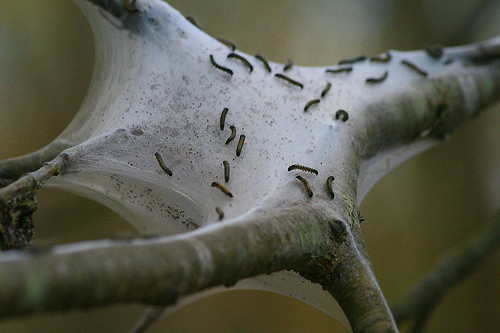
Eastern Tent Caterpillar tent

They were Eastern Tent Caterpillar eggs. They were especially conspicuous against the dark bark of the tree they were on, or I may not have noticed them at all.

This week, when I arrived at my parents’ for a couple days, I was struck by the huge number of web tents in the trees. I wondered if there really were an unusual number this year, or if it was just that I was taking more notice this year, what with the motivation of potential blog entries making me more attuned to these sorts of things. Either way, there seemed to be lots of them, two or more in a few trees even.

My mom pulled out her handy dandy Stokes Guide to Observing Insect Lives and we looked it up (my images are nicer… :) ). Over the winter we’d investigated Chokecherry Tentmakers. Thinking that I’d seen several webs in the chokecherry out front, I’d suggested it was these. In fact, they don’t appear till later in the summer. The only web tents found at this time of year are those of the Eastern Tent Caterpillar (Malacosoma americanum).

Eastern Tent Caterpillars

There are two primary species of tent caterpillar: the Eastern and the Forest. The Forest is associated mostly with oaks and maples. The Eastern is found on trees of the Rosaceae family, most notably apple (cultivated, wild, and crabapple) and cherries (cultivated, Black and Chokecherry), as well as hawthorn, pear and plum. Indeed, when I really stopped to look, all the tents at my parents’ appeared to be in the chokecherries, the crabapple, and the cultivated apple trees. And the little tree where I’d found the eggs at the station was also a young apple. When I checked back this week, sure enough, there was a little tent.

Eastern Tent Caterpillar tent

The most obvious sign of their presence, of course, is their web tents. When the caterpillars hatch out of their egg cases they migrate along the branch till they reach a major fork, where they set up shop. This is another feature that tells the tent caterpillar apart from the webworms; tent caterpillar nests are never out at the end of the branches. The young caterpillars all band together in an amazing show of cooperation, building the first little nest to get them started.

As time progresses and the caterpillars eat and grow, they build more layers on the nest to expand it. They lay down silk on the outside of the nest, and as it dries it tightens, eventually separating from the layer it was laid down upon. This creates a stratified effect within the nest. As the caterpillars grow they need more room, but they also require additional layers as the existing ones become filled with frass and moulted skins. The caterpillars leave a hole or two in the webbing, usually near the apex but potentially anywhere, by which they come and go from the nest. You can see the hole here. They tend to lay down the most silk on the side that faces the sun most directly. Usually this is the southern or southeastern side, which allows them to catch the morning rays more efficiently to warm up at the start of the day.

Eastern Tent Caterpillars

You can see in this picture, of a relatively new nest beside my rather dry fingertips, just how small the caterpillars are to start off. They use the nest for a number of purposes. The first and perhaps most obvious is for protection from both predators and the elements. When not feeding, the caterpillars huddle inside the tent. They also use the outside of the tent for basking or huddling to raise their body temperatures prior to heading off to feed, which you can see them doing in this photo. They pack together like this to reduce individual heat loss due to air movement. The stratified layers within the nest also help them thermoregulate, as the silk traps heat like a mini greenhouse. By moving in or out as needed they can adjust their temperature.

Eastern Tent Caterpillars

As the caterpillars move about, they are constantly laying down silk secreted from a spinneret at their tail-end. In going to and from the feeding areas they end up creating silken trails along the branches. They appear to follow these trails when moving, but they’re actually following a trail of pheromones that are also laid down by individuals. Initially, or once a particular source is depleted, individual caterpillars will go on “scouting” trips, looking for good food sources. So that they can find their way back to the nest they leave a scent trail to trace their steps. If they found a really good source of food, on their way back they lay down a stronger, more specific pheromone trail that tells the nestmates where the good stuff is. Well-traveled trails will be strongly defined with silk, while new or lightly-traveled trails may be barely visible.

Eastern Tent Caterpillar hatched eggs

Here you can see the empty egg cases of the little caterpillars, with a silken trail leading away towards the nest. The eggs are laid by the adult moths in the late spring or early summer, about 200-300 in a single egg mass. It doesn’t take long for the caterpillars to develop within the eggs, only about three weeks. However, they then remain dormant until the following spring. They hatch out just as the leaves are beginning to unfurl. Occasionally, the caterpillars from two or more egg masses laid close by to each other will come together to form a single colony. I think that’s what happened in the case of this bunch, since I found at least three empty egg masses within the same branching system, but only one nest.

Eastern Tent Caterpillars

The caterpillars will eat and grow and shed their skins and eat and grow some more for 4-6 weeks. They’ll go through six larval stages, or “instars”, each one still a caterpillar, but getting progressively larger. In their sixth instar they stop laying silk down on the nest or trails, instead conserving it for pupating. It’s during this stage that you usually find the caterpillars on sidewalks, benches, roads, and elsewhere, as they disperse from the nest to find a safe location to spin their cocoon and pupate. The cocoon is usually tucked into a corner or crevice, and is fuzzy and imbued with a yellow powder.

Eastern Tent Caterpillars

The caterpillars come out of their nests three times a day to feed, all corresponding with the times of lowest predator (especially bird) activity: at the crack of dawn, in early afternoon, and at dusk. The only deviation to this pattern is in their final stage, when they only emerge at dusk. They back this up with a chemical deterrent. Apple and cherry tree leaves, in particular, contain small amounts of cyanides, which the caterpillars ingest. When disturbed they produce cyanide-laden fluids to dissuade predators.

Eastern Tent Caterpillars

Tent caterpillars are much-maligned because they’re a defoliator. I recall as a kid being under the impression that tent caterpillar nests, when found, should be cut from the tree and burned to prevent spread of the infestation. What a dramatic reaction! An individual nest will not do significant harm, and in fact even an outbreak of the insects will not do any lasting damage to a tree. The caterpillars rarely kill their host trees, usually only if the tree was already weak or damaged prior to infestation. Any defoliation caused by the insects will generally regenerate later in the summer, once the caterpillars have headed off to pupate. Of course, depending on the size of the colony, it may be possible that that year the tree doesn’t produce any fruit. I think this may be where their bad rap stems from – they would be nuisance pests in orchards where they may stunt the fruit crop for the year. They are likely also perceived as unsightly in suburban settings (both their nests and the resulting defoliation). But really, they’re pretty harmless.

The only potential problem the caterpillars may cause is they’ve been implicated in Mare Reproductive Loss Syndrome (basically abortion by horses). The going theory is that the hairs of accidentally ingested caterpillars may puncture the intestinal walls and provide a conduit that allows bacteria to enter the uterus.

Eastern Tent Caterpillars

I like to cheer for the underdog (unless there are obvious good/evil sides), and so I support the tent caterpillars, much as I back Purple Loosestrife and Brown-headed Cowbirds (subjects of future posts, I’m sure). They’re a good food source for many creatures, including as many as 60 species of birds, maturing just when the birds are looking for bugs to take home to feed the kids.

One for Sherlock

Rusty Blackbird - male

A week and a bit ago, when I was down at TTPBRS to allow the coordinator a much-needed day off, we caught a Rusty Blackbird. It was a rather slow morning, we hadn’t caught many birds, so this caused a bit of excitement. Although Red-winged Blackbirds are a dime a dozen, Rustys are the opposite. We see them every season, but in very small numbers, rarely more than one or two at a time, and usually only a handful over the course of the whole season.

This year the water levels are very high on the lake, possibly the highest we’ve seen them in the five years we’ve been there so far. A couple of our net lanes are located close to the water’s edge, and as the water level has crept up, the lanes have become flooded, such that we now require rubber boots to be able to wade in to check them. This is great Rusty Blackbird habitat, as they, like their cousins the Red-wings, are partial to water, and indeed this was the net the Rusty was caught in.

Rusty Blackbird

As we do with all birds, we banded him and took a few measurements and then let him go (after an obligatory, but short, photo shoot). He flew up into a nearby birch where he perched for a few moments, straightening out his feathers and checking out this new accessory on his leg. I couldn’t tell how old he was specifically; most songbirds can be aged as far as whether they were a baby or a parent last summer because of the way the two age classes moult their feathers (adults generally moult everything, while young birds only replace a subset of their nest feathers prior to migrating). However blackbirds are one of those exceptions to the rule, and all I could say was that I knew he wasn’t a 2008 hatchling.

Rusty Blackbird - adult female

In the top photo you can see the rusty tips to the glossy black feathers that give the species its name. We tend to think of a lot of species as having “breeding” and “winter” plumages. In most cases, these breeding plumages are obtained through a second moult in the spring. However, there are a few that only have one moult a year, in the fall, generally before they migrate. Their breeding plumage is obtained through the general wearing down of the feather tips over the winter. European Starlings are a good example of this that most people are familiar with. In the fall the birds replace all their feathers with fresh, white-tipped ones. Over the winter the white tips wear off revealing the oily-black breeding plumage. Snow Buntings are another, rather dramatic example of this type of plumage “change”. In the case of Rusty Blackbirds, their rusty tips wear down to form their black breeding plumage. This individual is an adult female that we banded a couple of years ago in the fall. This year’s male is the first that I’ve banded in the spring. Although we see them both seasons, they’re ordinarily a fall capture.

Rusty Blackbird

Rustys are just migrants through our area. They do breed in southern Ontario, but only once you get up onto the rocky Canadian Shield. There they favour forested wetlands and swamps, particularly fens, bogs and muskeg. In the recently published Ontario Breeding Bird Atlas, the southernmost record for the species were concentrated around Algonquin Provincial Park, a huge expanse of protected boreal forest about three hours north of Toronto, just a few shades shy of Yellowstone National Park in size. They nest as far north as Hudson Bay, where they tend to breed in muskeg along creeksides. They reach their highest breeding abundance in the Hudson Bay Lowlands, where they can be relatively common, though never as abundant even in their peak areas as Red-winged Blackbirds are south of the boreal forest.

Rusty Blackbird - first-year female

Population monitoring surveys such as the Christmas Bird Count and Breeding Bird Survey have shown a rather alarming trend for the Rusty Blackbird. Since BBS counts started in the 1960s, the species has declined by about 95%. Put in other words, only 5% of the population that existed in the 1960s still remains today. The reason for this incredible decline remains a bit of a mystery, as other species that share their habitat and food preferences on the breeding grounds have not shown the same dramatic trends, although many species that breed in boreal wetlands have been declining to some degree. This may be in part due to acidification of boreal wetlands by acid rain (the limestone rock base south of the shield does a lot to neutralize the acids in the water here, but on the shield the rock is granite which doesn’t have the same properties, so groundwater becomes acidic), or, more recently, chemical or physical changes in boreal wetlands as a result of global warming. But it doesn’t explain the huge decrease in numbers of the Rusty Blackbird.

The answer may instead lie on the wintering grounds. In the non-breeding season blackbirds and related species will congregate to roost in flocks of often hundreds of thousands of birds. They target the waste grain left behind in harvested agricultural fields, but also become a pest to growing crops, particularly ripening corn and sunflower seeds. Blackbirds aren’t protected by the same laws of the Migratory Bird Act that cover other songbirds, and they’re often persecuted as agricultural pests. Surfactants are sprayed on roosting winter colonies that disrupt the birds’ natural water-repellent protection, and the birds succumb to the elements. Despite that Rusty Blackbirds don’t actually feed in agricultural fields very often (even in the winter they prefer wet woods for foraging), they tend to join these communal roosts at night, and so are targeted by the same control methods.

Virtually all species of blackbird are in some level of long-term decline (this includes the widespread and widely abundant Red-winged Blackbird, which is nonetheless declining as well). Why the Rusty should have been so dramatically affected when other birds haven’t been is hard to say, and is part of the mystery behind their population crash, however another likely factor is the gradual loss of wet woodland habitat on their wintering grounds as it’s converted for agriculture and development. It may be that a combination of breeding ground and wintering ground factors are coming in to play to cause the species’ decline.

Rusty Blackbird

Because the cause of their decline is still uncertain, it is difficult to form a plan of action to protect the species and bolster its numbers. All we can really do for now is to try to protect the birds on their wintering grounds, maintain the habitat they require there and during migration, and continue to monitor their populations.

It’s sad to think that once upon a time, not so long ago, Rusty Blackbirds may have rivaled some of the other blackbird species in numbers during migration and the winter. Nowadays, it’s a real treat to spot one of these guys as they make their perilous way north and south.