The Marvelous in Nature

Life under a rock

Silver Creek

Last week, after my mom and I visited the pond with the salamanders, we stopped by a little creek that was just around the corner. It’s Silver Creek, which is one of the primary tributaries of the Credit River, which itself runs into Lake Ontario. Silver Creek joins the Credit just south of Georgetown, a small town west of Toronto, not far from where my parents live. It runs north through Georgetown, passing the little hamlet of Ballinifad, to its headwaters… or I suppose it’s the other way around, running south from the headwaters, to join the Credit. Either way, it’s one of the primary creeks in my parents’ “neighbourhood”.

Silver Creek

The Credit River was one of the rivers that was part of an Atlantic Salmon reintroduction program launched in 2006 due to the quality of its water. The salmon can occasionally be seen migrating up its Silver Creek tributary, and there are signs in areas where the creek passes under roads or through parks indicating that it’s a salmon-spawning creek. It’s a good creek for salmon, with the sort of stony bottoms that create many nooks and crannies for spawning. The same characters that make it good for salmon make it good for other aquatic invertebrates and fish.

Silver Creek

We stopped at this beautiful stone bridge and hiked down to the water’s edge. The water comes over the waterfall above and then slows down (a little) in this broader area just before the bridge. The slower water allows creatures to move around between and under the stones where in the faster currents they would be swept away. It also allowed us to step in to the water without being knocked over or our boots filling with water. Or my mom’s boots, anyway – I stood on the bank. Mom waded in and started turning over stones while I held the net a short ways downstream.

Crayfish

It didn’t look like we’d caught anything at first, but as I pulled the net out of the water I could see something large moving amongst the debris. We put some water in a tub and dumped the net contents in. To our surprise, there was a lot more than we initially thought. The large moving thing turned out to be this giant crayfish… in fact, all the moving things were crayfish, of varying sizes. The biggest one was dark, and very big. I can’t believe I didn’t see it go into the net when Mom turned over the stone. Mom decided she didn’t really want to lift up any more rocks.

Crayfish

In contrast, the little guys were quite little, perhaps only 1.5cm (less than 3/4″). There are about 500 species of crayfish in the world, about 350 of which occur in North America, where they’re also called crawfish or crawdad. I had no idea there were so many species of them. The largest is found in Tasmania and may grow up to 40cm (15.5″), the smallest is in the southeastern US and only reaches 2.5cm (1″). On average, most species grow to about 7-8cm (2.5-3″), sometimes reaching 12cm. Our big one was definitely one of the larger guys.

So I don’t know if what I had in the tub were different species or just different life stages. McMaster University lists 9 species occurring in Ontario, of which 6 are stream-dwellers. Many species will reach sexual maturity and mate the fall after they hatch, though fertilization (the female holds the sperm internally over the winter) and egg-laying usually occur in the spring. The female carries the eggs attached to her belly until they hatch 2-20 weeks later (what a time span! I assume that to be a range across species, although water temperature is also a factor). The young stay on the female till after their second moult. A crayfish lives on average about two years.

Crayfish

Crayfish are crustaceans, closely related to lobsters, and are in fact eaten in much of the world. In the US, they’re mostly found on plates in the southeast, prepared similarly to the lobster. Wikipedia makes the interesting observation, “Notably, in Canada the crawdad is considered interchangeable with the potato.” You know… this one seems to have slipped my observation. I use potatoes.

They’re also occasionally found as pets in aquariums. They’re easy to keep, feeding on shrimp pellets, tropical fish food, algae wafers, or other easy sources. They’re also not opposed to taking small fish if the opportunity arises, and may deplete an aquarium’s community rather quickly. Most Ontario species eat small invertebrates or fresh vegetation.

Crayfish

The eyes of a crayfish are on movable stalks that they manipulate to look around, rather than moving the eyeball (or the retina, like the jumping spider). They have two pairs of antennae, which they use for sensing their environment. They breathe through gills that are located on their frontmost legs (which are also used for manipulating food, and are in front of even their large pinchers); you can see them poking out from under his chin here.

After examining our catch and marveling at the size of the big guy, we gently released them back into the water to carry on with what they were doing. Which was probably sitting under a rock waiting for food to float by.

Wings of a warm week

Blacklight and sheet

This past week we’ve had beautifully warm temperatures. Up to 20 C (68 F) or more on some afternoons, warm enough to wear a t-shirt (some warm-blooded types might also pull out the shorts or skirt, but I need for it to be at least 25 before I’d feel comfortable with bare legs. Either that, or sitting in the sun with no breeze). These warm daytime temperatures translated into warm nighttime temperatures – a regular occurrence come late May, but in April are worth taking advantage of for mothing. Some early-spring species live for these warm April evenings, and there are many that are more difficult to find as the season wears on.

Moth trap

As indicated last post, early this week I was at my parents’, out in the middle of the countryside. The rural setting there, it turned out, and the relatively diverse habitats on the property resulted in an excellent collection of species observed over the two nights. I ran the blacklight and sheet in the self-portrait of the first photo for a few hours of the evening, shutting down about midnight, and then had my trap set up which ran the whole night. In the pic it’s shown with a blacklight, but I actually had the more powerful mercury vapour bulb in it, which I think helped with the night’s catch. Although the blacklighted sheet didn’t do too poorly, either, really. It wasn’t a wide array of equipment; I also had two more blacklights and an extra sheet to what I put out, but I didn’t want to have to spend a lot of time taking it all down. And, as it turned out, I didn’t really need it anyway.

Released after photographing

I ended up with a conservative estimate of 42 species, but there was probably a few more than that – I haven’t yet ID’d all the little small guys, and there’s a good chance that, with my inexperience, I may have written off some stuff as variations of other more common species. This isn’t too shabby for mid-April, as I understand it. Most of these species have emerged from overwintering as larvae or pupae, but a few overwinter as adults. They tend to be the raggedy ones, at least in the spring. Later on in the year the raggedy moths are just worn with age. As I photographed them I released them on to a concrete statue of a raccoon my mom has beside their front stoop. Because they go into a sort of torpid state they didn’t move very far after I placed them on the statue.

Lettered Sphinx Lettered Sphinx

This was possibly my favourite moth from the two evenings. I caught five of them total, three on one night, and two the other (it’s possible that one or both of the two were among the three caught the next night, I suppose). It’s a Lettered Sphinx, one of the smaller of the sphinx moths, and fairly blandly coloured compared to many other sphinxes. I loved the way it curls its abdomen up when at rest. I didn’t realize what it was at first, something about photographs of sphinxes makes them look bigger than they really are. This was actually one of the larger moths I caught, but it was still less than 4cm (perhaps 1.5″) long. For whatever reason, these moths only came to the mercury vapour bulb at the trap, I didn’t have any at the sheet.

Dogwood Thyatirid - Euthyatira pudens

Another that only came to the trap was this Dogwood Thyatirid. Considering the abundance of Flowering Dogwood, the larvae’s host plant, at my parents’, it wasn’t a great surprise to discover five in the trap over the two nights, either. They’re a pretty nice moth, with a hint of pink to the whiteish patches that just doesn’t really come through in the photos well.

The Joker - Feralia jocosa

This moth was the opposite, I had five individuals over two nights that only ever came to the blacklighted sheet. Now why would that be? I hypothesize that the blacklight produces a slightly different wavelength of UV light that the different species orient to with greater or less preference. But really I don’t know. This striking green moth is The Joker, and was the very first moth on the very first night. Considering that up to that point most of the moths I’d seen were rather drab, this really made my evening. And, I gather, they only get better from here.

Caloptilia stigmatella

Here’s another one that I was pleased to see. It belongs to the genus Caloptilia, and it’s tiny, less than a centimeter long. This group of moths are among the leaf miners that create trails through deciduous leaves. Like the sphinx moths, when I first saw photos of these guys I thought they were substantially larger than they really are. I thought they were pretty neat-looking, propped up on stilts as they seemed to be. I got one to a sheet last fall, and immediately recognized it (it’s really a rather distinctive shape and posture), but was a little shocked at how tiny it was. Little moths (the so-called micromoths) are tricky to photograph because they tend to come out of torpor very quickly, basically as soon as you disturb them, because their small size means their bodies warm up and resume normal function very quickly. I got two of these guys, both in the trap. The first one I only got a photo of it on the carton it was resting on while in the trap; as soon as I nudged it to try to get it onto something more photogenic it took off. This one is waving its antennae furiously as it contemplates leaving.

Grote's Sallow - Copivaleria grotei

This last moth I like because of the intricate mottling and nice mossy-green shading to the pattern. It’s a Grote’s Sallow, and I think I got five between the two nights (what is it about the number five?). Imagine this guy tucked into a crevice on an old, jagged-barked tree trunk. He’d blend right in and you’d never know he was there.

It’s hard to pick just a few species to highlight of the dozens I got, but those were definitely among my favourites. Those interested in checking out more of what I got can visit my moths series on Flickr.

I’ll wrap up with this photo of Lettered Sphinxes snickering behind a Curve-toothed Geometer’s back.

Group discussion

Cute newt

Red-spotted Newt

In the last week or so I’ve managed to accumulate quite a backlog of potential post subjects. This is largely because I’ve been out looking at things, rather than sitting indoors in front of a computer, and with spring progressing there’s the potential for a lot of interesting observations. For the same reason that I’m getting lots of good stuff, I’m also falling behind on writing about it – it’s hard to write when you’re not at the computer! I rather suspect that a number of these subjects will be tucked away for safekeeping, to be pulled out at a future date when things aren’t coming quite so fast and furious, or when I’m stuck indoors and haven’t been out to observe much. Julie Zickefoose refers to a person who sequesters posts for lean times (such as herself) as a “blog ant”, referring to the ant’s habit of building a larder in the underground (think of the Aesop’s fable of the ant and the grasshopper). I’m probably more akin to a packrat than an ant – an ant, it would suggest, is discerning. My blogging habit more closely resembles my living habits, where I store things that may come in useful, and when I decide I need something I go back and look over my cache for something that might work.

None of that has anything to do with this post, of course. I’m not writing about packrats, or ants (although I do have some ant photos tucked away). Rather, today’s post is on salamanders, who I’m pretty sure don’t participate in caching behaviour. While visiting my parents this week, my mom and I went out to a local site where she often does pond study field outings with schoolgroups for a local non-profit. It’s a relatively small, but still nice pond, set in the woods back from the road. They usually scoop up some water or sediment and poke through it to see what they can find, learning about the aquatic environments in the meantime. So, to be prepared for what they might encounter, my mom wanted to scout the site and see what was happening.

Red-spotted Newt

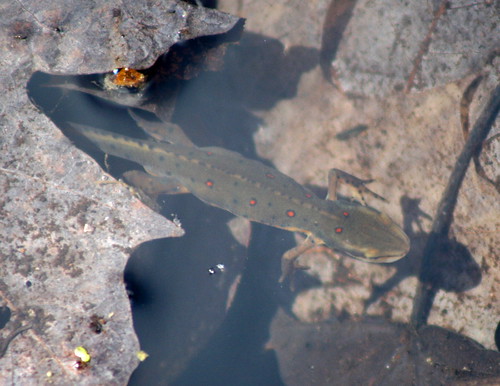
Along with a handful of different invertebrate species, there were a couple species of frogs heard, and these guys. This is a Red-spotted Newt, a subspecies of the widespread Eastern Newt. A newt is actually a type of salamander, one belonging to the family Salamandridae. The Eastern Newt is the only representative of this family in North America, although they’re fairly widespread on other continents, primarily in the northern hemisphere. There are in fact 10 different families of salamanders, but the other ones we typically think of here in North America, such as the Jefferson’s or the Spotted, are mole salamanders, family Ambystomatidae. Most other salamander families aren’t differentiated by name the way the newts are, however.

Red-spotted Newt

The Red-spotted Newt inhabits still or slow-moving waters such as ponds or small streams. They generally prefer moist woodlands, with sufficient debris or submerged vegetation in the water to be able to hide under. The ones we saw were all doing that, they’d cruise languidly along in the warm surface waters (the water was less than a foot deep in the very gradually-sloping pond edges, so it was pretty much all surface water) but as soon as I made an attempt to come in with the net they’d dive under the leaf litter at the bottom. They never went very far, but they disappeared completely.

They eat aquatic insects and insect larvae, small molluscs and crustaceans, and even small frogs and tadpoles. They have an amazing lifespan – females can live up to 12 years in the wild, males up to 15. I suppose this difference could be due to the greater energy demands on a female in creating and laying eggs, versus the relatively energy-“cheap” effort of creating sperm. One study notes that female survivorship from year to year is generally lower than that of males, though a reason isn’t provided.

Red-spotted Newt

At just 7-10cm (2.5-4 in), they’re not large creatures. They also aren’t very difficult to catch, once you know how. I started out trying to catch them by surprise by swooping in quickly before they could dart away. Although I successfully got the first one this way, the drag of the net through the water reduced its speed to the point where speed was not the answer anymore; the salamanders were all easily able to dart off before the net reached them. Then I discovered that if you came in quite slowly, they would just sit there, and you could practically scoop them up without them moving.

Red Eft (Red-spotted Newt)

The species has three life stages. The first is as “larvae”, the salamander equivalent of a tadpole. Eggs are laid in the spring, and take about a month to hatch into young. These are gilled, and spend the next 2-3 months in the water hunting small aquatic prey. They hatch at less than a centimeter (less than 1/2″), but grow quickly; within a couple months they’ve reached nearly 4 centimeters (just under 2″). At this point they metamorphize into their second stage, pictured above.

The second stage is called a Red Eft, and is terrestrial. They can remain in this stage for as many as 4-7 years, depending on latitude and the richness of the local habitat. This is the most commonly seen stage of the species’ life history, likely because of the bright colouration and also their on-land habits. It is in this stage that dispersal takes place, with individuals undertaking long treks of 800m or more where they may encounter new ponds. While their olive-green back is useful for camouflage in the water, on land they have a different strategy. Newts in non-larval stages have toxic skin that is used as a deterrent to predators, but the skin of the efts is ten times more toxic than in the adults. Their bright orange colouration is a warning to creatures wanting to make a meal of them (this special warning colouration is termed “aposematic”).

Red Eft (Red-spotted Newt)

Of course, I didn’t know this at the time that I was looking at them, and I happily (though gently) picked them up to get a couple of side-on photos that better showed their faces and bellies than a top-down view of them sitting in the water. Fortunately, I suffered no ill effects from the encounter. The back is more toxic than the belly, and despite this defense, newts are often preyed upon; predators get around the toxicity by targeting the newt’s underside. The newts rely on a learned avoidance by predators, where young predators that attempt to take a newt for dinner will remember the distastefulness of it and not try any others. This may result in the loss of one newt, but the protection of many others. Some predator species have an innate avoidance of aposematically-coloured creatures.

Red-spotted Newt

The eft I caught was found in the water. This is an unusual spot for one, as they generally stick to the land, and it could be that it was preparing to metamorphize into the third life stage, the adult (perhaps resulting in a lowered toxicity level). Only the olive adults mate, which means that sexual maturity isn’t reached until often three or four years of age, or potentially up to seven or more if the efts metamorphize late. I wonder how old some of the newts I was looking at actually were.

Red-spotted Newts

The adults have an amazing homing ability, like that of homing pigeons. Displace a newt from familiar territory and it can still find its way back. It orients using magnetic fields, but also uses its sense of smell (to detect water) and sight (to orient against the sun) to guide it, although in experimental tests even newts with no smell or sight could successfully find water. Displaced newts will automatically orient downhill, which is reasonable, since water usually lies in the lower areas. I wouldn’t’ve thought that newts would find themselves displaced often enough to have needed to evolve such a complicated system.

I probably saw more salamanders in that single outing than I had in my life prior to that combined. They don’t occur in the ponds on my parents’ property (or, if they do, certainly not in great numbers like they were here, and don’t hang out in the open). I will admit to never having made a special outing to look for them before, either, though. As is the case with so many things, if you actually go looking for something, you can amaze yourself with how common it actually is.

Monster bug

Giant Water Bug

Yesterday I returned to my parents’ for a couple of days, and took advantage of the warm weather last night to try for some moths. There’s a great diversity of habitat here, with a mature mixed forest on one side, open scrubby areas to another, of course the wet swamp in the corner of the property. So I was hopeful for some good stuff, and I wasn’t disappointed. That all will be the subject of another post. I’ll be setting up again tonight (I head back home tomorrow), to hopefully add to the list.

I ran my new trap overnight, but I also put out a sheet and blacklight. I got a number of species at the blacklight that didn’t show up in the trap, and some nice ones among them. However, the most interesting thing to come to the sheet last night wasn’t a moth at all. Most of the time I just glance over the beetles and wasps and midges (I can only focus on one taxon at a time, and currently it’s the moths). But I couldn’t ignore this guy. I was leaning forward investigating some moth on the sheet when a very loud buzzing whirr whizzed by my head and flopped on the ground in front of the sheet. Out of the corner of my eye I thought it was a sphinx moth or something big like that, but when I stooped to investigate, it most definitely was not. My second impression was of a cockroach, since it had the same dorso-ventrally flattened body.

Giant Water Bug

But it’s neither. In fact, this is a Giant Water Bug, also called Giant Electric Light Bug, after its habit of coming to artificial lights. It was rather alarming in its size and apparent ferocity. Fortunately, the same features made it very easy to identify. I got a clear plastic container and brought it inside to show my mom. She joked that she wasn’t going outside at night again.

Giant Water Bug

It’s about 6cm (or 2.5″) in length, with these giant broad modified front legs that it uses to secure its food. As its name indicates, it’s an aquatic insect, primarily, associated with swamps and wetlands. Normally it lives in or near the water, preying on aquatic insects, but supplementing this diet with opportunistically-caught vertebrates such as frogs or small fish. It uses a tubular rostrum to suck out the body fluids of its victims. It can inflict a painful bite, and so also has the name “Giant Toebiter”, which I would assume dates back to the days when kids were more likely to wade into mucky water barefoot (I used to do that as a kid, carefree about the creatures inhabiting it; I’m more cautious now, but it’s more because of concerns over submerged or buried sharp things, especially glass or metal garbage).

Giant Water Bug

Check out the giant eyes, which it obviously uses in stalking its prey. Plus the giant single claws at the end of each leg. I’m not sure what the white goop on its one eye is. The bugs are found across North America; there’s actually three species that are similar in appearance (I’m not sure which one I have here), and which overlap in range. Young look similar, but are obviously much smaller and take smaller prey. It takes them five moults to reach adulthood, which they do in a season; they overwinter buried in the mud as an adult. This site suggests that adults are edible, but I’m not sure I’d find them much of a delicacy.

Mites on a Giant Water Bug

When I copied the photos to my computer and looked at them closely, I discovered that the bug had been carrying what I took to be mites. You can also see a couple of large ones in the second photo, where it has its wings spread. I have no idea what species they are, or even if they are really mites, and not fleas or some other parasite like that. It seemed to have a good infestation going.

It’s amazing how it’s possible to overlook something that you would think would be quite obvious. If it comes to lights, why have we never seen it at the porch light? And being so large, you’d think we would have noticed it one of these times when down poking around the ponds. But it somehow escaped our notice to now.

Red-tail fly-by

Red-tailed Hawk

I was down at the station yesterday, one of two days a week I’ve been going down. It was an absolutely lovely day, cool at startup, but not cold, and warm enough to strip down to a single layer by the time we wrapped up at noon. I pulled out my sunglasses and wore a ball cap instead of a toque for the first time this spring. Naturally, on these first, early sunny days of spring I can never seem to remember to pull out the sunscreen, and so I inevitably get lightly sunburned. At least it’s not the painful, peely sort.

Despite a relative dearth of birds yesterday, there was a good diversity of species. One of the birds hanging about the station was this beautiful Red-tailed Hawk. Red-tails are rather uncommon birds at the station. This isn’t necessarily reflected in the log book, where we often record hawks sailing over high. It’s also not really applicable to the park as a whole, where there’s usually one or two hawks hunting the broad, open meadow areas that cover most of the land area of the park. However, down on the station’s peninsula it’s mostly early successional forest, with enough trees and shrubs to make it less than ideal for the usual hunting tactics of a Red-tailed Hawk.

Red-tailed Hawk

This guy (or girl; although hawks are dimorphic, it’s by size and not plumage, and a hawk sitting on a branch fifteen feet away just looks large no matter which way you cut it) flew right up and perched just beside the station building, where I was in the process of doing some training with a new volunteer. We both stopped and ogled the hawk while it sat there, since it’s not often that a wild raptor will oblige you with such flattering views. I did my best to run off a few shots, despite the backlighting. A moment or two later he decided further down the road might be better, and he took off from the branch, soaring by just a few feet above my head, close enough that had I desired to (and had the reflexes to), I could have reached out and snagged a few feathers at his passing.

Banded Red-tailed Hawk and me

I’ve handled a Red-tail before, though – we banded one in 2004, my second fall at the station, when I was there in official capacity as an assistant (now I’m an unofficial, volunteer assistant instead). Boy, do I ever look young in that photo. Normally birds this large don’t stick in the net very long, if they even fall into the net in the first place; just as often they’ll bounce right off the mesh and carry on. If they do fall into the net, they’ll likely take a minute or two to flap their way to the end of the net, where they can find some tension in the mesh to pull against to launch themselves out. This assuming that they don’t bounce out before reaching the end. In the case of the above, one of our volunteers happened to be just approaching the net at the time when the hawk flew in. A flailing hawk in a net is extremely dangerous, so we ask our volunteers to call for myself or the coordinator rather than tackle it themselves, but she was able to get help over very quickly. It’s the only Red-tail banded by the station to date, and one of just three large hawks (the other two being a Cooper’s in 2003, and a Northern Harrier in 2005). However, if this Red-tail continues to hang about low the way he has been the last few days, it’s likely that eventually he’ll blunder into a net. Hopefully we’ll be there to snag him.

Red-tailed Hawk

A bit later we observed him fly from his perch in a tree down to the leaves on the ground in an open patch of trees. He hopped about here, clambering over sticks and tangles, looking for I’m not quite sure what. Insects? Although they prey primarily on rodents, Red-tails are opportunistic hunters, and will eat large bugs like grasshoppers if they’re available. They’ll also take rabbits, which can be very abundant at the park, but I doubt he’d be hunting those on foot. I don’t think he was after grasshoppers this early in the season, either. Snakes are a possibility, I did see a few out in the warm weather, and they’d still be a bit sluggish in the early morning cool. You can see a smear of blood on its upper breast in the first photo, so it was obviously finding something to eat down there.

Red-tailed Hawk

I never actually saw him snag anything while he was on the ground, so it might be he was just looking. On the other hand, he stayed pretty well hidden behind a low ridge and some trees the whole time, so it was difficult for me to see everything he was up to. It may be that this particular individual was less dominant to the ones that frequent the meadow habitat, and was here less by choice than because he was forced out of the other areas. Or perhaps he just desired a change of scenery.

Red-tailed Hawk

A minute or two later, after deciding there wasn’t much worth looking for down on the ground, the hawk turned about and took off – once again straight toward me. Red-tails can travel at up to 20 to 40 mph (30 to 60 km/h) at cruising speed when flying. I doubt that this guy was going that quickly, but he was moving too fast for me to be able to get my focus adjusted well.

Red-tailed Hawk

I managed to snap this shot just as he soared by me; a little further this time than the first, I probably couldn’t have touched him, but it was still closer than I usually find hawks flying by me! I got the impression that while he was wary of humans, and kept an eye on us, he wasn’t terribly concerned. He was down there again today (I wasn’t), flying about the area, and demonstrating a similar coolness toward the people.

Red-tailed Hawk

He swooped up to perch in a tree not far from me, before departing for parts unknown.