
The Marvelous in Nature

Make it a green Superbowl

It’s Superbowl Sunday! Perhaps the single biggest annual sporting event in the United States (I don’t include Canada because I suspect here the Stanley Cup is slightly more popular; hockey is followed regularly throughout the year, whereas the NFL, being strictly American, is only really followed in any detail in the playoffs, and even then, only really paid attention to in the final game. And probably a lot of people watch it for the commercials. That said, the Superbowl is a big event here, too). I will be curled up in front of the tv this afternoon with a bowl of snack food to enjoy the game. No party for me; I’m more comfortable by myself or just with a friend.

However, there are lots of people who’ll be going to parties, to pubs, or to other events. An estimated 93 million people tuned into last year’s Superbowl broadcast, the most-watched tv event of the year (estimates are reaching up to 135 million for this year’s). A further 70,000+ people will travel to the stadium to attend the game in Glendale, Arizona. Not to mention all the NFL personnel (players, coaches, referees, and all the behind-the-scenes folks who help make it happen).

Think about this for a moment. When you consider the fuel necessary to transport teams and fans, the electricity necessary to power the facility, as well as the tv sets of people at home, the amount of waste produced from refreshments both at the game and away, the event starts to have a rather large environmental impact. A whopping 3,000 vehicles will be involved in transporting just the NFL folks and equipment alone.

Last year the NFL announced that Superbowl XLI (41) would be “carbon neutral”. The concept of carbon neutral stems from the idea that one can balance the carbon emissions from burning fossil fuels (eg. gas in cars, coal or other sources in power plants) by doing something that reduces emissions, such as by planting trees or purchasing power from renewable energy sources. This has been popularized with the idea of “carbon offsetting” – for instance, you still want to take that plane trip to the Carribean for your vacation, so you make up for the carbon emissions that will create through offsetting – usually paying money to a company that will take the necessary steps (such as planting the trees) for you.

Although the NFL did run a very green Superbowl last year, they received some flak for labelling the event “carbon neutral” when in fact the offsetting only accommodated for the actual venue, and not the carbon cost of fan travel, etc. Because of the difficulty in not only factoring in and offsetting this increased cost, but also just simply calculating it, the NFL this year has shied away from applying the term “carbon neutral” to the event.

That said, they have taken many steps to make it green and offset 100% of the direct carbon impact. For example, some 42 acres of wildfire-burned forest will be replanted in nearby locations in Arizona. This will more than offset the carbon cost of the 3,000 vehicle fleet as the trees absorb carbon dioxide from the atmosphere as they live and grow. The venue will draw its energy for that week from Mexican wind turbines and Californian geothermal energy sources, both green, renewable sources of electricity. The stadium has recycling containers available for fans to recycle their cans and papers, rather than throw them into garbage bins that would be dumped in a landfill (and with 70,000+ fans, that makes a big difference). I have to admit that, with recycling so widespread here in my home area, it baffles me that there are places where it’s still a novelty. But there you go.

If you’re hosting a superbowl event and want to try to offset some of the costs associated with it (such as additional electricity usage or carbon fuel costs of transportation), here’s some ideas:

  • Recycle! If you don’t already have a recycling program in place in your home, start one. If you’re part of an apartment complex that doesn’t have it, petition them to get it. Not only do you keep waste out of landfills by doing this, it also means trees don’t need to be cut down for new paper, or ore mined for pop cans, etc. Recycling a single aluminum can saves enough energy to run a tv for 3 hours.
  • Cut down on your car usage. Do you really need to drive, or is it close enough to walk or bike to? This is, admittedly, easier to do when the weather is nice or you won’t be carrying much. If you don’t want to or can’t walk, think about taking public transportation.
  • Plant a tree in your backyard, or buy one for your balcony. Or, join in a local tree-planting program. One tree will offset about 64 litres (about 17 gallons) of fuel burned per month.
  • Investigate green energy options from your hydro provider. Many providers have special programs where you can purchase your electricity “from” the portion of electricity that they get from renewable energy sources (in reality there’s no way to make sure the actual electrons flowing into your home were from the wind turbines or whatever, but the energy source will create enough energy for a set number of people, which then gets added to the total amount available in the grid. You’re essentially saying “make me one of the 100 people that the wind turbines provide for.”). If they have 150 people asking for green energy, but only enough current energy sources for 100, they’ll invest more in renewable energy sources.

Read up on other things you can do to help at reliable sites such as the Suzuki Foundation or the official Arizona Superbowl site.

And don’t forget to enjoy the game!

All photos borrowed from Wikimedia Commons.
Hooking a free ride

Burdock

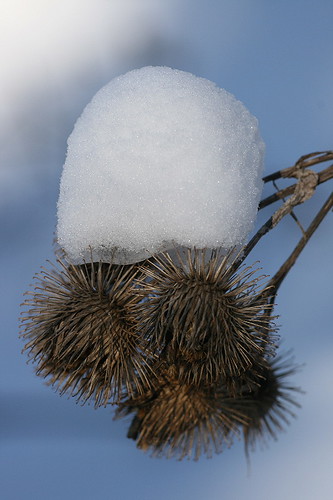
Although technically a year-round plant, burdock is one that you usually notice most in the fall and winter. That’s because it’s at this time of year that the seed heads dry out and hook themselves on just about any passer-by who unwittingly gets too close. They particularly like socks and shoelaces. And horses’ tails, and long-haired dogs. Golden Retrievers are their favourites.

Burr

The challenge of dispersing seeds is something every plant has had to evolve a solution to. Many will cast their seeds out to the wind by producing lightweight seeds, or creating a “parachute” to carry a heavy seed (like milkweed puffs or maple keys). Some put their seeds in a fruit and encourage animals to carry them away to a new location. In this case, the burdock has developed long spines with hooks on the end that protrude from the seed case. The hooks snag loose hairs and the dry burr head pulls off the stem, catching a free ride. The hooks are so strong and effective that they’ve been recorded to snag and trap tiny birds.

Burr hooks

Check out those hooks close up. They look like miniature fish hooks! In fact, they’re the inspiration behind the widespread everyday material, Velcro. Velcro was the brainchild of Swiss inventor George de Mestral, who came up with the idea after taking his dog for a walk and observing the seed heads that they both came home with (I bet he owned a Golden Retriever). He examined the hooks under his microscope when he got home, and wondered if a similar hook-and-loop system could be used as a fastener. Velcro was born in 1945 and patented in 1955; today it’s a multi-million dollar company.

Interestingly, despite being incredibly common, burdock isn’t native to North America. Originally from the “Old World”, it has been introduced to this and many other continents. In Asia, the taproot of the plant is commonly eaten as a tuber, the way we eat carrots. In the UK, there’s a soft drink called “Dandelion and Burdock” (I’d be interested to taste that one!). Burdock root oil extract has also been used in herbal medicine to cure scalp conditions like dandruff and increase hair vitality. Pretty cool for a plant that the only consideration many of us give it is cursing under our breath while plucking it from our socks.

Mid-winter moth sighting

Agonopterix pulvipennella

Speaking of hibernating insects, last night when I went to brush my teeth I discovered this little guy on the wall. The last time I saw a moth was probably back in November; generally speaking they’re not the sort of bug you expect to be out and about in mid-winter. So I was a little surprised to see it. I took some photos but otherwise left it alone. It was gone by the next morning.

I’m relatively new into moths as a group, but I’m fairly certain this one is Agonopterix pulvipennella. Moths are the sort of creatures where they’re either so obviously distinct it’s hard to mix them up with something (for example, a Luna Moth), or so similar to six other species that you really wonder just what criteria was being used in calling them unique. This one falls into the latter category. The key here is the dark spot on the wings, with a little white spot at the bottom, and a broad pale arch that crosses the shoulders and joins the two dark spots. But it takes a bit of scrutiny to identify, and it still looks like a bunch of other Agonopterix species.

A. pulvipennella, it turns out, doesn’t die with the cold weather, like many insects do, but rather overwinters as an adult, and then comes out to breed in the spring. Like the ladybugs and wasps, it will often choose cracks in the walls of your house to crawl into to settle down for the winter. When the weather warms up a little, they can end up in your house. What was funny about this one is that yesterday it was rather nippy out (not helped by the gale-force winds), so I guess it’d come out the day before (when it was nice and mild) and had been hanging around, unseen.

It seems to be a relatively common and widespread species, found throughout much of northeastern North America. The larvae feed on the leaves of goldenrod and nettle during the summer. They pupate in late summer, and adults emerge starting in August. Although the moths are about throughout the fall and into the spring, they’re apparently most commonly seen in the spring, which seems sort of funny to me. Perhaps because, to a moth, UV wavelengths mimic the pheromones of a female, they’re more likely to be attracted to lights, where we can see them, in the spring when looking for a mate?

A visit from the queen

Wasp

The temperature today was an incredibly balmy 8 degrees Celsius. This was a one-off, however, because a cold front is supposed to roll in tonight and tomorrow is forecasted to be -10 oC (I shouldn’t complain; today in the Canadian prairies it was -50. Before windchill). Still, the warm weather was nice. I wasn’t the only one to think so. This afternoon I found a wasp crawling, somewhat sluggishly, along the windowsill in the den.

In my very first post I talked about the appearance of ladybugs mid-winter. Wasps are very similar visitors. They crawl in to cracks in the walls of the house in the fall when looking for hibernation spots to spend the winter. Normally they would only come out when the warmer spring weather finally arrives, but warm spells can cause a few to come out prematurely. Those that chose to hibernate in your house will quite often go the “wrong” way, toward the warmer temperatures inside, and end up crawling along your floor or windowsill.

Wasps are like honeybees, in that most species spend the majority of their year living in colonies. There’s a queen who “rules” the colony, although her primary job is simply laying eggs. There are sterile worker wasps, who spend their time collecting food for the young grubs and the queen (and themselves), repairing and defending the nest. And there are fertile male wasps, whose only job is to mate with new queens.

Wasp

In the spring, a new queen, who mated with a male before going into hibernation in the fall and stored the sperm inside her, will pick a site for the nest and start a new colony. Depending on the species, she may start it alone, or with a few of her sisters who overwintered with her. She lays fertilized eggs, which develop into sterile female workers. She’ll care for the first couple of broods herself, but once there are enough workers to tend to the eggs and larvae properly, she concentrates on just laying more eggs. Once the sperm runs out, in mid- to late summer, the unfertilized eggs grow into fertile males and new fertile queens, who go out and mate, and start the cycle again. The wasps that turn up in your house in the middle of winter are all young mated females who have gone into hibernation till the spring. All the other groups – the original queen, the sterile workers and the males – died once the weather turned cold (if not before).

These mated females are stingless. The initial reaction upon seeing a wasp, particularly if you have kids or pets, is to worry about someone getting stung. However, the stinger in wasps and bees is a modified ovipositor (the body part used to lay eggs). Males don’t have an ovipositor to begin with, and mated females need theirs to lay their eggs come spring. Only the sterile worker females have the ability to sting. I suppose she could give you a good chomp with those powerful jaws (look at the size of them in that first photo!), but it’s unlikely to feel like more than a pinch. Paper wasps use their jaws to strip bits of wood from logs or dead trees, which they then mix with saliva to create the “paper” used in building their grey papery nests. If you spend a lot of time on your deck in the summer, you might catch one collecting wood from the deck or siding.

Wasp

Wasps are generally predatory, preying on other insects, although they can sometimes be seen feeding on the nectar of flowers. The particular composition of their diet depends on the species. They’re useful to have around your yard because they’ll take care of many other undesirable bugs in your garden or around your home. As long as you don’t actively disturb their nest, or pester an individual (intentionally or not), they’re generally fairly docile, willing to let you do your thing while they do theirs. If it’s a mild day when you come across a wasp in your house, let her crawl onto a piece of paper and then transport her outside, where she can find herself a new hibernation spot, and she’ll take care of your garden for you come spring.

Colour-coding chickadees

Edit: This post was recently included in the 69th edition of I and the Bird, a blog carnival focusing on, you guessed it, birds. You can check out the full edition at Living the Scientific Life.

Colour-banded Black-capped Chickadee

Yesterday afternoon Blackburnian and I went out birding in a tract of woods near Paris, Ontario. It wasn’t a large patch, but was still perhaps 8 or 10 acres, and we spent some time wandering through it. There was very little activity in most of it, which is typical of woodlands in the winter. Although in spring and early summer the woods can be alive with birdsong, once the migrants depart in the fall there are very few birds left that favour that sort of habitat. Woodpeckers, chickadees in small flocks, perhaps the odd tree sparrow or junco in the scrubby bits if you’re lucky. But pretty quiet.

Northern Cardinal

The best places to see birds in the winter is near a feeder, which is part of the reason I don’t do a lot of birding in the wintertime – when all the birds are coming to you, where you can view them from the comfort of your home, why go out into the cold to wander around an empty woodland? Of course, there’s lots else to see in the woods, but I usually reserve those outings for warmer days with lovely weather. The place we were at yesterday had a section of boardwalk where a few feeders had been set up, and kept regularly stocked. Although they were visited predominantly by Black-capped Chickadees, there were also Dark-eyed Juncos, American Tree Sparrows, Northern Cardinals and both Red- and White-breasted Nuthatches visiting them.

Feeding the chickadees

Like at a lot of parks with bird-feeding trails, the chickadees and nuthatches had learned to come to people’s outstretched hands to pick up seed. This is an absolute delight for small children, and even for adults there’s some magic in a wild creature coming to your hand with enough trust to take a bite of food. Although we hadn’t thought to bring any seed with us, we borrowed a few seeds from one of the feeders and offered them to the chickadees. And the chickadees were quite happy to take them.

Colour-banded Black-capped Chickadee

Just nearby is Wrigley Corners Outdoor Education Centre. As part of their education and research programs, they have been banding the chickadees that come to the feeders here in the park. They use a combination of bands, both silver aluminum and coloured plastic ones, to create a unique colour combination that can be easily visually identified at a distance. This allows you to follow individual birds to learn more about their behaviour patterns and movements. No two birds in a study are ever given the same band combination, unless it’s known the previous owner of a combination is deceased. Band colours are read from top to bottom, with the bird’s left leg first, then the right. So the bird at the top of this post would be Red-Orange:Silver-Green. The above bird would be Silver-Pink:Blue-Blue.

Colour-banded Black-capped Chickadee

Here Silver-Red:Yellow-Yellow surveys the proffered seeds before coming down. The bands circle the bird’s leg much the way you or I would wear a watch, or a bracelet; they aren’t attached to the bird’s body, and they cause it no discomfort or inconvenience. Although it takes the bird a few minutes to get used to this new addition, it quickly moves on with foraging for food, or whatever else is on its daily agenda, and isn’t bothered by it again.

Colour-banded Black-capped Chickadee

And, as you can tell by these birds still coming to peoples’ hands, the process of having the band put on hasn’t caused them any real distress. Most birds are banded and measured, and then safely released within a minute or two. In addition to the coloured bands, the silver band has a 9-digit number that also uniquely identifies the bird in a national database, should it ever decide to wander and someone else encounters it. This number is also useful for identifying birds without colour bands if they’re captured again (it’s too small to read from afar on most birds), and particularly for migrant birds that may turn up somewhere else on the continent.

Colour-banded Black-capped Chickadee

Colour bands are most often used on studies of birds on territory; that is, birds that aren’t moving around a lot. By banding the breeding birds of a particular species in a forest plot, say, you can track how many individuals there are, who owns what territory, what males are mating with what females, how far birds are foraging from their nests, and other interesting and valuable information. The data collected from such projects is used in making decisions about conservation practices to protect the birds and the habitats they live in. Similar studies take place with birds on their wintering grounds. Even though we didn’t spend a lot of time with them yesterday, we were still able to make some observations, such with as the above bird, Red-Orange:Silver-Green. In the above photo, s/he (both sexes look the same) was about 20 metres down the trail from where the first photo of the post was taken. Ordinarily I would probably have thought they were a completely different set of birds, but obviously they were moving around the area – seeing if other peoples’ offerings were any better, I guess!