The Marvelous in Nature

Returning birds

returnees

Although it’s probably the first moth of the year that I look forward to most as far as signs of spring go, it’s definitely the return of the first avian migrants that marks the arrival of the season for me. In particular, Red-winged Blackbirds. Where I grew up there was a small swampy wetland area at one corner of the property, and every spring the song of the Red-winged Blackbirds would ring out from that swamp just as the snow started getting mushy and the ground muddy. They’d show up at the seed scattered below the feeders, and would perch in the tree branches above the house. Even before I started paying attention to birds, their return was a sure sign of spring. The sound of a Red-wing singing immediately recalls memories of my childhood to my mind.

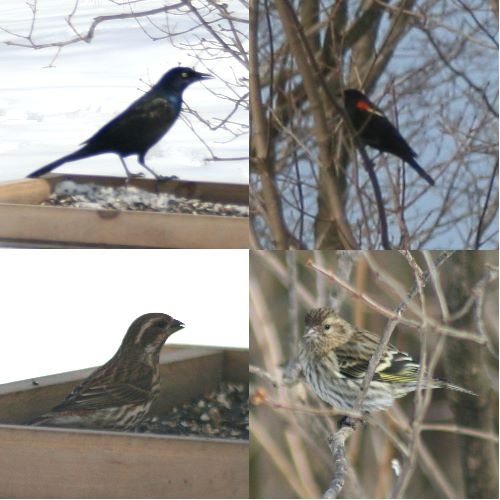
The same warm front that enticed the first moth out of hiding last Wednesday brought with it the first Red-winged Blackbirds. They’d shown up at my mom’s, an hour or so south of us, last weekend so I knew it was just a matter of days before they arrived here. Red-wings, like all blackbirds, are diurnal migrants. They roost, often in large flocks (especially in the fall), overnight and then move during the first half of the day. They put down by the afternoon so they have some time to forage before going to rest at night again. When I went out for my afternoon walk with the dogs on Wednesday, and all during it, I watched for Red-wings without seeing any. It was only upon returning to the house that I heard the distinctive chuck of a Red-wing in the trees by the feeders (the photo above is a record shot of that bird). Spring has officially arrived.

The next day, Thursday, we got our first grackle. I have no similar associations of grackles with spring, other than that they’re usually on the tail of the Red-wings (who nearly always arrive first by a few days). Just the one so far, that I’ve noticed. On Saturday, Dan spotted a pair of Pine Siskins at our feeder, and today, a Purple Finch. Dan said he’s seen siskins around all winter, in low numbers, but they must hunker down by the time I’m out for my walk with the dogs in the afternoon; I haven’t seen one since December. Ditto on the Purple Finch.

All of these birds are temperate migrants, moving a short distance south of their breeding range to slightly milder regions – though not necessarily a whole lot milder, as some blackbirds and grackles do spend the winter in Ontario, along the shores of the lower Great Lakes. The siskins and finches winter around here, but many travel farther south, beyond our border; their movements aren’t really migrations proper as they’re more food dependent and vary from year to year, but they often follow similar timing when they happen. The individuals we saw this weekend may represent some of these returning, rather than locals, though we can’t really tell.

As far as the two blackbird species, the timing of their return tends to be with the first warm fronts that bring spring-like temperatures to a region. They can get by on seed, but they’re also insect-eaters when there’s insects to be had. If you see Red-winged Blackbirds sticking their bills into cattail heads, for instance, they’re actually looking for small moth caterpillars that spend the winter there, rather than gathering fluff or eating the seeds.

I don’t have a photo of the first Red-wing from last year, but the first grackle seems to have showed up on March 21 (or at least, I have seven photos of a grackle from that day, and I pretty much never photograph grackles except the first one to arrive because it’s so exciting). So it might be he’s a little ahead of schedule. The date I have in my head for the arrival of Red-wings is March 15. This is carried over from my home where I grew up, too, which is more southern than where I live now. I don’t really have any data to back this notion up, but it does seem to me that the blackbirds being back already is earlier than normal. That first one last week was on March 7.

There is some concern about climate change causing the timing and pattern of bird migration to shift. Many birds use temperature cues rather than day length to know when to migrate. Before humans arrived on the scene, birds and the food they depend on had evolved together so that everybody’s life cycles were all carefully timed. Birds would arrive back from migration timed just right to be able to set up territories, build nests and incubate eggs so that the insect population that they depend on to feed their nestlings peaked just as the eggs started hatching. Early nesters who come back too soon because they’ve been fooled by abnormal weather patterns risk their own survival (should the weather turn foul again – this is especially dire for birds like swallows that catch their food on the wing) and/or that of their nestlings (if there’s not enough food available yet when they hatch).

My mom posted about this and talks about it in a little more detail. She also includes a link to a CBC radio broadcast on the topic, which happens to interview some Canadian birders and biologists I know personally. Worth a listen if you’re interested.
First moth of 2012

firstmothof2012

Yesterday was beautiful. (I felt the need to start the post this way because every first-moth-of post I’ve done has started with these words, I discovered.) I took an extra-long walk with the dogs in the afternoon, soaking up as much of that lovely southern-warm air and gorgeous sunshine as I could, to store up against today, which is overcast and wet and blustery. We return to winter for a few days, but the mild temperatures are forecasted to return next week, happily.

With the weather so mild yesterday, I figured there was a pretty good chance that the first moth of the year might make an appearance. So I dug out my mercury vapour bulb from where it had spent the winter, set up my tripod and put it out. I turned it on just before 7pm; finally, at around 10:30pm, as I was beginning to consider the evening a bust and turning it off for the night, the first (and only) moth arrived.

I’d been expecting a little wee guy, most likely an agonopterix of some sort, which tuck themselves into woodpiles and other cracks and are quick to warm up. We still had a good 7 or 8 inches of snow on the ground, and I thought that might affect the potential for moths. So when I spotted this guy fluttering around over my head, I felt a rush of excitement. I was worried he’d fly off before I could catch him!

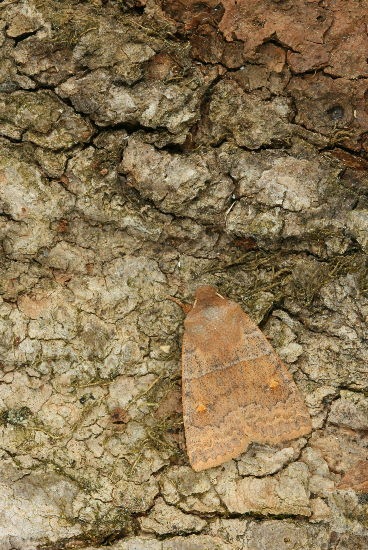
But he didn’t. The first moth of 2012 iiiis…. a Straight-toothed Sallow (Eupsilia vinulenta)! (Of course, the element of suspense is sort of lost when you head up the post with the photo of the individual in question.) He’s arrived about on schedule, compared to past years:

  • 2011 – March 17 – Morrison’s Sallow (Eupsilia morrisoni)
  • 2010 March 7 – Goat Sallow (Homoglaea hircina)
  • 2009 – March 6 – Morrison’s Sallow (Eupsilia morrisoni)

In actuality, last year’s first moth was an unidentified micro in late February, but the weather hadn’t been very warm so it felt less like the first moth of spring and more like a fluke moth of winter. Winter really hung around last March, too, and our first spring-like days weren’t till the middle of the month. Also, the true first moth of 2010 was on March 2, an Inornate Semioscopis (Semioscopis inornata); but I wanted to compare the first macromoths across the years so it didn’t fit.

You’ll notice that three of the last four years, the first moth has been a Eupsilia species. Another early species that I haven’t yet recorded first but is generally seen in the earliest days is Three-spotted Sallow, Eupsilia tristigmata. This whole genus is cold-weather moths, appearing late in fall and early in spring. They all overwinter as adults so they can emerge on those first mild days. Their caterpillars all feed on tree species, so they get out early, lay their eggs on the bare branches, and the caterpillars hatch as the tender new leaves are emerging.

I’d placed my bets on a Morrison’s Sallow being the first moth of the season… so I was wrong, but not by much!

National Moth Week

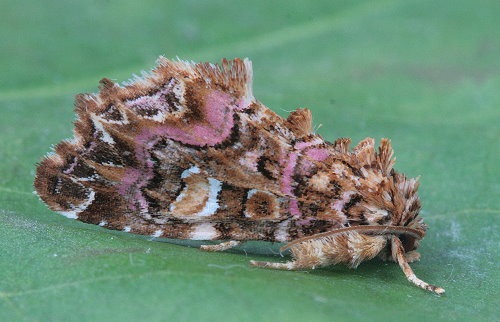
9631 - Callopistria mollissima - Pink-Shaded Fern Moth
Pink-shaded Fern Moth, Callopistria mollissima, #93-2192 / #9631


It’s late winter and mothing season is on the horizon – just another couple of weeks, at most, and the first moth of the season will arrive here at my porch lights. They’re calling for pretty warm daytime temps on Wednesday, and as long as the rain holds off I’m hopeful we might get one or two that night. It’s been nearly four months since we had the last ones of fall, and I’m looking forward to their return. I’ve been meaning to post about the following for a little while, so as we gear up for the start of the season it seems like a good time.

Great Britain has run a National Moth Night for a number of years now. Theirs is a three-night affair, with moth’ers all across the UK participating, recording and reporting their finds. This year the UK’s event will be held from June 23 to 25. It will be in August in 2013 and July in 2014; they shuffle it around so that all of the mothy months eventually get sampled, since many moth species have short and/or specific flight windows.

Till now we haven’t had anything comparable in North America (though I did join in the UK night on two nights in 2009). But David Moskowitz and Liti Haramaty of East Brunswick, NJ, decided to remedy this, putting together North America’s own National Moth Week (don’t let the name or logo fool you; it’s actually open to all moth’ers everywhere, including outside of North America). The premise is the same – on a set of specified dates, moth’ers everywhere go out with their lights and sugar bait and see what they find. They’re working on setting up methods to collect data from participants, much the way they do in the UK.

This year, National Moth Week has been scheduled for July 23-29. On one, a few, or all nights that week, go out with your mothing equipment and record what comes in. You can either run your own night(s) or join in on a public event in your area – check out this webpage for a map of participating moth’ers, including public events.

There will be some contests for people taking part in the event – for instance, highest species total or most participants at an event. A few people have donated prizes; there will be a few signed copies of the new Peterson moth guide, for instance, as well as books from David Wagner and John Himmelman. But you need to register your participation in order to be eligible!

I’m planning to hold a public moth night that week, though I haven’t yet set a date or location for the event. I’ll probably start figuring that stuff out in July, and will post an update (and reminder to participants) then. In the meantime, mark your calendars! I’m looking forward to seeing what we all turn up.

The moth guide has arrived!

book1

Guess what arrived today? My first copy of the new moth guide! Yaaaaaay!

The books are all printed overseas, and they’re all on a container ship somewhere on the Pacific at the moment, but the printer sends a few copies by air to the publisher so they can review them for quality (and start distributing them to the authors :), etc. This is one of the copies that came by air; the rest will arrive at the publisher’s about a month from now, then will be checked and inventoried and distributed and will be in bookstores maybe the week before release.

So you guys still have to wait. I’m sorry. But I can share with you some peeks at the book in advance! Complete with goofy faces. Because that’s just how excited I am. (Also, forgive the photo quality; these were taken with my webcam.)

book14

For example. My name! On a book!

Check out the width of that sucker. It’s 1.25 inches thick. That’s 611 pages of amazing mothy goodness.

book7

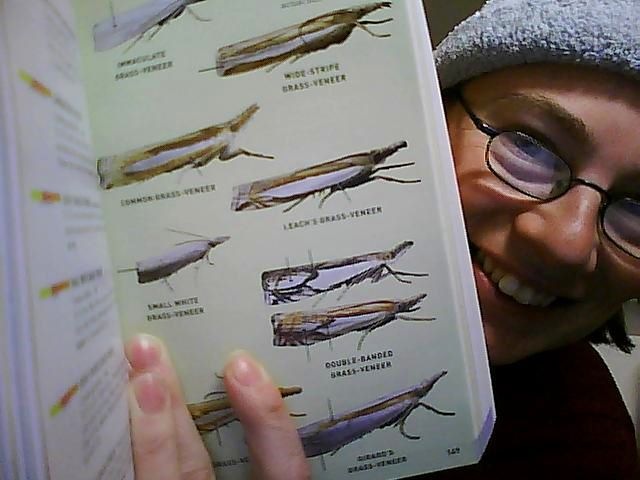
And between my fingers there is the species checklist at the back of the book. It’s 38 pages long. That’s a lot of moths, folks! I lost count along the way, but I think we were just a couple species shy of 1500 total in the book. Very close to 2000 images. (Which I clipped out from their backgrounds by hand. Every single one. Whew. Thank goodness they look so good in the book!)

book2

The title page! I love this photo. It was taken by Dave, in his yard, and was a last-minute addition to the book.

Look! There’s my name again! Also, the map of area covered. Quite a number of the species in the book will be present in other parts of the continent, though, so the guide is potentially useful outside of the range depicted here. You just won’t have the benefit of range maps with the species accounts.

book3

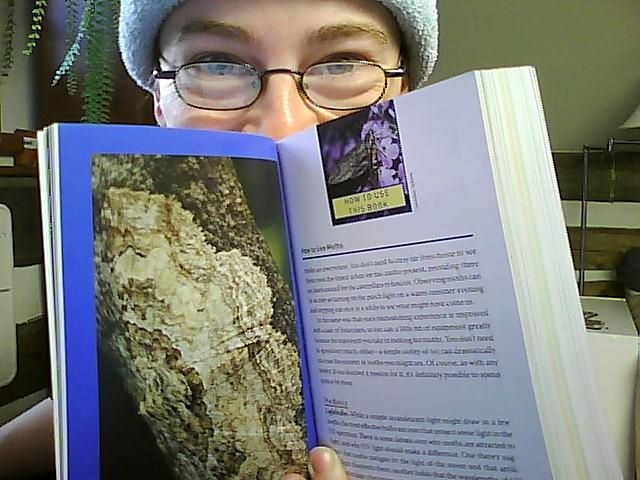
Here’s the opening page of the How To Use This Book section. All of the sections have full-page images of different species of moths, like this. They’re nearly all Dave’s photos, moths he’s caught and placed on a natural-looking log or branch for photographing, and they look really great. The top of the sections also have those little square photos, also of moths in natural settings. All of them have the species name given, so you know which species the moth is. (This was my mom‘s suggestion. Thanks, Mom. :)

book9

That’s me! It’s the only photo of a person in the entire guide (no author photos). That’s my blacklight setup from… I think that was taken at my parents’ old house, actually, the place in Halton county where I grew up. I still run blacklight bulbs occasionally, but mostly now I use mercury vapour at home. They don’t make as interesting a photo, though. I’ll probably have both with me on the book tour.

The How To section has information on how to go about attracting and photographing moths as well as the necessary info on how to read and interpret the guide. Also tips on how to start learning to identify moths. It’s relatively short and quick to read, at 18 pages. So I hope you all read it, because I put a lot of time and careful consideration into writing it. :)

book8

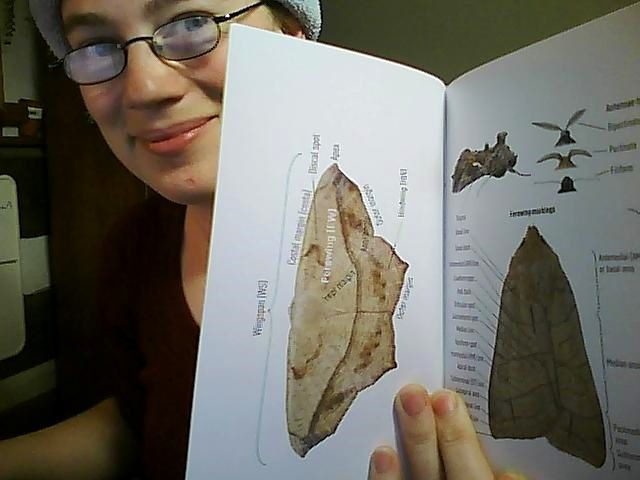
These are the front endpapers. The diagrams are also in the How To section, but because it’s a pain to have to flip through the introduction in order to look up terminology, I requested these be put here at the front, where they’re easy to flip to. On the left are structural terminology, on the right are those for patterns. A number of these get referred to regularly in the text accounts.

book6

And these are the back endpapers. We don’t have every type of moth displayed here, but we do have many. The idea is a lot of moths can be quickly identified to group by shape/size alone. Some are very distinctive (scoopwings, for instance, or plume moths). So this provides a quick reference to give you a place (or places) to start browsing, if you’re not sure.

All of the measurements in the book are given in millimeters because so  many of the species are so small that inches don’t work well. On the inside of the back cover (barely visible in this photo) there’s a ruler printed with both centimeters/millimeters and inches, so you can quickly look up sizes.

book4

On to the identification pages!

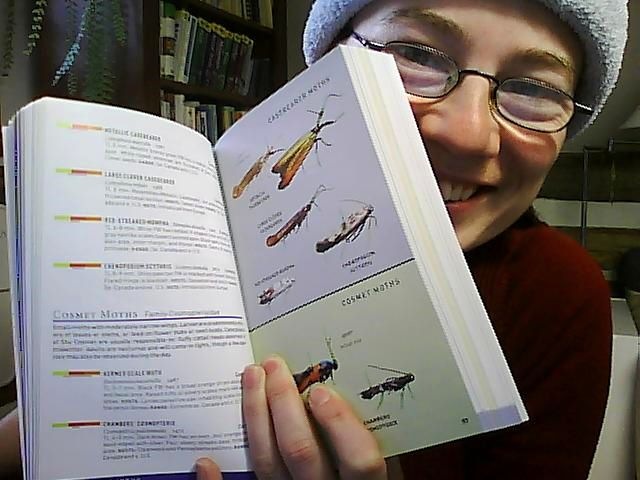
Each family is headed up with a paragraph describing general family characteristics and often mentions habits and/or host preferences, if there are some that are particular to the group. Where two families are on the same page, as here, the identification plate is separated into two panels.

Although it’s hard to see on this particular page, you’ll notice on the next few there’s a gray silhouette beside one of the images on the plate. This is showing the moth’s approximate size in real life, so you can get an idea how big these things really are.

book10

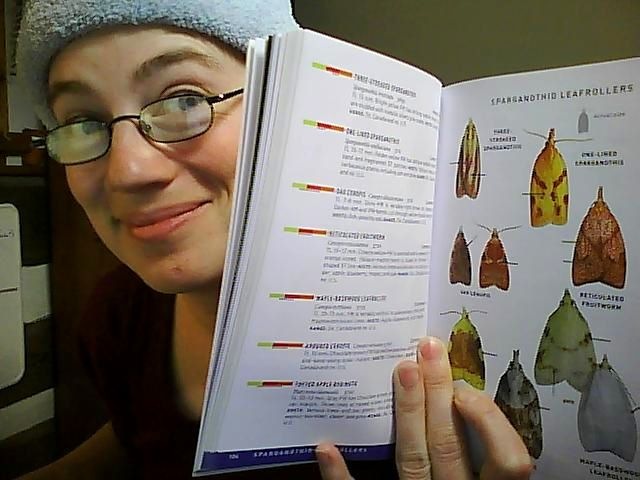
One of the things that makes this book unique over the few guides that have come before (besides that they’re all in natural resting poses here; most other guides show pinned/spread moths) is the number of micromoth species we’ve included. These are all the species that come in the first half of taxonomic lists, basically the moth equivalent of non-passerine birds (the first half of a bird field guide, all the birds that don’t sing songs). For the most part they’re small, hence the “micro”.

Not very much is known about most micromoth species, except for a few that are commercial pests (crops/forestry). So there are no range maps for these species. There are, however, flight period bars, those coloured bars beside each species’ name. Under each is a black line that corresponds to the time of year the moth can be found, and the three colours in the bar represent the three seasons of spring, summer and fall, roughly three months each.

book5

Here’re macromoths – the second half of the taxonomic list, and, for the most part, larger than the micromoths. These ones mostly do all have range maps, information being much easier to come by for these. A large part of the reason for this has simply been the paucity of field guides that include micromoths – hobbyists actually contribute quite a lot of what we know about the distribution and other information for species. Some macromoths are still lacking in this department – for instance, the Obtuse Brocade, here, didn’t have enough information for me to be able to extrapolate a range map with any degree of confidence. Hopefully there will be future editions of the guide, and we’ll be able to create maps for these species then, as more people join the hobby.

book11

Not the greatest photo, though I blame that mostly on the limitations of the webcam. But trying to point out here the Peterson arrows. It was unfortunate timing, but Dave ended up being away for most of the period when the manuscript was at the stage where we insert the arrows (it wasn’t something that could be planned for, either, really), so I ended up doing this mostly all myself. And let me tell you, on 1500 species, there are a lot of arrows.

book12

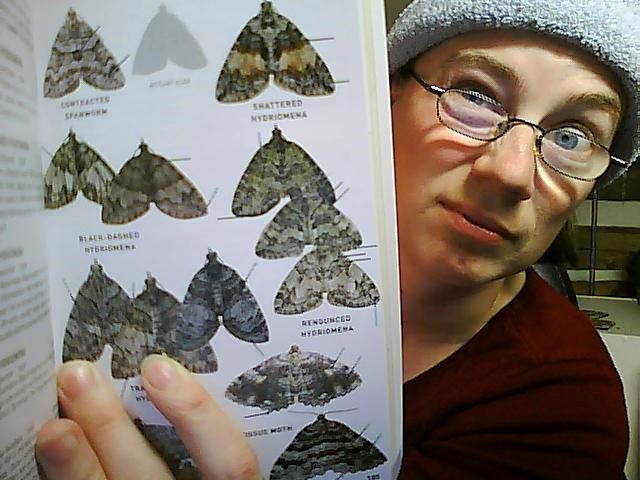
Although there are plenty of species of moth that are so distinct they don’t really need the arrows, there are also lots that look so similar the arrows will be invaluable in helping you separate them out. For instance, the hydriomenas. That face I’m making here? I wore that for about two hours, seriously, as I sorted out specifically which features I should be pointing the arrows at. It involved several emails back and forth with moth expert Chris Schmidt of the Canadian National Collection (he was awesome with his time and expertise – you rock, Chris!), and lots of studying of images he sent me, ones I had, and ones online. As you can tell from this plate and the fact that each species has multiple images, there’s a fair bit of variation. But I finally got it figured out. You lucky souls don’t have to worry about it; the arrows are already there for you. :)

book13

The timing of the release could hardly be much better – right at the start of the new mothing season! It’s still winter here, but the first moths will be arriving soon – potentially just two weeks from now. That moth I’m pointing to, that’s my bet for first of the year for me – Morrison’s Sallow. All of the species on this page are contenders for first-of-season, though. (That’s my you-can-bet-on-it face, which actually works better when you can see me nodding knowingly.)

So there you go! A quick preview of the new field guide to moths. I honestly can’t wait till the release date (April 17! Two months!) so all of you can get your hands on a copy, too, because it looks great. Dave and I are both really happy with how it turned out, and I hope you will be, too.

You can currently preorder the guide from most retailers (online, though I think if you go into your local indie bookstore they’ll take orders, too…). If you want a signed copy, there are buttons on my sidebar or on this page where you can order one directly from me.

Otter trails

ottertracks2

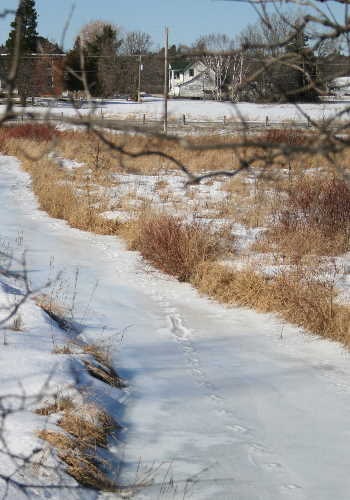
A couple of weeks ago I noticed these trails out on the ice of the creek the rail trail crosses. It looked like the animals had traveled down the frozen stream on a mild day, or perhaps just after a rain, when the snow that had been sitting on top of the ice had softened just enough to create slushy conditions. The temperature must have dropped shortly after because the prints, while not detailed, were certainly well-defined.

When I first noticed them I’d naturally not brought my camera along, but the unusually dry winter we’re having did me a favour and didn’t snow at all before I was able to make it out. (It’s snowed since, but not very much, and you can still pick out the tracks frozen into the ice. I worry a bit for what this will mean for spring water levels, unless nature’s saving it all up for March. In which case, I worry for March.)

ottertracks3

The tracks belong to otters, of course. I say “of course”, but I actually wouldn’t have known this prior to moving to the lake house a few years ago. Then, we discovered a set of similar tracks out on the ice of the lake, and I’d hypothesized that it was a predator periodically dragging a heavy prey. Which still seems like a reasonable guess, but the real answer is obvious, now that I know it.

The long troughs are from the animals sliding on their bellies. They’ll bound for several strides and then flop down, letting their momentum and the slippery ice carry them forward. This helps conserve energy – and during winter, every little bit counts – but is also probably just darn fun. As animals go, otters must be among the most playful.

ottertracks1

I’ve actually seen otters in this creek before, so I’m not too surprised to see their tracks here, but I tend to forget they’re around. I encounter them much less frequently here than I do down in the Frontenacs where Dan and I do our summer bird programs.

The Atlas of the Mammals of Ontario, a project undertaken by Ontario Nature and published in 1994 (back when they were still known as the Federation of Ontario Naturalists), provides range maps for all of Ontario’s mammals. The larger species are typically more well-documented than the smaller ones (rodents, bats) simply because they’re easier to find and identify. All of the maps are available at Ontario Nature’s website.

ottermap

I’ve included here the range map for River Otter, as documented up through the early 1990s. White squares indicate areas where the precise location the record is from (mostly historical and/or OMNR trapline data) can’t be pinpointed. Coloured squares are known. The data used was taken across most of the last century, when available, with date indicated by shape.

It’s pretty clear that the otter shows a close correlation to the Canadian Shield, rarely found in the limestone regions of most of southern Ontario. This is probably partly due to the fact that water bodies become scarcer in regions with the more porous limestone bedrock, but also likely has something to do with human land use. We’ve modified the vast majority of Ontario south of the Shield, to either urban or agricultural landscapes, with all the loss of habitat and pollution that comes with both. The Shield itself is too rocky, with too shallow a soil base, to make for good farming, so it’s largely been abandoned to nature in the last several decades. Where we live still sees a fair bit of agriculture, but it’s all mostly low-impact – small-scale livestock and hay farms. In the Frontenacs, even that scale of farming becomes scarce, and the primary use of land is simply residential and recreational – homes and cottages.

I was so delighted when I discovered, via a neighbour at the lake, that there were otters in the area. And then when I found the tracks – and later, saw the animals themselves – I was over the moon. Otters! How cool! I’d always thought it funny that I’d never seen them where I grew up, and had kind of figured it was just because where I lived there weren’t any decent-sized water bodies. But looking at the map, now, I guess they weren’t in the area at all. Even if all I’m seeing are the tracks, it’s nice to know they’re here.