The Marvelous in Nature

Biothon tiger (beetles)

biothon27

I’m a fan of tiger beetles. Pretty much any open dirt or rocky trail in the summer will have at least one or two of these gorgeous metallic-green beetles. I usually notice them first when they’re flushed; they fly up  from the ground with a bright glint of colour that catches the eye. Once they’re landed they can be a bit harder to pick out, but on a bare dirt path, and in the sun, they really stand out.

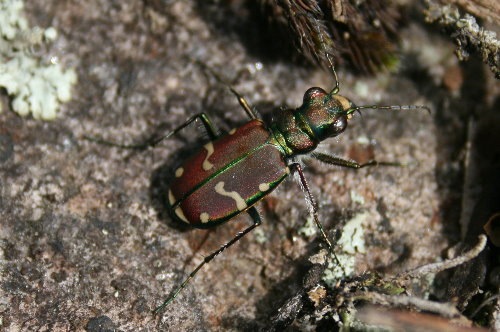
There are a number of tiger beetle species, found in every state and province, but by far the most common here in the east is the Six-spotted Tiger Beetle, Cicindela sexguttata. The only other species I’ve seen before was Green-margined Tiger Beetle, C. limbalis, along the road where we lived by the lake. I saw lots of Six-spotted on the biothon, hunting in sunny spots along open dirt trails. Tiger beetles, as their name implies, are predators. You can’t really see it in this photo, but they have huge, sharply-toothed mandibles that they use for catching their prey. Their large eyes are used for hunting visually, and their long legs make them swift.
biothon39

I was absolutely delighted when I turned up this second species of tiger beetle on the second day of biothoning. I didn’t recognize this one at the time, other than to know it wasn’t a Six-spotted; but it happens to be the same species I found along the road by the lake house, a Green-margined Tiger Beetle. This beauty caught my eye as it scurried across some open rock at the crest of a low roll (I’m not sure it was high enough to call it a hill) in a small treed meadow I checked out.

It was remarkably unflighty, which I found interesting, and even more so when I note that in my post from a few years ago, where I shared the lake house individual, I commented that that one was also pretty calm. Six-spotteds are so difficult to photograph because you really have to sneak up on them and even then they may take off before you get really close. But this one sat calmly for me (as did the lake house beetle); I was even able to lift off a twig that it had scuttled under and which was partially obstructing the photo. Species-specific temperaments in beetles?

Strangely, I wrote in that post:

In this case, Marshall notes, “The Green-margined Tiger Beetle lives on clay soils across Canada and the northeastern states.” BugGuide.net, my number one online reference for all things six-legged, adds that the habitat is “usually steep, moist bare clay soil, including… dirt roads”.

Except there really wasn’t any moist bare clay soil, dirt roads or otherwise, in the area where I found this one. It was on an open crown of granite amid quite a lot of grassy meadow. There were other patches of rock here and there, but I’m not sure there was even much open dirt along the trail, which was some distance away anyway. So that’s somewhat odd.

biothon18

I actually found this third species on the first day, not the second, so I’m presenting these a bit out of order. But this was the only one whose identity I needed to look up because I didn’t think I’d seen it before. Using this site of Ontario’s tiger beetles (created, interestingly, by a prof at my alma mater, University of Guelph, with whom I did an entomology course to Ecuador), I’ve tentatively ID’d this guy as a Twelve-spotted Tiger Beetle, C. duodecimguttata.

I found this one along the short dirt trail that led down to the gravelly beach. It paused to rest on a bit of rock, where I took this photo of it. It was much flightier than the Green-margined, more like the Six-spotted, and after snapping this photo (this is a tight crop from a much farther-away shot) I pressed my luck trying to get closer and it took off, not to be relocated.

On the Ontario page the habitat is given as gravel dams as well as areas with mixtures of moist sand and organic soil, tending to prefer sheltered spots rather than open beaches or dunes (the habitat favoured by most tiger beetles). BugGuide, meanwhile, says it’s found along the edges of streams and ponds. The lake we were camped at was hardly a pond, but it wasn’t huge, either.

When I found all these tiger beetles one of the first thoughts to cross my mind was “I’ll have to share these with Ted!” (Author of the wonderful entomology blog Beetles in the Bush, and an expert on beetles with a particular interest in tigers. He’s already corrected the ID of the fuzzy flower beetle of my last beetle post!) So Ted, hope you don’t mind confirming the identifications I’ve made here!
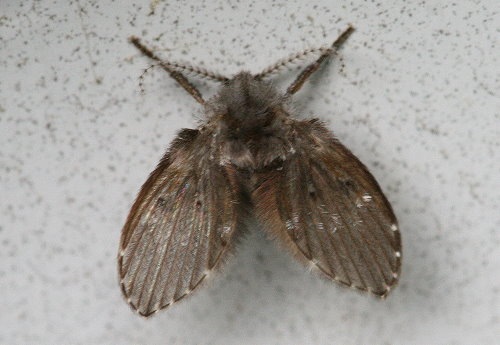
Moth fly

mothfly1

Hope everyone had a great holidays! I’m a little late with this week’s post as a result of my own. I’m digging back into the archives again for this one. I spent some time this fall helping my sister and her boyfriend out with a bit of house and yard work. I happened across this little guy while scraping old paint from exterior trim; he was sitting right next to the frame so I wouldn’t miss him.

It’s a moth fly, a member of the family Psychodidae, a group of flies whose hairy bodies and long antennae give them the look of moths. I was absolutely delighted by this find; I’d seen the photos of moth flies in my Kaufman Field Guide to Insects and kept watching for one, unsuccessfully.

Moth flies are pretty small, only a 1/4″ (1/2 cm) long at most (some are only a third that length). They favour wet habitats, and apparently can become nuisance pests in kitchens, where their preference for sink pipes lends them another of their common names, drain flies. The larvae eat algae and bacteria that are growing in the damp environment of the drainpipe (or other more natural situations); adults are nectar-feeders. Because they utilize habitats in human homes, they can be encountered at any time of year.

mothfly2

There are 113 species in North America, but some 3000 worldwide. A particular subfamily are blood-suckers and can transmit diseases, but the ones found in your home are generally harmless. In fact, the larvae of some moth fly species are actually useful and important in the purification process of sewage treatment plants.

I’m pretty sure this one is Clogmia albipunctata, for which BugGuide gives the common name Filter Fly. BugGuide notes that the species used to be primarily tropical but is now found through much of North America.

Biothon beetles

biothon24

Remember back in the summer I did a biothon in support of Frontenac Bird Studies? I wrote one post for it, but I never did get around to returning to the rest. And since I had selected and edited 48 photos from it, that left quite a few photos unused. I thought I’d revisit some of these over the winter.

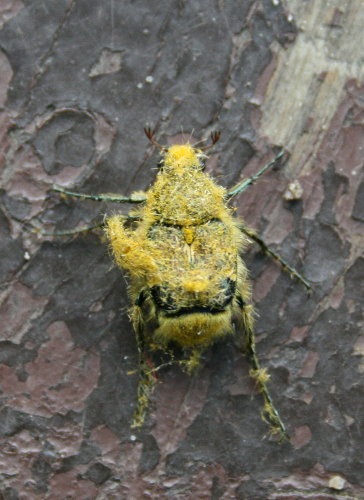
Here’s the first, and possibly my favourite, of the outstanding photos. Dan brought me this guy back from a hike he and the other participants had gone on; it’d been in one of my moth containers for a little bit, so it got a bit rubbed up. But it was still pretty clear to see that this was a FUZZY YELLOW BEETLE. Yes, it was just that cool that it requires all-caps.

[Edit: I’ve been corrected by the fabulously knowledegable Ted of Beetles in the Bush. The beetle is not, in fact, a bumble bee scarab, but rather another type of scarab in the genus
Trichiotinus, sometimes called hairy flower scarabs or bee-like flower scarabs. Ted suggests that while members of this genus do have a fair bit of “fur”, much of what’s on this beetle is actually debris, with pollen giving it the bright yellow colour. Thanks Ted! The info below still applies to bumble bee scarabs… just not to my beetle.]

As always, my fabulous Kaufman Field Guide to Insects (go buy a copy if you don’t already own one!) provided me with its ID. It’s a bumble bee scarab, family Glaphyridae. There’s only one genus in this family found in North America, Lichnanthe, containing eight species. The common eastern species on BugGuide.net is Lichnanthe vulpina, which goes by the common name Cranberry Root Grub for its larvae’s habit of feeding on – surprise – cranberry roots. BugGuide says it’s primarily in eastern coastal states, but we do have cranberry around here, too, so I don’t know. Adults seem to be bumblebee mimics and visit flowers during the day. I can’t find much other info on it.

biothon29

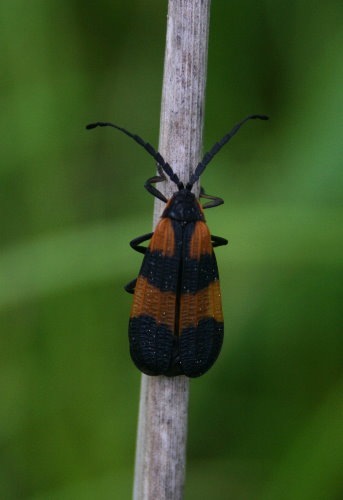
Another beetle! I’ve got at least half a dozen beetles to share, but I’ll stick to these two for this post. This one’s much easier to figure out: it’s a net-winged beetle, family Lycidae, by the interesting pattern of raised veins on the wings; and it’s Calopteron discrepens by the way the vertical black bar joining the upper black band to the thorax widens as it reaches the thorax (another lookalike, C. reticulatum, remains the same width).

There are five species in this genus, all restricted to the north and east. The KGI suggests that some members of this family feed on honeydew from aphids, though I don’t know if it’s true for this species. Other species seem to feed on nectar from flowers.

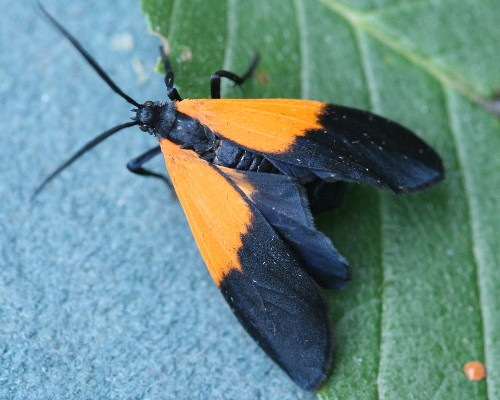
Another species, C. terminale, lacks the upper black band. There’s a species of moth, the Black-and-yellow Lichen Moth, Lycomorpha pholus, that looks nearly identical except that it’s wings are smooth, lacking the raised veins, and its antennae don’t have the saw-teeth. And, y’know, it’s a moth, not a beetle. :) The black and orange patterning of these beetles is probably aposematic (warning predators that they’re distasteful or toxic), in which case the moth would benefit through mimicry.

Not a beetle:

8087 - Lycomorpha pholus - Black-and-yellow Lichen Moth

Book tour update

Just a quick post to provide an update on the book tour! I’ve got a number of dates set now, and some others that look likely. Here’s the schedule of set and probable dates and locations:

tourmap-conf1

Red dates are confirmed or probable; I’m trying to set up something for teal dates; brown date is the New River Birding and Nature Festival (paid event); navy date is my day off to visit a couple friends in the area. :) A few of these are subject to final confirmation and may change; I’ll post the definitive schedule in a few weeks once I know.

April 29 – Detroit, MI area

April 30 – Columbus, OH area (The Nature Conservancy Ohio)

May 1 – Wheeling, WV (Good Zoo at Oglebay Resort)

May 2-5 – New River Birding and Nature Festival, WV (closed/paid event)

May 5 – if anyone is interested in an event in eastern KY, western VA or southwestern WV, let me know; it may be possible to arrange an event on May 5

May 6 – Richmond, VA area

May 7 – Davis, WV (Canaan Valley National Wildlife Refuge)

May 8 – Millersburg, PA (Ned Smith Center for Nature & Art)

May 9 – Hockessin, DE (Ashland Nature Center; Delaware Nature Society)

May 10 – East Brunswick, NJ (Playhouse 22, Friends of the East Brunswick Environmental Commission)

No event on May 11.

May 12 – Athol, MA (Athol Bird and Nature Club)

May 13 – Ithaca, NY