Monday Miscellany

Country road in spring

It’s amazing just how fast the trees leaf out once they start. Just two weeks ago I was noting the late afternoon sun glowing through the sprinkling of leaves on the saplings across the road from the house. Now, I can barely make out the neighbour’s house, which was so apparent in winter. By June, I won’t be able to see it at all. All manner of plant life has greened up or is hard at work at it. Some shrubs are completely leafed out, while the tall ash trees are only just starting. Like the creeks that start tumbling over their rocky beds at spring melt, once spring arrived, time seems to have picked up speed and is rushing by.

Blue Jay

We’ve had a fair bit of rain over the course of the last week. It seems to have gotten all the wet out of its system now, however, and we’re forecasted to have mostly clear skies the rest of the week (whether it remains that way remains to be seen). Although all that rain was undoubtedly part of the reason behind the green explosion, the animals were less than happy about it. This Blue Jay, for instance, was looking a bit bedraggled as it visited the feeders one afternoon.

Mink Frog

The rain has made the ground near our dock rather soggy. As Dan was flipping his boat over one day last week to try to locate a leak that had gotten worse over the winter, he disturbed this guy from the pool of water around the boat. I spent a lot of time debating the identity of this guy. The bright green upper lip and speckled underbelly should make it easy to ID, I figured. I think that it’s a Mink Frog, Rana septentrionalis, but it could also be a Green Frog, Rana clamitans. I couldn’t figure out a definitive ID characteristic that would rule one out based on the photos I have. A Mink Frog would be a “lifer” for me, a species that I’d never encountered previously. In Ontario they tend to be found further north than the GTA where I grew up, but we’d be at the southern edge of their range, here. They’ve been recorded over in the Park. I’m leaning toward Mink because of the small eardrums, dorsal ridges that terminate halfway down the back, and lack of strong barring on the back legs, but I get the impression these are all somewhat variable features.

Water bug, Belostoma sp.

Before Dan flipped over his boat, he bailed out some of the water. And sitting in the water was this guy. I believe it’s a water bug in the genus Belostoma. It was rather large, about an inch long, and quite active within the container Dan had scooped it into. This group of water bugs are among those where the female lays her eggs on the male’s back in the spring. He “broods” the eggs, keeping them clean of fungus, protecting them from predators, and making sure they’re well oxygenated (by doing “push-ups” at the surface of the water). I’m not sure if the lack of eggs on this one means it’s a female, or just a male that hasn’t been laid on yet. I did notice, however, in examining the photos on my computer, that it’s sporting a bunch of red mites.

Bolitotherus cornutus

I found this strange beetle clinging to a piece of driftwood beside my moth trap one morning. I wasn’t sure if it was alive, as it fell off the wood when I touched it, and sat with its legs curled under it. I set it on a shelf in a vial for a couple of hours as I sorted through my trap and photographed the moths I’d caught. When I returned to it, it was sitting in a different spot in the vial, and its legs appeared to be out. As soon as I picked up the vial again, however, it fell over and its legs curled underneath it again.

I pulled out my trusty Kaufman Guide to Insects (I love that book, have I mentioned that?), and there it was at the bottom of page 193: Bolitotherus cornutus. Looking it up on BugGuide.net reveals its common name to be Forked Fungus Beetle, or sometimes Horned Darkling Beetle. The two horns are projections from its thorax, and are used in “battle” with other males to win females (I’m not sure the purpose of the orange “hairs”). They are associated with bracket fungi of hardwoods such as maple and beech. The Kaufman guide makes a note that they are adept at “playing dead”, so I guess that’s what my beetle was doing whenever I disturbed it. Was pretty convincing!

Unidentified bracket fungus

While out with Raven today I encountered this bracket fungus projecting from the side of a stump. Just recently I had read over at Huckleberry Days about Dryad’s Saddle, Polyporus squamosus, a stalked bracket fungus that appears about now, so I thought, “Aha! A Dryad’s Saddle!”. I took a documenting photo and returned home. I pulled out my mushroom guide just to confirm and look up a couple of life history details about the species, and now I’m not convinced that it’s Dryad’s Saddle after all. All the photos I can find on the web for the species show it being concave where it attaches to the stalk, rather than convex like my fungus. I searched through the guide a couple of times and poked about the ‘net, but couldn’t come up with an identity.

Bee fly

Very close to the same spot, I stood and watched this bee fly hovering at several Spring Beauties at the side of the road. It was much oranger than previous individuals I’ve seen, and I wondered if it was just a dark Bombylius major, the species I’ve seen before, or a different species. I gather the half-light/half-dark wing markings are fairly distinctive, and seem to only be shared by B. major and B. mexicanus. It’s hard to make out the specific pattern of dark, but I’m leaning toward B. major.

Crab spider?

I have no idea what this spider is. Not being insects, they’re not usually treated in much depth in the usual insect guides, although Stephen Marshall’s Insects doesn’t do too badly. It looks like it might be a type of crab spider, but I’m not sure. I’d knocked it off the branch of a tree onto a white sheet when I was out looking for beetles (as per a post by Ted of Beetles in the Bush that suggested if you go around thwacking some branches in the spring, it’s possible to discover some beetles you might not normally encounter). I’ve only gone out the once and thwacked half a dozen branches before I was disrupted by the arrival of a real estate agent who was coming to take photos of the house, and then it rained much of last week. Now that the weather is nice again I plan to give it another try.

Birdwatching

A few animals from a little closer to home… with the nicer spring weather the cats have been allowed to go outside in their harnesses to sit in the long grass, enjoy the sunshine, and watch the birds. They’re tied to the deck with short 10-foot leads, so they’re not really a threat to anything except perhaps the odd bug. Both for the safety of wildlife and the cats themselves, I never let my cats roam about outdoors, so this is about as outdoor-cat as these guys will get. They enjoy it, though. Despite the chipmunk who thumbs its nose at them by foraging on fallen seeds under the birdfeeder five feet away.

Fish eats cat, fish spits up cat

Fish eats cat. Fish spits up cat.

Water dog

Since late winter, when the snow was just starting to melt, Raven has been taking an increased interest in water. At the first start of ice breakup, she’d paddle her feet in the shallows of the lake, but it’s taken her a while of gradually working up to letting her feet leave the security of the ground. Even when she started doing that, she’d only push forward half a body length, and then quickly turn around to paddle back. After once or twice of that, she wouldn’t go after sticks that were further out anymore, she’d just look at you and whine. We’d taken her out in the boat a couple times and “thrown” her overboard, and she’d paddle back to shore just fine, but was reluctant to go in of her own accord.

Then, a couple days ago, it was like she had an epiphany. We’d thrown a couple of sticks for her just out of reach from where her feet could touch bottom, and she’d pushed off to grab them, but turn quickly back around. She showed a bit of willingness to go a bit further, and so we got her to do two body lengths, and then three. Then Dan suggested throwing the stick way out and seeing if she’d go for it. So I tossed it four or five meters out, and she struck right out to retrieve it.

Water dog

Within the course of five minutes, she was suddenly paddling all over the place like a bonafide water dog. Not only that, but once she realized she wasn’t going to drown if her feet left the bottom, she discovered that hey – I actually like this! Now when we take her down to throw sticks for her, she’ll jump right in the water and start paddling out before you’ve even tossed the stick out. Quite a change from the puppy who was reluctant to even get her feet wet last fall!

This one’s for my peeps

Spring Peeper

I have been hoarding these photos for a couple of weeks now. For various reasons, I didn’t get around to posting about them immediately after I took them, but neither did I just want to throw them into my catchall piles. So they’ve been sitting in my “to-post” file while I awaited an opportunity to talk about them.

I came across this frog while visiting my parents’ old home a couple of weekends ago. I had brought my mothing equipment with me and set up a couple of blacklit sheets in the yard. It was as I was heading around to check them that this little frog hopped in front of me. A year ago I had something very similar happen with a Wood Frog, in nearly the same place. This year, it was a Spring Peeper, Pseudacris crucifer.

Spring Peeper

Peepers are tiny frogs. They’re the smallest species found in Ontario, at an inch long or less. This makes them difficult to spot out in the waters of the vernal pools they inhabit in the spring. However, they’re certainly not difficult to hear. Pound for pound (ounce for ounce?), they’re one of the loudest animals. Their high-pitched peeps can reach levels of up to 90 decibels or more. Since they’re not trying to draw females in from across broad distances, the explanation for the noise is likely a result of sexual selection. A male’s vocal mechanism can make up as much as 15% of his body weight. The bigger and stronger his voice-box and amplification, the louder the noise he can produce. So females gravitate to males who can peep the loudest and the fastest. Over evolutionary time, this would drive up the amplitude of the male peepers’ noise. Standing beside a whole pond-full of male peepers giving it their all can cause your ears to ring. At 90 dB, prolonged exposure can actually cause hearing damage. Unsurprisingly, frogs have evolved a method of protection from their own noise.

Spring Peeper

The scientific name, crucifer, meaning “cross-bearing”, refers to the dark X on the frog’s back. They’re usually variations on brown, though some may be grayish. You can tell the sexes apart by size (females are larger), but also by the colour of their throat – those of females are pale, while males’ are pigmented. I suspect this individual is a female.

Although they don’t climb trees, they have excellent sticky pads on the ends of their toes that allow them to grip vertical surfaces such as rocks or vegetation. This gal used hers to climb out of the yogurt container I had placed her in while I got my camera. Interestingly, they had once been placed in the same genus as the Gray Treefrog, Hyla, before being assigned to the genus Pseudacris, the chorus frogs.

Spring Peeper

This time of year peepers are caught up in the drive to make more of themselves. In northern climates such as ours they breed from late March to June, but in southern regions such as Florida, their breeding season is October through March. The female can lay as many as 900 eggs each spring. Considering that in order to maintain stable population levels a single frog must successfully make one offspring within its lifetime (therefore a pair must produce two), the percentage of eggs that make it to sexual maturity must be exceptionally low for females to need to produce 900 eggs. If even as much as 1% of eggs made it to sexual maturity, there’d be an incredible population boom (1% = 9 eggs). Most eggs and/or tadpoles will probably be eaten by predators, or suffer dessication before they are ready to leave the water if their vernal pool dries up too early. A success rate of just 2 eggs is equal to about 0.22%.

Spring Peeper

Through most of their range they are simply known by the common name Spring Peeper, but they have some delightful local names (or at least, according to various sources on the web). In New Brunswick they are often called “tinkletoes”. In some parts of southeastern US they are known as “spring creepers”. In Martha’s Vinyard they’re “pinkletinks”. But my personal favourite comes from western Pennsylvania, where they have the delightful name of “peedee dinks”.

Here, they’re just peepers. But the name suits them. Our ponds are all full of peeps at the moment, the males all advertising their studliness. Although we have no ponds right near our house, the sound from the frogs in the ones in the nearby forest carries on the still night air, and I can lie in bed with the window open and enjoy this emblematic sound of spring.

Wood frog love

Wood Frogs

On Sunday, Dan and I took Raven and went up the road a little ways to a plot of crown land. There are a few such pieces, owned by the government and open to public recreation, but we only just recently found out about them, when Dan was doing background research for his new Frontenac Bird Studies program (incidentally now starting to gear up). Dan intends to install some his monitoring programs on these crown land parcels, and on Sunday the outing was dual purpose: to burn some puppy energy, and to scout the land a bit further for suitable spots.

As we neared the back boundary of the crown land we passed a pond from which I could hear frogs croaking. Dan offered to take Raven and carry on to the end, and then come back to get me on his way back. In the meantime, I’d scout the pond and see if I might be lucky enough to spot a couple of the noise-makers. Sounded good to me, I really wanted to check out some of the spring amphibians, but last thing I needed was a water-loving dog splashing around and disturbing everything. If I was by myself I might have her sit-stay, which she’s pretty good with as long as you don’t go far or keep her sitting long, but really this arrangement was better for everyone.

I followed the croaks to the back of the pond where it didn’t take long to spot a disturbance in the water. Drawing closer, it appeared to be a female with suitors. Drawing closer still, there appeared to be four love-struck males surrounding her.

Wood Frogs

The one that was swimming around the bunch buggered off when I got up next to them, but the other three had fought hard for their respective positions and weren’t about to relenquish them that quickly. That poor female could barely move, and I was started to wonder if it was possible for amorous male frogs to choked a female to death. Her strange red colour seemed odd, too. I was pretty sure that these were Wood Frogs, even though they didn’t show the typical dark masks the species usually does; I couldn’t come up with any other species might even be possibilities. But the reddish was a colour I hadn’t ever seen among Wood Frogs, so I wondered if maybe there was a species I didn’t know of around here. Or maybe it was just all the blood rushing to her head.

Wood Frogs

They were close enough to the shore that I could scoop them up with one hand, which I did just to make sure that the female really was still alive – she was. The third male took off when I disturbed them, but the other two still hung tight. Male frogs grip the females in a position called amplexus – Latin for “embrace”, even though is seems more like chokehold. Typically, if there’s just one male involved, Wood Frogs (and other “true” frogs, tree frogs, and Bufo toads) grasp the female from behind around her armpits. Obviously these boys had skipped that sex ed class.

The embrace can be iron-strong, seemingly locked in place, and if a love-blind male accidentally hooks up with the wrong species, the unwitting object of his affection may have a tough time escaping. The “lock” mechanism is a swollen pad, called nuptial pads, along each of the male’s “thumbs”. The pad is actually a gland that enlarges during breeding season and secretes a sticky glue-like mucous. The mucous, in combination with a rough pad surface, keeps the frog’s arms locked in place around the female.

Wood Frogs

This was another trio I found just a bit further down the shore. At least one of these guys knows what he’s doing. The female was that same weird shade of red. Apparently Wood Frogs will swim around in amplexus for an hour or more, but the actual egg-laying only takes about half an hour. The female lays her eggs in a large gelatinous mass, and the male releases his sperm over the eggs as she lays them. I looked around the edges of the pool where the frogs were, but saw no evidence of eggs anywhere. I must have found them in the early stages. The pond, apparently a vernal pond, had very little vegetation in it, so I hope they were able to find a suitable place to lay their eggs.

Wood Frogs

When I slipped the frogs back into the water, one male kicked off, propelling the whole group away from me toward the pond bottom. They weren’t very efficient swimmers in this state, clumsy and uncoordinated, and I mused how they would be easy pickings should something hungry come along. Good thing there weren’t any herons patrolling the shores of this pond. I guess, even though they’re somewhat vulnerable for an hour or so during the process, the odds of a predator happening across them during that period is pretty slim and most of them get the job done with no more threat than the occasional passing naturalist.

The best of 2008

As I indicated yesterday, today is my one-year blogoversary. To mark the occasion, I thought I’d pick out my favourite post from each month in 2008 and highlight them here. This proved tougher than I originally anticipated, with some difficult decisions having to be made, particularly during the summer months when there’s so much of interest to talk about. However, here are the ones I ended up selecting. For readers who joined me mid-year, some of these may be new and I hope you find them interesting! For readers who have been with me since the start, I hope you enjoy re-reading them!

redpolls5

January One amongst the redpolls
I went out to fill the feeders, and a whole flock of hungry redpolls swarmed them before I had moved away, a pretty neat experience.

Gypsy Moth pupa case

February Cattail thwacks revisited
A post about gypsy moth egg masses I found on the trunks of some trees mid-winter.

Cattail Caterpillar

March Cotton candy for blackbirds
I love this one because it lead to a probable new BC record for the species after Wandering Weeta read my post and investigated her own cattail patch.

Red-tailed Hawk

April Red-tail fly-by
A Red-tailed Hawk hanging around low enough for some neat shots.

Eastern Tent Caterpillars

May Tenting it with the family
I really deliberated over May, but this one finally won out. I have a thing for underdogs, and I thought the silk trails were cool.

Gray Treefrog

June Gray, but not really
A delightfully obliging (or distracted?) Gray Treefrog that I discovered in my parents’ water garden one evening.

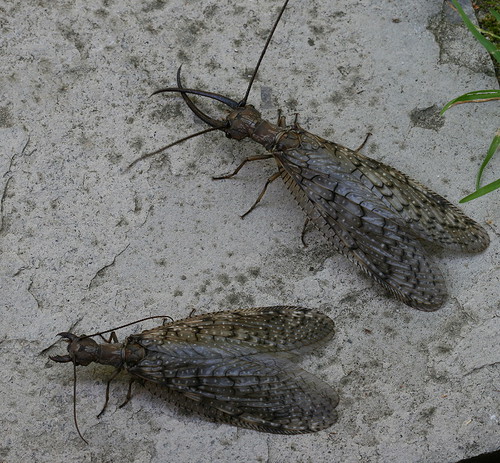
Male and female dobsonflies

July X-rated Dobsonflies
We all need a little animal porn now and then.

cicada13

August Arrival of the dog-days
I had trouble with August. August found us in a new home, in an absolutely stunning location, full of new things. I finally settled on this one because it’s an event you don’t often get a chance to observe.

Hairy Woodpecker

September Hammerhead, harpoon-tongue
This woodpecker hung around the yard for a few days, allowing some great views.

Northern Walkingstick, Diapheromera femorata

October All legs
I hardly ever come across walkingsticks, so this one was exciting to find clinging to the outside of the house one morning.

Biotite mica

November Relicts of a past age
I don’t do much with geology or minerals, so this was an different subject. It was also an interesting look at some of the history of the area.

RBWO8

December The Carolinian woodpecker
I was very excited when this bird showed up at our feeders, since it’s uncommon in our area, and happens to be one of my favourite woodpeckers.

Warts and all

toad2

I missed posting yesterday because I barely saw my computer. The only downside that I could really complain about living out in the country is that high-speed internet is still a specialty service, either for those who can afford the up-front costs of satellite, or for those lucky areas serviced by wireless or DSL. Since we fall into neither category, we are stuck with dial-up for the time being. Dial-up has the dual inconvenience of being exceptionally slow for today’s internet, and being more difficult to network effectively than high-speed. Also, unless you get a second phone line, your phone is tied up for the duration you’re online (which tends to be most of the day for us).

Blackburnian has been at the computer for the last few days to get his website set up and operational. And because of the above problems with dial-up, it’s been necessary for him to use mine (it’s the one with the modem), and it took him a fair while to work out the kinks. He’s an artist like myself, only better, and less distracted by writing and other projects. He is also planning on undertaking some research projects in our area, primarily with birds. His website is part art gallery, part promotional, and part blog. In the blog he plans to post his artwork as he completes it (all will be offered for sale through eBay) and talk about his research and other nature projects. I encourage all my readers to pop over and check it out (because he put a lot of work into it, but more importantly, because I sacrificed my computer for three days toward it!).

So now that that project is completed, I am back at my keyboard. And, as revealed by the photo above, the mystery subject of a couple days ago, that Blackburnian brought to the window, was none other than a very fat, very brown American Toad (Bufo americanus).

toad5

I’m not sure where Blackburnian found him; hopping across the grass beside the driveway is my guess, but he didn’t say. He’d picked him up and brought him to the window. I thought the toad would make an easy short post, but I just couldn’t decide on a photo. Or even two. At three photos we’re getting into long-post range, so I felt I should save them and go into more detail.

American Toads are very common, but are restricted to eastern North America. In the plains there’s the appropriately-named Great Plains Toad (B. cognatus), and Canadian Toad (Bufo hemiophrys), and to the west, the Western Toad (B. boreas). The southeast has a couple species, Oak Toad (B. quercicus) and Southern Toad (B. terrestris), and the southwest one, Red-spotted Toad (B. punctatus). One final toad has a range that covers most of the US, but virtually none of Canada, the Common Toad (B. woodhousei), sometimes also called Woodhouse’s Toad or Fowler’s Toad. In all, there’s only 17 “true toad” species, members of the genus Bufo, in North America north of Mexico. The only one I’ve ever seen is the American Toad. Fowler’s does make it into Ontario in the extreme southwest, but just barely, and it’s very rare.

toad6

The true toads are defined by the presence of two things. The first is bony ridges on the top of the head, just behind the eyes, called cranial crests. Not all toads have well-developed crests, and their location behind the eyes can make them easily overlooked. More obvious is the presence of large swollen patches at the back of the head, one on each side. These are glands, called parotoid glands, which produce a secretion that is toxic if ingested. They serve as a defense system against predators, although it’s unclear to me whether predators will spit the toad out when it tastes the secretion, or whether predators learn from prior experience to avoid toads in the future.

toad1

The other noticeable characteristic of toads, which is not present on any of the other amphibians in my area, is warts. Toads are very warty. These warts are also toxin-secreting glands, although because they’re much smaller they don’t secrete as much. Different species of toad can have different wart patterns. In the case of the American Toad, there is generally just one, or occasionally two, warts per black spot (in fact, the black spots can be hard to see because there’s just one wart). The Western Toad has two to three warts per black dot, and the Common Toad has three or more.

The beliefs that toads cause warts in humans, or that handling a toad is poisonous, are both false, although it’s good to wash your hands after handling one in case any of the toxins got on them. Probably if your dog picks up a toad it’s not going to die, but if it ingests any of the toxins it can potentially become very sick (this really applies to any animals, including humans, though what you’d be doing eating a toad, I don’t know…). Also not true is the belief that you can get high from licking a toad. There are a few toads whose toxins produce hallucinogenic effects, including the Sonoran Desert Toad, B. alvarius, but the toxins generally need to be dried and ingested, as an enzyme in human saliva inhibits the psychoactivity of the chemicals. More likely is that you’ll have a bad taste in your mouth and feel ill for a bit.

toad3

Like other amphibians, toads lay eggs in jelly-like capsules. The eggs are fertilized by the male, who sits astride the female’s back, his arms wrapped around her belly in a death grip (called amplexus, Latin for “embrace”), and releases sperm onto the eggs as she produces them. Toad eggs are produced in long strings, while frog eggs tend to be in large, floating globular masses (salamanders also lay eggs in globular masses, but theirs sink). Toad eggs have the characteristic of being dark on top and light on the bottom, to help camouflage them from view from either perspective.

As tadpoles, toads are herbivores, grazing on algae and plant bits. Toads are, for the most part, insect eaters, but will opportunistically dip into omnivory if they find something suitable. They may eat fruits or vegetables, or even dog food left out for Fido in the backyard. For the most part, though, they’ll eat crickets, worms, ants, and other small insects, and can be helpful for pest control.

toad4

Toads have dry, leathery skin, which is useful for preventing water loss. They are primarily a terrestrial species, generally only spending time in water during mating. As long as there is an appropriate body of water nearby for the spring, toads are happy to roam overland the rest of the year. They’re commonly found under decks, in gardens, or other shady, damp areas. They spend the winter hibernating burrowed in the ground. When digging out the burrow, they back in, and use their back legs to push the dirt out.

Come spring, as the days start to warm, the toads emerge and trek out to their mating ponds. I think of them as one of the earlier species to start singing in the spring. Their call is a long, level trill, distinct from the similar-voiced Gray Treefrog primarily by its length (a treefrog’s call is shorter, not so sustained). By summer they start to quiet, and by this time of year they should all be preparing to cozy in for the winter. I guess we still have a little while before frost hits, but it’s not too far off, so I hope this guy had a snug place lined up for the coming cold weather.