Today at Kingsford – Sawfly cocoons

Sawfly cocoon

These were the things that prompted me to start looking more closely at the branches, and lead to the discovery of the mummified caterpillars. I just noticed the one at first, a little tube tightly affixed to the side of a small twig, right at the crotch of a couple of branches. The closer I looked, the more I spotted. There were nine on the original little sapling, a young hop-hornbeam covered in marscecent leaves, in the understory below the evergreens lining the lake edge. Further up the hill, still in the same little patch, were a few more. And then on my way out, alongside the driveway, I found one more. All told there were 13 of these little cocoons.

Sawfly cocoon

When I got back I posted them to BugGuide.net, because I sure had no idea. It’s such a fabulous resource, that website. Post just about anything and someone will know the answer. I suppose I was expecting the cocoons to be lepidopteran of some sort, but it turned out they belonged to conifer sawflies, members of the order Diprionidae. More specificially, they were probably made by the Introduced Pine Sawfly (Diprion similis). As the very catchy name suggests, this sawfly is non-native, introduced from Europe sometime about 80 years ago, and now targets various pine species in northeastern North America, south to about North Carolina. White Pine is its favourite, and when I reflect on the specific location of the cocoons, the sapling was directly under a towering White Pine. Apparently the species particularly target trees that are exposed, either because they reach above the canopy of the surrounding forest, or because they’re separated from other trees. Like most such pests, minor outbreaks are no serious threat to the tree, but heavy and/or repeated outbreaks, or infestations on weak or diseased trees, do have the potential to kill the branch or even the tree itself.

Sawfly cocoon

The cocoons above, that look like one end has been sheared off, are typical of successful sawfly cocoons, ones where the larva made it to maturity. I found two that were still closed and looked like the larva didn’t make it. And then I found this one, which, instead of being sawn-off, had a trap-door type of exit. This apparently is evidence that the larva was parasitized by an ichneumonid wasp. The sawfly larva was killed, but the wasp larva made it to adulthood and left. Too cool.

Mummified hornworms

Mummified sphinx caterpillar shell

When out walking Raven the other day, I came across some little cocoons on a small sapling. Ordinarily I would probably have missed them, and I’m not sure why it was that the first one caught my eye. But I saw it, and stopped, and took some photos. And then I looked at some of the other branches on the sapling. After a moment or two I spotted another. And then another. I think my finally tally was 13.

Those will be the subject of tomorrow’s post, most likely, but the reason I bring it up is because that instance of being rewarded upon paying slightly closer attention, of discovering this stuff that I had passed by multiple times before and may have again had I not looked a bit closer, prompted me to pause and examine some of the branches I was walking by yesterday when I took Raven out. I didn’t know what I was looking for. Cocoons, maybe, galls, something abnormal or that showed that something had been there.

Mummified sphinx caterpillar shell

What I discovered was way cooler than anything I had envisioned finding. I had to post the images to BugGuide.net for a definitive ID. I got as far as thinking it was a caterpillar that had been parasitized, perhaps by a fungus, and the spike was the fungus growing out of it or something.

Turns out it’s the remains of a sphinx moth caterpillar, a young one that hadn’t grown very big yet. Many of them can get quite large, up to a couple inches or more. This was less than one inch long. However, the horn sprouting from its rear end is a characteristic of this group of caterpillars and not a fungal growth at all, an appendage that gives the group their “caterpillar name”, hornworms. But it had lost its head, and the caterpillar itself was long since dead.

Mummified sphinx caterpillar shell

The killer? A wasp in the genus Aleiodes, a group that bears the common name “mummy-wasps”. There are about 90 species in this group in North America. These wasps parasitize and eventually (but not right away) kill leaf-eating caterpillars, including many common and “pest” species such as Gypsy Moths, Tent Caterpillars, Fall Webworms, and others. The wasp larva develops inside the caterpillar’s body, eventually killing its host once it’s eaten enough, but it doesn’t consume the skin. Because the caterpillar would likely fall off the branch once it died, the larva actually affixes its host to the branch with a glue-like substance by chewing a hole in the caterpillar’s belly. When it pupates it leaves through a hole in the back of the dead caterpillar’s shell, but the caterpillar itself usually remains identifiable. This is unique among parasitoids, most of which consume the whole body, or the body otherwise becomes shriveled beyond recognition.

Mummified sphinx caterpillar shell

BugGuide.net pointed me to an identification guide put out by the US Forest Service on the common eastern Aleiodes species and their mummies. Based on this, I think my caterpillars were Waved Sphinx moths (a species I have actually encountered at my parents’ old place), and the guilty party therefore A. ceratomiae (a species I have not encountered, at least not consciously). This photo from Wikimedia Commons is of an Aleiodes (not A. ceratomiae, but similar) parasitizing a Gypsy Moth caterpillar.

Mummified sphinx caterpillar shell

In the case of the caterpillars previous, there was no exit hole. Chances are that the wasp larvae in these caterpillars died before it fully developed. I found two of those. I also found four of these brown empty cases, as in the photo above. Turns out, they’re the same thing, only the wasp larvae made it to maturation. The hole is the exit where the adult wasp left. The horn of the caterpillar at some point fell off during the drying process (as the head had done much earlier on both the above and this), but had been affixed to the right of the hole in this photo. You may note that this one is smooth, but the others are kind of spikey. The person at BugGuide.net who ID’d these wasn’t sure whether that was just the natural mummification process, or if perhaps there was also a fungus involved.

So there you go. You never know what you might find if you peer closely.

Looking for spring

Western Conifer Seed Bug (Leptoglossus occidentalis)

Starting about the last week of March, and going until mid-November, I could have a blog that was completely dedicated to invertebrate life. There are so many different insects, arthropods, and other invertebrates, of all different shapes and sizes, that I could post a different one each day and still have lots left over for next year, and the year after, and the year after that. The diversity is astounding. It makes you wonder why there aren’t more entomologists out there.

However, come December, it all dries up. Insects being cold-blooded creatures, that require warm ambient temperatures to function, they all but disappear once the cold and snow arrive. Many survive as eggs or pupae. Some will overwinter as adults, though, finding a protected nook where they aren’t exposed to the harsh winter environment. Before humans, this may have been trees or logs, under rocks or in the crannies in cliffs. After humans, at least a few of these bugs choose to spend the winter in our homes. Usually they just shack up in the walls. But sometimes a warm spell outside, or a leaky draft from inside, can warm them up enough that they come stumbling out, groggy, thinking it’s spring.

I was visited by just such a bug yesterday. I found him on a windowpane as Dan and I were discussing a noticeable draft we could feel coming in from the bottom of that window (the top seemed fine, however). Heaven only knows what prompted him to awaken and make his way inside – it was a bone-chilling (for southern Ontario) minus 30 Celsius (-22 F) overnight last night, and the day before wasn’t much better. But here he was, nonetheless. The first insect I have seen since well before Christmas.

Western Conifer Seed Bug (Leptoglossus occidentalis)

He is a Western Conifer Seed Bug, Leptoglossus occidentalis, a member of the leaf-footed bug family Coreidae, so named for the wide flanges on their rear legs. The other name for the family is squash bugs, as many of them target gourds such as squash and pumpkins. In North America there’s some 80 species, most of which are southern in range. As the common name implies, this species is a native of western North America, and has only been this side of the continent for the last couple of decades, recorded in southern Ontario for the first time around 1985, and New York state in 1990. It’s even become established in France. There are a couple other species from the genus Leptoglossus that have been recorded here in Ontario, but the Western Conifer Seed Bug is the most frequently encountered. The species can be told from the others by the white zig-zag across the back. This individual was actually from my parents’ house last winter, but shows the white zig very well.

Western Conifer Seed Bug (Leptoglossus occidentalis)

Like most insects, this guy can fly, but one doesn’t tend to see them flying very often. They prefer to amble from one place to the next. I got him to open his wings by flicking him from a sheet of paper onto the table, and then tried to be quick with my camera. They have these bright orange and black bars across their abdomen, which may be a mechanism used to startle potential predators (by flicking open his wings he exposes these bright colours), or may be tied to aposematic colouration (bright colours that warn predators of distastefulness or toxicity).

The other thing this photo shows is the two-parted wing that creates the distinctive pattern on the back of true bugs. The wings are called hemelytra – elytra being the name of the hard wing covers that most beetles sport, and hemelytra being half that. The upper part of the bug’s wing is hard and protective, while the lower part is membranous and so useful in flight. This characteristic is also what gives the true bugs the order’s name, Hemiptera (Hemi = half, ptera = wing).

Western Conifer Seed Bug (Leptoglossus occidentalis)

Here’s a close-up of the “leaf” on the bug’s leg. I’m not sure what the purpose of the flattened tibia is. Camouflage, breaking up the outline to look more leaf-like? Is it used in mating, fighting with others, perhaps to produce sound? I didn’t see anything about it on any of the websites I checked out. Maybe it doesn’t have a purpose. But then why would it have evolved?

Western Conifer Seed Bug (Leptoglossus occidentalis)

Another thing that characterizes the true bugs is that their mouthparts have become fused into a long tube that they use for sucking. In this photo the bug is on his side trying to flip back over, but it does expose his belly and that long feeding tube. If you look closely you can see it running along his underside from his head all the way down to the second abdominal segment, where it ends in a dark tip. In the case of this species, the long tube is used to pierce into conifer seeds, primarily pine but also spruce and fir. The bug feeds on the seeds as they’re developing, while their insides is still soft and pulpy. It can sometimes be a pest where conifers are commercially cultivated for their seeds (for instance, for growing plant-a-tree seedlings), but don’t affect mature trees even in outbreak numbers and so aren’t a direct problem for the forestry industry. They don’t bite or sting, or eat things in the house, so aren’t really a problem to homeowners, although occasionally they’ll release a pungent odour if disturbed (much like ladybugs will).

Western Conifer Seed Bug (Leptoglossus occidentalis)

I wasn’t sure what to do with the bug once I finished taking photos. I couldn’t put him outside, obviously. I didn’t know where he came from to be able to put him back there, either. So eventually I decided to put him up on the blinds, and let him fend for himself against the three insect-eating critters in the house. Raven will eat bugs on the spot. This has gotten her into trouble already once when she tried to eat a wasp and it stung her, resulting in her face swelling up so much that she looked like she was a bulldog cross. We only discovered that she had found a wasp when I looked down to see her itching at her swollen face. We tried to find wasps before she did, after that. The cats, on the other hand, like to play with the insects but rarely eat them. Oliver was quick to find the leaf-footed bug and was fascinated by it yesterday, but I noticed today it was crawling across my desk, so obviously the bug either got away unharmed, or the cats lost interest.

A year in photos

The final installment of my blogoversary series is a selection of my favourite photos from the past year, two or three per month. I had planned on choosing just one per month, but just couldn’t make up my mind. In fact, in the summer months, when we had just moved to the new house and the lake and forest were green and verdant I had several dozen I could have picked out, but I settled for three a month. Some of these have been used in posts over the year, others are new, photos I liked but that didn’t fit into a post.

Jan1

Jan2

Feb1

Feb2

Mar1

Mar2

Apr1

Apr2

May1

May2

Jun1

Jun2

Jul1

Jul2

Jul3

Aug1

Aug2

Aug3

Sep1

Sep2

Sep3

Oct1

Oct2

Nov1

Nov2

Dec1

Dec2

The best of 2008

As I indicated yesterday, today is my one-year blogoversary. To mark the occasion, I thought I’d pick out my favourite post from each month in 2008 and highlight them here. This proved tougher than I originally anticipated, with some difficult decisions having to be made, particularly during the summer months when there’s so much of interest to talk about. However, here are the ones I ended up selecting. For readers who joined me mid-year, some of these may be new and I hope you find them interesting! For readers who have been with me since the start, I hope you enjoy re-reading them!

redpolls5

January One amongst the redpolls
I went out to fill the feeders, and a whole flock of hungry redpolls swarmed them before I had moved away, a pretty neat experience.

Gypsy Moth pupa case

February Cattail thwacks revisited
A post about gypsy moth egg masses I found on the trunks of some trees mid-winter.

Cattail Caterpillar

March Cotton candy for blackbirds
I love this one because it lead to a probable new BC record for the species after Wandering Weeta read my post and investigated her own cattail patch.

Red-tailed Hawk

April Red-tail fly-by
A Red-tailed Hawk hanging around low enough for some neat shots.

Eastern Tent Caterpillars

May Tenting it with the family
I really deliberated over May, but this one finally won out. I have a thing for underdogs, and I thought the silk trails were cool.

Gray Treefrog

June Gray, but not really
A delightfully obliging (or distracted?) Gray Treefrog that I discovered in my parents’ water garden one evening.

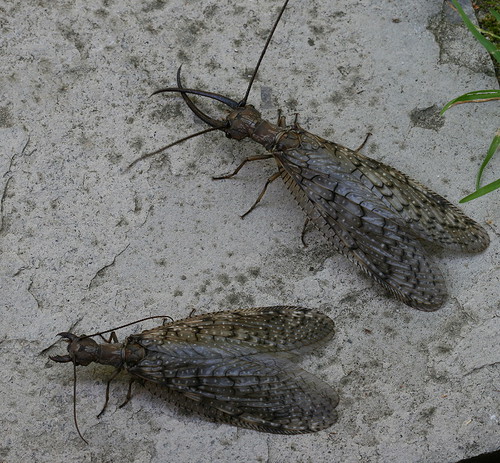
Male and female dobsonflies

July X-rated Dobsonflies
We all need a little animal porn now and then.

cicada13

August Arrival of the dog-days
I had trouble with August. August found us in a new home, in an absolutely stunning location, full of new things. I finally settled on this one because it’s an event you don’t often get a chance to observe.

Hairy Woodpecker

September Hammerhead, harpoon-tongue
This woodpecker hung around the yard for a few days, allowing some great views.

Northern Walkingstick, Diapheromera femorata

October All legs
I hardly ever come across walkingsticks, so this one was exciting to find clinging to the outside of the house one morning.

Biotite mica

November Relicts of a past age
I don’t do much with geology or minerals, so this was an different subject. It was also an interesting look at some of the history of the area.

RBWO8

December The Carolinian woodpecker
I was very excited when this bird showed up at our feeders, since it’s uncommon in our area, and happens to be one of my favourite woodpeckers.