Sunday Snapshots – Out Skiing

skiing2

It was a nice afternoon today, mild, sunny to start though it clouded over a bit later. Dan suggested we go out for a ski, and I was happy to join him. I handed him the camera on the way back and asked him to take a photo, ’cause I’m never in photos, always behind them.

skiing6

skiing1

The photos of Dan were shot from the hip, partly so I didn’t have to disentangle my ski pole to remove the camera from my shoulder so I could raise it to my face to take a photo. But mostly so that I could get candid shots, ’cause candid are much more interesting than posed.

The downside to shooting from the hip is that it takes some practice to know where the camera’s pointing. Particularly when you’re trying to take the photos stealthily, not looking like you’re actually taking photos. I run off dozens. Every once in a while I get lucky. Mostly I don’t.

skiing9

skiing10

skiing4

skiing3

Realizing you’ve got it set on manual focus helps with getting better photos, too.

skiing7

Hare-walk shoes

Showing off the snowshoes

I’ve recently discovered snowshoeing. Our landlady and her family were big outdoor recreationists, or at least one would be led to believe so by looking at their basement. The sons are grown and moved away, and the father sadly passed away, so when she moved from the house this summer she left most of the winter gear here and encouraged us to use it. This included six pairs of cross-country skis and three pairs of snowshoes. Since there are only two of us (unless you count the dog) we’re perhaps a little over-equipped, but nonetheless grateful for the free “toys”.

Earlier in the week Dan pulled out a couple of pairs of snowshoes and suggested we take Raven out for a quick tour about the property. I think it was the first time either of us had been on snowshoes in years and years. Certainly the last time I recall using snowshoes I was a young teen, and my sisters and I had decided to redeem our Canadian Tire money (basically old-fashioned rewards points for the auto/home/garden/recreation store Canadian Tire) on a pair of snowshoes. The pair we got were a simple moulded-plastic latticework, in white, and most of my memory concerning them is of them hanging in the garage, unused. Probably us kids found them to be more work than they were worth. After all, most of our time outside was spent rolling around in the snow. On those occasions when we decided to strap on some additional footwear, we went “ski-boarding” (for a long while we simply had a single pair of cross-country skis, which we split between two of us kids, each kid getting one boot, one ski, and one pole. We would slide along like one might use a skateboard, alternately pushing with the other foot and gliding on the ski. This was pre-snowboard days, so our made-up name of “ski-boarding” was a play on skateboard).

Snowshoes on snow

Returning to the point of the story: effectively, I had never really used snowshoes, so this was a new experience for me. First thing to figure out: how the heck do you strap these things on? There were two pieces of leather, one that buckled around the toe of your boot, and the other that fastened behind your heel. There was a big gap right in front of the straps, and in front of that was a heavy crossbar. It felt weird to have my toe hanging off into space, so I tried placing my toe on the crossbar and doing the straps up for that first outing. For whatever reason I didn’t have any trouble; perhaps I’d left the straps loose.

When I went to do that the second time I went out on them, though, I kept finding that the toe of the snowshoe would catch in the snow every time I took a step. How annoying! It took me half the loop around the property before I realized what was going on. That hole in the snowshoe, in front of the straps? Yeah, that’s for your toes to fit in.

Demonstrating the snowshoe

I’ve got it down now. Here I am, in an exaggerated demonstration of how the snowshoe works. You strap the shoe up so your toes fit over the big hole. Then when you take a step, you toe tips into the hole, rather than pressing down on the shoe. Since the straps are only attached at that one point near the toes, and the shoe is heaver at the back than the front, this allows the shoe to remain tip-up even while your free are toes-down. (These are self-portraits, by the way, with me setting the camera in the crook of a tree, putting it on 10-second timer, and hurrying to get in position before it goes off. Hence the goofy poses. Also the well-packed snow. Not being able to see how I lined up meant I took several photos to try to get it right.)

Snowshoeing

While Dan and I were out, we puzzled over two other design features of the snowshoe. The first is that long tail, which dragged on the ground with each step and often got caught under the other shoe, especially when you were trying to turn around. Was it simply an artifact of bending a long piece of wood around, or was there some purpose to it? Unsurprisingly, it’s the latter. The tail of the snowshoe, as it drags along the ground, helps to keep the shoe pointed straight. This was helpful for me, since I found the leather on one of the snowshoe straps to be worn and a bit wiggly.

Snowshoes in snow

And the latticework. In deep fluffy snow, we’d sink in a good three or four inches or more. Why leave all those holes? Why not just make it a solid sheet of leather? There are two reasons, it turns out. The first one is primarily to prevent snow from accumulating on the shoe as it gets kicked up while you walk. The second is to provide grip (Dan realized, as he was descending a small hill) since a solid shoe would have the same effectiveness as a toboggan strapped to your foot. Modern snowshoes are a bit more solid, but still have gaps around the edges to prevent accumulation. They also often have some sort of pick or cleat on the underside for grip.

Six inches of snow under the snowshoe

Despite the couple of inches that the snowshoe sinks in with each step, it’s a huge improvement over wading through on foot. I stopped and used a bit of goldenrod stem to measure how much snow was still beneath my foot here, compacted underneath the shoe. The answer: a good six inches! Of course, in snow that’s less than a foot deep the snowshoe doesn’t make a whole lot of difference energetically from just wading through on foot. And as you can see by some of the photos above, neither does it prevent your pants from getting snowy and wet. It’s still a rather aerobic endeavor, good cardiac exercise. Note the bare hands and folded-up toque in the photos above – I needed to expose some skin to release some of the heat I was manufacturing! Still, once the snow starts getting deeper, where it becomes more of an effort to take each step and you can’t just shuffle along through it, then the snowshoes will make a huge difference.

Snowshoeing

I’ve noticed even in this shallower snow that I feel more encouraged to go out and break trail while wearing the snowshoes than I would without them. I find myself more adventurous, and I anticipate that when the snow gets deeper they’ll have an even greater influence over where I decide to go and what I check out. I hadn’t been over to the 100-acre woods since before the first snow, so today I decided to strap on the snowshoes and head over to see how it all looked. (Beautiful, of course.)

Although one has to walk a little more straddle-legged than one might normally (probably more noticeable for women than men), one quickly gets used to the gait and it’s possible to move fairly quickly along the trail. I love how each step fits neatly into the curves made by the one previous.

Snowshoe trail

Snowshoes are a development based on the observation that snowshoe hares, with their large, oversized feet, were better able to stay on top of the snow than animals with smaller feet. The traditional snowshoe as we know it is an invention of the North American indigenous peoples, and was especially commonplace in more northern tribes where travel through deep snow was a regular occurrence. Interestingly, each tribe developed its own shapes and sizes and structures for their snowshoes according to where they lived, what they had available, and what they needed to be able to do while wearing them.

The longest belonged to the Cree, and were nearly six feet (1.8m) long and turned up at the toe. They were used for hunting, and the slightly heavier weight of the larger shoe was offset by the greater surface area resulting in less sinkage (the amount the shoe sinks into the snow being referred to as its “flotation”), and therefore less effort to take each step; important for longer trips. Tribes that inhabited the boreal forest, where maneuverability was more important, tended to have narrower and shorter shoes. The current form, resembling a tennis-racquet, is a more modern adaptation apparently developed by lumberjacks in the 1700s. Europeans, especially the French voyageurs (fur-trappers and traders), were quick to adopt the snowshoe for their own transportation.

Pileated Woodpecker male

As a reward for hiking out into the 100-acre woods this afternoon (and to you, for sticking with me through this post), I was treated to a sighting of a male Pileated Woodpecker. I was paused to take a self-portrait of me snowshoeing down the trail, and as I returned to pick up my camera and dust the snow off, a loud swoosh passed not far from me. I was expecting an owl, thinking that perhaps Raven had disturbed one from one of the nearby evergreens. Instead I looked up to see this beautiful Pileated a short distance away, investigating a very stout snag. As they’ve typically seemed to be to me, he didn’t appear all that concerned about our presence, ignoring even Raven dashing about in the snow. He hopped up the trunk, checking out the crevices, until he reached the top. Then he took off, headed away, to search the next snag for goodies.


Pileated Woodpecker male departing

Along the rail trail

Old Ontario & Quebec Railway (CPR) rail trail
Raven shaking the snow off. The trail is used by snowmobilers in the winter, and where it crosses the road there are cute mini versions of street signs to direct the snowmobile traffic.

So I got to the end of the property and decided, what the heck, I’d walk a little bit farther. Raven, who has more energy packed into her little 45-pound frame than can possibly originate from a few cups of dry kibble, would have been happy to hike to Perth and back. Me, not so much. It was cold, and I had stuff to get back to. But I thought going down to the bridge that I had seen from the highway when I drive by would be a manageable distance.

Old Ontario & Quebec Railway (CPR) rail trail
Raven thinks we're headed to the 100-acre woods, and starts turning off the rail bed toward the property entrance when we get there. Not today, pup!
Old Ontario & Quebec Railway (CPR) rail trail
Along parts of it the bed passes through what looked like it had been a wet depression bordering on swamp. The large, possibly vernal, woodland pools were covered in ice now.

The “trail” is a retired railway bed, and as such it’s broad and flat. In the summer it’s loosely covered in gravel; in the winter it’s loosely covered in snow. I don’t think it ever gets plowed, I suspect they count on snowmobiles to pack the snow down, if they worry about snow maintenance at all. When we stepped out onto it the trail stretched out ahead of us pristine and clear of tracks. I don’t know how much use the trail actually gets. I’ve walked along it a few times, and only ever seen one other person on it, an ATVer back in the fall. I’d gotten so used to the trail being empty, the ATVer rather startled me.

Old Ontario & Quebec Railway (CPR) rail trail
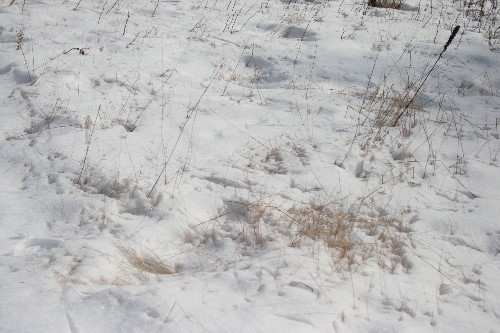
We met up with a line of tracks in one spot. They were large, and straight, and looked like a canine trotting. Somebody's pet, roaming the neighbourhood? Coyote? Perhaps one of the foxes I keep seeing signs of?
Old Ontario & Quebec Railway (CPR) rail trail
Raven, who had been sniffing out something behind me in the previous photo, now charges ahead again. She doesn't know what made the tracks, either, but they sure smell interesting.

Curious about the history of the trail, I called my dad, who readers of my mom’s blog will know as Railguy. He gave me a bunch of leads that helped get me started on a Google search for more information. Turns out, the rail bed itself was built in 1884 as the main through line from Perth to Toronto of the Ontario & Quebec Railway (incidentally, the OQR was acquired through perpetual lease by Canadian Pacific Railway, CPR, that same year, so it never got a chance to operate as an independent OQR line). The route starts just west of Perth in the hamlet of Glen Tay, where it branches from another CPR line, and runs west through several small Ontario towns to Peterborough, and then southwest to Toronto. The rail line was essentially completed May 5 of 1884, but the first train didn’t travel the line until August 11, due to delays caused by a sinkhole some 60 kilometers (38 miles) west of here near Kaladar.

Old Ontario & Quebec Railway (CPR) rail trail
There's that blue, blue sky again. It's funny how dark it looks because the sun is low in the sky already, even though it's just after noon.
marsh beside Highway 7
Standing on the rail bed, looking toward the bridge over the creek along Highway 7. I waited for a car to come by to better show how close it is. Sorta takes away from the nature-y-ness of it to have traffic rumbling away so close.

Less than 15 years after opening, the Perth-Toronto line had become so well-traveled that there was discussion about widening the bed and laying down a second, parallel track. Surveys were completed in 1898 to assess feasibility and cost in straightening the line and reducing the grade (built at 1.1%, they wanted to reduce it to 0.8%). Some 17 locations totaling half of the length of the line would require fixing, and the decision was made instead to build further south, paralleling the shore of Lake Ontario, which had a better grade and didn’t require crossing the Canadian Shield (ie., could be built much straighter).

Old Ontario & Quebec Railway (CPR) rail trail
A section lined by cedars on both sides. And a rare instance where Raven had fallen behind. Look at that clean, unblemished snow.
Old Ontario & Quebec Railway (CPR) rail trail
Coming up on the bridge, I can just see it in the distance.

As passenger travel gave way from trains to automobiles, service along this line would likely have become primarily freight, and then even that eventually mostly shifted down to the lakeshore line, since the easier grade allowed trains to move faster and haul more. Finally, in July 1971, 87 years after it was laid, the track between Glen Tay and the small town of Tweed was retired from service. Sixteen years later, in 1987, the second half of that line “subdivision”, from Tweed to Havelock, was discontinued.

Farm on Highway 7
My favourite photo of the outing. All the pieces just came together compositionally for this one. The highway lies between me and the barn, but you can't even tell. Maybe I could sell them a print.
beaver lodge
A beaver lodge just to the left of the barn. Didn't see any beavers, or even any signs of beaver activity, so I'm not sure if it's still active.

Most of that information came from this website on “Old Time Trains”. It doesn’t provide any indication on when the rails would have been pulled up. I don’t know who owns the land now, whether it still belongs to CPR or if it’s been bought or leased by another company (I thought I might have seen something about Bell Canada having right-of-way?) or organization (for instance the Eastern Ontario Trails Alliance – do they lease land?)

Old Ontario & Quebec Railway (CPR) rail trail
The old bridge. Judging by the state of the wooden crossties, this might be the original bridge installed in 1884. Or perhaps it was a replacement made in the early decades of the 1900s. It looks as though it's been around quite a long time, in any case.
creek
Standing on the bridge, looking south. You can just make out the farms on the crossroad. I didn't realize the bridge was this close to the crossroad, or I might have thought twice about walking down. It was 1.5 km (0.9 mi) along the railbed each way, plus 0.75 km (0.5 mi) there and back to the rear of our property - a 4.5 km (2.8 mi) round trip when I'd left the house just planning on doing one!

I searched and searched looking for any indication that this section was part of a formal trail system, but was unable to find anything. Some 25 kilometers (16 miles) west of here, the retired line from Sharbot Lake west to Kaladar has been incorporated into the Trans Canada Trail. At Sharbot Lake, instead of continuing east along the line, the TCT jogs southward and actually passes near our old house, going through the south of Frontenac Provincial Park. It then returns north, ending up 30 kilometers (19 miles) east of here, in Smiths Falls. I’m not sure why they didn’t just run the trail straight through. It’s not even listed as an “alternate route” as some trail systems sometimes offer.

beaver lodge? and creek
This looks like it might once have been another beaver lodge. Or maybe just a pile of sticks that someone cleared from cutting up a few trail-infringing saplings?
small pond
With the sun low and clouds periodically sweeping through, the light did some neat things during the walk. This was the best photo of a light-effect, with the sun reflecting off the ice.

The only spot I could find this section of rail bed formally recognized as a recreational trail was on the website of the Eastern Ontario Trail Alliance. They provide a map on their website which shows trails throughout Shield Country. They mark this section of the rail bed in purple. Unfortunately, the resolution of the map is too small for me to be able to determine what purple means. I suspect they represent things like multi-use, pedestrian, ATV/snowmobile, etc. It’s different from the yellow and green trails, though, whatever it is.

Old Ontario & Quebec Railway (CPR) rail trail
Raven looks like she's 200 feet ahead of me, but it's only because I'm using the wide-angle; she keeps to a pretty regular 50 feet in front, glancing back regularly to make sure I'm still following her. Here she's noticed I've stopped to take a photo, and has stopped to wait for me.
Old Ontario & Quebec Railway (CPR) rail trail
She'd paused to sniff something, and lost a precious 25 feet of lead-space, which she now bounds off to make up.

East from our house the rail bed largely parallels the highway. A short distance west it starts to turn south away from the highway and cuts through the bush more. I would be interested in following it west at some point. I don’t think I’d be much inclined to go far in the winter, but perhaps in the summer I might bike for a ways. That would require obtaining a bike first, I suppose…

The world in white

snow8

More snow photos, forgive me. I just couldn’t help myself. When I got up this morning there was a lovely white fluffy blanket of a couple of inches of the stuff spread across the ground and just about everything else. The first snow we got was just a sprinkling, a hint of what was to come. Today’s snowfall was our first significant accumulation. Since everything looked so lovely, and the sun was out and shining brightly, I decided to walk to my usual header-photo-taking spot halfway along the field immediately behind the house and get a new seasonally-appropriate image for the blog. This will be the blog’s header image until winter really settles in and we’ve accumulated enough snow that you can’t see much of the grasses anymore – late January, perhaps.

snow17

A photo of the front yard, with a smooth white frosting, as taken from the living room windows. Dan’s poor boat, with nowhere to float these days, sits overturned in the same place it’s been since we moved in in July, tucked against the foot of a spruce. I really like that we’re surrounded by so many evergreens. This photo looks down toward the road, not that you can see it. The owners, many years ago, planted the spruces (and, farther beyond, the pines) as a privacy screen when the neighbours started building their house. They do a great job. They also look stunning draped in snow. Snow on spruce boughs has to be one of my favourite winter sights. Snow on pine boughs runs a close second.

snow9

It was too pretty to just walk back for the house photo, so I decided to take Raven and hike to the back field, and admire the snow. Raven was up for that. She’s always up for a hike. You comin’, slowpoke?

snow7

She has great fun in the snow. Her favourite thing is snowbanks, which she loves to roll around in like those playful ravens, her namesakes. (We didn’t really name her after the playful ravens, just ravens in general.) But just dashing around, snuffling at footprints, that’ll suit her, too.

snow10

snow12

The sky was such an incredible, rich blue. There’s something about winter that really brings out the blue of the sky. Is it simply that it has no other colours to compete against?

snow11

Midway back, a group of cedars. Number three is snow on cedar boughs. Actually, I think this little grove has a little bit of everything in it.

snow13

And then we reach the back of our fields. At the very back there’s a large section of wet ground, almost bog-like, filled with cedars and sphagnum moss and a few tamarack. The cedars form dense groves through the wet bits.

snow14

Led on, perhaps, by the beautiful scenery? I had planned only to go as far as the last field, but when I got there, I decided to push further, to the back fenceline. The wet areas would be frozen, which was my main deterrent for going through there in the warmer months. It would be nice to have a little boardwalk to cross through without stepping on vegetation or getting your feet wet. The evergreens through here all look so pretty with the snow adorning their branches.

snow15

Very tall cedars where the ground dries out a bit more. It’s funny how even though the trees are the same species, the grove can have a completely different feel. Despite the closed canopy, the ground still has a layer of snow.

I get to the fenceline, just beyond. And… I’m not ready to turn around and go back to the house just yet, despite that I didn’t wear my longjohns. Perhaps just a short ways down the rail trail that abuts the back end of the property? Yes, I think so. Maybe I’ll walk down to the stream and come back… Raven thinks this is a great idea.

snow16

To be continued…

A trip to the north woods

South Shore Rd, Big Gull Lake, North Frontenac

Pretty much since our forced departure from our waterfront home this summer, Dan and I have been anticipating our eventual return to lakeside living. We loved the area we were in, but expect the price of real estate there would put most waterfront properties out of our financial reach (at least until the moth guide hits the bestseller lists and I strike it rich). We’ve been eyeballing a part of the Frontenac Arch that’s a little further north, a little more remote, and consequently a little more affordable. It will be years before we have the savings to make the move there, most likely, but that doesn’t stop us from dreaming about it.

In the meantime, Dan has been considering placing a MAPS station in that part of the Shield Country, since it represents a substantially different habitat type than what’s found further south, near Frontenac Provincial Park, the location of his other stations. This afternoon was gloriously mild, and we decided to head north for a few hours to check out some of the area.

South Shore Rd, Big Gull Lake, North Frontenac

Frontenac County is divided into three townships: South, Central and North Frontenac. Our previous house was in South; the area we’re now primarily considering (unless property values conveniently drop) is North. The township of North Frontenac sprawls across 1,136 square kilometers (about 438.6 square miles), of which over 70% is crown land (that is, belonging to the Canadian government). Much of the private land is used seasonally. The 2006 population census reported just 1,904 permanent residents for the whole township – that’s a population density of about 1.7 people per square kilometer (about 4.4 people per square mile; compare to the value of 19.4 people per sq km in South Frontenac), one of the lowest densities in eastern Ontario.

South Shore Rd, Big Gull Lake, North Frontenac

We didn’t see too many cars on the roads, even the main one whose name included the word “Highway”. We followed a cottage lane off the main “highway”, one that I knew passed through crown land that we could stop and hike around in. We stepped out of the car and were met with a complete lack of human sound, that incredibly blissful silence that I have missed hearing since leaving the lake. There was nothing except the wind rustling the trees and the crunch of our feet on the gravel. I’m sure that in the summer, when cottagers are visiting their recreational properties, the woods aren’t quite so quiet, but there was no hint of it today. It’s one of my favourite sounds on earth – the absence of people.

South Shore Rd, Big Gull Lake, North Frontenac

The road we followed in ran along the south shore of Big Gull Lake, one of the biggest lakes in North Frontenac, at 21 km (13 miles) long and with a surface area of 2,540 sq km (980 sq mi). The lake has no significant inflow streams, and the majority of its water comes from springs and snowmelt. We passed a dam at the nearby town that helps to maintain the water levels. In the fall, the dam is opened to allow the water to drop, providing room to accommodate spring runoff. This usually occurs in mid-October, after the Thanksgiving weekend (usually the weekend in Ontario when most cottages are closed up). Apparently the minimum water level is usually reached in December, so it still has a little bit more to go. This afternoon, the weeds and pond lilies at the edges of the little bay were all exposed.

South Shore Rd, Big Gull Lake, North Frontenac

The portion of the road we walked along bordered a small bay. There were no cottages along this stretch, although there were a couple of powerlines that stretched across the water, and a dock on the far side, its owner not visible from where we stood. Big Gull, being a large lake, is home to many cottages; the most recent number I could locate had the estimate in the 350s. That said, the overall population of the lake is low, with many stretches containing no cottages at all. The lake has a shoreline of about 88 km (55 mi), and a large portion of that is North Frontenac Park Lands, a stewardship program and backcountry camping experience that helps to protect land around a number of the township’s lakes.

South Shore Rd, Big Gull Lake, North Frontenac

Whereas South Frontenac is predominantly deciduous forest, most of North Frontenac has a very strong coniferous component, especially along lake or marsh edges or rocky ridges. Black Spruce is a reasonably common species in this area, a tree that in South Frontenac I’d only see associated with bogs and fens. The landscape there is noticeably rockier, too, especially compared to our current location. Both features are characteristic of the Shield, and North Frontenac represents the southern edge of it. The land isn’t much use for farming, and the vast majority is forested.

South Shore Rd, Big Gull Lake, North Frontenac

Despite the warm temperatures today, we didn’t see much in the way of wildlife. A flock of geese flushed from the water of the bay, a Blue Jay flitting among the hemlocks, a White-breasted Nuthatch foraging on a dead snag. I didn’t see any insects, although I admit I wasn’t looking too closely. It would be nice to visit in the summer when the woods are in full vibrant song. As we were leaving the road, we passed a noticeboard where one rather hopeful resident had posted a request for information on any possible sightings of Ivory-billed Woodpeckers in the area. I wish I had got a photo. I bet he got a lot of well-intentioned reports of Pileateds.